Is Australia funding Indonesian Death Squads? Densus 88 in West Papua

Statement by the West Papua Project, Centre for Peace and Conflict Studies, University of Sydney, 16th July, 2012

Questions are being asked about the role that the partly Australian funded
and trained elite Indonesian police squad, Densus (Detachment) 88, has
played during the recent violence in West Papua. Set up in the wake of the
Bali terrorist bombings, Densus 88’s mandate was to tackle the rise of
domestic terrorism in Indonesia. Australian support might have been
motivated by revenge as well: 88 Australians were killed in the Bali attack.
While acclaimed for capturing or killing known and suspected terrorists,
Densus 88 also gained a reputation for extreme violence: many suspects being
killed rather than arrested. Now reports are suggesting that Densus 88 is
operating in West Papua, possibly clandestinely, and has been responsible
for the assassination-like killing of Papuan political activist, Mako
Tabuni, on June 14.
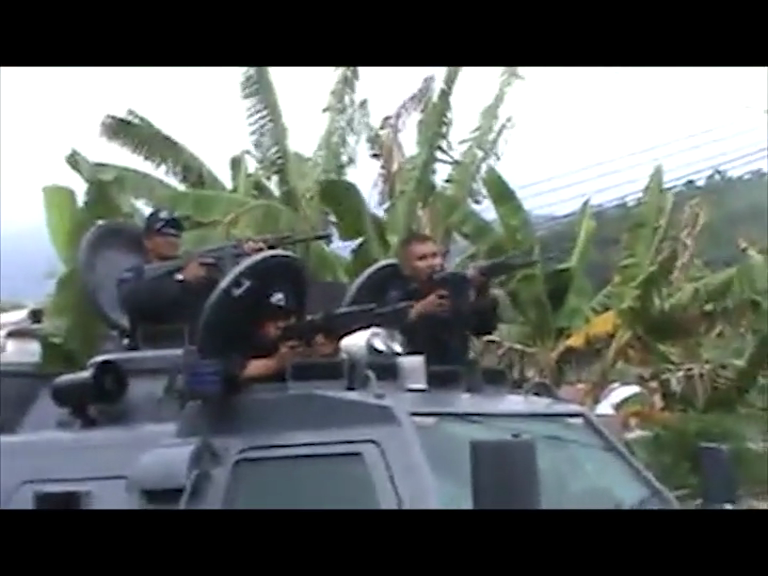
Detachment 88 troops firing live rounds at civilians during the brutal crackdown on the Third Papuan People’s Congress, October 19, 2011 (West Papua Media video still)

While Indonesian National Police spokesman, Saud Usman Nasution, has denied
Densus 88 is operating in West Papua he has left the door open for their
involvement, saying in the Jakarta Globe on June 27, “Densus will be
deployed if terrorism occurred there.” However other reports, for instance
from Kontras Papua, a local human rights organization, state that Densus 88
is already operating in West Papua “carrying out undercover activities”
(Cenderwasih Pos, June 23). Kontras Papua believes that Densus 88 was
involved in the Tabuni killing – where the victim is reported to have been
standing in the street eating betel nut when three unmarked cars pulled up
nearby. With no provocation a person emerged from one car and shot the
victim dead.

Police report that the victim had tried to snatch a weapon from the
plainclothes police involved and was killed in the resulting fracas. Police
also claim that Mako Tabuni was wanted for a series of shootings that had
occurred in Jayapura over the previous few weeks: a claim that seems
unlikely given his role as Deputy Director of KNPB (the West Papua National
Committee), which is a non-violent political organization. Tabuni had also
been publicly calling for an independent investigation into the recent
shootings of which he was accused. Nonetheless, any charges should have been
heard in court and given due legal process, now impossible with Tabuni’s
death. Other reports of Densus 88 activities in West Papua have come from
respected Papuan leaders. Reliable sources observed Densus 88 police arrest
KNPB member, Zakeus Hupla, in the lobby of the Dhanny Hotel, Entrop,
Jayapura, on the morning of June 23. Other reports indicate further arrests
of KNPB members by Densus 88 and their subsequent torture. According to
family members, no arrest warrants were issued by Indonesian police for
these arrests, and the Jayapura police deny that the KNPB members are in
their custody. Indeed it is unclear if these men have been arrested,
abducted or ‘disappeared.’

These events are of genuine interest and concern to Australia because
Australian taxpayers’ money is spent training and maintaining Densus 88.
This organization has a legitimate role to play in countering the rise of
terrorism, but it should act strictly within its organisational mandate. If
Australian taxpayers are indeed partially funding a clandestine force
involved in killings, abduction and torture of Papuan activists an
unacceptable situation has developed. These events and allegations must be
comprehensively investigated and all funding for Densus 88 frozen until
either the allegations have been disproved or the individual police officers
guilty of crimes arrested and tried in an open court. We call on the
Australian government to immediately halt the funding of Densus 88, to
investigate the claims of its misconduct, and to apologise to the Papuan
people if they are proven to be true.

WPNA demnstration will call for greater concern from the government

Tabloid JUBI,
9 July 2012

Jayapura: The aspirations of the Papuan people for Papua to become a zone of peace are becoming increasingly difficult to achieve. Imprisonment, killings, corruption, terror and acts of intimidation against the civilian population are now occurring in  Papua but no one knows who will take responsibility for all these things.

In response to this situation, the West Papua National Authority (WPNA) and other pro peace and anti violence organisations decided to organise a peaceful demonstration on Tuesday this week, calling on the Indonesian government and the Papuan  people to spare no efforts in resolving the conflict in Papua and to seek a solution as quickly as possible in the interests of peace, justice and order for the Papuan people and the Indonesian people now living in the Land of Papua.

‘All of us who feel these concerns  should join together in a peaceful demonstration to mourn he current situation. When will there be pease in Papua,’ said one leaflet that has been distributed widely in Jayapura.

The co-ordinator of the demonstration Sius Ayemi said that they would organise the demonstration under the slogan: ‘Papua Mourns’.on Tuesday, 10 July from 9am until late in the afternoon.They will not allow people in the demonstration to bring alcohol or  sharp implements which could lead to anarchy. and disorder.

One of the leaflets says:  ‘Dont just think about us or our organisation but ask yourselves  when will there be peace in Papua?’

[Translated by TAPOL]

New supermarket in Jayapura triggers complaints about goods on offer and price differentials

Bintang Papua, 9 and 10 July 2012

[Comment: This report reveals the continuing tendency to promote businesses from outside Papua while failing to advance the interests of local Papuan producers. TAPOL]

Many complaints about price differentials at newly open supermarket in Jayapura

Although the supermarket  Hypermart Jayapura has only recently open its doors to the general public, many people who have purchased goods have complained that there has been a huge differential  between the prices marked on the shelves and the prices of the goods when they reach the cashier to pay for their purchases. As a result people who have been shopping at the new store are being advised to take care about their purchases to avoid losing a lot of money.

One shopper who spoke to Bintang Papua said  that she was charged at the cashier for something costing Rp 91,000 although she hadn’t even purchased the product. Other shoppers made similar complaints. In once instance, the shopper was charged  Rp. 105,000 for cooking  oil while the oil normally costs only Rp. 29,000. Other shoppers complained of striking differences in the prices they were charged.

In most cases, the shoppers were able to get refunds from the store after complaining. A store manager said that they would give refunds to anyone complaining about price differentials.

In a subsequent article, Bintang Papua reported that demands were being made by many people for the supermarket’s licence to trade to be revoked, because the terms of the licence which had been agreed in Jakarta with the business had been violated.

Some people complained that many of the vegetables and fruit that were offered for sale had been imported from outside West Papua or even from abroad. Indigenous Papuans who were able to produce these products in large quantities had not been able to compete with the many products on offer at the store. Another complaint was that the store was selling alcohol

The Indonesian Consumers Association said that there was no need for foodstuffs to be imported from outside Papua or from abroad because they were readily available in the Land of Papua and would enable local producers to compete in the local market. Taking supplies from local producers would also help to improve the level of welfare of the Papuan people

[Abridged in translation by TAPOL]

Two nonviolent activists arrested for pleading for international community to ‘Save Papua from Genocide and Grievances’.

from the West Papua Media team

July 10, 2012

In recent months, West Papua has come under an international spotlight over Indonesian military and police impunity for brutal assaults on civilians and non-violent activists.   Despite the palpable repression on the Papuan street , activists from the self-declared Federated Republic of West Papua on July 10 held a peaceful demonstration in Jayapura,  with the theme, “Save Papua from Genocide and Grievances”.

Leading up to the demonstration, POLDA (Regional Police command) Papua refused to issue a permit to rally organizers, and even banned activists from the Federated Republic of West Papua to organize any peaceful demonstrations under threat of treason charges being leveled on rally organizers of peaceful demonstrations.

A coordinator of today’s rally, Sius Ayemi,  told West Papua Media prior to his arrest that police refused permission despite four rounds of intense negotiations and several letter, denying basic rights to freedom of expression.  In a phone conversation to the West Papua Media team, Ayemi has challenged the Indonesian government and its military regime to “reconsider military approaches in West Papua,” and called on the international community “to stop believing the Indonesian government’s rhetoric about its commitment to dialogue, or the (Indonesian) Republic’s effort to ‘wage peace aggressively’.”

The demonstration was to start at several different locations  – Expo Waena/UNCEN, Entrop/Hamadi /Argapura  and Pasir 2 / Dok 9 – at around 9:30am, then converging to meet at the DPRP (Papuan legislative assembly) office in Jayapura.   Police blockaded the demonstrators at the first two locations, preventing demonstrators from proceeding to the DPRP office.   However,  demonstrators from Pasir 2 and Dok 9 were able to march to the DPRP office but were quickly and brutally rounded up by one company of fully armed police.

Markus Yenu, the Federated Republic of West Papua Governor of Manokwari and a planned speaker at the rally, told West Papua Media that the police physically pushed the demonstrators backward with their guns and told them to go home.  He told the West Papua Media team by phone, “the moment we arrived in front of the DPRP office, we were threatened, searched and dispersed by police officers and requested harshly to hand-in all the attributes for the rally.” He further mentioned that the police confiscated several cameras, megaphones, mobile phones, placards and banners.

According to witnesses on the ground,  Sius Ayemi was attempting to negotiate with the police in a disciplined-manner but was quickly surrounded by few police officers who arrested him and bundled him away, together with Edison Kendi who stood next to Mr. Ayemi at the time of the arrest.  Until now, both Sius Ayemi and Edison Kendi are still being held at police custody in Jayapura.

West Papua Media attempted to make few phone calls to KAPOLDA Papua, KAPOLRI and WAKAPOLDA Papua but they all refused to comment about the arrest of the two activists and ended the call.

Local human rights sources have asked for advocacy for the release of Sius Ayemi and Edison Kendi, by calling the below contact details:

Kapolri +62811910277,                                                                                                                                       Kapolda +62811950376,                                                                                                                                 Wakapolda +62811496251

Act of Terror perpetrated against the President of the Alliance of Baptist Churches

Report from Matius MuribAt around 7.30pm, on Thursday 6 July,  a group of four policemen from the elite force Brimob, Papua District, stopped the car in which the chairman of the Baptist Synod, Socrates Sofian Yoman was travelling, together with his wife and their three children, along with Matius Murib, the former deputy chairman of Komnas HAM-Papua. They were on their way home after attending prayers at Kota Raja Luar.The car door was forced open by someone, and another member of Brimob shone a torch.in the face of Revd Yoman.

Matius Murib said: ‘Why have you stopped here? Who are you? Who are you working for? If you aren’t happy about the police, dont behave like this.’

Murib later told the media that apparently they had been followed since they were driving past the town library. The police who had been travelling in a truck pointed their torch at Yoman.

In response to this unacceptable behaviour, he said: ‘I’m sorry. It wasn’t deliberate.’  But within five minutes, the police started pushing the body of this man who is  a well-known church leader, while shouting at him.

Matius Murib  thought that the  police didn’t realise that they were  talking to the President of the Synod of the Baptist Church, Revd Socrares Sofian Yoman.

At this point, a senior police officer arrived at the scene to caution the police who were terrorising the President of the Synod. They subsequently withdrew and returned to their barracks.

Matius said that this incident would be reported to the deputy police chief in Papua. ‘Go ahead and report. We aren’t afraid ‘  the four policemen replied. They then withdrew  from the scene and left, going in the direction of the police command office in  Abepura.

Matius Murib said that he hoped that  the chief of police would investigate this case and call to account the four police officers who had behaved so arrogantly  towards a well known leader of the Papuan people. The action they had taken was a deliberate act of provocation intended to arouse the feelings of the Papuan people.

‘We call for an end to such acts of terror and violence perpetrated against the indigenous Papuan people.The Papuan people will continue to press for peaceful dialogue  between Jakarta and Papua.’

Matius Murib, Director

[Translated by TAPOL]

Create a website or blog at WordPress.com

Up ↑
