Papuan women angry about failure to provide them with permanent market

Tabloid JUBI
6 December 2012
Jayapura: The Rev Dora Baluban, co-ordinator of Solpap, Solidarity of Indigenous Papuan traders,  said that their organisation is being treated like a ping pong ball by the provincial administration because of their failure for so many years to provide women traders – mama-mama – with a permanent market-place.’We have made so many attempts to get a permanent market place  for indigenous Papuan women  but as yet, nothing has happened,’ she told journalists.Solpap has been trying to get a permanent market place for the women traders since 2004 but after six years, nothing has happened. Back in 2009, the government promised that they would make available land used by Perum Damri (Indonesian Government national transport company ) but to this day, nothing has happened. ‘ It is apparent that Damri is not willing to vacant the land.

She said that they have had so many promises by the government  but to no avail. She said that  the government is treating Solpap like a ping pong ball,  hitting us here, there and everywhere.

The government also promised    to provide Rp 10 billion to build the market place but this has not yet happened either. One of the traders, Yuliana Pigai, said the government has made so many promises but has failed to do anything.

‘This is our right and the government should keep its promises,’ she said.

[Translated by TAPOL]

Papuan serving 20 years dies in prison

via Tapol
December 12, 2012
The following information has been received from a reliable source in Papua:This is to inform everyone who struggles consistently about the problem of human rights in the Land of Papua that one of the Papuan political prisoners, Kanius Murib, died on 10 December. He died at his family home in Hokilik Village, district of Wamena, Papua.

He had been suffering from 2010 up until December 2011. The prison authorities reached an agreement with his family that, in accordance with the family’s wishes, he would be able to stay with the family so as to ensure that he died surrounded by his family because of his physical condition as well as the fact that he had become mentally unstable.

1. Kanius Murib was serving a sentence of twenty years.

2. The government paid little attention to his state of health and just allowed his condition to linger on.

3. None of his children have been able to go to school.

The way he was treated is extremely unjust. This is the way all Papuans are being treated. The Indonesian government has ignored the recommendations made during the Universal Period Review, while the Co-ordinator Minister for Politics and Human Rights said while on a visit to Papua in 2012 that there are no political prisoners in Papua.


AHRC: A Papuan was tortured on the unreasonable allegation of engagement with separatist group


ASIAN HUMAN RIGHTS COMMISSION – URGENT APPEALS PROGRAMMEUrgent Appeal Case: AHRC-UAC-201-2012

<http://www.urgentappeals.net/support.php?ua=AHRC-UAC-201-2012>

11 December 2012
———————————————————————
INDONESIA: A Papuan was tortured on the unreasonable allegation of engagement with separatist group

ISSUES: Arbitrary arrest and detention; inhuman and degrading treatment; police violence; torture
———————————————————————

Dear friends,

*The Asian Human Rights Commission (AHRC) wishes to inform you of the case regarding the torture of a Papuan in Mimika, Papua. The victim was arrested by officers from the Mimika Sub-District Police wearing civilian clothes without any warrant. The police randomly accused him for being involved in the separatist movement organised by Free Papua Organisation (Organisasi Papua Merdeka, OPM). As result of the torture, the victim was severely injured and could not walk for four days.

CASE NARRATIVE:
According to the information from the Justice, Peace and Integrity of Creation of the Evangelical Christian Church in Papua (JPIC GKI), Frengki Uamang was visiting a church and about to buy mineral water from a local shop on 27 November 2012 when a silver-painted car approached him at 11am. Two unidentified men wearing civilian clothes came out the car and arrested Frengki. One of the men told him that he was a police officer.

Frengki was taken in the car to a place located about 20 metres away from the church and asked for the reason of his visit to the church. Frengki explained that he was attending a religious event at the church but the police instantly told him ‘don’t lie to us. You want to buy weapons, so don’t lie to us!’

The police later took Frengki to Kwamki Baru Sub-District Police at 11.45 where he was interrogated and accused of committing various actions, one of which was providing food for the military members of OPM. During the interrogation, the police tortured Frengki for approximately four hours. Frengki was kicked by police officers wearing boots and he had his head, ears, face and chin kicked and beaten. The police also hit Frengki on his chest, legs and tights which resulted in him not being able to walk for four days.

At 3.30pm on the same day, the police took Frengki out of the police station and drove him to Irrigation Street in Mimika. In addition to the car that was taking him, another car full of police officers was also following. In total there were about 10-12 police officers came to Irrigation Street with Frengki. The police asked Frengki to show them two houses where OPM’s military members were allegedly hiding in. Frengki told the police officers that he himself is only a visitor to Mimika and he has no idea of what houses they were talking about, yet the police insisted on taking him to Irrigation Street.

On their way to the Irrigation Street, the police again tortured Frengki. The police officers pulled his fingernails using pliers. As they arrived at the Irrigation Street, the police took Frengki to a plantation area. Frengki was asked to slither on his stomach while his hands were handcuffed. Three police officers pointed their guns at Frengki and asked him to pray. One of them told Frengki, ‘you killed my fellow police officers. You are a member of OPM’s military. You’re obviously from Kali Kopi’. Kali Kopi is one of the headquarters of OPM’s military.

As the three officers were pointing their guns at Frengki and he himself was praying, the rest police officers coming with Frengki randomly opened fire towards the trees, creating the impression that they were in crossfire against the OPM’s military members. Out of nowhere, one of the police officers took Frengki to Mimika Sub-District Police. Frengki was again interrogated, yet this time the police asked him of his link to the shooting that took place in the area owned by PT Freeport, an American gold mine company. Frengki was detained at the police station for one night, his hands and legs were chained to a table in the police’s cell.

The next day at around 2pm, Frengki was released by the police. He was not able to walk so a police officer took him to Immigration Street where Frengki was staying.

ADDITIONAL INFORMATION:

As of today, torture is yet to be criminalised in Indonesia and the legal proceeding on such abuse is far from independent. Due to the absence of law criminalising torture, state officials who committed it are usually charged with provisions concerning physical assault which is not in accordance with the definition of ‘torture’ stipulated in the UN Convention against Torture and Other Cruel, Inhuman or Degrading Treatment or Punishment (UN CAT). As the physical assault article under the Penal Code only carries a maximum punishment of two years and eight months imprisonment, those who committed torture are sent to light punishment, if they were punished at all.

In addition to the absence of law criminalising torture, the unavailability of independent legal mechanism to investigate torture allegation has aggravated the problem. For a criminal proceeding on torture allegation to take place, the victims need to submit a criminal complaint to the police whereas it’s actually the police themselves or their colleague who committed the abuse. As a result, most of torture complaints are not followed up and criminally investigated by the police. Torture victims may also submit a complaint to the monitoring mechanism within the police called the Professionalism and Security Division (Propam). Yet this mechanism is not transparent and only has the power to impose disciplinary punishment to police officers practising torture.

http://www.humanrights.asia/news/urgent-appeals/AHRC-UAC-201-2012


Yusak Pakage: ‘I was arrested for being a former tapol.’

by OKTOVIANUS POGAU of SuaraPapua.com
5 December 2012Jayapura: ‘I was arrested because of my having once been held as a political prisoner (tapol),’ said Yusak Pakage, a Papuan activist. who said that the charge against him was a frame-up, alleging that he was dangerous just because he was carrying a knife.

He made this statement to suarapapua.com on 4 December, following a hearing at the Class 1A district court in Jayapura  He said that as soon as he was arrested on 27 July this year, he was taken to a police command post and questioned about his behaviour towards a court official, Sefnat Fonataba.

‘Soon after, Fonataba came to the police station and told the police there that there was no problem with me and apologised to me for what he had done.’  The policeman asked Pakage to write a statement  saying that there was no problem between him and the policeman which is what he did.

When he was about to sign the statement, the chief of police in Abepura came along and said that he had other instructions about how to handle this case.

‘Shortly afterwards, I was taken to the police station where I was interrogated for quite a long time about the knife. I said that it was a very cheap knife, the kind of knife that you can find in any traditional market in Jayapura. It is just something I carry about with me for my everyday needs. I didn’t buy it in order to do something criminal, as the security people seemed to think.’

‘ I have never  heard anything about needing a special permit to carry an ordinary knife.The law in Indonesia is very confusing and I don’t know about any rule governing the carrying of a knife.  The chief of police said that he didn’t know who I was and wanted the case to be handled in the usual way.’ But according to Pakage, the police officer knows very well who he is and that he had previously been held as a tapol. ‘He was lying,’ said Pakage.’He just wanted it to be known that I had formerly been held as a tapol, when I was arrested along with Filep Karma in 2004 for carrying the  Morning Star flag.’

‘I frequently make statements about the human rights situation in Papua and take a leading part in many demonstrations, so of course he knows very well who I am.’

Pakage also said that during his interrogation, all his personal belongings were taken away, even including his ballpoint, and none of these things  have been returned to him.

On 19 August, he was transferred to the prison in Abepura and he is now waiting for his case to be completed and to hear the verdict of the judge.

Pakage used this occasion to warn his activist friends to be very careful and keep control of their feelings when they are doing anything to struggle for the rights of the Papuan people.

‘I tell them not to get too emotional and to learn from my own experiences which show that I can be arrested for something very trivial.’

Siman Pattiradjawane, the lawyer who is defending Pakage told reporters that the verdict in the case will be announced on 11th December.

Wewak PNG turns out in numbers to support West Papua

from West Papua Media sources in Wewak, Papua New Guinea

December 11, 2012

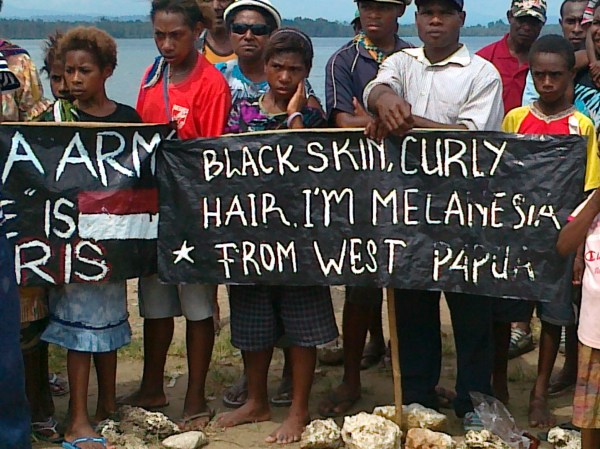
Over one thousand civil society members from Wewak, East Sepik Province in Papua New Guinea, turned out on December 10 to support their wantoks across the border in a large and vibrant demonstration that brought the provincial capital to a standstill, local stringers from West Papua Media report.

The rally and festival, called to bring attention to human rights situation in neighbouring West Papua on International Human Rights Day, saw PNG government officials, security forces, church leaders and ordinary people march together calling on the PNG government to do more to stand up to Indonesia on the issue of West Papua, and for the sovereign rights of West Papua to be respected.

This slideshow requires JavaScript.

At around 9:00am the marchers gathered at Mongian Compound, about 500 metres from Wewak town market.  A long-march started with less than hundred people but the numbers grew throughout the day.  As the marchers approached Wewak town area around 10:00am,Wewak local time, the number had grown to one thousand people.  The positive environment and support from the authorities and civil society motivated long-march organisers to do four laps around Wewak Town until midday.

One West Papuan observer told West Papua Media via phone conversation that the spontaneous support from the public was “amazing and unreal”.  As further quoted “a lot of ordinary people and women who sell their food at Wewak town market left their goods and joined the march. They even donated money, food, drinks and various garden food to us (West Papuan asylum seekers).”

At around, 12:30pm, the streets of Wewak was covered with sea of people who called for basic human rights to be protected, but importantly echoing the aspirations of the sovereign right of West Papuan people, according to participants

The long-march finished at the new Police Station near Wewak Town Market, where various speakers addressed the crowd.  Amongst the speakers were, Miss Sophie Mangai, President of Wewak Women’s Council, who led the long-march calling on those gathered to “lets all support our brothers and sisters from West Papua for their struggle for independence.”

“West Papuans are our brothers and sisters; we are one people; one ancestor; and one Melanesia in the Pacific. So we must drive out Indonesia from the land of West Papua,” said Miss Mangai.

Other Speakers included: Florence Parinjo (Wewak Women Council), Abraham Kareni, Jusuf Kambuaya and Daniel Waromi (West Papuan expatriates living in Wewak) and followed by other West Papuan asylum seekers.

PNG Media including NBC also covered the rally, interviewing many West Papuan and PNG people present.

According to rally organisers, the rally was fully endorsed by Sakien Sakawar (Police Border Commander), Mr. Francis Kemaken (Coordinator of Diocese of Caritas PNG/Oceania, and Patron of the Federated Republic of West Papua Branch-ESP Wewak PNG), 3. Miss Sophie Mangai (President of East Sepik Council of Women), and Jusuf Kambuaya (General Secretary, Federated Republic of West Papua Branch Office Wewak).

Informal festivities continued into the night, according to local sources.

West Papua Media
 

Create a website or blog at WordPress.com

Up ↑
