Police question Papuan leader over peaceful demo ‘treason’

Written up Pacific Scoop from Social Media Reports by West Papua Media

March 6, 2013

Markus Yenu, Manokwari Governor of the West Papua National Authority (National Federated Republic of West Papua), was forced to appear at Manokwari Police Sector HQ  today (March 6) for questioning over makar (treason) charges relating to the organising of a peaceful mass demonstration almost two months ago.

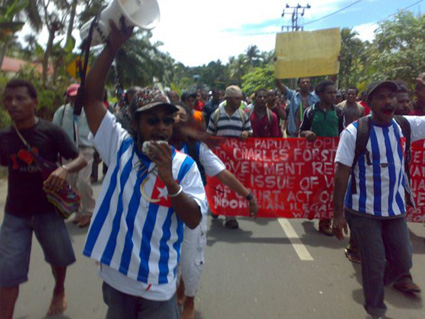
The executive governor of the West Papua National Authority area 2, Markus Yenu, and the chairman of Solidaritas Pemuda Melanesia Papua Barat, Abraham Wainasiri,  lead a peaceful rally at Manokari on January 17. Image: WPM
The executive governor of the West Papua National Authority area 2, Markus Yenu, and the chairman of Solidaritas Pemuda Melanesia Papua Barat, Abraham Wainasiri, lead a peaceful rally at Manokwari on January 17. Image: WPM

Yenu has not yet been released, and no further information has yet been received about his status – whether he will be charged or released.

West Papua Media has contacted police in Manokwari without reply and the Papua Police Criminal Investigation chief in Jayapura – who claims to know nothing about Yenu’s whereabouts.

On January 17, a crowd of peaceful protesters calling for a referendum on the future of Indonesian-ruled West Papua assembled at a rally point in Manokwari.

The crowd – including students and workers – moved towards the Banyan Tree at UNIPA Manokwari together with the protest coordinator, Alex Nekemen, and speakers, among them Silas Ayemi, the area secretary of Bintuni WPNA),; Abraham Waynarisy (SH chairman Solidaritas Pemuda Melanesia Papua Barat SPMPB) and the pro-independence group KNPB.

Political speeches were made accompanied by slogans of “Papua Merdeka” (“Free Papua”) along the way.

The crowd marched around the city of Manokwari towards an open field.

In front of the office of the State Attorney of the Republic of Indonesia, Markus Yenu openly questioned bout the detainees after a an incident on December 14 – Melkianus Bleskadit, Rev. Dance Yenu and 5 students from UNIPA Manokwari who have been held by police for almost four months without charge.

Earlier story by West Papua Media


Biak District court decides to continue hearings against two KNPB Biak activists

from KNPB sources in Biak – verified by WPM

March 7, 2013

The Biak district court again carried out the trial against two Biak KNPB  (West Papua National Committee) activists, in the fourth hearing to hear the judge’s decision whether the case is continued or returned to the DA (District Attorney) because of incomplete material.

Biak Prosecutors indicted the two KNPB Biak activists, Barnabasl Mansoben and Paulus Alua, with charges under Indonesia’s national emergency laws for allegedly “intentionally carrying sharp tools and explosive bombs”, which carries a maximum 20-year prison sentence.

The lawyer for two of the KNPB activists said in their defence, the indictments were excessive, and with the absence of strong evidence to prosecute the two KNPB Biak activists, they appealed to the judge to release the two activists.

However, the judge rejected the lawyer’s submission to release the two activists, and said the trial will resume next week, to hear witnesses and examine evidence.

Meanwhile Apollos Sroyer, Chairman of KNPB Biak, said after the hearing that “this is the scenario of Indonesian police to criminalize peaceful movements of struggle performed by the KNPB.”

Three Papuan Civilians Allegedly Seriously Tortured by Wamena District Police

From our partners at SuaraPapua.com

by Oktovianus Pogau

March 8, 2013

 JayapuraOn 7 March 2013, members of the Wamena District Police reportedly arrested three civilians in Pirime, Lanny Jaya Regency, Papua. The civilians have been named as Tinius Kiwo (23), Wurin Tabuni (46), and Kiwenus Tabuni (30).

The three men were allegedly severely tortured after being arrested, with their skin being sliced open by razor blades. Their whereabouts is not currently known.

Chairman of the Fellowship of Baptist Churches in Papua (PGBP), Socratez Sofyan, confirmed the arrests and torture when contacted by suarapapua.com.

“[The allegations are] correct. The three people arrested are members of the Baptist Church. A report I received last night stated that they have been tortured and their skin sliced with razor blades by policemen,” Yoman explained by mobile phone, Saturday (9/3/2013).

Yoman states that he attempted to contact Papua Province Police Chief, Police Inspector General Tiro Karnavian, last night in relation to the arrests. Yoman has not yet received a response.

“I sent the Police Chief an SMS last night. Usually he responds quickly, but even this morning, I have not heard anything from him. The community here is currently searching for the three men arrested by the police,” Yoman said.

The chronology of events, according to Yoman, began on 1 March 2013, when the three men left their village of Pirime, in Lanny Jaya District. They were travelling by plane to Sinak, Puncak District.

After nearly one week in Sinak, the men flew to Wamena District, before returning home to Pirime. They were subsequently arrested and taken to Wamena Police Station.

It is not yet clear why the three men were arrested and tortured. (WPM note: Whilst not clear, massive joint military and police sweeps are occurring throughout the Sinak area after the shooting deaths of eight Indonesian soldiers by West Papuan pro-independence guerrillas).

The Head of Public Relations for Papua Province Police, Police Grand Commissioner Adjutant I Gede Sumerta, did not respond to media enquiries.

STATE VIOLENCE WHICH PARALYSES COMMUNITIES IS INTENSIFYING IN THE LAND OF PAPUA: Press Release by KINGMI Church and Papuan Alliance of Baptist Churches

PRESS RELEASE

LEADERSHIP WORKING FORUM OF PAPUAN CHURCHES

STATE VIOLENCE WHICH PARALYSES COMMUNITIES IS INTENSIFYING IN THE LAND OF PAPUA

As leaders of churches in the Land of Papua, we are deeply concerned about the state violence which is occurring in our  sacred motherland. This is clear proof of the fact that the government and the security forces  have failed to provide protection for the indigenous Papua people. These concerns of ours have already  been conveyed by our communities in the following statements:

(a)    The eleven recommendations made by the Consultation of the Papuan People’s Council (MRP) and the Indigenous Papuan Communities on 9-10 June 2010;

(b)   The Joint Communique of Church Leaders on 10 January 2011;

(c)    The Theological Declaration of Church Leaders  on 26 January 2011, and

(d)   The Prophetic Message by Papuan Church Leaders to the President of Indonesia on 16 December 2011, in Cikeas, Jakarta.

Similar concerns have been expressed by member countries of the United Nations (the USA, the United Kingdom, Switzerland, Canada, Norway, South Korea, Japan, France, Germany, Mexico, New Zealand, Australia Spain and Italy) on the occasion of the 23 May 2012 session  of the Human Rights Council (UPR) in Geneva, Switzerland.

Based on the above facts, we believe that the Indonesian Government and the security forces  are part of the problem of violence which has been created by the State, preserved by the state and allowed to continue in order to legitimise yet more acts of violence in the Land of Papua and to take advantage thereof in order to strengthen the security forces.

We regard these developments as a reflection of [Generative Politics] which was described in an article by Nugroho published by The Jakarta Post on 10 July, 2012. According to Nugroho, generative politics are political views and considerations which have paralysed and worsened the situation of Papuan communities and which have been pursued  in accordance with the policies  of the Indonesian Government for the past fifty years.

Herewith is a list of several incidents of violence that have systematically and structurally been perpetrated as a reflection of the generative politics mentioned above:

  1. On 2 March 2013, a priest named Yunus Gobay (male, 55 years old) was tortured and mal-treated and after being released, he paid ransom money to the police forces in the Police Command Post in the town of Enarotali, Paniai.
  2. The shooting incident in Sinak, District of Paniai, Tinginambut, Puncak Jaya on 21 February 2013 and the shooting incident  in Udaugi on the border of the District  of Delyai on 31 January 2013 when a number of civilians and members of the security forces were killed, which in our opinion happened  because of the neglect of the unlawful sale of weapons.
  3. On 15 February 2013, Dago Ronald Gobay (male, 30 years  old) was arrested  in Depepre, district of Jayapura by the police and while being interrogated was tortured in the office of police intelligence in Jayapura.
  4. The attempt by the government and the security forces to forcibly disband a religious ceremony which was being held on the 4th anniversary of National Committee of West Papua (KNPB) on 19 November, 2012 in the STAKIN ASSEMBLY HALL, Sentani, on which occasion the security forces were under the command of the Police Chief of Jayapura, AKBP Roycke Harry Langgie and the deputy of the District Head (Bupati) of the District of Jayapura, Robert Djoenso D, SH.
  5. The unlawful murder of Mako Musa Tabuni, first chairman of the NKPB on 14 July 2012 in Perumnas, Jayapura.
  6. The murder of TPN/OPM General  Kelly Kwalik by police from Densus 88 and a member of the Indonesian army (TNI) on 16 December 2009 in the town of Timika, and on the same day and month in 2012  another Papuan Hubertus Mabel was murdered  by police of Densus 88 in Kuruku, the town of Wamena.
  7. Ferdinand Pakage was tortured in Abepura Prison by Herbert Toam, a warder at Abepura Prison, on 22 September 2008, as a result of which he was permanently blinded in the right eye.
  8. The torture and murder of Yawan Wayeni on 13 August 2009 by the police chief in Serui, AKBP Imam Setiawan.
  9. Two incidents of gross violations of human rights  in Wasior in 2001 and in Wamena on 4 April  2003, the latter of which is related to the assault on an ammunitions dump; this incident has been investigated by Komnas HAM (National Commission of Human Rights), but the results of which have not been forwarded by the Attorney General to the Human Rights Court for a verdict.

These are just a few of the cases which are evidence of crimes which have been perpetrated by the Indonesian state and the security forces in a systematic, well-structured, widely-based  and prolonged way and which are reflective of the generative politics (paralysis, destructive, eliminating) which, according to Nugroho in his Jakarta Post article of  10 July 2012, have been perpetrated by the Unitary State of the Republic of Indonesia in the Land of Papua for the past fifty years, since 1961.

Bearing in mind all the very disturbing facts given above and the living experiences of the indigenous Papuan people, we church leaders in the Land of Papua, make the following recommendations:

Firstly, the Indonesian Government and the security forces should return to the original aspirations of this country by investigating and  putting an end to  the unlawful sale of weapons and ammunition which is happening in the Land of Papua.

Secondly, the Indonesian Government should speedily take cognisance of the prophetic messages from the Church, the eleven recommendations of the MRP on 9-10 June 2010 and the Appeal by members of the UN Human Rights Commission at its session  23 May 2012.

Thirdly, we believe that the Indonesian Government is responding in a very discriminatory way to the aspirations of the Papuan people for peaceful dialogue.  We therefore press the Indonesian Government to enter unconditionally into a dialogue based on the principle of equality between Indonesia and West Papua, with mediation by a neutral party, which is what happened in the dialogue between GAM (Gerakan Aceh Merdeka – the Aceh Liberation Movement) in Aceh.

Fourthly, the Indonesian Government should unconditionally release all political prisoners in Papua and should allow  a visit to Papua by the Special Rapporteur  of the United Nations, as well as by foreign journalists and human rights defenders. And it should forthwith end all its efforts to criminalise the political struggle of the Papuan people for self-determination.

Fifthly, the shooting to death of members of the TNI as well as civilians which occurred in the district of  Sinak, Puncak Jaya and in the district of Tingginambut, Puncak Jaya on 21 February 2013 should be regarded  as a separate incident. It was in no way connected to the election of the bupati (district chief) of the district of Puncak. This violent incident  is part and parcel of  state policy to build the necessary infrastructure for the TNI and Polri (the police) in the mountainous interior in order to establish the Puncak Jaya 1714 military command, to increase the budget for the security forces and  to criminalise the peaceful struggle of the Papuan people at the international level.

Sixthly, the Chief of Police in Papua, Inspector-General (pol) Drs M  Tito Karnavian, MA, has failed to investigate who it was who perpetrated acts of violence in the Land of Papua and has created the impression that he is allowing the illegal sale of weapons to go ahead. We urge the chief of police in Papua to implement the statement made by the chief of police, Inspector-General Bekto Suprapto in December 2010 that those who are responsible for the entry into West Papua of illegal weapons will be investigated.

Seventhly. we call on all Papuan communities and all components in society to study the laws in force regarding the TNI and Polri, in order to be able to control criminal actions as well as the policy of the Indonesian government and security forces  in the Land of Papua.

Port Numbay (Jayapura), 6 March 2013

Chairman of the Synod of KINGMI Church, Papua:

The Rev. Dr Benny Giay.

Chairman of the Executive Board of the Alliances of Baptist Churches in Papua:

Socratez Sofyan Yoman

End of translation by TAPOL


Forkorus regrets the death of Indonesian soldiers and civilians

[Our sincere apologies for not posting a translation this item of news on the day it was received. Tapol – and WPM] 1 March 2013


Jayapura: Forkorus Yaboisembut, President of the Federal Republic of West Papua, speaking at a press conference, expressed his profound regret regarding the incident in Tingginambut, Puncak Jaya  which resulted in the deaths of eight members of the Indonesian army, the TNI, and four civilians which occurred on 22 February 2013.

Whoever it may have been who was responsible for these deaths, it is deeply regrettable. A shooting incident like this can only result in other killings in West Papua , something that has been happening ever since West Papua was annexed by Indonesia in 1962.

‘We mourn the deaths of the soldiers, along with their families, because members of the Indonesian army as well as civilians were the victims . Things like this can happen again tomorrow, next week or next year, when members of the TPN/OPM can be the victims.This kind of thing goes on happening, when victims fall from both sides. Isn’t there a better way, more humane, something more peaceful, moves that are in keeping with our sense of justice, to resolve the basic issue here in the Land of Papua?’

Forkorus said he regretted the fact that the Indonesian government persist in their policy of a semi-military approach, and the continuation of limited or widespread military operations in an attempt to destroy the state of Papua, ever since the declaration of the Trikora Command by President Sukarno, the first president of the Republic of Indonesia  on 19 December, 1961.

Forkorus, who is also chairman of DAP, the Council of Traditional People, accused the Indonesian authorities of being deaf to the appeals for efforts to find a solution to the political and legal status of West Papua by means of dialogue, taking account of the terms of reference set down by the Papuan people at the Second  Congress of the Papuan People in 2000.

Indonesian leaders continue to pursue the policy of military operations, intel operations, attempts to deal with security  and to conduct programmes of economic development and welfare, in an attempt to prevent West Papua from becoming an independent country.

He stressed that Papua must get its political independence while recognising that this is a matter regarding which there is a difference of opinion with the Indonesian government.

H went on to say: ‘We will continue to press the Indonesian government to take the peaceful and democratic way as the guiding principle of dialogue or negotiations with the Papuan people.’

At the Third Congress of the Papuan People they restored their independence based on   the de facto establishment of West Papua. ‘Furthermore, on two occasions we sent pre-negotiation teams to Jakarta , the first in August 2012 , and the second in October 2012, as a follow-up. Despite the fact that there was no response from the Indonesian government, we were hoping that they would acknowledge receipt of our message and our presentation of material for pre-negotiation moves and the conditions under which the negotiations should be held.

‘In 2013, we will continue to take the same approach, so as not to be regarded as trying to sell a cat inside the sack of negotiations. If there is no response from these moves which have been taken in accordance with the principles of decency, peace and democracy, the NFRPB will call for international intervention , as we wait for the process of negotiation to begin.’

‘We sincerely hope that the Indonesian Government will not proceed with its attempts to destroy the state of Papua as was indicated in the Trikora Command, because such an approach can only lead to there being many more victims on both sides along with the intensification of human rights violations of many types. Enough! Enough!’

[Translation by TAPOL]

Create a website or blog at WordPress.com

Up ↑