Australia must make a stand for West Papua

Article in the Sydney Morning Herald
As YouTube evidence of Indonesian soldiers burning the genitals of the West Papuan Tunaliwor Kiwo received its 50,000th viewer, the Indonesian military (TNI) was exposed holding a cynical mock trial to try to cover up systemic violence.

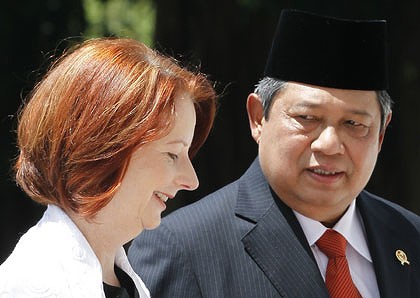
Julia Gillard was red-faced. When in Indonesia with Barack Obama last month, she had praised President Susilo Bambang Yudhoyono’s quick response and the coming trial. Soldiers from another, lesser ”abuse case” were then paraded and given soft sentences, while Kiwo’s torturers remain on active duty.

Despite the Australian embassy in Jakarta telling Indonesian officials of Australia’s “unhappiness with the military’s investigation”, the blatant contempt shown for Gillard and her officials creates little confidence.

Gillard bit her tongue again this week. ”The President of Indonesia,” she said, ”has made it absolutely clear he wants to see any wrongdoers brought to justice on this matter.”


Where’s the solidarity that lifted East Timor out of the geopolitical rubbish bin and into the minds of mainstream Aussies? In 1999 East Timor held a United Nations referendum, due in part to international and Australian pressure, and the Indonesian military tortured, raped and scorched its way back to Java.

In that year in West Papua I discovered the best kept secret in the Asia-Pacific region. Hiking among the highland farms of the Dani people, I heard stories of dispossession, detention, torture and murder. Yale University suggests that since the Indonesian military invaded in 1962-63, it has killed 400,000 West Papuans yet few Australians know anything about these killing fields.

I had lived and travelled on and off in Indonesia for 15 years but never heard even a whisper from West Papua. I departed shocked by the locals’ stories and with a growing suspicion that we were being lied to. The Australian government has always known what’s happening there but has chosen placation over human dignity and moral leadership.

Back in Australia, it was as if this province of 2.6 million had been erased. Why the silence? Where are the churches, students and humanitarian groups who fought for East Timor? Where are the unions who boycotted the Dutch in Indonesia and the regime in South Africa? Where are the conservatives who beat their chests after John Howard ”saved East Timor”?

History offers a clue. When General Suharto took power in Indonesia in 1965-66, he opened the floodgates to Western resource companies. Every Australian government since Menzies kowtowed to this murderous bully, partially to ward off the feared disintegration of this 18,000-island republic, but mainly to gain access to Indonesia’s vast natural resources.

The first Western company to do business with Suharto was the Freeport goldmine in West Papua. Partly owned by Australia’s Rio Tinto, it is the largest gold and copper mine in the world and Indonesia’s biggest taxpayer. Yet West Papuans live in poverty, experiencing the worst health, education and development levels in Indonesia.

Freeport’s $4 billion profit last year didn’t come easily. Dr Damien Kingsbury of Deakin University says the local Amungme people ”have been kicked out, they’ve been given a token payment and if they’ve protested, they’ve been shot”.

None of this would have been possible without Freeport’s paid protection from the TNI, which gets two-thirds of its military budget from its own private businesses. This conflict of interest is at the heart of the military’s ongoing human rights abuses. How can it serve the country while serving itself? West Papua has necessarily become a resource cash cow, a military fiefdom 3000 kilometres from Jakarta, full of tribally divided, uneducated farmers, sitting atop a new El Dorado.

Despite journalists still being banned, West Papua is no longer the secret it was in 1999. Gillard should not be placated by Indonesia’s mock trial of torturers nor train them, in the form of Kopassus. We should work with Jakarta to reform the military and open up West Papua to international scrutiny. It’s time for Australia to step up for our tortured and murdered neighbours to the north.

Charlie Hill-Smith is the writer-director of Strange Birds in Paradise – A West Papuan Story, which is nominated for four AFI Awards including best documentary.

West Papuan political prisoners denied food for 2 days

via Tapol

Since 3 December 2010 when Filep Karma and Buchtar Tabuni were transferred to the police authorities in Papua, no legal proceedings have been started against them and they still do not have any legal counsel. They have also been denied food for two days.

Since 4 December, access to the two prisoners has been prevented. Two younger siblings of Karma as well as a representative of the SKPHP tried to visit them on 6 December but they were confronted by police officers. At 4pm, a member of his family asked the police for permission to meet Karma because visiting regulations allowed for daily visits except on holidays and other special days [tanggal merah] from 3pm till 5pm.

The family member asked a police officer: ‘Why aren’t we able to meet our brother Filep Karma?’  to which the officer replied:  ‘Because Karma and the others have been transferred here from Abepura Prison. According to orders from our superiors, if you want to visit them, you must first report to the head of the criminal investigation branch (Kasat Reskrim, Polda Papua)  because we here are only carrying out orders from our superiors.’  The relative said that he only wanted to give Filep Karma some food and other essential needs and to hear what he himself had to say about why he had been transferred and why they couldn’t meet him.

The police officer then allowed only a very brief meeting to take place, only time enough to hand over the things he needed whereupon the officer asked the relative to leave.

According to information from the family, the five prisoners were given no food at all until 5 December. When Karma asked why they hadn’t received any food,  he was told that it was because ‘all of you have been transferred from Abepura Prison and it is the responsbility of the prison authorities, not the police’.

Five of the convicts had almost no access to food and drink till 5 December and since 5 December, they have been given some food but without anything to drink. Relatives had to bring the prisoners a gallon of Acqua  to be shared between five men.

Since 4 December, Karma who insists that he is not guilty of anything, has been on hunger strike in protest against treatment by the district chief of  Papua and the director of the Abepura Prison.

On 7 December, the family wrote to the director of Abepura Prison, the police chief of Papua and the head of criminal investigations asking to know what legal provision is being used to prevent them from visiting Karma.

The situation now being faced by Filep Karma and Buchtar Tabuni represents a form of non-physical torture by the State, quite apart from the law on treason and incitement which was used to sentence Karma to 15 years and Buchtar Tabuni to three years. They said that convicted prisoners are human beings with the same rights and dignity as people who are not in prison.

The transfer of Filep Karma and Buchtar Tabuni  represents a case of  wrongful treatment by the  State against Papuan political prisoners. They are failing to act in accordance with Article 10 of the International Covenant on Civil and Political Rights which states: ‘All persons who are deprived of their freedom must be treated humanely and with respect for their dignity as human beings.’

It is also clear that state officials are not acting in accordance with Law 8/1981 of the Criminal Procedural Code, bearing in mind that the police officials stated that they were acting in accordance with orders from their superiors and not in accordance with the  law which in the legal basis which should be the basis for their actions.

Filep Karma and Buchtar Tabuni are entitled to receive visits from their families, from legal counsel and from other people in accordance with Article 18,  paragraph 1 of a decree by the minister of law. And furthermore, Filep Karma and Buchtar Tabuni are free to correspond with legal counsel and family members, according to paragraph 4 of the above mentioned ministerial decree.

The families of people who have been convicted for incitement and are now in custody because of the  recent riots in Abepura Prison have asked what is the legal basis being used by the police in Papua towards prisoners who have been transferred to them from Abepura Prison already for four days. who have been told that they cannot receive visits from their families, from legal counsel or from anyone else.

Meanwhile, an online campaign has started in a bid to award Filep Karma the Nobel Peace Prize. So far over 200 people have joined the group on social network Facebook. Click here for more info

West Papua human rights defender arrested by police

West Papua human rights activist Sebby Sambom has been arrested by police at Sentani Airport in Jayapura yesterday morning. He was on his way to a meeting with the Asian Human Rights Commission.

Sebby was released from prison last year after serving 1 year of a 2 year sentence following a legal glitch. He has since been living in hiding after him and his family received death threats.

It is not clear what offence he is alleged to have committed. Witnesses said he was in the boarding lounge of the airport when Indonesian intelligence officers and police arrested him.

In other developments, police last night shot dead Miron Wetipo at Abepura Prison leading to a riot by prisoners. High profile political prisoners Filep Karma and Buctar Tabuni have now been moved to Papua police hearquaters from Abepura prison by police. There are reports of intimidation towards remaining prisoners.

Situation tense in Jayapura as police and military launch operations

Report from KNPB, Jayapura

I inform you directly from Jayapura West Papua that the people of West Papua is now on emergency under Indonesia military forces. Until this night TNI (the national army of Indonesia) and Police are still blockading every places in Abepura. I got accurate information from my people near Tanah Hitam that Indonesian military shot dead a farmer at Abe Gunung when this man was in garden. One man namely Miron Wetipo shot on 6.18 PM this afternoon and his body was in Bhayangkara Hospital.

Last night on 03.00 AM Indonesia military forces destroyed all of the West Papua people’s houses near Abe gunung and arrested 2 man. One of them was a shepherd. From the morning till this night police and TNI arrested people without any reasons. According to the witness, they are looking for Dany Kogoya. He is an activist and also advocate for the OPM and TPN.

According to Danny’s neighborhood, TNI and Police intentionally put the gun and bullet near the Danny’s house to publish out that it was Danny’s gun and bullet so that they could carry out everything they want.

Here is the name that were arrested:
1. Ev. Yesmin Yikwa
2. Yupiter Tabuni
3. Tenius Yikwa
4. Manu Kogoya
5. Lambert Siep
6. Nalius Karoba
7. Yumbuk Yikwa
8. Yotan Kogoya

According to the chef of Police in Jayapura, the reason was to arrest the perpetrators of the shooting that happening some days ago. But I inform you that the Indonesian army and the police are carrying out shooting and arresting without any interrogation against them. They have intimidated, terror and tortured the civil of West Papua brutality. In fact, they are not the perpetrators. Police and TNI also were blockaded near the barracks of Uncen (Cenderawasih University).

Tonight, many shooting sounds are still continue.
Victor F. Yeimo
The international Spokesperson for KNPB

British Lord Mayor backs West Papua’s freedom bid

Oxford Town Hall in the UK has been flying the West Papua flag from its roof for the past 3 days in a show of support for West Papua’s independence struggle.
The gesture came about after a meeting between exiled tribal leader Benny Wenda and the Lord Mayor of Oxford four years ago. Since then, Oxford Town Hall has flown the flag every year on West Papua’s independence day.

West Papua Media Alerts previously reported on how the Indonesian Embassy in London had last year put pressure on the UK Foreign Office to outlaw the raising of the West Papua flag at Oxford Town Hall, but this request was refused.

This Wednesday, activists from the UK based Free West Papua Campaign held a demonstration in London outside the Indonesian Embassy in London. Tribal leader Benny Wenda then visited Downing Street with Lord Harries to hand in a letter and ‘genocide dossier’ to the Prime Minister.

Earlier this year, British Prime Minister David Cameron described the plight of the Papuan people as a ‘terrible situation’ – the highest profile political leader to acknowledge the situation. Since then there have been growing calls within the UK for action to help West Papua. David Cameron had previously met Benny Wenda whilst leader of the UK opposition and showed sympathy for the West Papua issue.

Create a website or blog at WordPress.com

Up ↑
