Thousands of West Papuans demand Referendum in Jayapura 14 Nov 2011

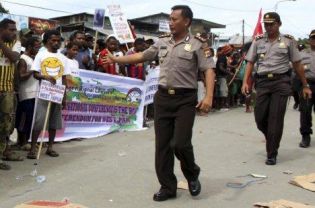
Several thousand West Papuan people took the streets in Jayapura on November 14 to  calling for a Referendum to demand their right of self determination.

This slideshow requires JavaScript.

In another show of mass civil resistance since the brutal crackdown by Indonesian security forces on the 3rd Papuan Peoples Congress,  the demonstration organised by the West Papua National Committee also called for the Government of Indonesia to take responsibility for its increased unjustified violence towards West Papuan people.

Indonesian police attempted to block the march, but protestors pushed through peacefully to continue to the offices of the DPRP, the provincial parliament building.

Demoted former Papuan Police chief Iman Setiawan attempts show of force (Reuters)

Protest organisers earlier expressed grave fears that security forces would attempt to repeat the violence on unarmed and peaceful protestors, but international monitoring and effective citizen media on the ground contributed to the restraint shown by security forces.

Participants rejected dialogue or talk with Jakarta until violence ended and maintained their position that a referendum was the only just pathway towards fulfilling Papuan rights.

“Give us the space for a referendum so that we can choose what we want.  We don’t want dialogue doing the bidding of UP4B, or other policy of Special Autonomy;  We don’t need money, we don’t need to be with  Indonesia, let us be free on our land,” said speakers, referring to the Special Development unit set up by Indonesian President Yudoyhono to dilute Papuan calls for independence.

[youtube http://www.youtube.com/watch?v=X4jVXagcUlM]

“The Papuan people have asked for an immediate referendum for self-determination. We reject any dialogue with Jakarta,” protest coordinator Mako Tabuni said.

“The referendum is non-negotiable.”

Mass Action Jayapura, 14 Nov 2011 (Af Wensi)

UN Declares Indonesia’s Detention Of Filep Karma A Violation Of International Law, Calls For Immediate Release

In response to a petition filed by Freedom Now and Hogan Lovells LLP, the United Nations Working Group on Arbitrary Detention has issued its opinion that the Government of Indonesia is in violation of international law by detaining Filep Karma. The Working Group calls on the Government of Indonesia to immediately release the human rights advocate.

Mr. Karma is a prominent Papuan human rights advocate and former civil servant arrested on December 1, 2004 for raising the Papuan Morning Star flag at a political rally in commemoration of Papuan independence from Dutch rule. Although Mr. Karma has explicitly denounced the use of violence, he was convicted for crimes of hostility against the state and sedition in a trial that fell far below international standards of due process. He now languishes in prison serving a fifteen-year sentence, despite health concerns and calls for his release by numerous NGOs and government officials. In August, 2011, 26 members of the U.S. Congress urged President Yudhoyono to release Mr. Karma. Forty members of Congress signed a similar letter in 2008. This week, President Obama will be in Indonesia attending the 2011 ASEAN Summit—which takes place November 17-19 in Bali—where many hope such human rights discussions will take place.

Freedom Now Executive Director Maran Turner stated: “The United Nations Working Group on Arbitrary Detention has found Indonesia’s actions a clear violation of international law. Mr. Karma is a nonviolent advocate who was arrested for his views and convicted in a trial marred by judicial bias, denial of appeal without reason, and intimidation tactics. I urge President Obama to raise Filep Karma’s case with President Yudhoyono and to call for Indonesia’s compliance with the UN opinion by releasing Filep Karma.”

The United Nations Working Group determined that Mr. Karma’s arrest was due to his exercise of the fundamental rights of freedom of expression, peaceful assembly, and association. According to the UN, provisions used to convict and detain Mr. Karma—including declaring “feelings of hate”—were “drafted in such general and vague terms that they can be used arbitrarily to restrict the freedoms of opinion, expression, assembly and association.” Such a detention violates the International Covenant on Civil and Political Rights, a multi-party treaty by which Indonesia is bound, as well as the Universal Declaration of Human Rights. The Working Group also censured the Government of Indonesia for violating Mr. Karma’s right to a fair trial.

The opinion concluded by calling the Government’s attention to broader human rights violations in Indonesia, for which Filep Karma’s situation is emblematic, stating, “The Working Group will remind The Republic of Indonesia of its duties to comply with international human rights obligations not to detain arbitrarily, to release persons who are arbitrarily detained, and to provide compensation to them.”

Freedom Now, a non-profit, non-partisan organization that works to free prisoners of conscience, and Hogan Lovells LLP, an international law firm, welcome the UN’s decision. They call on the Indonesian government to uphold its commitments under international law and immediately release Mr. Karma.

Source: Freedom Now

SBS: Calls for scrutiny on Papua human rights

Indonesian police officers man a security check point near the Freeport mine in Timika, Papua province. (AAP)

Amnesty International is calling on Prime Minister Julia Gillard to use upcoming meetings with Indonesia to address alleged rights abuses in Papua.

Amnesty International is calling on Prime Minister Julia Gillard to use meetings at the East Asia Summit in Bali to press Indonesia into addressing concerns of abuse and violence in Papua.

Ms Gillard is also expected to meet with Indonesian President Susilo Bambang Yudhoyono following the conclusion of the summit.

Amnesty International spokesman Josef Benedict told Aileen Phillips, while trade and development will be on the agenda, he hopes there is room for discussions on human rights.

Shocking video confirms Indonesia’s brutal suppression of West Papuan rally ahead of US visit

16 November

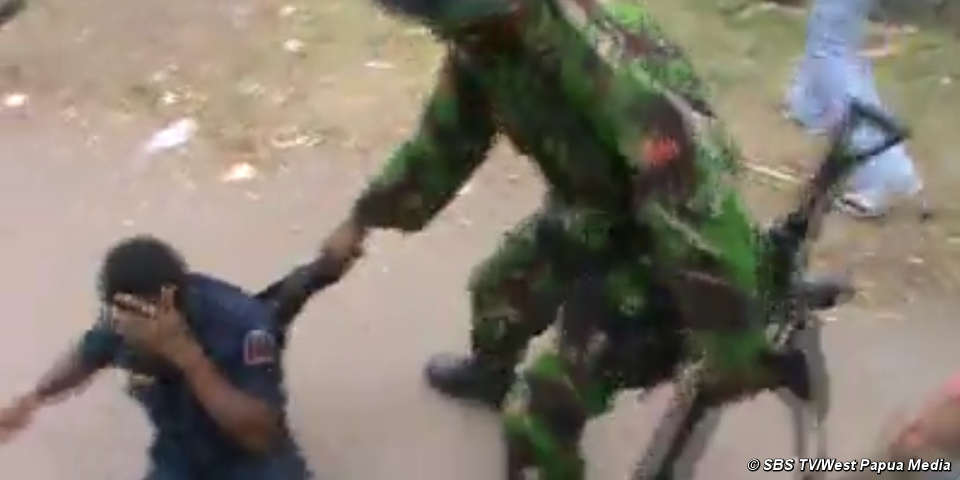
The shocking footage shows Indonesian soldiers beating West Papuans
© SBS TV/West Papua Media

Alarming video of Indonesian forces shooting, beating and kicking civilians at a peaceful rally in West Papua has emerged ahead of a US visit to the region.

Ten people are believed to have died when Indonesian security forces broke up the rally of independence activists last month.

Watch footage of the attacks (©SBS TV/West Papua Media,WARNING: DISTURBING CONTENT):

Indonesia’s brutal attack on West Papuan rally
Shocking scenes of Indonesia’s brutal suppression of a West Papuan rally on October 19 2011©SBS TV/West Papua Media

The video comes ahead of a visit to Bali by the US President and Secretary of State, for a regional summit. The US has applauded its ‘new partnership’ with Indonesia, but only last week Hillary Clinton criticized its human rights abuses.

The disturbing footage was smuggled out of West Papua exactly one year after scenes of Indonesian soldiers torturing Papuan mencaused worldwide revulsion.

These latest clips allegedly show a local police commander giving the order to break up the rally on the outskirts of Jayapura – and the brutal and unprovoked violence that ensued.

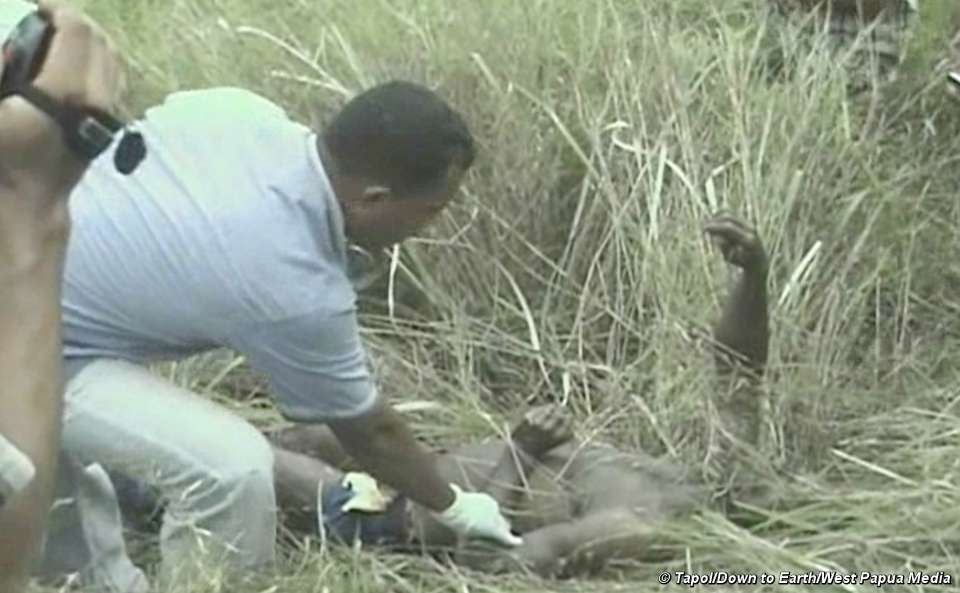
Victim is found after Indonesia's violent crackdown on West Papuan Congress
Victim is found after Indonesia’s violent crackdown on West Papuan Congress
© Tapol/Down to Earth/West Papua Media

Indonesian security forces, many in plain clothes and wearing crash helmets, are seen randomly firing their weapons and arresting scores of people, many of whom are punched, kicked, beaten or forced to crawl along the ground.

Reverend Benny Giay from West Papua says violence has escalated since the Congress was dispersed. ‘I think maybe this is the Indonesian military and police’s response to the international pressure.  The response is that they are being sent to Papua to kill, terrorize and abduct Papuans, but please do keep on the international pressure. Please tell people what is happening here for the sake of our future, our lives, our culture, our identity and our very existence.’

West Papua has been ruled by Indonesia since 1963, and more than 100,000 civilians are believed to have been killed during its occupation.

Survival’s Director Stephen Corry said today, ‘Indonesia’s brutal occupation of West Papua is a catalogue of some of the worst human rights abuses and violations of tribal peoples in recent times. Hillary Clinton should use her visit to the country to highlight the horrific violence that Indonesia is wreaking on all those who dare to oppose its rule.’

Note to Editors:

A Survival campaigner who has been to West Papua is available for interview.

More clips are available for download from West Papua Media

Open Letter to President Obama from West Papua Advocacy Team (WPAT) and East Timor and Indonesia Action Network (ETAN)


Contact: John M. Miller, +1-718-596-7668; mobile: +1-917-690-4391, john@etan.org

Ed McWilliams, +1-575-648-2078, edmcw@msn.com

President Barack Obama
1600 Pennsylvania Ave. NW
Washington, DC 20500

November 15, 2011

Dear President Obama,

We urge you to seize the opportunity of your imminent return to Indonesia to consider the challenges and opportunities posed by the U.S.-Indonesia relationship more realistically than you have up to now.  Your Administration urgently needs a policy that addresses the problems created by the Indonesian security forces’ escalating violations of human rights and criminality and its failure to submit to civilian control. The recent 20th anniversary of the 1991 Santa Cruz massacre in Dili. East Timor (Timor-Leste), when hundreds of peaceful protesters were massacred by Indonesian troops wielding U.S. supplied weapons, reminds us that a lack of accountability for past crimes — in Timor-Leste and throughout the archipelago — keeps those affected from moving on with their lives, while contributing to impunity in the present.

Indonesian military and police forces continue to operate without any accountability before the law. Only in rare instances are individual personnel brought before military tribunals for crimes against civilians, often because of international pressure. Prosecution is woefully inadequate and sentencing, in the rare instance of conviction, is not commensurate with the crime.

Indonesia’s security forces, including the Kopassus special forces and U.S.-funded and -trained Detachment (Densus) 88, continue to employ against civilians weaponry supplied by the U.S. and to use tactics developed as result of U.S. training. In West Papua, these security forces have repeatedly attacked civilians, most recently participants in the October 16-19 Congress and striking workers at theFreeport McMoRan mine. Those assaulted were peacefully asserting their right to assemble and freedom of speech. At the Congress, combined forces, including regular military units, Kopassus, the militarized police (Brimob) and Detachment 88, killed at least five civilians, beat scores more, and were responsible for the disappearance of others.

Moreover, in the central highlands of West Papua, these same forces regularly conduct so called “sweeping operations,” purportedly in search of the very small armed Papuan resistance. These operations have led to the deaths of many innocent civilians and driven thousands from their village into forests where they face life threatening conditions due to inadequate access to shelter, food and medical care.

Indonesian military and police forces continue to operate without any accountability before the law. Only in rare instances are individual personnel brought before military tribunals for crimes against civilians, often because of international pressure. Prosecution is woefully inadequate and sentencing, in the rare instance of conviction, is not commensurate with the crime. Several videoed incidents of military torture of civilians — widely discussed during your November 2010 visit to Indonesia — concluded in just such failures of justice. The concept of command responsibility is rarely considered in the military tribunals.

International monitoring of these developments in West Papua is severely hampered by Indonesian government restrictions on access to and travel within West Papua by foreign journalists, diplomats, researchers, and human rights and humanitarian officials. The International Committee of the Red Cross remains barred from operating an office in West Papua. Indonesian journalists and human rights officials face threats and worse when they try to monitor developments there.

Elsewhere in Indonesia, too many times security forces have stood by or actively assisted in attacks on minority religions, including deadly attacks on Ahmadiyah followers.

The Indonesian security forces — especially the military — are largely unreformed: it has failed to fully divest itself of its business empire, its remains unaccountable before the law, and continues to violate human rights. These forces constitute a grave threat to the continued development of Indonesian democracy. The upcoming national elections in Indonesia present a particularly urgent challenge. The Indonesian military is in position to pervert the democratic process as it has in the past. The military has frequently provoked violence at politically sensitive times, such as in 1998 when it kidnapped tortured and murdered democratic activists.  For many years it has relied on its unit commanders, active at the District, sub-District and even village level to influence the selection of party candidates and the elections themselves. The territorial command system is still in place.
In the past, U.S. restrictions and conditions on security assistance have resulted in real rights improvements in Indonesia. Your Administration should learn from this history.

Given this threat to democracy and to individuals posed by Indonesian forces, it is essential that the U.S. employ the significant leverage that comes from Indonesia’s desire for U.S. security assistance and training to insist on real reforms of Indonesian security forces. Rhetorical calls for reforms are clearly insufficient. These exhortations have manifestly not worked and readily brushed aside. Secretary of State Hillary Rodham Clinton’s recent expression of “concerns about the violence and the abuse of human rights” in Papua were dismissed by a spokesperson for Indonesia’s President Susilo Bambang Yudhoyono , who called the escalating rights violations “only isolated incidents.”

In the past, U.S. restrictions and conditions on security assistance have resulted in real rights improvements in Indonesia. Your Administration should learn from this history and quickly suspend training for those units whose human rights records and impunity are especially egregious, as required by the Leahy law. We specifically urge you to end plans to re-engage with Kopassus and to end assistance to Detachment 88. These actions would demonstrate U.S. Government seriousness in pursuit of real reforms of the security forces in Indonesia.

Sincerely,

Ed McWilliams for WPAT

John M. Miller for ETAN

see also


Create a website or blog at WordPress.com

Up ↑