Kimanus Wenda’s tumour operation

andreasharsono.net
22 March 2012

[Translated by TAPOL] 
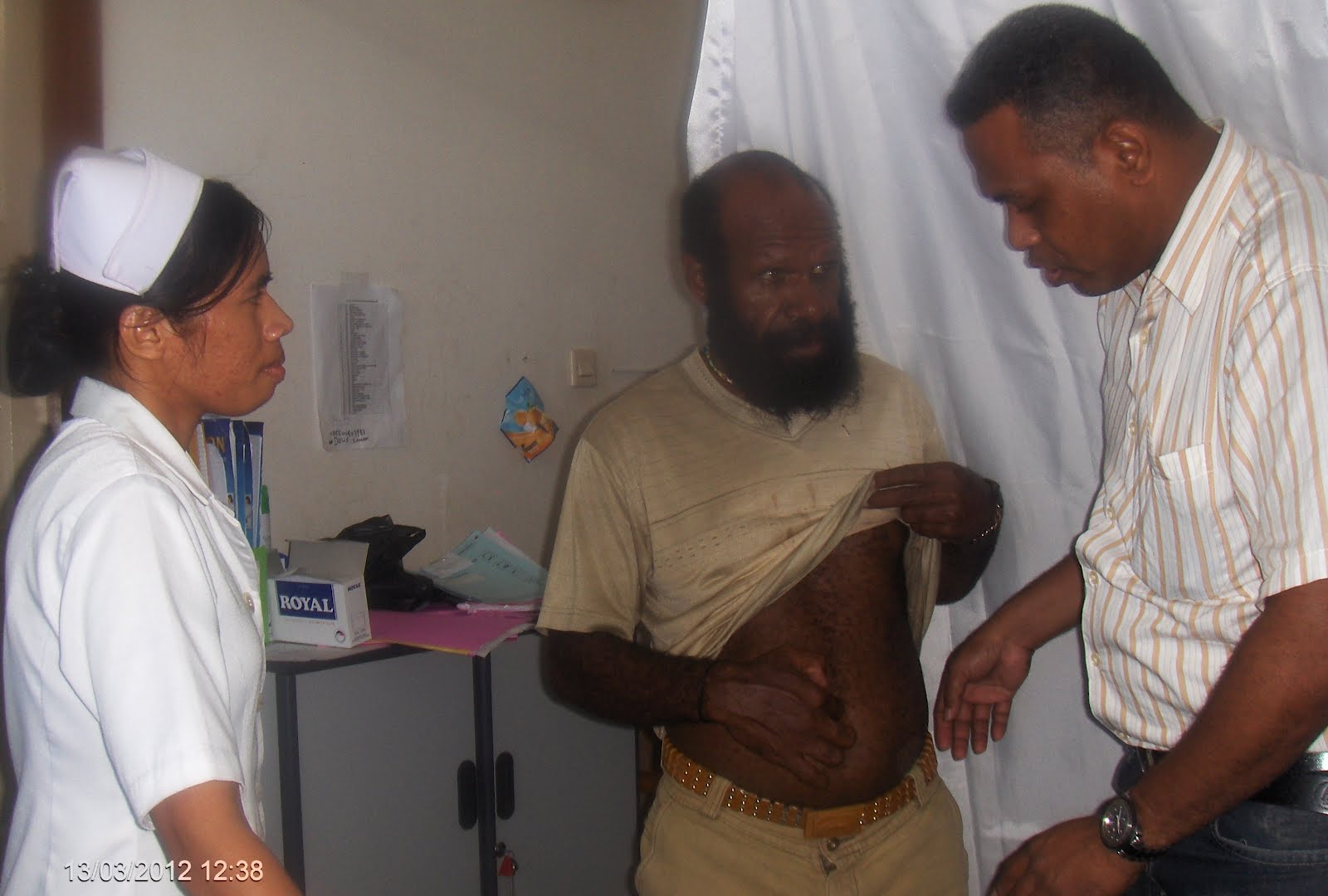
Papuan detainee Kimanus Wenda being examined by the doctor at Dian Harapan Hospital in Waena, Jayapura. ©Peneas Lokbere

KIMANUS WENDA, a prisoner usually detained in Nabire prison had an operation to remove a tumour from his stomach at Dian Harapan Hospital, Waena Jayapura on 14 March 2012.  Wenda is detained for treason (makar) and is serving a 20 year prison sentence.

According to Peneas Lokbere from United for Truth (Bersatu Untuk Kebenaran), an organisation which provides support for political prisoners in Papua, the operation began at 10:00 and lasted for two hours.

“After the operation he was transferred to the inpatient ward. The procedure went well without any obstacles,” said Lokbere.  A growth and a hernia were operated on, and he was given six stitches.

Wenda was hospitalised until Saturday 17 March 2012. On Satuday, Dr Trajanus Lauretius said that Kimanus could go “home” to the jail in Abepura, but that every Tuesday he needs a check-up at the Dian Harapan Hospital.

Lokbere took Wenda to Abepura jail on Saturday afternoon. On Sunday Lokbere came back to bring his medication.   According to Lokbere, Kimanus Wenda said that two staff from the jail came into his cell.  All his belongings – including his clothes and medicines – were turned upside down with no clear reason.  He was offended by being treated in such an impolite manner while he was just recovering from an operation.

Kimanus Wenda is actually listed as a prisoner at Nabire jail.  However he cannot return to Nabire at present because he needs to recover properly first and have the stitches removed from his stomach.

According to the Asian Human Rights Commission, Kimanus Wenda started
to complain of feeling ill in 2010, and was vomiting frequently.  The doctor at Nabire prison examined him and said that he needed to be examined in Jayapura.   However, the Ministry for Justice and Human Rights said that they could not pay for an operation in Jayapura.  They claimed they didn’t have the money to cover the costs of the operation.

An official of Nabire jail disagreed that Wenda was ill.  The proof?  Kimanus Wenda could still play volleyball in the prison field in Nabire.  His obstructive behaviour prompted Peneas Lokbere to gather funds for Wenda’s operation. Various non-governmental organisations have contributed to the cost of the journey, transfer between the Nabire and Abepura prisons, and the medication for Kimanus Wenda.

According to the Facebook page of TAPOL, an organisation which provides support for political prisoners, their internet fundraising campaign using the gofundme.com website raised £2,000, [which included £1,040 in direct donations and an anonymous private donation of £1,000 – TAPOL]. They channelled the funds through Peneas Lokbere and friends in Jayapura.

At present, Lokbere is monitoring Kimanus Wenda’s recovery in Abepura prison.  Once he recovers and the stitches are out, Wenda will return to Nabire prison.  According to Indonesian law, the Indonesian government is responsible for providing prisoners with healthcare.

However, the problem of budgets is often used by the Ministry for Justice and Human Rights as an excuse for not complying with this regulation.

Ironically, the Indonesian government has also banned the International Committee of the Red Cross (ICRC) from working in Papua since March 2009, despite the fact that ICRC often helps the families of prisoners to visit the detainees.  The ICRC also usually gives support for medication for prisoners, no matter who they are.

Peneas Lokbere and TAPOL are now collecting funds for an operation for Jefrai Murib who is currently in Biak prison.   Jefrai Murib is suspected of having suffered a stroke on 19 December 2011.  The left side of his body and his left arm and leg have lost all sensation. Murib has been examined at the Biak General Hospital, where the doctor’s diagnosis was that he needs to be examined at the General Hospital in Jayapura.

http://www.andreasharsono.net/2012/03/operasi-tumor-kimanus-wenda.html

Medical personnel seriously lacking in Papua

JUBI, 2 April 2012

Taking into account the vastness of the territory of the Province of Papua, there is a serious shortage of medical personnel here. Moreover, the ratio between the number of medical personnel and the number of hospitals and clinics is also far too low.

‘If you take into account the number of hospitals, clinics and medical centres, I reckon that the shortage of medical personnel amounts to as much as 2,700,’ said the Head of the Provincial Medical Services in Papua, Josef Rinta Rachatmaka.

He said that as a way of reducing this shortage, the Provincial Medical Services intends, in co-ordination with the Agency for Personnel Education and Training in the Province of Papua, to look more closely at the data about healthcare personnel in the area.

‘On the basis of our present calculations, the number of healthcare personnel in Papua is very low indeed.. With 20 hospitals, 310 clinics and 760 healthcare centres, we need a further 2,700 medical personnel,’ he said. He said in particular that there was a need for more medical personnel in the medical health centres that are spread right across the territory.

He said that the shortage would become even more acute if new hospitals were built. The medical personnel includes the number of doctors, midwives, dieticians and so on. The key factor in any healthcare provision is that there is the right number of personnel. However many medicaments and however much money is available, if there are not enough personnel, then nothing will function properly. While agreeing that there are enough facilities, the most important thing is to have enough medical personnel. ‘Many of the facilities we have here are standing empty.’

He went on to say that whenever there are plans to build new hospitals, if the personnel are simply taken from those at the already existing facilities, this would only lead to a further lack of personnel. He said that they plan to open up new diploma courses for nurses, midwives and dieticians.’We very much hope that, as new healthcare facilities are built, there will be a sufficient number of personnel and not continue with the situation as it is at present.’

[Abridged in translation by TAPOL]

Two Papuan tapols with paralysis are waiting for permission to get treatment

JUBI,
30 March 2012

Two Papuan political prisoners who are being held in Biak Prison say that they are  waiting for permission to go to Jayapura for medical treatment.They are both suffering serious medical conditions.

Jefrai Murib said that he and his colleague Apot Lokobal are waiting for information from their lawyers and from the Department of Law and Human Rights  about their transfer to Jayapura for treatment. One of their lawyers, Lativa Anum Siregar told them they would have to wait until after the case of Forkorus and his colleagues has been completed.

[Note: Forkorus and his four co-defendants were sentenced to three years on 16 March 2012. Their lawyers have just announced that the five men are due to lodge an appeal against the sentence on 2 April. No date has yet been set for when the appeal will be heard which is likely to be weeks ahead. This means that these two suffering  tapols are likely to have to wait for at least several weeks if not months before getting the medical attention which they urgently need. According to another of their lawyers,  Olga Hamadi,  they will appeal against the sentence and call for the release of the five prisoners. They will argue that the court failed to prove that the five men were guilty of makar (treason). – Tapol]

As has previously been reported, lawyers at the Forkorus trial  said that none of the witnesses heard in the trial had given testimony about the alleged role they were said to have played; according to KUHAP, the Criminal Procedural Code Article 110 they should be proven to have been involved in a conspiracy.

Furthermore, 69 items of evidence were mentioned at the Forkorus trial, of which only one was presented during the trial, namely a banner.

Forkorus and his four co-defendants are now serving their sentences in Abepura Prison.TAPOL]

Jefrai Murib, one of the ailing tapols said they will have to wait till after the  Forkorus trial has been completed as well as after another of their colleagues, Kimanus has been treated for another ailment.

Jefrai Murib said the right side of his body is completely paralysed because of a stroke. ‘My right hand is also paralysed. Just going to the toilet is very difficult indeed for me..’

His colleague Apot Lokobal  said that he too is waiting for a permit to get medical treatment in Jayapura. He said that his condition is not as bad as that of his colleague Jefrai who is much more seriously ill. He is suffering from the same condition as Jefrai, with the right of his body paralysed.

The two men were arrested and sentenced for their involvement in an assault on an ammunitions dump of Kodim 1702, Wamena. Another twelve tapols were also tried and sentenced in connection with the same incident.

[Abridged in translation by TAPOL]

“Papuans do not feel safe in their own land” – Faith Based Network holds forum in Geneva

from the Faith-based Network on West Papua

Newsletter, March 2012

On 15 March, the Faith-based Network on West Papua (FBN) in cooperation with Franciscan International (FI), the Asian Human Rights Commission (AHRC), the World Organization against Torture (OMCT) and TAPOL held a side-event at the Human Rights Council in Geneva.

National and international human rights experts discussed the implementation of the Universal Periodic Review (UPR) recommendations from 2008 in Indonesia with regard to the human rights reality in Papua. Four years after the Indonesian Government accepted the UPR recommendations, the human rights experts observe no significant changes in the protection of human rights violations on the ground.

“Many Papuans do not feel safe in their own land”, said Rev. Matheus Adadikam, General Secretary of the Evangelical Church in the Land of Papua (GKI-TP). Extrajudicial executions, torture, arbitrary arrest and detention remain a reality for the indigenous people of Papua.  Ferry Marisan, Director of the Institute of Human Rights Studies and Advocacy (ElsHAM Papua), reported 75 people tortured and three killed by the Indonesian security forces after the 3^rd Papuan Peoples Congress in October and over 1.000 refugees caused by a military operation in Paniai Regency in December 2011.

Norman Voss, from the Asian Legal Resource Center (ALRC), drew a bleak conclusion of the UPR recommendations in Indonesia. “The implementation of the 2008 recommendations is very disappointing”, the international human rights expert said. The initial momentum of the so-called “Reformasi” with its improved human rights legislation had gone. There is no accountability for human rights violations in Papua and also no remedy for the victims, Norman Voss explained.

Novel Matindas, from the Papua Desk of the Communion of Churches in Indonesia (PGI), supported these observations and criticized the lack of political will from the Indonesian government to implement the Special Autonomy Law for Papua. The PGI therefore requests a dialogue between Papua and Jakarta to find the “best solution” for the ongoing problems.
For more information on the Faith-based Network on West Papua: http://www.faithbasednetworkonwestpapua.org or contact fbn_papua@vemission.org

Related News

*World Council of Churches expresses concern over human right violations in Tanah Papua*

The World Council of Churches (WCC) Executive Committee recently issued a statement expressing concern over the escalation of violence in Tanah Papua, Indonesia. <http://www.faithbasednetworkonwestpapua.org/news_release/world_council_of_churches_expresses_concern_over_human_right_violations_in_tanah_papua>

*Concerns of JPIC in Papua regarding the situation in Papua*

The secretariats of JPICs in Papua confirm that the pro-investment policy of the Government of Indonesia and the torture and cruel treatment by the security forces have undermined law and the dignity of the indigenous Papuans, marginalising and threatening their right to life. <http://www.faithbasednetworkonwestpapua.org/news_release/concerns_of_jpic_in_papua_regarding_the_situation_in_papua__reflections_on_the_situation_in_2011_>

*Statement: Torture and extrajudicial execution still take place in Papua*

FI, FBN and TAPOL would like to draw the attention on torture and extrajudicial execution still taking place in Papua. <http://www.faithbasednetworkonwestpapua.org/userfiles/files/Item3-General%20debate-joint%20statement-FI-FBN-Tapol-West%20Papua%20%282%29.pdf>

*Joint Press Release*

The Jayapura State Court found five Papuan leaders guilty of treason, sentencing them to three years imprisonment. <http://www.faithbasednetworkonwestpapua.org/userfiles/files/Joint%20Press%20Release%20on%20Verdict%20%282%29.pdf>

*Urgent Appeal: Joint Letter to Mrs. Sekaggya*

Dear Mrs Sekaggya, We are writing to you in relation to threats made against human rights lawyer Mr Gustav Kawer by the Public Prosecutor’s Office in Jayapura. <http://www.faithbasednetworkonwestpapua.org/news_release/urgent_appeal>

*Papua Update*

A Statement to the Human Rights Sub-Committee of the Joint Standing Committee on Foreign Affairs, Defence and Trade, House Representatives of Australia Canberra. <http://www.faithbasednetworkonwestpapua.org/userfiles/files/BH%20paper%20for%20ozi%20joint%20committee_2012%20%282%29.pdf>

Groups Urge U.S. Not to Sell Attack Helicopters to Indonesia

AH-64 Apache
AH-64 Apache (Photo credit: Wikipedia)
Press Release

Contact: John M. Miller, +1-718-596-7668; mobile: +1-917-690-4391, john@etan.org
Ed McWilliams, +1-575-648-2078, edmcw@msn.com

March 30, 2012 – Ninety organizations today urged the U.S. government and Congress not to provide deadly attack helicopters to Indonesia. Indonesia has announced that it plans to buy eight AH-64 Apache attack helicopters from the United States.

The groups warned that the helicopters will escalate conflicts in Indonesia, especially in the rebellious region of West Papua: “Providing these helicopters would pose a direct threat to Papuan civilians.”

The Indonesian military (TNI) regularly conducts “sweep operations,” involving attacks on villages where innocent villagers are forced from their homes. The groups write that “Papuan civilians either flee the attacks to neighboring villages or into the surrounding forests where many die or face starvation, cut off from access to their gardens, shelter, and medical care.” Sweep operations are now underway in the Central Highlands region of West Papua.

The letter was organized by the U.S.-based East Timor and Indonesia Action Network (ETAN) and the West Papua Advocacy Team and signed by human rights, religious, indigenous rights, disarmament and other organizations based in 14 countries.

Signers include: Faith-based Network on West Papua, Fellowship of Reconciliation, Peace Action, International Lawyers for West Papua, Land Is Life, KontrS (Indonesia), and Pax Christi Australia. A complete list of signers can be found here: http://www.etan.org/news/2012/03helicop.htm

The AH-64 is designed for air to ground attack. It can operate day or night and is armed with high caliber chain guns and equipped to fire missiles.

ETAN was formed in 1991. It celebrated its 20th anniversary this December 10, advocates for democracy, justice and human rights for Timor-Leste and Indonesia. See ETAN’s web site: http://www.etan.org

Text of Letter

As organizations concerned about human rights in Indonesia and West Papua, we are writing to urge the U.S. government and Congress not to allow the sale of AH-64 Apache attack helicopters to the Indonesian military (TNI). Providing these helicopters would pose a direct threat to Papuan civilians, who have been the target of deadly TNI assaults for many years.

The sale of this weapons system to the TNI — notwithstanding its long record of disregard for civilian casualties, corruption, human rights violations and impunity in East Timor, Aceh and elsewhere — would only increase the suffering of the Papuan population.

Indonesia’s Deputy Minister of Defense Sjafrie Sjamsoeddin told the Antara news agency, that  Indonesia intends to buy eight AH-64 Apache helicopter from the United States.

The heavily-armed AH-64 is a highly lethal weapon which can be used to escalate conflict within Indonesia and in West Papua. These aircraft will substantially augment the TNI’s capacity to prosecute its “sweep operations” in West Papua and thereby, almost certainly lead to increased suffering among the  civilian populations long victimized by such operations.

TNI “sweep operations,” including several now underway in the Central Highlands region of West Papua, involve attacks on villages. Homes are destroyed, along with churches and public buildings. These assaults, purportedly to eliminate the poorly armed Papuan armed resistance, force innocent villagers from their homes. Papuan civilians either flee the attacks to neighboring villages or into the surrounding forests where many die or face starvation, cut off from access to their gardens, shelter, and medical care.

The AH-64 is designed for air to ground attack. It can operate day or night and is armed with high caliber chain guns . It is also equipped to fire missiles.

Congress must be notified of major weapons sales. We urge Congress to oppose the sale of these helicopters.


Create a website or blog at WordPress.com

Up ↑
