AHRC: A Papuan was tortured on the unreasonable allegation of engagement with separatist group


ASIAN HUMAN RIGHTS COMMISSION – URGENT APPEALS PROGRAMMEUrgent Appeal Case: AHRC-UAC-201-2012

<http://www.urgentappeals.net/support.php?ua=AHRC-UAC-201-2012>

11 December 2012
———————————————————————
INDONESIA: A Papuan was tortured on the unreasonable allegation of engagement with separatist group

ISSUES: Arbitrary arrest and detention; inhuman and degrading treatment; police violence; torture
———————————————————————

Dear friends,

*The Asian Human Rights Commission (AHRC) wishes to inform you of the case regarding the torture of a Papuan in Mimika, Papua. The victim was arrested by officers from the Mimika Sub-District Police wearing civilian clothes without any warrant. The police randomly accused him for being involved in the separatist movement organised by Free Papua Organisation (Organisasi Papua Merdeka, OPM). As result of the torture, the victim was severely injured and could not walk for four days.

CASE NARRATIVE:
According to the information from the Justice, Peace and Integrity of Creation of the Evangelical Christian Church in Papua (JPIC GKI), Frengki Uamang was visiting a church and about to buy mineral water from a local shop on 27 November 2012 when a silver-painted car approached him at 11am. Two unidentified men wearing civilian clothes came out the car and arrested Frengki. One of the men told him that he was a police officer.

Frengki was taken in the car to a place located about 20 metres away from the church and asked for the reason of his visit to the church. Frengki explained that he was attending a religious event at the church but the police instantly told him ‘don’t lie to us. You want to buy weapons, so don’t lie to us!’

The police later took Frengki to Kwamki Baru Sub-District Police at 11.45 where he was interrogated and accused of committing various actions, one of which was providing food for the military members of OPM. During the interrogation, the police tortured Frengki for approximately four hours. Frengki was kicked by police officers wearing boots and he had his head, ears, face and chin kicked and beaten. The police also hit Frengki on his chest, legs and tights which resulted in him not being able to walk for four days.

At 3.30pm on the same day, the police took Frengki out of the police station and drove him to Irrigation Street in Mimika. In addition to the car that was taking him, another car full of police officers was also following. In total there were about 10-12 police officers came to Irrigation Street with Frengki. The police asked Frengki to show them two houses where OPM’s military members were allegedly hiding in. Frengki told the police officers that he himself is only a visitor to Mimika and he has no idea of what houses they were talking about, yet the police insisted on taking him to Irrigation Street.

On their way to the Irrigation Street, the police again tortured Frengki. The police officers pulled his fingernails using pliers. As they arrived at the Irrigation Street, the police took Frengki to a plantation area. Frengki was asked to slither on his stomach while his hands were handcuffed. Three police officers pointed their guns at Frengki and asked him to pray. One of them told Frengki, ‘you killed my fellow police officers. You are a member of OPM’s military. You’re obviously from Kali Kopi’. Kali Kopi is one of the headquarters of OPM’s military.

As the three officers were pointing their guns at Frengki and he himself was praying, the rest police officers coming with Frengki randomly opened fire towards the trees, creating the impression that they were in crossfire against the OPM’s military members. Out of nowhere, one of the police officers took Frengki to Mimika Sub-District Police. Frengki was again interrogated, yet this time the police asked him of his link to the shooting that took place in the area owned by PT Freeport, an American gold mine company. Frengki was detained at the police station for one night, his hands and legs were chained to a table in the police’s cell.

The next day at around 2pm, Frengki was released by the police. He was not able to walk so a police officer took him to Immigration Street where Frengki was staying.

ADDITIONAL INFORMATION:

As of today, torture is yet to be criminalised in Indonesia and the legal proceeding on such abuse is far from independent. Due to the absence of law criminalising torture, state officials who committed it are usually charged with provisions concerning physical assault which is not in accordance with the definition of ‘torture’ stipulated in the UN Convention against Torture and Other Cruel, Inhuman or Degrading Treatment or Punishment (UN CAT). As the physical assault article under the Penal Code only carries a maximum punishment of two years and eight months imprisonment, those who committed torture are sent to light punishment, if they were punished at all.

In addition to the absence of law criminalising torture, the unavailability of independent legal mechanism to investigate torture allegation has aggravated the problem. For a criminal proceeding on torture allegation to take place, the victims need to submit a criminal complaint to the police whereas it’s actually the police themselves or their colleague who committed the abuse. As a result, most of torture complaints are not followed up and criminally investigated by the police. Torture victims may also submit a complaint to the monitoring mechanism within the police called the Professionalism and Security Division (Propam). Yet this mechanism is not transparent and only has the power to impose disciplinary punishment to police officers practising torture.

http://www.humanrights.asia/news/urgent-appeals/AHRC-UAC-201-2012


Yusak Pakage: ‘I was arrested for being a former tapol.’

by OKTOVIANUS POGAU of SuaraPapua.com
5 December 2012Jayapura: ‘I was arrested because of my having once been held as a political prisoner (tapol),’ said Yusak Pakage, a Papuan activist. who said that the charge against him was a frame-up, alleging that he was dangerous just because he was carrying a knife.

He made this statement to suarapapua.com on 4 December, following a hearing at the Class 1A district court in Jayapura  He said that as soon as he was arrested on 27 July this year, he was taken to a police command post and questioned about his behaviour towards a court official, Sefnat Fonataba.

‘Soon after, Fonataba came to the police station and told the police there that there was no problem with me and apologised to me for what he had done.’  The policeman asked Pakage to write a statement  saying that there was no problem between him and the policeman which is what he did.

When he was about to sign the statement, the chief of police in Abepura came along and said that he had other instructions about how to handle this case.

‘Shortly afterwards, I was taken to the police station where I was interrogated for quite a long time about the knife. I said that it was a very cheap knife, the kind of knife that you can find in any traditional market in Jayapura. It is just something I carry about with me for my everyday needs. I didn’t buy it in order to do something criminal, as the security people seemed to think.’

‘ I have never  heard anything about needing a special permit to carry an ordinary knife.The law in Indonesia is very confusing and I don’t know about any rule governing the carrying of a knife.  The chief of police said that he didn’t know who I was and wanted the case to be handled in the usual way.’ But according to Pakage, the police officer knows very well who he is and that he had previously been held as a tapol. ‘He was lying,’ said Pakage.’He just wanted it to be known that I had formerly been held as a tapol, when I was arrested along with Filep Karma in 2004 for carrying the  Morning Star flag.’

‘I frequently make statements about the human rights situation in Papua and take a leading part in many demonstrations, so of course he knows very well who I am.’

Pakage also said that during his interrogation, all his personal belongings were taken away, even including his ballpoint, and none of these things  have been returned to him.

On 19 August, he was transferred to the prison in Abepura and he is now waiting for his case to be completed and to hear the verdict of the judge.

Pakage used this occasion to warn his activist friends to be very careful and keep control of their feelings when they are doing anything to struggle for the rights of the Papuan people.

‘I tell them not to get too emotional and to learn from my own experiences which show that I can be arrested for something very trivial.’

Siman Pattiradjawane, the lawyer who is defending Pakage told reporters that the verdict in the case will be announced on 11th December.

Wewak PNG turns out in numbers to support West Papua

from West Papua Media sources in Wewak, Papua New Guinea

December 11, 2012

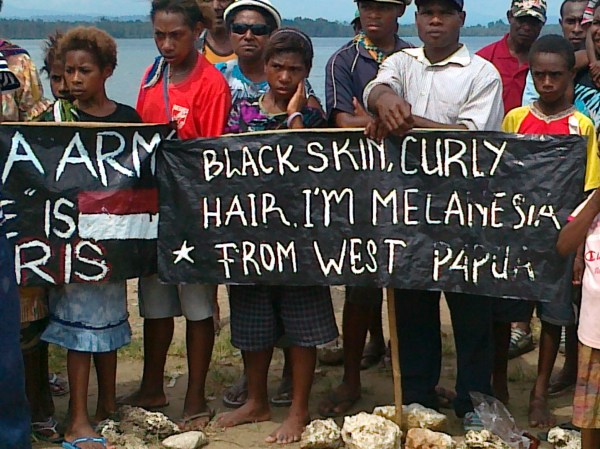
Over one thousand civil society members from Wewak, East Sepik Province in Papua New Guinea, turned out on December 10 to support their wantoks across the border in a large and vibrant demonstration that brought the provincial capital to a standstill, local stringers from West Papua Media report.

The rally and festival, called to bring attention to human rights situation in neighbouring West Papua on International Human Rights Day, saw PNG government officials, security forces, church leaders and ordinary people march together calling on the PNG government to do more to stand up to Indonesia on the issue of West Papua, and for the sovereign rights of West Papua to be respected.

This slideshow requires JavaScript.

At around 9:00am the marchers gathered at Mongian Compound, about 500 metres from Wewak town market.  A long-march started with less than hundred people but the numbers grew throughout the day.  As the marchers approached Wewak town area around 10:00am,Wewak local time, the number had grown to one thousand people.  The positive environment and support from the authorities and civil society motivated long-march organisers to do four laps around Wewak Town until midday.

One West Papuan observer told West Papua Media via phone conversation that the spontaneous support from the public was “amazing and unreal”.  As further quoted “a lot of ordinary people and women who sell their food at Wewak town market left their goods and joined the march. They even donated money, food, drinks and various garden food to us (West Papuan asylum seekers).”

At around, 12:30pm, the streets of Wewak was covered with sea of people who called for basic human rights to be protected, but importantly echoing the aspirations of the sovereign right of West Papuan people, according to participants

The long-march finished at the new Police Station near Wewak Town Market, where various speakers addressed the crowd.  Amongst the speakers were, Miss Sophie Mangai, President of Wewak Women’s Council, who led the long-march calling on those gathered to “lets all support our brothers and sisters from West Papua for their struggle for independence.”

“West Papuans are our brothers and sisters; we are one people; one ancestor; and one Melanesia in the Pacific. So we must drive out Indonesia from the land of West Papua,” said Miss Mangai.

Other Speakers included: Florence Parinjo (Wewak Women Council), Abraham Kareni, Jusuf Kambuaya and Daniel Waromi (West Papuan expatriates living in Wewak) and followed by other West Papuan asylum seekers.

PNG Media including NBC also covered the rally, interviewing many West Papuan and PNG people present.

According to rally organisers, the rally was fully endorsed by Sakien Sakawar (Police Border Commander), Mr. Francis Kemaken (Coordinator of Diocese of Caritas PNG/Oceania, and Patron of the Federated Republic of West Papua Branch-ESP Wewak PNG), 3. Miss Sophie Mangai (President of East Sepik Council of Women), and Jusuf Kambuaya (General Secretary, Federated Republic of West Papua Branch Office Wewak).

Informal festivities continued into the night, according to local sources.

West Papua Media


A Chronology of PT Minersave’s (Freeport’s) Entry into Intan Jaya Regency, West Papua

This article from KOMISI, a group of students from Intan Jaya in West Papua (in co-operation with the SuaraPapua website), recounts how the Freeport mining company, through its subsidaries, established exploration activities in remote Intan Jaya regency over twenty years ago with the help of a western missionary. Currently, as local politicians grant permissions for further exploration work without a mandate or the consent of the communities that live there, the students make a clear demand that the company leaves their land, knowing the pattern of conflict that is bound to emerge otherwise.

Translated from http://suarapapua.com/2012/12/kronologis-masuknya-pt-minersave-di-kabupaten-intan-jaya
Article available in English on hidupbiasa: http://hidupbiasa.blogspot.com/2012/12/a-chronology-of-pt-minersaves-freeports.html

December 2, 2012.

Intan Jaya Regency is a new administrative region which split from Paniai Regency in 2008. Until that time, Sugapa, Hitalipa and other areas were still under the administration of Paniai Regency.

The story begins in 1989 – 1990 when several westerners arrived, calling themselves the Survey Team. They were accompanied by a missionary from District Hitalipa, who had been given the friendly nickname of Jani Mala by local people.  His real name is John Cutts, a foreigner who was born and raised in Intan Jaya.

They arrived from Timika in an Airfast helicopter, and after arriving at the Kingmi Missionary Post in Hitalpa district , they continued towards the Hiyabu river, not far away.

Once at the river they started taking sand, water and rock samples. Then they continued towards the confluence of the Hiyabu and Dogabu rivers, and then to the confluence of the Wayabu and Wabu rivers and to several streams that joined the Wabu River, taking more samples at each river.

As they passed the Wabu River at Wandoga, John Cutts happened to meet a local resident, Stevanus Sondegau, by a stream known as Wonemiggi.  John and his companions continued their journey to the confluence with the Tigabu river, where once again they took samples and panned the sand to look for gold.

At that moment John met with another local resident, known locally as Ojegoa Tawa Mbole Belau or Didimus Belau, from Bilogae village, Sugapa District, who farmed cassava, taro and other plants along the Tigitalipa river. As usual John Cutts spoke in Migani, the local language, and told Didimus what they were doing there.

“ A me,..mepao,..mendaga kaneta taliago kaya, Hitalipagemaya tali ne,..du ne,..homa ne,.. inigiao dia digio,. usua naga ndogo- Timika ge inua noa nggaga inuapa dutima dia diggiyo,.data kapage go wabu ge dega-dega data homeyo pialiggiyo dipage go Timika puapaya,”  John Cutts said to Didimus in Migani, which means “I’m accompanying these people to collect water, rock and sand samples from Hitalipa to look at in the laboratory in Timika. From here we will continue to follow the upper reaches of the Wabu river then to Homeyo District and then we will go to Timika”.  John Cutts, the man who the local people always addressed as Jani Mala, continued with the survey team towards Homeyo District.

Several months later, on 28th September 1991, John Cutts made a second visit to Sugapa, Intan Jaya as a representative of PT Freeport Indonesia. His aim was to meet with the head of the Sugapa district and tribal chiefs to inform them that PT Freeport would start operations in Sugapa district and several other districts in Intan Jaya.

That meeting, which took place in the Sugapa district office, was attended by Hombore BA, the district head at the time, the members of the Tripika (local representatives of government, police and military), together with community leaders who hold the customary land rights, who all came and listened to what John Cutts had to say.

Migani community leaders that were present in that meeting included Paulus Japugau, Yuliu Sani, Adolof Belau, Oktopianus Sondegau, Samuel Japugau, Andreas Tipagau, and Bony Sondegau amongst others. They were confused when they heard John Cutts’ explanations, and didn’t understand why he wanted to carry out this exploration (Survey) on their land. They went straight home without agreeing to anything or being in agreement with John Cutts’ wishes to start surveying their land.

John Cutts took advantage of the Intan Jaya people’s limited knowledge and lack of experience to introduce Freeport to the area on its own terms, without any agreement to co-operate or Memorandum of Understanding with customary land rights holders. Although no such agreement had been made, John Cutts nevertheless imposed his wishes, bringing PT Freeport to Sugapa and other locations in Intan Jaya.

The way John Cutts gave PT Freeport the opportunity to carry out exploration activities in Sugapa, Hitalipa and other areas of Intan Jaya is an example of daylight robbery.  The people had no option but to accept what little they could at that time, so they made the non-written suggestion to PT Freeport, that they would allow them to go ahead with their explorations.  However as compensation for the trees that PT Freeport cut for their helipad, drillpad, material pad etc. they must take on local people to work for the company, explained a reliable source who is a customary landowner in that village.

In this way several local youth accepted jobs from PT Freeport in Sugapa, but they met with many obstacles. They didn’t know what they had to do.  Each mornng at 4.30 am they had to have tools and materials ready to build the basecamp and clear the land, while other workers went up and down to where the helipad, drillpad, materialpad and landing site would be built in the forest. Day after day, week after week and month after month, the wages the local workers received was very small indeed.

The helicopter which had been hired for the exploration made endless trips to Timika to bring food for the local workers in Sugapa. As exploration activities took hold in Sugapa, the Freeport manager took on the police and military who were assigned to Sugapa district to maintain security at the site.

The company needed building materials to build the camp and so requested that local people provide boards and wood, with the promise that they would be paid 15,000 Rupiah for thin planks, 10,000 Rupiah for large pieces of wood, and 5000 rupiah for medium sized pieces of wood.

When they heard that the people prepared the materials the company required. However the people were sadly not paid as had previously been agreed with PT Freeport, but had to renegotiate for a lower price. The people protested at this transaction, but were confronted with the police and army.

Whenever anyone protested, the police and military stationed there would deal with the problem; if anyone claimed they should be paid the price the company had proposed, the police and military would hit that person without hesitation until their face was black and blue. After one man, Linus Sondegau, was beaten in this way, a mass fight broke out between police and army and the local workers.

On seeing this, local people felt powerless to make any further protest against PT Freeport’s deception in Sugapa. Meanwhile John Cutts had since disappeared, after bringing these people who knew no pity. Local workers just took all this while remaining outwardly calm, because they were not really ready to become labourers. Many local people who were accepted into the hoist team fell from the helicopter, because they were not equipped with sufficient knowledge of safety at work.

Several local workers fell from the helicopter holding the rope to attach it, for example one worker who was caught in the trees on the side of Mount Wabu-Sugapa. No-one came to his help but fortunately the helicopter released the rope. The worker, called Didimus Japugai was caught in the branches of a tree. Local people’s crops were damaged by the downdraught from the helicopter as it landed with its cargo of tools for the company’s. The owners of the land asked to be paid for the damage done to ther crops by Freeport’s helicopter, but nothing could be done because the process was handed over to local police and military.

So the people had to gracefully accept this injustice.

Exploration took place in vital places for the local people’s livelihood, such as their hunting grounds, the places they would find wood or rattan, and the land they cultivated. The Sugapa-Bilagae base-camp was tightly guarded by police and military who forbade the people to roam around the base-camp both day and night. Once two or three pigs from Bilogae villagers were killed by guards without letting the village chief know beforehand. The guards then asked for half of the meat, in exchange for the bullets they had lost they said, and like-it-or-not the pigs’ owners had to once again gracefully accept, afraid of being beaten or shot by the security forces.

At night the people from the Bilogae (Wabu) base camp would take advantage of their situation and bring underage girls and even several married women from the village for sex. Local workers were encouraged to gamble and other negative actvities. When a local worker wanted to visit a sick family member they were told go to work or be fired, that’s how the workers were treated at the time.

PT Freeport, using PT Minersave as it’s vehicle, felt at liberty to explore the land, forests and rivers of Wabu, Intan Jaya as if it was land that belonged to nobody. Compensation for the flora and fauna has still not been paid to the holders of customary rights over this land until the present day.

As a result, PT Freeport destroyed the natural environment which protected the people’s animals and plants, and so all who lived there evacuated to places where it was possible to live better and more peacefully.

That is the story of how PT Freeport, by means of PT Minersave, was able to enter Intan Jaya regency and assume that the natural environment of Intan Jaya was without an owner, leaving it free to explore just as it pleased.

Recommendation letter not legitimate

The recommendation letter below was issued by the caretaker leader (Bupati) of Intan Jaya Regency Maximus Zonggonau and the head of Intan Jaya People’s Representative Council Herenius Sondegau without co-ordination, discussion or input from Intan Jaya’s indigenous people.

Recommendation letter number: 65/REK/BUP./IJ/2012 states:

“based on the Director of PT IRJA EASTERN MINERALS letter Number IM/08/II/2012 dated 16th February 2012, the Bupati of Intan Jaya hereby grants its recommendation to PT. IRJA EASTERN MINERALS to make use of the protected forest of Intan Jaya regency for exploration activities. In the course of carrying out these  activities it is intended that all valid regulations are obeyed, especially to protect the environment in the conservation forest.”

Such laws had never been obeyed by any of the exploration and exploitation activities carried out in Sugapa during the years before this note was written.

Unilateral Claims

The Elected Bupati and vice-Bupati of Intan Jaya Regency, Natalis Tabuni, Ss, Msi and Fr. Yan Kobogayau, Sth, M Div have stated that they are “able to  develop and unearth Intan Jaya’s natural potential”.

Natalis Tabuni’s statement to journalists which was reported in rthe print and eletronic media Bintang Papua and Papua Pos Nabire is a unilateral claim because the population of Intan Jaya in general depends on the natural environment and rivers such as Wabu, Kemabu, Mbiabu for their livelihoods, and the location of Intan Jaya is extremely unsuitable for a mining company’s operations.

Most people in Intan Jaya live along the aforementioned rivers. If a mining company manages to force its way in, the mine waste would clearly be disposed of in Intan Jaya’s rivers. Meaning that water, land, the environment and the people would all be affected by this chemical waste which will result in the slow but sure extinction of local ethnic groups.

PT Freeport, which through PT Minersave has been operating in Wabu Sugapa Intan Jaya in recent years, and is still active in the area, is what has become of John Cutts’ strategy of taking advantage of the local people’s limited  understanding.

PT Freeport commenced operations on 28th September 1991, but until the present day customary land rights holders have not granted their agreement to co-operate. Until today people are still seeking redress for the damage to the flora and fauna, especially for the pollution of water resources and illegal logging.

The people are asking for PT Freeport to be stopped, because the company has not made agreements with community leaders, indigenous leaders, church leaders, women leaders, youth leaders or intellectuals and students from the Moni people who inhabit the land between Mbulu-Mbulu and Anepone-Sanepone.

The people of Intan Jaya are in general agreement and spread the word from church to church, from village to village and in every district of Intan Jaya to stop the mining company on their territory. So, whoever it is that is that is letting the mining company force its way into Intan Jaya, whether for exploration or exploitation, should stop right now. If any permissions have been given they should be immediately revoked, because it constitutes an attempt to kill and wipe out the people of Intan Jaya, whether directly or indirectly.

People will be killed directly as a result of the security operations around the mining area, keeping indigenous people out so they cannot disturb mining, which will surely end up with people being imprisoned and killed, as well as provoking wars between tribes and clans who will end up killing one another as the riches of nature that indigenous people can access disappear into nothing. [translator’s note: all of this already happens on a regular basis around Freeport’s existing mine near Timika.]

Indirect killing comes neatly packaged, structured and planned and is divided up between government, NGOs and churches, alongside the effects of alcohol, HIV/AIDS and chemical waste polluting Intan Jaya’s rivers. We often read in the print and electronic media about protracted conflicts caused by mining. The evidence shows there is a high risk of conflict in mining areas the world over. These conflicts are deliberately created by people with vested interests in the natural riches belonging to the indigenous people, but once they start it is difficult for anyone to stop the conflict.

Statement of Opinion

As residents and students of Intan Jaya Regency involved in the Somatua Intan Jaya Independent Community of Students (Komunitas Mahasiswa Independen Somatua Intan Jaya (KOMISI)), we wish to emphatically state that:

Firstly, as we have seen, read and heard, mining the world over results in conflict. Therefore we strongly reject the irresponsible and inhumane attempts that are being made to allow a mining company to operate.

Secondly, we do not want mining companies to carry out exploration or exploitation in ant part of the territory of Intan Jaya either now or at any time to come, because that will mean that indigenous people will be wiped out from Intan Jaya.

Thirdly, if a mining company is going to force its way into Intan Jaya, it would be better if we, the people of Intan Jaya and students in KOMISI, were to all be killed straight away.

This statement has been prepared so that those with a vested interest in Intan Jaya regency will take no further action. We have only one objective, and that is that the people of Intan Jaya can be saved from the threats of large-scale foreign investment that bring no real benefits to the local people.

*This piece was published as a collaboration between KOMISI and Suara Papua editors.
 

Manokwari Riots: Human rights investigation Report

Report of Human Rights Investigation by Monitoring Team from LP3PH (Institute for Research and Development of Legal Aid), Manokwari, as assembled from various local sources and members of the victim’s family.

December 6, 2012

Wednesday 5 December 2012, the weather was overcast without rain, seeming to restrain the usual busy activities of the local population, government and private company staff, white and blue collar workers, market traders, farmers, fishers, schoolkids and students, plus the security forces: army, police and intelligence.

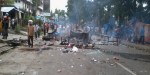
From early morning the atmosphere was tense: from about 07.00 to 09.oo [Papua time] groups of local people could be seen moving to blockade various major road intersections in Manokwari Town.  Primary official routes like Jl. Yos Sudarso, [near Sanggeng in front of the Bank Mandiri, Bank BRI and Bank Papua complex] as far as the three-way intersection on Jl. Merdeka & Jl. Gunung Salju [Makelew Fanindi complex] were blocked by mobs using wood, old tyres set on fire, tables, and tree branches, all thrown on the road. Various intersections of roads heading out to the residential areas of Fanindi beach [beside the Swissbel Hotel], Arkuki [beside the Bahagia store], Sanggeng market, and Jl. Serayu Sanggeng were blockaded by a populace brewing with anger.

While the atmosphere in Manokwari has been tense there has never been any trouble between groups in civil society or between the local community and the security forces. Several witnesses said that ‘people are very emotional, they are making these protests because of the shooting of Timo Ap’. The police secretively shot and killed Timo Ap, and then took his body to his house in Wirsi, Manokwari.

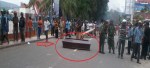
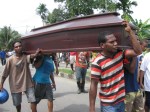
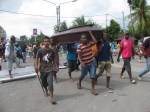
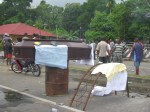
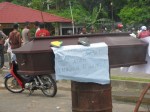
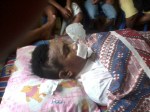
All Photos: LP3PH/West Papua Media

Chronology

A chronology of events has been put together as follows, from various civilian sources including the family of the victim Timotius Ap:

1)      More than 3 days ago the victim Timotius Ap, grandson of the late Timotius Ap, [former area head of Wirsi complex in West Manokwari], returned from Java to Manokwari: in Java he had been staying with family and working as a Marine;

2)      Timo Ap returned home to Manokwari with his wife Iwanggin;

3)     Timo was rarely present at the Wirsi house, he was mostly elsewhere due to being on the DPO [Wanted List], related to various cases that the Police accused him of;

4)     On Tuesday, 4 December 2012, as morning was turning to midday, Timo Ap was hanging out with his friends at Wirsi and wanting to eat areca nuts [?] but after eating them, his friends cannot account for his whereabouts;

5)     By the evening of 4 December, at around 09.00 Papuan time [21.00?] Timo was received and treated at the Dr Azhari Hospital [Navy Hospital] Manokwari;

6)     Around 10.00 [22.00?] Papuan time on 4 December, a friend of the family brought a message to Timo’s aunt Nelestin Ap, to ‘please come to the hospital to see Timo, whether he is still alive or already dead’. So then Timo’s aunt and other relatives hurried to the Navy Hospital but on the way they passed police and medical vehicles taking Timo’s corpse home to his grandmother’s house at Jl. Simponi Rindu, Wirsi, West Manokwari;

7)     On arriving at the house, there was only the victim’s grandmother, in her 70’s, living alone. She had no idea that her grandson’s body was being brought to her house. ‘The employees bringing in the corpse said nothing at all to the grandmother’, and then those employees just left the coffin there and went off;

8)     After several minutes the aunt and several of the victim’s loved ones arrived, or came back from the hospital and cried hysterically upon seeing the body wearing only underpants and a clean T-shirt that he had been dressed in. His friends said that he had no other clothes apart from the clean T-shirt and underpants he had been dressed in. At the hospital he had been wrapped up in bandages around his chin and neck as though he were injured, but there appeared to be no injury to his neck, chin or head in general. His only wound was discovered to be on his stomach near the centre, where a surgical incision to remove the projectile [bullet] had been stitched up.

9)     By 11.30 the news had started to spread widely, that the victim Timo Ap had been shot dead by Police, and the local community began arriving to pay their respects and condolences.

10)  In the morning at about 06.00 [Papua time] various family members began blockading the route into Wirsi [Jl. Simponi Rindu]. Blockades then spread to various road junctions in Manokwari, while the local daily paper MEDIA PAPUA released in its Headline news that Timo Ap had been shot dead by the OPNAL [Professional Operations Team] of Polsek [Police sector] Manokwari town at Maripi beach, South Manokwari district at about 16.00 Papua time. This was due to his opposing the officers with an improvised pistol; he was killed with a shot to the head;

11)   From around 07.00 to 09.00, Papua time, the community closed off the main roads of Mankwari such as Jl. Yos Sudarso, Jl. Merdeka, the route to Sanggeng settlement, Jl. Siliwangi, Jl. Soedjarwo Condronegoro [?], Jl. Gunung Salju [heading to Ambun];

12)   At the same time, activities in Manokwari came to a complete standstill. The business centre, Hadi department store, Orchid Swalayan, the market, stalls and shops were closed en masse by their owners. Offices also shut their doors – the Manokwari Regency Government office of West Papua province, schools, banks: from early this morning until mid-morning as this report is written;

13)  At 10.00 Papua time, large groups began violent action, smashing shops along the length of Jl. Yos Sudarso and Jl. Merdeka as far as Jl. Siliwangi. Tens of buildings along the road suffered quite serious damage, and many cars and motorbikes were wrecked by the mob;

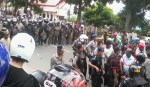
14)  Around 12.00, as the mob moved towards the town centre right in front of the West Papuan governor’s office, patrols of Brimob [mobile brigade], Dalmas Polres [area police] backed up with Indonesian Army forces were seen closing off the intersection that the crowd wanted to pass;

15)  A local man, Demianus Waney held a megaphone in front of the security forces, asking the crowd to disperse and go home…. ‘I say go home’… said Demianus Waney….. but hearing those words, the crowd became more worked up. In the process of their demonstrations against Demianus Waney, a number of buildings, restaurants owned by transmigrants around the harbour and PT Pelni [national shipping line] became targets of their anger;

16)  The police, Brimob and TNI [Indonesian army] started to rush forward but were stopped by an attempt at negotiation by a priest, who said he had been the victim’s priest [i.e. Timo Ap who had been shot and killed]. However at the same time Demianus Waney said that every avenue had been tried already, inviting the armed forces to action;

17)  The security forces then moved forward to break up the crowd. The police, Brimob and soldiers using trucks, paddy-wagons and Barracuda vehicles moved rapidly to take over the main road that had been controlled by the mob;

18)  Around 13.00, Papua time, the situation had become calm and back to normal.

Create a website or blog at WordPress.com

Up ↑