Papuan Prisoner of Conscience Filep Karma in Jakarta for Medical Treatment

This slideshow requires JavaScript.

Press Release – Karma family

Papuan Prisoner of Conscience Filep Karma in Jakarta

for Medical Treatment

Jakarta, Indonesia [27 September 2012].

Filep Karma, a political prisoner of conscience from Papua, has attended a two-week medical treatment in Jakarta hospital and now is back in the Abepura prison in West Papua. He arrived in Jakarta on September 14 and took a colonoscopy treatment in PGI Cikini hospital, Jakarta.

Indonesian physicians in Jayapura, who earlier examined Karma with simple equipment, suspected that he has a colon tumor. As it is not possible to conduct a colonoscopy in West Papua the physicians referred him to the hospital in Jakarta.

Karma was imprisoned in 2004 and is serving 15 years in prison for participating in a peaceful independence demonstration and for raising the Morning Star flag, an important Papuan symbol of independence.

The UN Working Group on Arbitrary Detention declared him a political prisoner in September 2011, asking the Indonesian government to immediately and unconditionally release Karma. The government, however, denies the existence of “political prisoners” in Indonesia. His injuries were sustained from acts of torture inflicted on him while in prison. He also injured his hip during a falling in 2006.

It took nearly six months for Karma to be able to be transferred to Jakarta despite this referral. Abepura prison officials, under the Ministry of Law and Human Rights, have refused to cover cost of his medical treatment and travel. The Indonesian government’s refusal to cover his costs is in direct contravention of national and international law.

According to United Nations Body of Principles for the Protection of All Persons under Any Form of Detention or Imprisonment (Principle 24), and Indonesian law (Regulation No. 32/1999 on Terms and Procedures on the Implementation of Prisoners’ Rights in Prisons) it is required that all medical costs for treatment of a prisoner at a hospital be borne by the State.

Despite the Abepura prison authorities recently giving permission for Karma to travel to Jakarta, they still refuse to cover the cost of his medical treatment and travel. Funds have been raised through donations from the Prisoners of Conscience Appeal Fund (London), Rev. Socratez Yoman’s church service (Timika), STT Walter Post (Jayapura) and many individuals.

Not only Karma, there are seven political prisoners in Papua with variety of illness. They are Apotnagolik Lokobal (stroke); Ferdinand Pakage (stroke); Forkorus Yaboisembut (impaired vision); Kanius Murib (memory loss); Kimanus Wenda (hernia);  Jefrai Murib (stroke);  and Yusak Pakage (indigestion).  Karma urges the Indonesia government should release all political prisoners immediately and unconditionally and give them the proper medical treatment.

(Note from Andreas Harsono/ HRW: Note: Filep Karma finished his medication on Tuesday and returned to Jayapura Wednesday night. He has arrived safe and sound in Jayapura Thursday morning. But he’s back to his Abepura prison. A number of family members, assistants and friends helped his hospitalization in Jakarta.  I am sending you some photos from his medical treatment in Jakarta as well as the airport departure in Jakarta. His sister Margaretha, daughter Audryne (and her boy friend), assistants Cyntia Warwe and Soleman travelled with him back to Jayapura.


This slideshow requires JavaScript.


The Coverage of Gunfire in Nabire is Public Deception

Tabloid Jubi

September 25, 2012

by Victor Mambor

Jayapura, (25/9) The coverage about gunfire between police and armed civilian groups in Urumusu, Nabire Regency on Monday (24/9) that was reported by national and local media, has been described as ‘public deception’ by human rights activists in Nabire. A resident called Kristian Belau/Zonggona, named by police, was shot in the gunfire.

This allegation of public deception was asserted by the Nabire Kingmi Klasis Church Bureau of Justice and Peace in a chronological report of events received by tabloidjubi.com , on Tuesday (25/9). The Bureau of Justice and Peace of the Nabire Kingmi Klasis Church, which undertook an investigation into this incident says that this was actually a case of police shooting the victim, Kristian Belau/Zonggonau, because of road-blocking elated activity on the Interior Trans-Nabire road, not because of gunfire between police and armed civilian groups.

From the chronolgy collected by the Bureau of Justice and Peace, on Tuesday 25 September 2012, at approximately 6:00am CDT, a group of Moni Youth were road-blocking on the roadside of the Interior Trans-Nabire Road next to the Wadio Atas Elementary School, Gerbang Sadu Villiage, in the West Nabire District of Nabire Regency. Unfortunately, when these young people stopped an Inova type car that was heading inbound and requested money from the passengers, it turned out there was a police officer in the car. The police officer then fired into the air three times, which made all the Moni youth run to safe themselves. But three other Moni youth used a motor bike to travel to the rubbish dump in Wadio Atas and continued their road-blocking actions. The police officer that fired the shots directly reported to Nabire Police District Command (Polres) that there were people carrying out road-blocking in Wadio Atas.

Kristian Belau lying down awaiting the operation to remove the bullet

After morning assembly, police from Nabire District Command took one track heading towards Wadio Atas and checked a spot that is often blocked. Upon arriving at the rubbish dump in Wadio Atas, Gerbang Sadu Villiage, Nabire West District, police met with the three Moni Youth. When the police attempted to arrest the three, two escaped. However, one of them, Kristian Belau/Zonggonau, instead advanced towards police. At the time, Kristian Belau/Zonggonau is suspected of being drunk because all night he was drinking heavily. When he advanced towards the police officers, he was shot in the right thigh. Kristian was then lifted to the police patrol car to be taken to the Siriwini Hospital Emergency Room, Nabire. Currently, the victim is in custody at Nabire Police District Command for questioning. According to several citizens in around Gerbang Sadu villiage, road-blocking on the Interior Trans-Nabire Road happens every night. It has been occurring for quite a while. Although police have repeatedly arrested road-blockers, there still are those who road-block. Usually every vehicle that travels inbound is billed according to the type of vehicle. Taxis are billed RP 50,000, private vehicles are billed RP 50,000 and trucks are billed RP 100,000. This issue makes the police angry, to the point that they carried out the shooting of Kristian Belau/Zonggonau.

In the reporting that followed, police said they could not avoid exchanging fire with armed civilian groups in the mentioned location. ‘Because a member was shot, in the end returning fire could not be avoided, one person of the armed group was named Kristian Belau/Zonggonau was shot in his left thigh. Other members of the armed group successfully escaped into the forest whist continually firing at police with revolvers and SS1 type guns’, explained Lieutenant Colonel Gede Sumerta to tabloidjubi.com (25/9),

Based on the investigation carried out, given to tabliodjubi.com the Nabire Kingmi Klasis Church Bureau of Justice and Peace disputes the police explanation. According to them, statements of gunfire between police and armed civilian groups that use revolver and SSQ type weapons is information that has been distributed by irresponsible parties and constitutes public deception. ‘Gunfire between police and armed civilian groups that use revolver and SSQ type weapons is an announcement that is irresponsible and public deception’, said Yones Douw, an activist from Nabire Kingmi Klasis Church Bureau of Justice and Peace to tabloidjubi.com (25/9).

‘Because the Urumusu location is far from the Interior Trans-Nabire road, entering Topo District, Nabire West Regency, a distance from the incident of approximately 45 kilometres. This morning, our human rights activists met with Kristian’s elder sibling and the Moni community in Wadio Atas. They said their children (the three youths who were road-blocking) do not own weapons. If they get drunk and road-block, it’s possible’, continued Yones Douw. (Jubli/Victor Mambor).

a policeman with his weapon guards Kristian Belau

Kristian Belau awaiting operation

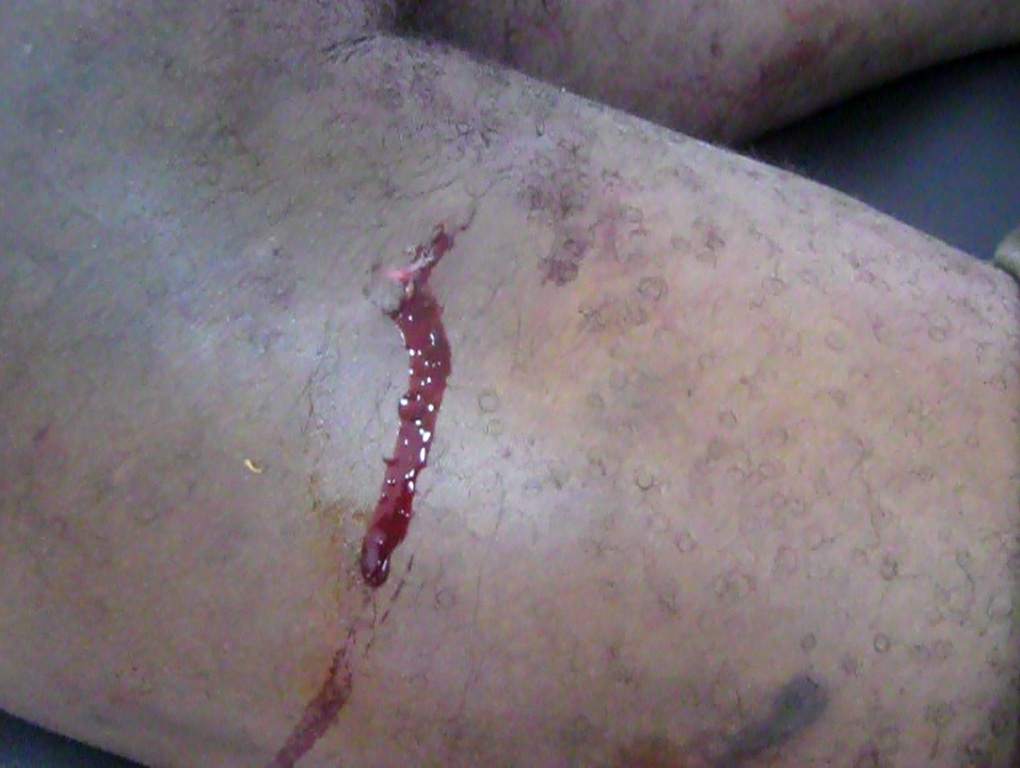
right thigh hit by bullet

Journalists face difficulties when trying to report about the trial of Buchtar Tabuni

JUBI
25 September 2012[Photo at the top of the report shows several of the police on guard, all of whom are heavily armed.]

The police who guarded the courthouse during the trial of Buchtar Tabuni made it difficult for some of the journalists wanting to cover the case to gain access to the court.

Benny Mawel of JUBI said: ‘I showed my press card but the police  insisted that I open my bag and take everything in it out for them to examine’ He said that access to the court had been made difficult.

Journalists were interrogated and the police demanded to see the contents of their cases. ‘This happened not only to me but to other journalists,’ said Benny Mawel, ‘even though we had clearly displayed our press cards.’

This did not happen during the earlier hearings of the trial.

A journalist  from Papua Pos Daily, Rudolf,  also said he had been heavily investigated. His bag had also been searched. He said that before entering the court, he hung his press cord round his neck but even so, the police examined the contents of his bag.

While on the one hand regretting the  measures taken against journalists by the police, Viktor Mambor, chairman of the Jayapura branch of the Alliance of Independent Journalists, AJI. said he hoped that journalists would understand what the police were doing.

”They certainly acted excessively and this should not be necessary this if journalists have clearly shown their press cards. But at the same time,’ he said,  ‘I could understand what they were doing because during an earlier discussion I had with the chief of police, there was concern about the fact that the credentials of some of the journalists were suspect because of recent indications about the involvement of certain pressmen in the recent violent conflict  in Papua.’

He went on to say that some time around July this year, a journalist had been interrogated by the police because he had reported that the Morning Star Flag had been flown on some occasions. In Papua, such reports only complicate matters because it stigmatises people, thereby legitimising excessive measures taken by the security forces. As Papuans, we have to understand this,’ he said.

Translated by TAPOL]

IHRC Media Release: Indonesia Human Rights Committee applauds NZ Superannuation Fund decision to divest from Freeport McMoran on ethical grounds

PRESS RELEASE
Indonesia Human Rights Committee,

 26 September 2012

IHRC is delighted that the NZ Superannuation Fund has decided to pull its investments from the Freeport McMoran mining giant. (NZ Superannuation Fund Media Release 26 September, 2012. )

‘We have been campaigning for the Superannuation Fund and other Crown Financial Institutes to divest from Freeport for six years and we know the news will be welcomed the West Papuan people who have been campaigning about the mine’s impact on their communities for decades.’

‘The Norwegian Pension Fund divested from Freeport several years ago on environmental grounds, but the NZ Superannuation Fund has stated that the breaches of human rights by the security forces were the critical factor in their decision making. So this is an advance.’

‘We intend to call to the Super Fund Offices in Auckland on Friday to make a personal acknowledgement of this important step.’

Freeport has been directly or indirectly responsible for gross human rights abuses in West Papua since it was first granted a highly favourable contract to exploit gold and copper in the days of the Suharto dictatorship.  These abuses include torture, illegal detentions, and killings.   These days the area close to mine is no-go area and an area where the Indonesian security forces rule the roost.   Shooting deaths are regular occurrence on the access road and last October police killed a miner and injured several others who were carrying out a lawful strike.

According to Rev Socrates Yoman a leading human rights advocate Freeport is like an ATM for the security forces – when there is conflict they can be sure of money.

The mine has destroyed a mountain considered sacred by the indigenous Amungme people and displaced thousands, destroying their forest-based subsistence lifestyle in the process.  Local people live below the poverty line- only Jakarta and the mining magnates get the wealth from the enormously profitable mining enterprise.

Freeport uses a system for disposing of the mine waste tailings in the river system -outlawed almost everywhere else in the world.   Over 200, 000 tonnes of waste a day are deposited in the river leading to the creation of vast dead zone where nothing grows.

For further information; Maire Leadbeater; 09-815-9000 or 0274-436-957

Buchtar Tabuni sentenced to eight months; tight security round the courthouse.


Bintang Papua
24 September 2012
The former chairman of the KNPB – National Committee for West Papua – was sentenced to eight months in prison, having been charged with inflicting damage on the prison where he was held. The sentence was  less than the demand of the prosecutor who wanted the accused to be sentenced to one year. The eight month sentence will be reduced by the time the accused has already spent behind bars.Aggravating circumstances were that he had previously  been sentenced and that his actions caused anxiety among the people, while the mitigating factor was that he had behaved politely in court.

Following the announcement of the verdict, the defence team said that they had not yet decided whether to launch an appeal against the sentence. ‘We are still thinking about how we will respond,’ said Gustav Kawar.

The defence team said that the sentence was light and the accused should have been released. However, according to Gustav Kawar. the panel of judges had  given him a sentence as the result of external interference.
———————

Bintang Papua, 25 September 2012

After further consideration, the defence team said that the verdict had not been decided independently and had been seriously influenced by the authorities, Gustav Kawar told  journalists. This influence had come from the security forces, that is to say the army and the police This was the factor that had caused the judges to hesitate before reaching their verdict. There were also doubts because of the fact that the testimony from several of the witnesses was contradictory. Nor had it been proven that the accused had been acting  in consort with others.

According to Gustav Kawar, the Criminal Procedural Code (KUHP) stipulates that  if  any element in the charge has been proven to be invalid, the entire charge must be declared invalid. The accused as well as his defence team said that they would consider what to do in the coming seven days.

Security measures round  the court

On the day the verdict was announced, around 230 security forces from the local and district forces, including personnel  from the police intelligence unit, Brimob  were among those standing guard.

The chief of police said that several  elements of the security forces had taken part in security at the time of the various hearings.  He asserted that  they had discovered sharp weapons among the crowd of people outside the courthouse following the earlier hearings but after measures had been taken, this did not occur during the latter hearings.

[Translated by TAPOL]


Create a website or blog at WordPress.com

Up ↑