DPRP condemned for failing to keep its promises

JUBI, 12 May 2011

DPRP never keeps its promises

The chairman of Papuan Anti Militarism Solidarity, SRPAM, Elias Petege,
has called the DPRP, the provincial legislative assembly, a body that
always breaks its promises. So no one should be surprised that many of
the people’s aspirations have not been met. He said that to this day,
the DPRP has failed to keep its promise to meet the SRPAM in order to
discuss ways of solving the violation of human rights in Dogiyai.

‘Yesterday the DPRP accepted a request by our demonstration and promised
to meet us today but they didn’t keep their promise, without explaining
why.’

Petege said that during an action that took place yesterday, 11 May,
SRPAM called on the chief of police to dismiss the chief of police in
Papua, the chief of police in Nabire and the chief of police in
Moenamani because they had done nothing to halt the gambling that is
believed to have the support of the police in Moenamani.in the
sub-district of Dogiyai.

As a result, a fight broke out between the local police and the local
community during which several members of the community were killed.

The DPRP was also called upon to immediately mediate between the two
sides in order to solve the problem. Via the intermediary of the deputy
chairman of commission A, the DPRP promised to hold a meeting with
SRPAM to discuss measures that need to be taken, but unfortunately this
turns out to have been nothing more than lip service.

In the opinion of Petege, the DPRP is simply not bothered about the
matter and has failed to respond to the aspirations of Papuan people.
The DPRP just allows human rights violations to go on happening in Papua
without lifting a finger,’ he said.

‘We feel very disappointed indeed and have lost all confidence in the
DPRP. Just imagine, we arrived at their office at 9am and stayed there
until 3pm, but there was no one at all at the office and no one there to
explain why they were absent.’

Hana Hikoyabi formally challenges interior minister for rejecting her membership of the MRP

From Bintang Papua 1 May 2011,[Abridged in translation by TAPOL]

By Hana Hikoyabi

Although I was elected democratically as a member of the MRP – Majelis Rakyat Papua – from election constituency 1 and my election was confirmed by the  the district chief and the governor, my membership has been rejected by the Interior Minister, like someone who has been found guilty though nothing has been proven in a court of law, I wish herewith the challenge the minister’s decision which is quite without any justification.

I fully conformed with all the procedures as required. including police requirement, for the district  of Jayapura district, the Keerom district for the period 2011 – 2016.

According to informed from the MRP secretary I was referred to  as being  a person not suitable for membership because I do not conform with the requirements.

According to government decision 64/2008, anyone whose membership is not acceptable can seek clarification.

I object to the decision of the interior minister to the effect that the membership of Dra Hana Salomina Hikoyabi and Drs Agus Alue Alua cannot be confirmed as members. as we do not conform with the requirements under article 4 (c), (d)  and (h). This article  says that members must be loyal  to the  Pancasila and have a strong commitment  to protecting the community and loyalty to the Indonesian Constitution, should be a person of high moral standing and be a model to the community.  and has not been found guilty of anything under law. These requirements are set down clearly under law.

According to PP54/ 2004 regarding the MRP,  the person shall not have been found guilty in a court of law for committing a crime and receiving a sentence of five year or more.

In accordance with the above,  it is clear that the decision to reject my appointment as  member of the MRP is in conflict with the law, because it is not based on any court verdict.

This places me in the difficult position of  having been responsible for an act of treason – makar – whereas at the time that I nominated myself for member of the MRP form 2011 – 2016, I received an official confirmation from the local police and from the local court of law that I am well-behaved and have never been found guilty of anything or convicted of anything

The minister’s decision means that the statements issued by the police and the Jayapura district court are unlawful. It also means that the administrative procedures regarding personnel cannot be relied upon as the way of handling the governance. in accordance with the rule of law.

[Note: The MRP consists of Papuans from three groups, women, youth and traditional clans.]

The hope for Papua’s freedom: ‘Go International’

image

Apologies for delay in posting

Tuesday, 03 May 2011 19:58

Editor : Markus

Tabloid JUBI — The struggle of the native people of Papua for freedom from all the evils they have suffered since their annexation into the Unitary Republic of Indonesia on 3rd May 1963, still echo to this day, not only on the local and national scene, but already internationally.

“At this time, our hopes for freedom for the People of West Papua depend on the support of the world. Privately and through our own organisations we are struggling, but now we have the help and sympathy of all the countries of the world,” said the Head of the National Committee of West Papua, Mako Tabuni, on Tuesday 3rd May 2011.

Support from the international world is growing and becoming stronger,for example from Israel.  This is a long campaign, and this is the way to do it – by gaining friends. “The problems of West Papua are also world problems, and Indonesia has to open itself up to recognise the truths of its history, of what happened some decades ago,” said Mako.

The formation of  two  bodies called International Lawyers for West Papua (ILWP) and International Parliamentarians for West Papua (IPWP), said Mako, came about as a result of the world’s notice and support for West Papua. ‘We are being well supported by the ILWP and the IPWP, which are fighting for the fate of West Papua.”

He said this as on the day after Monday 2nd May, when thousands of people had marched peacefully to assemble at the Post Office in Abepura, Jayapura.

The KNPB (National Committee) had emphasised several important points which are tied to our history, status and the sad fate of the people of Papua.

Firstly, the people of West Papua have not, did not nor ever will give their consent to join the Unitary Republic of Indonesia (NKRI) to become a part of their republic, West Papua.

Secondly, the process of making West Papua part of the NKRI, beginning in 1963 and finishing in 1969, organised jointly by Indonesia, United States of America, the Netherlands and the United Nations, was engineered as a false process, not following the Principles of international justice. The owners of the area of West  Papua were never involved in the process, and the international talks and arrangements took no account of their wishes.

Thirdly, the agreement called “The New York Agreement” was not supervised by the whole of the United Nations, resulting in the “referendum” of 1969, where the people of West Papua were not given their political right to vote on the basis of “one person, one vote”; this “vote” consisted of only 1025 people chosen by Indonesia to “represent” West Papua. This is a violation against the political rights of the people of West Papua.

Fourthly, NKRI has killed and destroyed many of the native citizens of West Papua since they began their DOM (Local Military Operation) to take up possession of the land of West Papua in 1963.

Fifthly, NKRI has pursued, intimidated, terrorised and killed many of the citizens of WP since this operation began.

Sixthly, Special Autonomy was offered as a solution to these problems. This policy was never really implemented as promised and published as policy by Indonesia.

Seventh, the only thing which is supporting Special Autonomy, which is the one thing the NKRI is offering, is part of their colonisation of Papua which nullifies the political rights of the native people of Papua, because the foremost problem for them is their right to determine their own future for themselves, which has been suppressed and undermined by the unilateral annexation of Papua through the so-called Act of Free Choice of 1969.

“We do not recognise the right of the Government of Indonesia, and all the institutions of that country, to stand in the nation of West Papua,” said Mako Tabuni, reading from a petition which had been signed by the whole assembly which had attended the march.

What we, the KNPB, are demanding is, firstly: that Indonesia stop all political manoeuvres using the Special Autonomy, formation of the MRP and the UP$B program in the land of West Papua.

Secondly, Indonesia and West Papua be the subject of an international legal process so that the political status of West Papua can be brought to the table at the International Cpurt, to determine a just policy about the validity of Indonesia’s annexation of the land of West Papua, and a justice for the people of West Papua.

Thirdly, in order to determine the will of the people of West Papua, a Referendum be held in a democratic way by the United Nations, to find a final solution to the political conflict in West Papua.

To find a framework to support this process to end the problems in West Papua via an international legal and political process, the KNPB puts forward the name of  Ms. Melinda Janki as Head of the ILWP, Mr. Charles Foster and all the members of the ILWP.

Also,  Mr. Andrew Smith as Head of the IPWP, Mr. Caroline Lucas together with all members of the IPWP to support the political process to bring the matter before an  internasional forum, together with the support of a free Papua. Also, the Government of the Republic of Vanuatu, as a member of the United Nations, also gives a similar mandate  to determine the legal status of West Papua through an international legal process at the International Court of Justice.

At the same time, the Spokesperson of the International KNPB, Victor Yeimo, can be a representative and coordinator to express the hopes and expectations of the people of West Papua. For this to happen, we need to form a representative body: a National Council of West Papua.

“It is not just anyone, it is the people of Papua alone who can bring about freedom. So, let us, the people of this land, come together and work and struggle,” said Yeimo.

About twenty Papuan representatives who addressed the assembly signed a petition before the demonstration ended at about 6 pm.

 (Markus)

The Arab Spring: a harbinger for a “global spring” against oppressive rule?

(published with especial relevance to West Papua)

by Edmund McWilliams

Democracy, respect for human rights, good governance – these are the themes that have been on the lips of peaceful demonstrators from the Mediterranean to the Arabian sea.

In country after country, Arab men and women, young and old have showed extraordinary courage, facing down dictators and autocrats even when those corrupt leaders have employed the full weight of their armed forces against the unarmed protesters.

The Choice of Papuan People (Photo courtesy KNPB)

The inspiration of one young Tunisian who sacrificed himself in protest has spread from one Arab nation to another, in each country people coming to the profound realization, ‘if they can do it there, we can do it here.’

The largely peaceful demonstrations have not had an Arab or a Muslim character. Rather, common to all these peaceful revolts is a pent up desire for freedom and a new sense that change is possible.

We have seen similar uprisings which have swept vast areas:  the East European spring in the late 1980’s; the anti-colonial movement that followed World War II.  These, like the “Arab Spring” were trans-cultural, and transnational.   They derived their power from a common frustration with abusive, and sometimes foreign rule and a conviction that, in the words of the revolutionary mantra, “a people united can never be defeated.”

So we are left with the question of whether this movement will be confined to
Arab peoples, and largely to Muslims.  Or will this struggle for democracy and respect for human rights extend to non-Arab and non-Muslim cultures and peoples who also have suffered under brutal rule?  Will Tahrir square be emulated in Beijing, in Tashkent, in Hanoi, in Vientiane, in Rangoon and Pyongyang.  Will the Papuans, Montagnards, Hmong and Karen draw inspiration from the “Arab Spring” and break the colonial chains that have enslaved them to demand genuine autonomy or even full independence?  The physical and cultural distance separating Papuans in the Puncak Jaya or Hmong in Phong Saly from the “Arab Street” may seem to place them
in different worlds but they have a common experience in their suffering under undemocratic rule.

Is the “Arab Spring” a harbinger for a “global spring” that challenges oppressive rule around the world? For now, we can only assume that autocrats around the globe are sleeping more fitfully.

May their nightmares come true.

Edmund McWilliams
Retired senior U.S. Foreign Service Officer

SONAMPMA: Photo Report of Show of Support by Papuan people for Referendum

Port Numbay,  Papua.

from National Organisation for Student Solidarity of Papua.

 Peace and Freedom !

 We are reporting on the  Demonstration of the People of Papua demanding a Referendum about Self-determination on May 2, 2011 ; for the people of Papua to have the right to determine their own fate. The demonstration took place at the Post Office in Abepura, Jayapura, as shown below :

 – The Show of Support by the people of Papua was coordinated by the National Committee of West Papua, made up by the following organisations :  Organisation of Students and Youth, DAP, Women, Religions, Intellectuals of Papua, and the whole people of Papua from this area. They marched from Sentani, through Waena and Abepura, towards Jayapura (Imbi Park), starting at 8 am.

This slideshow requires JavaScript.

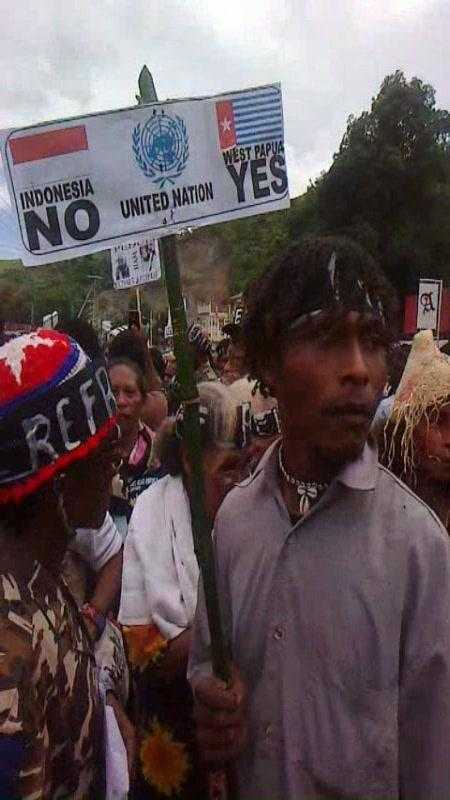
While waiting for the people to arrive from Sentani, there were political speeches from the coordinating body, and from several support organisations , all carrying street banners, leaflets and pamphlets, attracting the close  attention of the security forces, there to  « keep the peace », also tried to obscure some of the pictures.  Some of the banners  were saying :  Some of the leaflets said « Papua, Yes ; Indonesia No. », with each of their flags illustrated. Others said « Referendum » and « Papua Merdeka ».

 –          At another coordination point (the campus of USTP) that morning a group began to gather in front of the campus gateway fronting onto Jalan Raya, Sentani, while others came from the campus of UnCen-Abepura. They had banners saying REFERENDUM. There were speeches and the people began to move towards the main square of the campus.

 –          A large group of people assembled at Imbi Park in the early morning, not to avoid observation, because there were thousands of people already assembled there.

 –          About 5 or 6 detachments of Police from Jayapura were there and 3 units of Brimob (mobile police), observing the demonstration with some bodyguards, using 7 or 8 trucks and other vehicles, some of them equipped with weapo

–          Speeches went ahead until about noon, with 600 people who had arrived from Sentani began to assemble at Expo Waena. The whole procession gathered there were about 1000 people, preparing for the Long March to the Post Office at Abepura.

 –          The Long March began at 1 pm, and proceeded towards Abepura.  At the TNI  post at SIPUR, the demonstrators were surprised by an escort of Mobile Ambulance, together with a group of TNI (Army), fully armed, who accompanied the demonstration.

 –         Mass action continued its long march to the Central (shopping) centre , Post Office-Abepura escorted by security parties mentioned above.

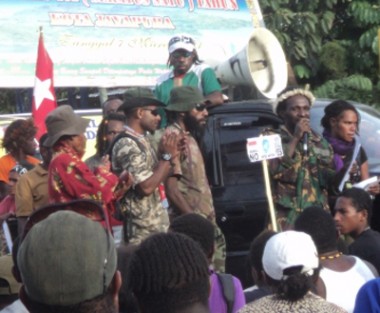
–          There were speeches, which were answered by cries of « Referendum » and « Papua Merdeka ».  They stopped at the traffic lights at the Post Office at Abepura and began to sit on the road. All other activities in the town were halted and the town closed down early.

–          The total number of people eventually numbered about 2000 to 2,500. At about 2.15, the procession from Jayapura began to arrived and gathered together with the others at the Post Office.  The numbers swelled even more. The demonstrators stayed at this place, and listened to speeches from some of the leaders of the different groups representing the protestors.

– This demonstration was carried out peacefully until 6 pm, helped by vehicles which helped to keep the peace,   dispersing the people peacefully,  after which they resumed normal economic activities on the streets.

– The demonstration today, after marching well with vehicles and on foot, went off well and peacefully without any violence.

This report that we have made is completed by the Organising Committee for the Demonstration, 2nd May 2011, with great care, and we thank you for reading it.

SONAMAPA

Create a website or blog at WordPress.com

Up ↑