West Papua's Independent Human Rights Media

Posts tagged “POLRI

Paniai sweeps intensify misery under Indonesian control as security forces ban music and torture priest

by West Papua Media

March 6, 2013

Local residents in Paniai regency are bracing for more repression in sweep operations by Indonesian security forces after two separate incidents across the Paniai have intensified ongoing crackdowns on West Papuan independence sentiment, torturing a  local priest and even banning the possession of traditional music.

The latest crackdown, imposed in Paniai after guerrillas from Paniai commander Jhon Yogi’s Paniai unit of the West Papua National Liberation Army (TPN-PB) were involved in armed engagements with the Indonesian army (TNI) and Police throughout February .

Reliable human rights sources in Paniai have reported to West Papua Media that an influx of joint TNI and police have “arrived with total war equipment” to bolster sweeps and raids across Paniai against civilians accused of holding pro-independence sentiments.

“In order to confront the TPN PB and on orders from President SBY, a brigade of TNI / Police have arrived with total war equipment. There were drops of TNI/POLRI in Paniai on 3 March 2013. The brigade arrived by 7 ‘Inova’ vehicles via the coast road,” the source told West Papua Media.

Helicopters belonging to illegal gold miners in Degouwo were again being used by Indonesian troops to support the operation, similar to the massive offensive against Paniai people during 2011 and early 2012, according to both human rights and church sources.

“A yellow and white helicopter owned by an illegal business in Degouwo at 13.00 WPB (west Papua time) made two drops of personnel and logistical war equipment. The first drop was to the Enarotali airport in Paniai district, and the second helicopter drop of the brigade forces together with war equipment was at Obano also, in the west of Paniai district,” the human rights source told West Papua Media.

Independent sources are also reporting that Indonesian colonial occupation forces are putting massive pressure on local civilians, with routine violations of civilian’s dignity, and arbitrary strip searches, that have created opportunities for brutality and torture on local people.

The notorious battalion 753 from Nabire has erected scores of “state of emergency tents” every 5-10 kilometres along the main road between Nabire and Paniai, according to witnesses. “TNI are carrying out very strict checking of everything. The TNI from unit 753 are undoing the clothes of every passenger in the area to check them including females. Advocacy and monitoring is requested,” said the human rights worker.

Military Destruction of traditional culture amounting to cultural genocide
Papuan independent media outlet Tabloid Jubi  has reported remarkable accounts of the extraordinary measures Indonesian police commandos from Paniai police headquarters are taking to destroy traditional Papuan culture by banning music.

Father Saul Wanimbo, the Director of the Commission for Justice and Peace (SKP) in Timika diocese, told Tabloid Jubi that during police sweeps, local people are being forced to hand over their mobile phones.  They analyse the memory cards on the mobile phones to find songs in Papuan language, and if the memory card is found to contain either one or many Papuan folk songs, police will smash the memory card with stones, according to Fr Wanimbo.

“The police are sweeping HP (Handphone) memory cards of Enaro society (people) for the last two months,” Wanimbo told Jubi, citing his own experiences and stories directly from Enaro residents from 1-20 Febrruary 2013.  Wanimbo said that Paniai people have been so demoralised that they just accept the oppressive actions of the occupation forces.

Wanimbo said that the actions by Police were killing three values:  “There is destruction of cultural values, murder of the people’s creativity, and character assassination.”

“The situation is conditioned in such a way so that people cannot resist. How can the people fight if the area has a variety of (security force) members lurking there,” Fr Wanimbo told Jubi.  The police acts were morally and legally wrong, police could not arbitrarily violate people’s privacy for no apparent reason, and such actions must be done with a warrant, he said.

“Paniai Police must explain the meaning of this sweeps. Or the Papua Police chief must stop the actions of the Kapolresnya (local police command) men in Enaro. This is serious. We can say it’s the beginning of the genocide, ” he said.

Priest tortured by police who then demand bribe for his release

Meanwhile, again in the Paniai regional centre of Enarotoli, local human rights workers have documented a serious case of torture of a local priest.  According to human rights workers attached to the Kingmi church, at 8.30 in the morning on March 2, Reverend Yunus Gobai (55 years) was arrested, threatened and tortured by local and Brimob commando police at the Enarotali (Kapolresnya) police compound in Paniai district.

According to the report received and confirmed by West Papua Media, as a result of beating Gobai’s nose was bleeding, his upper and lower lips were split and  bleeding, and he sustained abrasions on his hands, swelling on his forehead and cuts on his head, after which he he was put in a cell at the Police Sector command (Polsek) in Enarotali.

Family members went to request his release from the Police station, but the Paniai police demanded a bribe or ransom money to free him, according to the report.  Family members reported they were forced to gather money in order to pay the police, and a Paniai member of the DPRD directly handed over to police one million rupiah (about US$103) at Polsek Paniai.  Reverend Gobai was then released at 1030am local time, and taken straight home to his village by his family, according to the report.

Rev Gobai is the former pastor and head of the council of the community of KINGMI Maranatha Nabire. According to his family, after Rev Gobai became pastor of the community he suffered from (an undefined) mental disturbance together with epilepsy.  Gobai’s family reported that he would regularly be seen “shouting for no reason or running around shouting”.

Reverend Gobai was arrested after exhibiting these symptoms outside the police station in Enarotoli, causing his arrest, but police did not treat the issue as an illness and used unwarranted torture and inhumane treatment on the pastor, according to the report.

(WPM Editor’s Comment: Whilst the KINGMI report uses unclear terminology describing the pastor’s behaviour as “mental illness”, often random outbursts of unintelligible shouting and psychotic visions are perfectly normal and accepted behaviour of Christian pentecostal pastors, Muslim imans, Hindu holy people, and almost all other religious leaders and clerics across human history.  To arrest and torture someone for this behaviour is to ignore the experience of humanity.)

Paniai is no stranger to unrestrained Indonesian security force violence and torture against local people, primarily made up of members of the Mee tribe.  Previous offensives in the  Paniai since December 2011 have displaced tens of thousands of civilians, and burnt down hundreds of villages.  Paniai was the scene of widespread military operations between 1963-1969, 1977-1978, and again in 1981-1982. During this period U.S. supplied Bronco aircraft were used to bomb villages while helicopters strafed Papuans with machine gun fire.

West Papua Media


KNPB: Regional Police Chief Must Wipe Clean ‘Wanted Persons’ (DPO) list

Tabloid Jubi

Editor : Victor Mambor

January 6th, 2013

A spokesperson for the West Papua National Committee (KNPB) has claimed that the detention of a number of KNPB activists and the addition of more KNPB members’ names to the Wanted Persons List has been done purely in the interests of the Papuan political elite.

Photo caption: Wim Medlama (in blue hat) with Hakim Pahabol, West Papua National Parliament member, and KNPB members during their press conference.

KNPB stated that the political elite, along with the Regional Police Chief, are trying to place the blame activists and the broader Papuan community [for the lack of democracy].

“Papuan police are suppressing democracy in order to favour the Papuan political elite. It is in the elite’s interest that the people of Papua are being victimised. Many members of society and of KNPB have had their names added to the Wanted Persons List,” KNPB’s spokesperson Wid Medlama said during a press conference on Saturday (5/1), at the Cafe Prima Garden, Abepura, Jayapura, Papua.

KNPB are urging the Regional Police Chief to free a number of KNPB activists and remove their names from the Wanted Persons List. “Clear the names of all KNPB members and activists from the wanted list, and free those detained without clear evidence,” Wim said.

According to the KNPB, the people of Papua wish to have the freedom to fulfil their aspirations and to go about their lives without anyone having to suffer. Space for the people to express themselves collectively must be made available by the government. Without this space, the government cannot talk about a ‘democratic country’ or a ‘democratic society’.

“A democratic space is needed for the people of Papua. Without it, there is no point in [calling ourselves] a democratic nation. What is the meaning of becoming a democratic nation if there is no democracy for the people?” added Hakim Pahabol, a member of the West Papua National Parliament.

(Translated by West Papua Media translators)


Police kidnap pro-democracy activist in Biak: Reports

by West Papua Media from human rights workers in Biak

December 29, 2012

Unconfirmed Reports have emerged from Biak that Indonesian armed police have disappeared local Papuan pro-democracy activist Anthon Kafiar.

At 15:00 local time on December 28, 2012, outside the offices of the Supiori Regent, several heavily armed police officers used pistols to accost and bundle Anthon Kafiar into a Four Wheel Drive Vehicle Type Avanza, numberplate DS 900 DD.  The vehicle then drove off, and Kafiar’s whereabouts remain unknown, according to local human rights worker Dorus Wakum, from NGO Kampak Papua.

It is not yet known if the police were local police officers, or roaming members from the Australian-funded special anti-terror Detachment 88 unit, whose members have engaged in a campaign of kidnappings and shootings against Papuan pro-democracy activists since the appointment of new Papua Police Chief Tito Karnavian, the former commander of Densus 88.

According to the NGO, Biak citizens and witnesses visited the Kapolres (local Police Chief), the Supiori Regent and Supiori Council members to demand that Kafiar be immediately found and released.

This is a developing story.  More to come.


KNPB: Police Chief’s Statement Has No Legal Basis

April 3,2012

by Arnold Belau for SuaraPapua.com

PAPUAN, Jayapura — The statement made by the Papua Regional Police Chief via the Deputy Regional Police Chief Brig.-Gen. Police Paulus Waterpauw in several media outlets on Tuesday (3/4), requesting that the Chair of West Papua National Committee (KNPB – Komite Nasional Papua Barat) Buchtar Tabuni take responsibility for protest action that was organized by KNPB on Monday (2/4), is evaluted to be without sound legal basis, and very premature.


This position was affirmed by KNPB (Vice-)Chair I, Mako Tabuni, who issued a statement to journalists at Prima Garden Café, Tuesday (3/4) in Abepura, Jayapura, Papua. In his statement, Mako clarified a few issues underlying KNPB’s rejection of the Police Chief’s reaction, given that from the start the Papua Regional Police failed to issue a letter acknowledging receipt of the notice for the action that was submitted by KNPB well in advance of the day of the demonstration.

“Papua Regional Police refused and did not issue a a Notice Receipt Letter, whereas we organized a peaceful demonstration featuring Papuan arts and culture, without violating the law of the Unitary Republic of Indonesia (NKRI – Negara Kesatuan Republik Indonesia), said Mako to journalists.

“Arrows and spears are part of the Papuan nation’s cultural toolkit, and even this was clearly stated in our notice letter to the Regional Police, so how does it make sense for them to see demonstrators carry these objects and then to ask KNPB to take responsibility?” said Mako.

According to Mako, since decades ago the legal system of NKRI has occupied the Papuan nation, and this is a form of modern colonization which the Papuan people know and understand.

For this reason, Mako continued, KNPB is legally guaranteed the right to demand a referendum in the land of Papua, because the presence of the Indonesian government in Papua does not accord with international principles and standards from a standpoint of law, human rights and democracy.

Because, continued Mako, “From 1961 to 1969 the status of the territory of Papua was included in the United Nations’ decolonization category”.

Mako also denied that by calling the Chair of KNPB the mass actions in Papua will be stopped.

“Go ahead and call the Chair of KNPB, or even decide not to issue a demonstration permit to KPNB, but we will still mediate the people of West Papua to convey their demands and actions by other means”, stated Mako who has in the past been a political prisoner.

Mako also regretted the coverage in a number of mass media outlets, which is consistently biased in its perspective, and always judges each demo action negatively.
“Coverage like that harms KNPB, and harms the people of West Papua, so we invite media in Papua to show some consideration”, asserted Mako hopefully.

Previously, yesterday, Monday (2/4) a mass of thousands responded to the KNPB call for a peaceful demo action to show support for the Nieuw Guinea Raad conference and launching of the Netherlands branch of IPWP (International Parliamentarians for West Papua) which took place Wednesday (5/4).

This event was coordinated by the Free Papua activist in Britain, Benny Wenda, and a group of international lawyers who are members of IPWP, with a number of Netherlands Parliament members in attendance.

ARNOLD BELAU


Shootings, village burnings and helicopter attacks continue across Paniai


SPECIAL REPORT AND UPDATE

by Nick Chesterfield at westpapuamedia.info

December 16, 2011

Harrowing accounts of terror and intimidation are emerging from villagers and human rights workers in the remote Paniai district in West Papua overnight, as a massive Indonesian military assault against National Liberation Army guerrillas continues.

Local human rights and church sources are reporting that ordinary villagers are being subjected to significant human rights abuses by a combined Indonesian police and military force, and have called for immediate international intervention in West Papua to stop the violence.

Over four full strength combat battalions of Indonesian army (TNI) Kostrad commandos from Battalion 753, Brimob paramilitary police, and elite counter-terrorism troops from Detachment 88 – all units armed, trained, and supplied by the Australian Government – were deployed in an offensive to surround the headquarters of the Paniai Free Papua National Liberation Army (TPN-OPM), under the command of General Jhon Yogi.

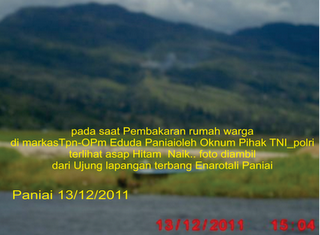
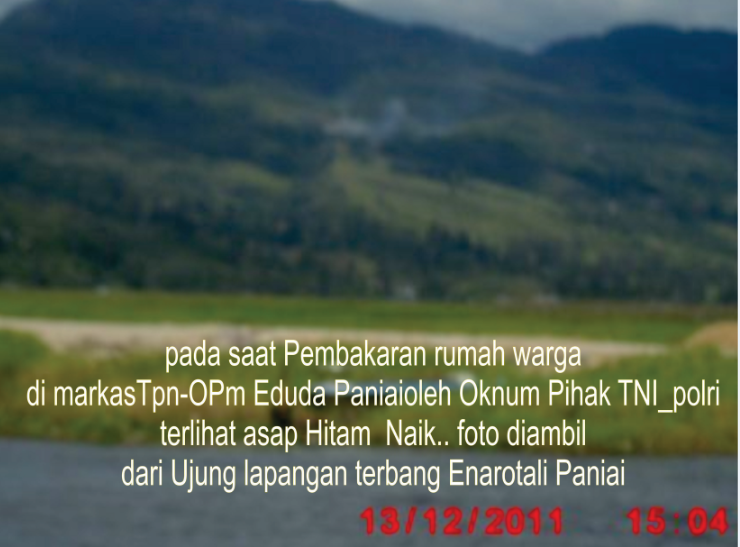
TPN/OPM headquarters Markas Eduda burning after TNI attack, 13/12/2011, Paniai, Papua

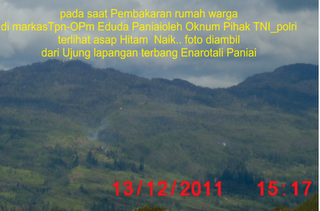
Paniai villages burning after TNI attack, 13/12/2011, Paniai, Papua

TPN/OPM headquarters Markas Eduda burning after TNI attack, 13/12/2011, Paniai, Papua

Punitive village burnings and raids are continuing in remote villages around the TPN/OPM headquarters of Markas Eduda.  At the time of writing, seventy-five houses, six schools, and about 25 other buildings have been recorded as burnt down in a total of 27 villages by Indonesian security forces.

Eighteen people are now confirmed dead – fifteen from gunshot wounds, and three refugees who allegedly succumbed to starvation in the so-called care centres under the control of security forces.  The victims’ names from the attack in Eduda are:

Dead:

  1. Tapupai Gobay (30) was shot in the chest.
  2. Tawe Bunai Awe (30) head crushed*.
  3. Uwi Gobay (35) was shot in the abdomen.
  4. Wate Nawipa (25) was shot in the back.
  5. Martinus Gobay (29) head crushed*.
  6. Owdei Yeimo (35) was shot in the back.
  7. Ruben Gobay (25) was shot in the abdomen.
  8. Paul Gobay (42) was shot in the abdomen.
  9. Bernadus Yogi (23) was shot in the chest.
  10. Demianus Yogi (15) was shot in the back.
  11. Simon Kogoya (40) was shot in the abdomen.
  12. Simon Yogi (30) was shot in the head.
  13. Luke Kudiai (25) was shot in the chest.
  14. Alfius Magai (20) head crushed*

Note:  those with “head crushed” allegedly sustained these fatal injuries through severe beatings with rifle butts and “boot stamping”, according to sources

Wounded:

  1. Paschal Kudiai (15) hit by a bullet in the head.
  2. Martinus Kudiai (30) was shot in the hand.
  3. David Mote (40) was shot in the thigh.
  4. Amandus Kudiai (43) was shot in the arm.
  5. Yohan Yogi (21) was shot in the leg.
  6. Mon Yogi (20) was shot in the back.

Credible reports have also confirmed that two civilian “company” helicopters were provided to Security forces, and were allegedly used to drop live grenades and chemical dispersal weapons onto villages surrounding Eduda, and strafe villages with sniper and machine-gun fire on December 13, 14, and 15.  Several independent witnesses have claimed to West Papua Media, and reported elsewhere across social media, that the helicopters are well known in the area for local non-military operations.

"Company" Helicopter alleged by local sources to be used in Indonesia security force offensive in Paniai. Source claims photo taken on Dec 13 aas helicopter was circling group. This photo is not independently verified, however analysis shows the image is consistent with independent witness descriptions, and the terrain and weather conditions are consistent with other photos supplied. (West Papua Media source)

Witnesses interviewed by local human rights workers have claimed that at 0800 local time on December 13, the Company helicopter launched CS gas salvos into the village of Markas Eduda, the TPN headquarters, to flush out villagers and guerrillas.  According to a separate account sent to West Papua Media by TPN/OPM sources, the helicopters landed troops and occupied Eduda for most of the day, with guerrillas taking to forests in retreat.  In retaliation, TPN/OPM fighters shot at the helicopters, unsuccessfully, and several hours of intense fighting ensued which was suspended when Free Papua fighters witnessed many village houses and schools being simultaneously burnt in the surrounding area.  According to the TPN/OPM source, villages were set on fire around Eduda and gunshots were heard for the rest of the day and through the night.  Free Papua fighters have retreated to the forest and are awaiting orders for their next moves, according to the source.

Villagers from across Paniai are continuing to be displaced by the operations, forced to flee en masse into areas around Enaratoli, on the opposite side of Lake Paniai.  As reported on December 14 by West Papua Media, over 131 villages have been abandoned causing at least 10800 Paniai villagers to flee the military operations.

Church sources have further reported that refugees seeking shelter in the Enaratoli area are enduring worsening conditions without any relief.  Armed Indonesian security forces have established a police supervised secure “Care Centre” at Uwatawogi Hall in Enaratoli, and have crammed into it 1715 people from Kopabutu and Dagouto villages.  According to local activists in reports to West Papua Media, local residents are being threatened with arrest and beatings if they try to provide detainees with adequate humanitarian relief.  Police are also preventing people held at the hall from leaving for food or sanitation needs, according to sources.  At the time of writing, three people have died at the “care Centre” since December 9 from Diarrhoea.  They are :

  • OTOLINCEA DEGEI age 2 years , died 8:20pm, 9/12/11;
  • YULIMINA GOBAI Age 4, died 3pm, 14/12/2011;
  • ANNA DEGEI Age 47, died 1030pm, 14/12/2011.

No food, sanitation or medical aid has been made available by any government agency to give relief to this large number of internally displaced people.

Over 9000 refugees are either hiding in the forest or seeking shelter with their own extended families in the region area.  Those with their families are considered safe, however their needs and conditions are difficult to monitor and assess given their isolation

Local teachers have also been in contact with West Papua Media’s stringers.   Since 27 November 2011, teaching and learning activities have been suspended indefinitely in all village schools surrounding Markas Eduda.  Schools such as SD YPPK in Badao Dei, Yimouto, and Obayauweta villages have been suspended, as has Primary, Junior High, “shop” (trade school) and Elementary Instruction in the towns of Dagouto, and Uwani.  The students of these schools have been evacuated with their parents.

A teacher in junior YPPGI Uwani said while repression was occurring in the villages that: “For while we have closed the schools, because school children are frightened and fled with their parents. In addition, we as teachers do not feel safe to make teaching and learning activities. All the teachers have fled Paniai district, and to Nabire. “

On December 15, the army / police battalions have returned to the villages of Uwamani, Dei and Obaipugaida to prepare a major attack for a new phase of the campaign.  It is believed strongly by local activists that the “company” helicopter will still be used in addition to   Unconfirmed reports have been received by West Papua Mediathat the Indonesian arsenal against civilians in Paniai includes one Mil Mi-24 SuperHind gunship, one of two usually stationed near Jayapura.

650 Kostrad troops from Battalion 142 being deployed from Palembang to Paniai in Papua, boarding their troop ship on December 9, 2011

West Papua National Committee (KNPB) activists in Paniai reported on December 15 that after the assaults on villages, the Indonesian military forces are now arresting, intimidating and carrying out interrogation on all  residents across the districts of Toko, Kopabaida and Uwamani.   According the KNPB, Indonesian police have arrested scores of  children and adults, and are conducting brutal and physical interrogations and questioning from 11.00 am until the end of the day

The offensive was ongoing throughout December 15, with Indonesian security forces opening fire in many locations around Eduda.  Overnight, from 0200 to 0600, heavy gunfire erupted across the Degeuwo River valley.  Human rights sources in villages and also with refugees conveyed reports that people were being shot at by snipers if they were moving anywhere after dark, even to collect, food, water, or to secure pigs.  It is not known how many people were killed during the night, but local source are expecting the toll to rise.

According to a report provided tonight by a local pilot, Indonesian security forces shot eleven times into houses in the village of Gekoo, where mourners were gathering for a the funeral of a local man who died from illness.  Villagers alleged that some bullets even landed in their cooking fires, exploding their food pots.

Witnesses reported a series of helicopter raids from 11am on December 15, with helicopters being used to machine-gun the villages of Obaiyepa and Uwaman.  Human rights workers have been unable to access these areas to see if any casualties were sustained.

Unidentified village burnt down 13, dec 2011, near Eduda, Paniai

Helicopters landed at Eduda ceremony ground 11 times from 11:00 to 13:00 hours,  and residents suspect logistics, ammunition and additional forces were being deployed.

The area around Paniai has been long subject to conflict and heavy Indonesian  military offensives against civilians, however in recent months the Indonesian police have taken charge of punitive operations against West Papuans harbouring pro-independence sympathies.   The conflict has recently escalated over land rights and the control of local gold mining operations, with Brimob deeply involved in both joint venture security, and direct involvement in gold businesses and associated activities. The Australian gold mining company Paniai Gold is also operating in the Degeuwo River region.

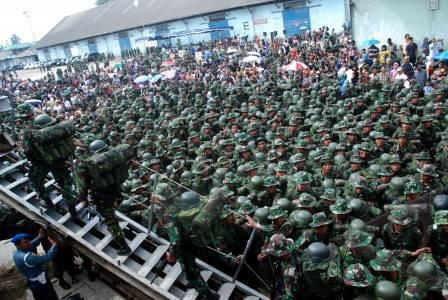
Indonesian soldiers in Paniai, December 2011

Civilians in the foothills are in panic and reliving the trauma of past operations, according to the report from a local pilot.  “They are concerned emotions again will open in Wegeuto  of the 1982 war Memoria Passionis (memory of suffering) and again when the Army conducted ongoing military operations (DOM – Daerah Operasi Militer) from  1989-1993 across the Badauwo area, near Eduda, ” the source said via email.  He explained that during the last DOM period the army accused and stigmatised civilians as being  members of the TPN-OPM, and subsequently tortured thousands of villagers.  Human rights sources at the time documented villagers being waterboarded / tortured for 24 hours;  residents’ houses burned, raped girls and married women, extrajudicial killings, burning off fingers, moustaches and beards,  pulling fingernails and quartering villagers with armoured vehicles.  Troops also conducted burning and destroying food gardens, killing livestock and pets, and fouling water supplies.

Residents are concerned that the current angry and emotional behaviour by the TNI-police toward TPN / OPM will be vented on civilians living on the slope of the hamlet Wegeuto especially, directly adjacent to Markas Eduda.  In a message delivered to West Papua Media local villagers have pleaded for International Advocacy to get Military and Police immediately withdrawn from Eduda and Paniai in general.

Much trauma is being felt by civilians across Paniai as a result of the offensive.  Independent journalist Sonny Dogopia, from  Papuan Voices ,  interviewed local villagers by telephone on December 14.   Magda Tekege, a housewife from Deiyai District, said civil society is very scared and depressed. ” Here also TNI / Police beat us and put us under surveillance, and are one full alert status, ” she explained.   Deiyai Magda called the situation unusual , “this is probably due to invasion by TNI / police in Paniai, therefore Deiyai also suffer the effects.”

Reports from Tuesday described the exercises that the Australian trained, funded and armed Brimob Gegana unit, upon arriving in Enaratoli proceeded to take over the streets immediately, causing normal town life to be immediately disrupted as local people emptied the streets to hide.

On December 6, Human rights, church sources and local activists had independently claimed that 542 people have been forcibly evacuated by troops from the Special Gegana Brimob “Counter” terrorist police unit.  The villages of Dagouto and Kopabatu and surrounding hamlets in the Dagoutu Paniai district were evicted after the Gegana unit decided it wanted to expand a new headquarters facility to deploy in the offensive against Jhon Yogi, the local leader of the armed guerrilla unit of the National Liberation Army (TPN-OPM).

The Gegana unit, a specialised elite anti-terrorist unit of the Indonesian police has been deployed heavily across Papua to crackdown on pro-independence activists engaged in non-violent resistance, as well as to eliminate the armed struggle groups.  Gegana is one of several elite Indonesian police units that receives arms, funding, and training from the Australian Government, and was blamed on December 3 for burning down a church and school in Wandenggobak, in the highland regency of Puncak Jaya.

As this article was going to press, an update was received from a trusted human rights worker in Paniai.  “At 2300 in the evening, Brimob Coconut Battalion 2 burned down buildings of Paniai Districts’ tourism assets, located in Bukit Dupia, in the same location as the Regent’s residence.  This evening in Paniai the situation is very tense”.  TPN fighters reportedly have returned fire on the attack and heavy fighting is still occurring,

The situation is ongoing and developing and West Papua Media will continue to closely monitor events.

Please urgently help us continue this work.  @westpapuamedia ia working tirelessly to end impunity in Papua with effective journalism. But we need your help  – PLEASE DONATE NOW wp.me/P1aPlR-116


SBS Radio: West Papuans fear flag day crackdown

30 Nov 2011

By Stefan Armbruster

Download Episode  Duration00:03:54  Download2MB

A West Papuan leader-in-exile fears Indonesian security forces will violently suppress the 50th anniversary celebrations of the independence movement’s flag … the Morning Star.

Thousands of police, military and special forces are reportedly massing in the two provinces just north of Australia, ahead of Papuan rallies planned for Thursday.

On Monday, Indonesian police said no officers would face charges over last month’s crackdown on the Papuan People’s Congress.

The crackdown left three Papuans dead and there are claims dozens were tortured.

Stefan Armbruster spoke with London-based West Papuan leader Benny Wenda, for whose arrest Indonesia this week issued an Interpol Red Notice.


New Docos examine upheaval in West Papua

As the 1st of December looms, two new short documentaries published by West Papua Media take a look at the recent wave of unprecedented political and industrial action and state repression in the lead up to the 50th anniversary of West Papuan Independence.

The Third Papuan People’s Congress

PLEASE NOTE: FOOTAGE FROM TIMECODE 04:59 – 05:43, OF PAPUAN GUERRILLAS FROM TPN/OPM RAISING THE MORNING STAR FLAG IS INDICATED AS FILE FOOTAGE FROM “FORGOTTEN BIRD OF PARADISE”, AND IS USED PURELY FOR HISTORICALLY ILLUSTRATIVE PURPOSES.  THIS FOOTAGE WAS SHOT IN 2008 IN THE HIGHLANDS OF PAPUA AND DOES NOT INDICATE, IMPLY OR ILLUSTRATE ANY ARMED PRO-INDEPENDENCE PRESENCE AT THE THIRD PAPUAN PEOPLE’S CONGRESS, WHICH IS FACTUALLY CONFIRMED AS BEING A PEACEFUL, NON-VIOLENT ASSEMBLY, WITH NO WEAPONS OF ANY SORT PRESENT BEFORE, DURING, OR AFTER PROCEEDINGS, OTHER THAN WEAPONS USED AND BELONGING TO INDONESIAN SECURITY FORCES.
PUBLIC OR PRIVATE MISREPRESENTATION OF THIS FACT WILL BE CONSIDERED DEFAMATION AND LEGALLY ENFORCED.

Credits

Production:  traverser11 and Nick Chesterfield

Music: Airi Ingram and Ak Rockefeller

Script: Nick Chesterfield and Mark Davis

Video Supplied by: West Papua Media, Tapol/Down to Earth, Dominic Brown; ABC  Lateline, SBS, TV Papoes, Metro TV Papua
Freeport Miners Strike

Video from the three month long strike at Freeport Mine in West Papua, police repression and actions in solidarity with the miners. Produced by traverser11 with music by Airi Ingram.

Credits

Production:  traverser11 and Nick Chesterfield

Music: Airi Ingram and Ak Rockefeller

Video supplied by:  SPSI Freeport (miners Unions), West Papua Media, Lococonut, Theagapaipho, WPACTION Network, Yerry Nikholas, Beni Pakage

and public domain content from: Al Jazeera English, Reuters


Papuan youth set alight by Indonesian civil security officers

TAPOL Press release

3 November 2011 – Evidence has emerged of a horrific attack on a Papuan student in the town of Wamena in West Papua‘s central highlands.

Yusuf Hiluka, set alight by police officer in Wamena on Oct 19 (via TAPOL)

According to a report received by TAPOL, at around 04:45 am on Wednesday 19 October, Yusuf Hiluka, 23, was stopped outside the office of the Regent of Jayawijaya District by two officers from Satpol PP (Satuan Polisi Pamong Praja), the district civil security unit, while making his way from a friend’s house to the Wamena bus terminal.

Without questioning Mr Hiluka, the Satpol PP officers poured glue on his head and set it alight. Mr Hiluka’s head and the back of his neck were engulfed in flames.

Mr Hiluka fled screaming to the nearby police station to seek protection. The perpetrator was detained immediately and held in police detention. An investigation has been conducted, and in accordance with customary law, a payment by the perpetrators to the victim’s family is being arranged.

Mr Hiluka suffered burns to his forehead and hands [1], and according to reports he is still awaiting hospital treatment for his wounds. The motive for this attack is not known, but it is yet another unexplained incident in a series of violent events that have devastated West Papua in recent months. It occurred on the same day that up to six people were killed during the violent dispersal of the Third Papuan Peoples’ Congress by Indonesian security forces in the provincial capital, Jayapura [2].

TAPOL calls on the regional Chief of Police, Inspector General Bekto Suprapto, to recognise the gravity of this cowardly attack, ensure that a thorough independent criminal investigation is carried out and that those responsible are brought to justice. The use of customary law in such cases cannot be deemed sufficient, either in obtaining justice for the victim, in punishing the perpetrator, or in acting as a deterrent against future violations.

ENDS

Contact: Paul Barber +44 (0) 7747 301 739 or paul.barber@tapol.org

Notes:
1. Photos of Mr Hiluka and his injuries are available on request from TAPOL.

2. See TAPOL/WPAT/ETAN press release, ‘Indonesian crackdown on Papuan
Congress sparks outrage’, 20 October 2011, at
http://tapol.gn.apc.org/press/files/pr111020.pdf.


AHRC: Manokwari Court acquits four Papuan students but sentences one more student with rebellion

ASIAN HUMAN RIGHTS COMMISSION – URGENT APPEALS PROGRAMME
Urgent Appeal Update: AHRC-UAU-046-2011

4 October 2011

[RE: AHRC-UAU-041-2011: INDONESIA: Manokwari court sentences two Papuan activists in flawed trial]
———————————————————————
INDONESIA: Manokwari Court acquits four Papuan students but sentences one more student with rebellion

ISSUES: Freedom of expression, Indigenous Peoples, Independence of Judges and Lawyers
———————————————————————

Dear friends,

The Asian Human Rights Commission (AHRC) has received updated information from the Institute for Research, Recognition and Development of Legal Aid (LP3BH) in West Papua regarding the sentencing of another Papuan student and the acquittal of four others in relation to their involvement in a peaceful protest on 14 December 2010. While the AHRC welcomes the acquittal of four of the seven victims brought before court the sentencing of the other three presents a violation of their right to freedom of expression. Concerns over the imprisonment of Mr. Bleskadit and the application of the rebellion charge against peaceful protesters in other cases in West Papua remain.

UPDATED INFORMATION:

In the urgent appeal on 23 June 2011 (AHRC-UAC-117-2011), the AHRC raised concerns about the rebellion charges against seven people, for organizing and participating in a peaceful protest and the raising of a West Papuan flag that symbolizes self determination. At the correctional facility, they were ill-treated and denied medical care for weeks resulting in serious health conditions. (photo: Melki Bleskadit in court, source:LP3BH)

On 18 August 2011, the Manokwari district court sentenced Melki Bleskadit (also known as Melkianus Bleskadit) to two years imprisonment. On 23 August 2011, Mr. Yenu was sentenced to seven months and 16 days imprisonment. The AHRC learned that the verdicts were declared based on a flawed process and issued an update AHRC-UAU-041-2011.

On 27 September 2011, the judges panel acquitted four of the five other Papuan students. According to the Manokwari court’s decision No: 84/Pid.B/2011/PN.Mkw, Mr Alex Duwiri and Mr John Wilson Wader were not guilty of acts of rebellion under article 106 jo, (in conjunction with) Article 55 and 56 of the criminal code. The Courts decision No. : 85/Pid.B/2011/PN.Mkw under the same charges declared Mr Panehas Serongon alias Panehas Sarongon and Mr Yance Sekenyap as not guilty. However, according to the latter decision, Mr Jhon Raweyai alias Joni was proven guilty for participating in the rebellion crime, and was sentenced to 9 (nine) months and 17 (seventeen) days imprisonment, most of which has by now already been served during pretrial detention.

The AHRC is of the opinion that the conduct of any peaceful protest is protected by the Indonesian Constitution and international human rights law applicable to Indonesia. Laying criminal charges against the protesters based on the content of the opinion shared violates the victim’s right to freedom of expression in this case. The relevant articles in the Indonesian Criminal Code that originates from the Dutch colonial period have to be reviewed and their further application halted. The AHRC has noted that several steps taken by the authorities have in the recent past aggravated tensions including the stigmatization many indigenous Papuans including activists as rebels. Many are charged and sentenced in flawed processes that lack impartiality and professional standards of judicial conduct, such as in the case of Mr. Bleskadit and Mr. Yenu. The perpetrators of such rights violations are rarely held accountable, which prolongs the use of the courts for political interests. In the cases of Mr Bleskadit and Mr. Yenu, no information regarding accountability actions against the perpetrators are known.

The court held four of the victims not guilty after they had spent approximately nine months in prison without proper access to medical care. Indonesian law entitles the victims to compensation for the deprivation of their liberty during detention and the health conditions they had to endure.

The AHRC has received reports from further sources that the security institutions in Manokwari and West Papua had earlier planned to undertake systematic efforts during 1-14 December 2011 to intentionally create a situation that would allow for the arrest of and criminal charges against protesters. According to the reports received this operation was planned to justify the ongoing stigmatization of indigenous Papuans with the view to scale up security operations. The AHRC urges an immediate investigation into these serious allegations to avoid repetition.

SUGGESTED ACTION:
Please write letters to the authorities listed below asking them to intervene in the case immediately to ensure that all allegations of institutional misconduct leading to wrongful deprivation of the victims liberty is investigated, that the victims are compensated and Mr. Bleskadit is released from his political imprisonment. All legal process must to be conducted in accordance with international norms.

Please be informed that the AHRC is sending letters on this case to to the Special Rapporteur on the promotion and protection of the right to freedom of opinion and expression, the Special Rapporteur on the rights of indigenous people, and the Special Rapporteur on the independence of judges and lawyers.

To support this appeal, please click here:

SAMPLE LETTER:

Dear ___________,

INDONESIA: Manokwari Court acquits four Papuan students but sentences one more student with rebellion

Name of victim: Jhon Raweyai, Penehas Serongan, Yance Sekeyab, Alex Duwiri, John Wilson Wader, Melki Bleskadit and Daniel Yenu
Names of alleged perpetrators: Police members, including guards of detention cell of Manokwari district police who arrested, detained and examined the victims, the prosecutor who examined this case
Date of incident: December 2010-September 2011
Place of incident: Manokwari, West Papua, Indonesia

I am writing to voice my deep concern regarding the conviction and sentencing of Jhon Raweyai at the Manokwari district court on 27 September 2011 and the ongoing imprisonment of Mr. Bleskadit for their involvement in a peaceful protest on 14 December 2010.

I know that on 14 December 2010, seven people were charged with rebellion after they had conducted a peaceful protest following a flag raising event. At the correctional facility, they were ill-treated and denied medical care for weeks resulting in serious health conditions.

Furthermore, I know that the Manokwari district court issued the verdict that two of the victims, Melki Bleskadit (also known as Melkianus Bleskadit) and Daniel Yenu, were guilty of acts of rebellion. On 18 August 2011, the verdict against Mr. Bleskadit was declared and he was sentenced to two years imprisonment. On 23 August 2011, Mr. Yenu was convicted to seven months and 16 days imprisonment. I am also aware that the verdicts were declared based on flawed process. Meanwhile, the other accused are still undergoing the trial process.

I was informed that on 27 September 2011, the judges panel acquitted four of the five other Papuan students. According to the Manokwari court’s decision No: 84/Pid.B/2011/PN.Mkw, Mr Alex Duwiri and Mr John Wilson Wader were not guilty of acts of rebellion under article 106 jo, (in conjunction with) Article 55 and 56 of the criminal code. The Courts decision No. : 85/Pid.B/2011/PN.Mkw under the same charges declared Mr Panehas Serongon als. Panehas Sarongon and Mr Yance Sekenyap as not guilty. However, according to the latter decision, Mr Jhon Raweyai als. Joni was proven guilty for participating in the rebellion crime, and was sentenced to 9 (nine) months and 17 (seventeen) days imprisonment, most of which has by now already been served during detention.

I am aware that the conduct of any peaceful protest is protected by the Indonesian Constitution and international human rights law applicable to Indonesia. Laying criminal charges against the protesters based on the content of the opinion shared by them violates the victim’s right to freedom of expression in this case. The relevant articles in the Indonesian Criminal Code that originated from the Dutch colonial period have to be reviewed and their further application halted. I am also aware that several steps taken by the authorities have in the recent past aggravated tensions including the stigmatization many indigenous Papuans including activists as rebels. Many are charged and sentenced in flawed processes that lack impartiality and professional standards of judicial conduct, such as in the case of Mr. Bleskadit and Mr. Yenu. The perpetrators of such rights violations are hardly held accountable, which prolongs the instrumentalisation of courts for political interests. In the cases of Mr Bleskadit and Mr. Yenu, no information regarding accountability processes against the perpetrators are known.

I am also concerned that the court held four of the victims as not guilty after they had spent approximately nine months in prison without proper access to medical care. Indonesian law entitles the victims to a compensation for the deprivation of their liberty during detention and the health conditions they had to endure.

I was shocked to hear about further reports that alleged that security operation were planned by some authorities in order to artificially create conditions that would allow the police to charge activists in various places of West Papua as rebels in order to maintain stigmatization and with the view to scale up security operations. Since many of the steps taken by authorities in recent years seem to aggravate the conflict in West Papua, I am very concerned about the approach of Indonesian institutions in West Papua.

Yours sincerely,

—————-
PLEASE SEND YOUR LETTERS TO:

1. Mr. Susilo Bambang Yudhoyono
The President of Indonesia
Jl. Veteran No. 16
Jakarta Pusat
INDONESIA
Tel: +62 21 3863777 / 3503088
Fax: +62 21 3442223

2. Head of Indonesian Police
Markas Besar Kepolisian Indonesia
Jl. Trunojoyo No. 3
Kebayoran Baru
South Jakarta 12110
INDONESIA
Tel.: +62 21 3848537 / 7260306 / 7218010
Fax: +62 21 7220669
Email: info@polri.go.id

3. The Minister of Law and Human Rights of the Republic of Indonesia
Jl. H.R. Rasuna Said Kav. 6-7
Kuningan, Jakarta 12940
INDONESIA
Tel: +62 21 5253006, 5253889, 5264280
Fax: +62 21 5253095

4. Mr. Basrief Arief
The Attorney General of Indonesia
Jl. Sultan Hasanudin No. 1
Kebayoran Baru, Jakarta 12160
INDONESIA
Tel.: +62 21 7221337, 7397602.
Fax: + 62 21 7250213

5. Head of Papua Regional Police
Jl. Dr. Sam Ratulangi No. 8
Jayapura
INDONESIA
Tel.: + 62 967 531834

6. Head of Division of Profession and Security of Papua Regional Police
Jl. Dr. Sam Ratulangi No. 8
Jayapura
INDONESIA
Tel.: + 62 967 531834

7. Head of National Commission on Human Rights of Indonesia
Jalan Latuharhary No.4-B,
Jakarta 10310
INDONESIA
Tel.: +62 21 392 5227-30
Fax: +62 21 392 5227
E-mail: info@komnas.go.id

8. Chairman of the National Police Commission (Kompolnas)
Jl. Tirtayasa VII No. 20 Komplek PTIK Jakarta Selatan
INDONESIA
Tel: +62 21 739 2352
Fax: +62 21 739 2317

Thank you.

Urgent Appeals Programme
Asian Human Rights Commission (ua@ahrc.asia)


Police, unprovoked, shoot man in Merauke

A silhouette showing a police officer striking...

Image via Wikipedia

by westpapuamedia.info

Information has been provided to West Papua Media that in an unprovoked attack, an Indonesian police officer shot a West Papuan teenager on on August 30  in Merauke, West Papua.

Activists from the West Papua National Committee (KNPB) in Merauke reported that Benedict Umap, 19, was shot outside the KNPB Secretariat office on  Johar Kelurahan Kelapa street at 1530 by Brigadier Jhon Piter Dias of Merauke Police.

According to witnesses, Umap had been walking back to his house, and was approached by Brigadier Dias without just cause.  Dias fired several shots from his rifle without provocation into Benedict Umap’s left leg, resulting in gunshot wounds and a broken leg.  Umap then scrambled with a broken leg to the Regional General Hospital Merauke assisted by family members who witnessed the shooting.

KNPB Merauke has described the situation as highly tense at this arbitrary and casual act of police brutality, with local residents and Papuan people in Merauke fearful of further police violence.

photos from KNPB Merauke


Church leaders mediation efforts between TNI/Polri and TPN/OPM in Paniai

JUBI, 29 August 2011

The churches in Paniai are very concerned about the unsatisfactory situation that has continued in Paniai following an armed skirmish that took place on 17 August, and also about reports that additional troops have been sent to Paniai to search for two firearms that were reportedly seized from police headquarters in Komopa on 15 August. In view of this situation, the churches are trying to mediate between the TPN/OPM and the Indonesian army and police to reach a dignified agreement to solve these problems.

The Rev. Hana Tebay, S. Th.said in a meeting on Sunday, 28 August that they had made approaches to the TPN/OPM and the Eduda headquarters (?) two days previously and she also said that in the near future, church leaders would be meeting the chief of police in Paniai.

‘The church is neutral. In our view we are all children of God which is why we speak from the heart with both the TPN/OPM and the security forces, the army and the police, she said.

‘We hope and pray that our efforts will bear fruit because we very much regret the continuation of these unsatisfactory conditions. A solution can be found and we will do everything in our power to mediate between the two sides so as to safeguard security in Paniai,’ she said.

The co-ordinator of the KINGMI Church in Paniai, Rev. Gerard Gobai, S.Th. said that the churches will use their prophetic mission to put an end to the situation that has emerged among the people. This situation has led to the people abandoning their homes, their work, their animals and fleeing from their homes.  As a result, Sunday worship meetings were attended by far fewer people than usual.

‘We are hoping for a solution. The two sides must agree to engage in peaceful efforts. ‘

He also expressed the hope that the local government would not allow this situation to continue for this would mean the continuation of a state of uncertainty for the people who are now living in fear.According to the mass media, the situation in Paniai is safe, but the fact is that the people feel very afraid. The place for the people is there, and they should not be wanting to flee from Paniai.

‘How can the people feel calm if even the bupati (sub-district chief) has vanished from Paniai?’

He went on to say that as far as the church is concerned, everyone must strive to make Papua a Land of Peace.

‘There must be an end to disorder, to conflict, an end to the loss of life..The church therefore expects the government to make serious efforts together with the TNI/Polri and the TPN/OPM to think about joint efforts to end this situation, and in particular to secure the return of the two firearms.’

[This item and the previous item from JUBI were translated by TAPOL]


Churches speak out for peace and security in Paniai

JUBI, 29 August 2011

The desire for peace in the district of Paniai is a common aspiration, especially in the wake of the many conflicts that have occurred in the recent past.   Everyone should be aware of the need to work together to restore a sense of security so that people can continue with their day-to-day activities.

These were the words contained in a press release issued by the Commission for Justice and Peace of the Paniai Diocese and the Commission for Justice and Peace of the KIINGMI Church on 28 August.

The representative of the Diocese of Paniai, Fr Marko Okto Pekei, and Yafet Tetobi of the KINGMI Church said that they hoped that the leaders of the security forces would not deploy forces from outside Paniai.   Moreover, they hoped that the forces already in the area would not roam round freely in the area with all their military equipment because doing so would only worsen the situation. People who are now thinking about returning home to Enarotali, Madi and places close by will start feeling afraid of going back to their kampungs after
realising that the situation is not yet safe.

They also said that all sides should realise that the preservation of security and an atmosphere of peace is the duty of all, leaders of the communities, the security forces – TNI the army and Polri, the police - as well as the TPN/OPM, leaders of the community, religious leaders, leaders of customary groups and leaders of the women and the youth.

The two church commissions for peace and justice also deeply regretted the wounding of two people during an armed conflict that occurred on 17 August in Uwibutu, Madi.  ’We also deeply regret the actions of certain elements who have destroyed the economies of families living in the area.’

They went on to say that any problems between the security forces and the TPN/OPM should be handled by means of persuasion, not by the use of repressive military measures because the latter would only result in casualties among civilians who are not in any way involved in these matters. Repressive measures, that is to say, violence or armed conflict, will only result in casualties. This means that all sides are responsible for preserving peace and security for the civilian population.

The church representatives said that they had felt called upon to speak out about the unsatisfactory conditions of the local people during the past three weeks. The various churches in Paniai have therefore been trying to mediate to find the best possible solution that accords with the wishes of the people so that they can live in safety and prevent the occurrence of casualties among the people.


Kontras: SBY must prioritiser the Papuan problem and stop the Escalation of Violence

THE PRESIDENT MUST GIVE PRIORITY TO REACHING A DIGNIFIED SOLUTION TO THE PAPUAN PROBLEM AND TO PREVENTING THE ESCALATION OF VIOLENCE IN PAPUA

There are fears that the prospects for peace in the land of Papua will become increasingly difficult for three reasons. The first is the escalation in the level of violence that has been disrupting the situation in Papua. The second is the total lack of accountability regarding security operations in Papua by the TNI, the Indonesian army, and Polri, the police force., and the third is the ambivalence in the President’s attitude towards the Papuan problem. If nothing is done
about these three problems, it can lead to activities that would be counter-productive for achieving a dignified solution to the Papuan situation.

The first problem, the latest in the occurrence of acts of violence in Papua, happened on Sunday, 21 August when a man named Das Komba, 30 years old, was found dead, having been murdered near his garden. Prior to this, there was information that the TNI in Arso would be holding training exercises near this man’s garden. Two women who usually garden nearby had met several people who were thought to be members of the TNI somewhere near the garden. This led to people in the vicinity becoming very fearful and feeling very unsafe. The killing came on top of a spate of incidents of violence and killings [altogether nine during August] that have occurred in Papua, particularly in the wake of the Papuan Peace Conference .

The second problem relates to the deployment of TNI forces and the role of Polri in Papua. The deployment of troops is not related to any political decision by the President or the Indonesian parliament, the DPR RI, but was promoted by the TNI. Such a political move should be accompanied by a clear mechanism for accountability as provided for in our laws. It is therefore abundantly clear that the security operations by the TNI are illegal and are in breach of the regulations. The government should have learnt from past experience in Aceh and Timor-Leste that the security approach never solves problems but only
intensifies the issues, making any solution even more difficult.

The illegal use of TNI forces also provides more evidence of the weak role of Polri in taking charge of security in Papua. Polri is increasingly showing that it lacks confidence in itself and its incapacity to take charge of security, in accordance with its mandate as stipulated in the Law on Polri. The government should be providing as much support as possible for the role of Polri in safeguarding security for the general pubic with the use of persuasive methods.

Aother problem that is no less important is the recent leak of Kopassus operational documents which drew attention to the huge role of intelligence and to the clarification of the TNI’s active role in pursuing the security approach in Papua.

The third problem relates to the attitude of the government, in particular the ambivalence of the President.  In a series of interviews, the President has spoken about achieving wellbeing for Papua.   But on the other hand, security continues to be the main approach and is not accompanied by any overall correction to security operations that do not promote the safety and sense of security of the people in general.

We therefore make the following demands:

1. The President of Indonesia should hold dialogue with the Papuan people representing all the interests of the Papuan people . This should be done in a dignified manner and should respect basic human rights.

2. The President of Indonesia should adopt a firm attitude to stop all the polemics going on among his ministers and pursue a single policy for Papua. The policy should be directed towards a model for solving the conflict and not just consist of speculations and stigmas.

3. The government should put an end to the continuing acts of violence and killings that have been occurring in Papua and make an evaluation of the presence and deployment of TNI forces, while maximising the role of Polri as the ones who are responsible for security.

4. All sides should play an active part in halting all forms of violence which can only have a negative impact on the peace process which is what the general public wants to happen.

Jakarta, 23 August 2011

Kontras: Commission for the Disappeared and the Victims of Violence


Security measures escalate in Papua

Bintang Papua, 20 August 2011

KNPB, the National Committee for West Papua, is scheduled to announce
the results of the meeting organised by ILWP, International Lawyers for
West Papua in Oxford, at 9am this morning , at the tomb of Theys Hiyo
Eluay.

Bintang Papua also reported that Major-General Erfi Triassumu, commander
of the XXVII/Cendrawasih Military Command, said he has not yet had any
reports about the results of the ILWP meeting in Oxford, but said that
the ILWP event has triggered events affecting the security situation,
especially in Papua.

In a meeting with the press, he said that promises made by various
groups were causing confusion among the population. It was not only
because of the armed activities of civilian groups that had occurred
before and after the ILWP meeting. The security situation had indeed
intensified throughout Papua recently, which had happened both before
and after the ILWP meeting.

Other factors were the election of the governor of Papua as well as the
special autonomy law – OTSUS. People were hoping that OTSUS funds would
be evenly distributed among the communities, although some of the funds
could not yet be released.

He said that he along with the police chief in Papua had together
committed to doing what they could to restore a conducive situation in
Papua.

Meanwhile, the district chief of Puncak Jaya, Lukas Emenbe. called on
everyone whatever their differing opinions to hold a dialogue in order
to agree on peaceful solutions. ‘ All these problems can be resolved,’
he said, ‘as long as we publicly express our opinions.’

The military commander, asked whether there would be an increase in the
number of troops in preparation for the forthcoming Idul Fitri [the last
two days of Ramadan] said that organic troops may carry out routine
movements because the Korem under Battalion 751 in Sentani does not
have special units available for security purposes.

Asked about the manoeuvres by armed groups which had been involved in
fighting in urban areas such as in Nafri, he said because of the current
civil emergency status, the police would be in the front line together
with the local government, because the govrnor, the district chief and
the city mayor are the ones who are responsible for security.’

‘I will assist if there is a request from the police for additional
personnel to help the police,’ he said.


Indon military open fire on vehicles carrying KNPB activists, arrests ahead of Aug 20 gathering

from Westpapuamedia.info and Local Sources

Indonesian Police and Army from a joint taskforce opened fire on a car of West Papua independence activists in Abepura, West Papua, on August 18, after arresting three other activists from the West Papua National Committee (KNPB) for distributing pamphlet in support of demonstrations planned for August 20.

The shooting occurred when KNPB (Komite Nasional Papua Barat) members attended the Jayapura police headquarters to check on the welfare of detainee Octovianus Mayor.   Mayor was arrested by members of the joint TNI/POLRI taskforce at 1000am local time at Expo Waena, for distributing pamphlets for a planned announcement on August 20 of resolutions from the Oxford ILWP “Road to Freedom” conference, at the grave of the late Theys Hiyo Eluay in Sentani.  Mayor is the Secretary General of the Timika Region KNPB.

Colleagues of Mayor went by car to Abepura police station upon hearing of his arrest to ensure his safety.  Demi Asso, Soni Kosa and several friends asked police guarding a post at Abepura of the whereabouts of their friend, whose location was given by police at District Police Jayapura.   After they left the  police station and drove towards PolRes Jayapura.   According to witnesses, police followed the activists from the police station, and began to shoot at their car, a black Avansa.

Police quickly pursued the KNPB activists vehicle, which was fired on by police officer Bripka Numberi at 12.000 midday, at Abepura circle, Jayapura, Papua.

Bripka Numberi allegedly fired indiscriminately in pursuit of the vehicle,shooting 10 rounds into the rear of the car, 4 rounds through the windscreen, 6 rounds into the rear bumper and 1 round in the wheel, causing the Avansa to stop.  The vehicles occupants panicked and ran, according to a a KNPB witness report and chronology obtained by West Papua Media.  The police continued to open fire on the unarmed group, shooting Demi Asso, Soni Kosay in the feet.  The three other unidentified activists did not sustain bullet wounds, and police arrested all immediately.  At around 13:00 the two shot KNPB activists and three others were taken to the Jayapura Police for further processing.

KNPB have appealed for support from international human rights observers, lawyers and NGOs to press for a credible investigation into the circumstances of this arrest and the excessive force used by Police to capture unarmed activists.

Nick Chesterfield, local sources

KomnasHAM-Papua condemns recent violence and makes recommendations

Bintang Papua. 15 August 2011

Jayapura: Komnas HAM, the National Human Rights Commission has condemned the brutal actions by unidentified people against innocent civilians as well as members of the security forces.that have occurred since June in
the province of Papua.

The chairman of Komnas HAM’s office in Papua, Julles R.A Onggen SH, together with other members of the commission called a press conference to discuss the security situation in Papua. They said that the significant increase in acts of violence was very worrying indeed, particular because of its impact on the need to safeguard peace in Papua.

They made the following points and recommendations:

First, they strongly condemned the many acts of violence perpetrated by unidentified persons towards the civilian population and members of the
armed forces acting in the course of their duties.

Second, they called on the police to take action speedily and objectively in accordance with the laws in force regarding acts of violence, while at the same time not forgetting to use the cultural approach in accordance with the terms of special autonomy to minimise these acts of violence.

Third, the Commission has set up a joint team consisting of the Komnas HAM, the DPRP, the provincial government of Papua, local governments, the churches and NGOs to investigate these acts of violence, each making their own specific contribution.

Fourth, it called upon all sections of the community to remain calm, not to be provoked, to live peacefully together, respecting each other in order to safeguard security.

Fifth, to request the military commander of Kodam XVII to clarify the issue of the KINGMI Church and it will set up a team to investigate the matter.

Sixth, in accordance with the provisions of article 34 of the Constitution, the Commission will seek the commitment of the national government as well as local governments to provide social security for the dispossessed, the poor, the street children and the unemployed people.

Seventh: in connection with the sixth point, to call upon the provincial government to put this into practice in accordance with the special autonomy law.

Other points dealt with the recognition of collective rights, including the need for peace, for development and for a healthy and clean environment. The provincial government should also ensure that civil and political rights are safeguarded, such as the right to compensation for those whose rights have been violated, freedom of thought and freedom of religion.

It also called on the provincial government to safeguard people’s economic, political and social rights, freedom from fear and impoverishment and from racial discrimination, the right to get a job with a decent wage.


Indon Police say ‘shoot on sight’ for petty criminals

Bintang Papua, 26 July 2011Abridged in translation by TAPOL

Police chief says: ‘Shoot on sight’

Jayapura: The many cases of petty thefts and harassments directed mostly against women has led to the police deciding to take strong action. The chief of police in Jayapura, Imam Setiawan has issued an order to ‘shoot on sight’ (door ditempat) for people engaging in such activities in Jayapura. ‘I have told my men to deal with these people either with sharp weapons or other equipment.and they should not refrain from using their weapons.’

In the past three months, the police have received reports of 28 such cases; 99% of these cases were targeted  against people who were on their motorbikes . In some cases,weapons have been used. There was a stabbing which was almost fatal, and in another case, someone had grabbed the person’s bag  which led to her falling to the ground and suffering permanent damage to her face’ In another case, someone carrying a sharp weapon threatened the victim to hand over the motorbike.’

In view of these many cases, the police have set up a team  to handle these  crimes, including the many thefts of motorbikes which have become much more frequent recently.And many of the cases have occurred in the busy parts of town. Police reports show that the worst areas were North and South Jayapura. However there were no thefts of motorbikes in Abepura during the past three months. The police have warned women not to go out alone on motorbikes in the busy parts of town.


Indonesian Army: Gunmen Kill Indonesia Soldier in Papua

FYI –

MEDIA NOTE:  West Papua Media has not received any INDEPENDENT confirmation from either human rights, church or TPN sources of this contact, despite communication.  In light of this, and in light of allegations of significant human rights abuses and killings of non-combabtants and civilians during this operation, it is wise to to treat military claims as unverified an not credible, unless they agree to allow independent international monitoring into the combat area.

The Associated Press
July 21, 2011

Army: Gunmen Kill Indonesia Soldier in Papua

An army officer says unidentified gunmen have ambushed Indonesia
soldiers and killed one of them in the easternmost province of Papua.

The chief army officer in Papua says soldiers are still searching for
the gunmen. Maj. Gen. Erfi Triassunu said the ambush Thursday morning
happened outside a village in the hilly district of Puncak Jaya.

Triassunu said the victim was a first private killed by a shot to his
head. No information was available on the other soldiers.

The attack occurred one day after a military tribunal indicted three
low-ranking soldiers for killing a civilian in Puncak Jaya last year.

Papua is a former Dutch colony incorporated into Indonesia in 1969
after a U.N.-sponsored ballot. A small, poorly armed separatist
movement has battled for independence ever since.


AWPA letter to Aust Minister for Foreign Affairs re Puncak Jaya

Australia West Papua Association (Sydney)
The Hon Kevin Rudd MP
Minister for Foreign Affairs
Parliament House
Canberra
ACT 2600
 19 July 2011
Dear Mr Rudd
I am writing to you concerning the Indonesian military operation that is occurring in the Puncak Jaya regency of West Papua. Media reports have indicated that up to 600 TNI personal are involved in “sweeping “ operations in the region. In the latest incident four civilians , one  women and  3 children were wounded when Indonesian troops from the Infantry Battalion 753 , who are based in Nabire  fired into huts in the villiage of Kalome while searching for members of the Free Papua Movement (OPM). The incident occurred on the 12 July.
These aggressive military operations in pursuit of the OPM leave the local people traumatised and in fear for their lives.  Many reports have pointed out the the security forces have great difficulty distinguishing  between what the term separatists  and the general public.  During these military operations villages are destroyed as well as  gardens and livestock. While the OPM are committed to peaceful dialogue, the retain the right to self defence and protecting the local people if attacked. Although the security forces try to blame all incidents in the area on the OPM, many attacks on the TNI are by unknown attackers .
Tensions are always high in the Puncak Jaya regency because of the regular military operations that occur in the area. Suspecion between the local people and the TNI remain high with the security forces  accusing locals of supporting  the OPM while the local people accuse the Indonesian military of human rights abuses.
In May the military began a “socialising programme “ in Puncak Jaya involving up to  300 Army, Air Force and Navy personnel . The programe is proposed to run for four months  and is to include the renovating of  homes, churches and markets. However, local people believe it is simply  a shield and a cover-up of the violation of human rights abuses that have occurred in the region. It is all reminiscent of the US programme to win the “hearts and minds of the Vietnamese people.
The problems in West Papua won’t be solved by Jakarta  deploying more troops to the region or conducting more military operations. In September  last year the House of Representatives (DPR) Law Commission deputy chairman Tjatur Sapto Edy commenting on a report by Komnas HAM on past military operations  in the PUNCAK Jaya Rregion said  “there should be no more military operations and such approaches  are no longer suitable in a democracy”.
We urge you to use your good offices with the Indonesian Government to
call on the Indonesian President to halt all military operations in West Papua and return all military personal to their barrack as a way of easing tension and saving lives.
Yours sincerely
Joe Collins
AWPA (Sydney)
CC. The Hon Stephen Smith MP, Minister for Defence
Various human rights organisations

Komnas HAM meets army commander to discuss rights violations

Bintang Papua, 16 July 2011

Komnas HAM meets military commander to discuss human rights violations

Jayapura: Many human rights violations are now confronting the National
Human Rights Commission – Komnas HAM in Papua. Commission deputy
chairman Nurcholis paid a visit to the command centre of the Cenderawasih Military Command to discuss two important problems.

The first was about the security situation at Freeport.   ‘A few weeks ago, we
received complaints from workers at Freeport about the security situation at the company and this is now being discussed with the military commander.’

The security problem began when some Freeport employees made complaints
about the situation and the families of the victims went to Komnas HAM, seeking assurances that legal processes would begin quickly.

The second problem relates to the shooting of members of the TNI in Puncak Jaya.  But apart from these casualties, there were four civilian casualties, a woman and three small children.  ‘We need to know whether these casualties were wounded or had died,’ he said.   Nurcholis stressed the need for caution about information being received, so as to correctly determine what measures need to be taken. ‘We are now gathering more complete information with the help of the human rights commission in Papua, to ensure that speedy action can be taken to solve the issue.’

Meanwhile, there are reports that some villagers have fled their homes because of armed skirmishes between civilian forces and the TNI in Puncak Jaya. He said: ‘If this is indeed happening, we hope to solve the problem so that our activities can focus on restoring security,’ he said.

No access to Puncak Jaya
He said that Komnas HAM is not at present able to gain access to Puncak Jaya and can only establish contact by phone. ‘The core of the problem needs to be dealt with through dialogue while recognising that this will not be easy. The next move will be to consult with the ministry of political and legal affairs, with dialogue being the only choice, and one that is supported by most of those involved so as to ensure that the difficulties can be overcome.’

Komnas HAM is checking whether the victims are civilian or military and whether the victims were wounded or have died. When asked how long this would take, Nurcholis said that he could not say.

‘The best indicator for solving human rights issues is not fixing a time frame but finding the best way to solve the problem ,’ said Nurcholis.


Indonesian Army shoot mother and 3 children in “crossfire” in Kalome, West Papua, as offensive escalates

Map of Puncak Jaya, Papua, Indonesia.

Image via Wikipedia

by Nick Chesterfield, with local sources and agencies

WestPapuaMedia.Info – Indonesian Army (TNI) troops have shot 3 young children and a mother in Puncak Jaya, West Papua, in the latest atrocities carried out during a two-week military offensive aimed at ending armed resistance to Indonesian Rule over the occupied colony.

Ny Dekimira, 50, was hit on the right foot, and the three children – Jitoban Wenda 4, and their neighbors Dekimin Wenda, 3, and Dimison Wenda, 8 – all had bullets hit their left legs after Indonesian troops fired indiscriminately into the honai (huts) just before dawn on July 14, according to local witnesses.

Credible reports about the scale of the offensive are beginning to filter through from the remote and inaccessible area about the scale of the offensive  The Indonesian government has closed off access to the Tingginambut district to both Indonesian and foreign human rights and media observers, and local activists have had to march for days across rugged terrain to get out verified information.   Local human rights observers and Papuan activists have independently reported to West Papua Media that TNI headquarters staff have threatened their safety if they alert journalists to abuses carried out by Indonesian security forces against West Papuan people.

Undeterred, the mass based Papuan activist network West Papua National Committee (KNPB) have accused the Indonesian Military “under the regime of General Susilo Bambang Yudhoyhono”

General SBY - Military approach will not solve Papua's problems

of manipulating the situation in Puncak Jaya to conduct military domination and control of the local population, despite the recent public relations offensive that it was engaged in “bakti” social service campaigns to help the people.  According the KNPB, the TNI should not cover up their mistakes and militarism by engaging in social activities – they should cease military activities on civilians altogether.

“Their reasons make no sense, because it’s so funny that the military themselves who set fire to the houses of citizens in almost all settlements, Indonesian military who burned alive the people’s animals, burned residents’ gardens; and now the TNI and Police are trying to justify themselves as heroes by playing a cheap propaganda in the media, ” said a KNPB spokesperson on Saturday.

Activists from the area have provided photographs to West Papua Media

showing the fully armed troops previously working on the Bakti projects suddenly boarding Puma helicopters in transit to the combat zone around Kalome.

TribuneNews.com quoted the TPN Secretary General for the Highlands Area, General Anthony Wenda, saying that villagers reported the shooting in Kalome on July 7 happened before dawn when residents were still asleep. “At that time, we’re on guard night and day in Kalome, and a barrage of bullets from the TNI were directed into a house of children and the elderly,” said Wenda to Tribunnews.com. “We always will be ready to make contact with TNI weapons until we are free, because this is the struggle of our people of West Papua.”

After this shootout, the force reportedly involving over 600 soldiers from the notorious 753 Battalion based in Nabire, have sought to enforce their control over the rugged and remote district.  753 Battlalion’s operations in the Kalome area reached international infamy in 2010 when troops tortured and killed Rev Kindeman Gire, and also with the torture of Tunaliwor Kiwo.  Kiwo’s torture, captured on video and uploaded to Youtube, created outrage that shone an international spotlight on the TNI’s behaviour against civilians in Papua.  The Indonesian government was later caught red-handed as it switched the defendants in the torture trial widely seen as farcical, and ran a military trial on issues of discipline instead of human rights abuses. Since this time, TPN fighters been permanently around the village for protection.  However, the TPN are poorly armed and their hardware is no match for a fully equipped modern military.

The current offensive comes as the Indonesian military is attempting to convince international observers that it is improving its human rights practice.  Last week, as troops were engaging both civilians and fighters from the National Liberation Army (TPN-PB), the commander of the TNI in West Papua,

Erfi Triassunu - duplicitous

Major General Erfi Triassunu, was duplicitous in speaking about ending impunity and abuses by its soldiers at the Jakarta-sponsored Papua Peace Network (Jaringan Damai Papua or JDP) conference in Jayapura.  Dr Neles Tebay and the Indonesian Institute of Sciences (LIPI), the organisers of the conference, were apparently unaware of the contradiction at this time, a contributing factor in the boycott or skepticism of the Peace Talks by the majority of Papuan representative organisations.

Yet according to the KNPB, one of the several sectors suspicious of the JDP, this peace process is illegitimate.  “Do not imagine Peace (will be brought) by the JDP, Indonesian Government through Governor, DPRP, TNI or the police in Papua.  Because in reality, Papua is a military zone by their physical and systematic actions done to destroy the Papuans and to control this region for the glory of foreign investors.”

According to Tribunnews.com, Maj-Gen Triassunu conceded that troops may have shot the Kalome villagers.  “The possibility exists, but we have not received a report from our post in Puncak Jaya”. Triassunu denied the incident in Kalome was proof that civilians were targeted.  ”We just pursued the TPN OPM in mountainous regions, because Papua is part of the Unitary Republic of Indonesia,” he told Tribune News.

However, the Head of Information Department of the Army (Kadispenad) Brigadier General Wiryantoro would not comment on this allegation.  “It’s related to operations of TNI forces deployment. When it comes to coaching the Army personnel, or related to the pure strength of the army, I can not answer” (Tribunnews.com)

When contacted by West Papua Media, no spokespeople for either the Indonesian military or Police made themselves available for comment on the allegations of the offensive, nor were replies made to telephone voice and text messages, or emailed questions.

West Papua Media also has made a decision to protect the identity of its sources*, as they have reported significant threats to their safety.  Political activists reporting on the events have also come under significant threat.  Victor Yeimo from the KNPB reports that when the Press Conference for local and national journalists to report on the Puncak Jaya incidents was called, phone and physical threats were received from persons claiming to be Pangdam (Indonesian Army Regional Commander), and Police.  Yeimo reports that these callers forced KNPB to cancel the press conference about the case in Puncak Jaya.   “Many journalists did not come after they terrorized by the Indonesian Military,” said Yeimo.

Siege Conditions may create humanitarian crisis

Credible local clandestine activists have relayed reports to West Papua Media of the TNI laying siege to several villages in the immediate area of Kalome, but they cannot get close enough to verify any casualties, displacement or destruction.  With village sieges and actions on other villages in the past having caused significant displacement, local human rights observers fully expect the civilian death toll to rise significantly.

Hundreds of people have reportedly fled to neighbouring villages or to the hills, and observers have expressed concern that in the depths of winter, with their food crops destroyed, locally people internally displaced who may have no alternative to seek refuge in higher ground, may succumb to starvation or exposure.  The areas high in the cloud forests and above the treeline are not suitable for sheltering large numbers of people, as they have been denuded by countless thousands of internally displaced refugees from previous military offensives.

Since the first aerial bombing campaigns by the Indonesian Air Force in 1978 in Puncak Jaya, almost every year from July to August, the TNI has launched offensives against civilians across the highlands.  An identical offensive in 2003 was investigated by Komnas HAM (Indonesian National Human Rights Commission), which found that the Australian-trained Kopassus special forces committed gross human rights abuses and crimes against humanity. Similar offensives occurred in 2005, 2006, and 2007, which forced several thousand people into famine conditions high in the mountains, above the treeline.  Last year also marked a particularly brutal operation, only noted by foreign media due to the inescapable viral distribution of the torture videos.

In light of the allegations of brutality by the TNI in Kalome, independence activists are also challenging the notion that the armed resistance practiced by Tabuni’s forces is terrorism.  According to a KNPB spokesman, “The TPN under the Goliat Tabuni continues to struggle, not for a personal profit nor to legitimise the habit of TNI and POLRI to obtain security protection payments. The struggle is resistance to colonial occupation by  Indonesia of West Papua, especially in Puncak Jaya … the reason the TPN was formed”

The recent deaths of TNI and Police.in Puncak Jaya is the fault of the generals in the view of the KNPB, who say that their policies and command structure sacrifice the members of it security apparatus.  “Victims will continue to fall if SBY and (TNI Command) prioritize militaristic ways to solve West Papua’s problems, by dropping hundreds of soldiers everyday to Puncak Jaya”.

“If SBY does not take  political will to solve the problem of West Papua immediately (by allowing an) act of self determination via a referendum then human rights violations will continue to occur,” stated the KNPB spokesman.

West Papua Media was this week contacted by a retired European missionary who had formerly served in Puncak Jaya regency who was concerned about the current situation.  He offered the following comments on condition of anonymity, as he is concerned for reprisals for his former colleagues:

  “Burning villages, causing people to flee with nothing but the clothes they wear, creating absolute terror amongst ordinary people, condemning babies to die starving and frozen hiding from the soldiers high in the mountains, killing and torturing priests and laymen alike… who are the real terrorists? This is not new, this slaughter happens every year since Indonesia first came – they are not hunting guerrillas, they are hunting Papuans until they are dead.  Whilst we might not always agree with the strategies employed by TPN, and that we pray for a peaceful solution, they are a legitimate army of national liberation there to protect their people in the absence of any international concern.”

West Papua Media will continue to provide monitoring and coverage of this evolving situation.  Please send any tips or corrections to editor<at>westpapuamedia.info

*Please note: bona fide journalists can be provided with sources if they are doing a story on this issue, but for their safety, their identities are strictly not for publication.

Related articles


AHRC: INDONESIA: Torture Report – A heinous act which is not seriously addressed


AHRC-FST-042-2011
July 14, 2011

Report on the practice of torture in Indonesia for the International Day of Support for Victims of Torture from the Commission for the Disappeared and Victims of Violence (KontraS) in Indonesia forwarded by the Asian Human Rights Commission

INDONESIA: Torture: A heinous act which is not seriously addressed

Download the full report at http://www.humanrights.asia/countries/indonesia/reports/ngo/KontraSTortureReport2011.pdf

I. Introduction

One of the serious issue of human rights violations—which is one of the nonderogable rights —that recently arised public attention is torture. First, in early October 2010 shortly before his plane left for the Netherlands, President Susilo Bambang Yudhoyono decided to cancel his state visit in the country. The cancellation was due to the filing of the lawsuit to the local court in the Netherlands by the activists of South Moluccas Republic (RMS/Republik Maluku Selatan) who live there. The lawsuit for one reason was based on charges of torture committed by police officers against those accused of being RMS activists. They were charged with treason when they displayed RMS flag as they performed cakalele dance in front of the president and some foreign guests during his visit to the Moluccas in June 2007. Following the cakalele incident the security forces, including special anti-terrorism unit Detachment 88 immediately arrested and detained hundreds of suspected RMS activists and some of them were allegedly become victims of torture.

Second, only a few weeks later in October 2010 a 10-minute visual documentation—circulating through ‘Youtube’—on torture of two Papuans recorded with mobile phone video tool. In the video, the extremely brutal and inhuman action was obviously conducted by people in military uniforms in order to conduct interrogations. With the rapid spread of that torture video, various Indonesian authorities—including President Susilo Bambang Yudhoyono— promptly responded to it and affirmed the practice of torture by military personnel in Tingginambut, Puncak Jaya, Papua. Many actually considered this video as an explicit example of the allegedly patterned practice of torture in Papua. The appeals of concern about the practice of torture also expressed by both foreign governments and international organizations.

This paper tries to examine the extent to which states implement human rights standards in the relevant international instruments of torture as an obligation of Indonesia post ICCPR and CAT ratification within the past year (July 2010 to June 2011). The implementative obligation is to do prevention efforts (through improvement of legislation, judicial system, and administration of state), ensuring the perpetrators brought to justice and provide redress to victims or their families. The contextual torture issues and problems in Indonesia can be seen from various post-priority agenda of meetings and discussions conducted by Indonesia government with relevant international human rights agencies.

So far Indonesia has made two reports to the Committee Against Torture under the Convention Against Torture, the first (initial report) was in July 2001 and the second (periodic report) in 2005. Unfortunately, Indonesia has not made the first report to the Human Rights Committee, the regulatory body for the ICCPR. In addition to reporting under the treaty body mechanism, there are also the follow-up results on torture based on the report
under the charter body mechanism. Under the mechanism of the UN Human Rights Council there are two follow-up agendas: first, the official country visit follow-up of Special Rapporteur on Torture, Manfred Nowak, conducted on 10-23 November 2007; second, the special meeting to discuss the results of Indonesia Universal Periodic Review/UPR in 9 April 2008 during the Fourth Session of the UN Human Rights Council. As follow-up results from various human rights mechanisms mentioned before, there are several similar recommendation agendas expected to be implemented by Indonesia related to the issue of torture, such as:

  • Torture should be made crime and its definition should be in accordance with Article 1 of the Convention against Torture;
  • The lack of this legal rule would lead to the practice of impunity;
  • There shold be an effort to revise the detention system, whether the duration of detention and the effort to test the validity of such detention;
  • In the context of law enforcement, any evidence or testimony that was made due to a practice of torture;
  • Ensure that victims of torture receive redress (reparation).

In conducting an audit over the issue of torture in Indonesia during the past year (July 2010-June 2011), KontraS took up cases of alleged torture which were directly dealt with. Information on alleged cases of torture would be considered a secondary source that could help clarify the picture of torture practices more broadly. In addition the audit report also discusses several policies, including plans for the creation or legislation revisions, which emerged within the past year.

To read the following sections, please download the full report here:

II. The Lack of Normative Provisions Against Torture
III. The Pattern of Torture Cases
IV. Development of New Legislation Draft Related with Torture Issue
V. Conclusions and Recommendations


Plea for help from Puncak Jaya against TNI military operations

(FORWARDING ON)
(Please note: By republishing this plea for help, West Papua Media does not necessarily explicitly endorse the call for arms.  We believe the situation would be far better served by allowing international journalists, and UN peacekeepers to be sent into this area to prevent this carnage.  However, in the absence of this, all peoples have the right to self-defence and self-determination, and therefore we cannot oppose the legitimate calls to assist in self-defence).
Report from Piron Moribnak
ARMY’S SOCIALISING PROGRAMME IS BEING USED TO CRUSH TPN/OPM LED BY GOLIAT TABUNI IN PUNCAK JAYA

The doubts of  people living in the central highlands about a socialising programme  launched by the commander of Cenderawasih Military Command/XVII to create harmony which has been under way since 2 May 2011 have been confirmed. The programme is nothing more than a shield which became clear when troops involved in the socialising programme suddenly halted these activities and started to conduct sweepings as part of a military operation.

Since 6 – 8 July, fully armed troops have surrounded the headquarters of the TPN/OPM under the command of General Goliat Tabuni in Tingginambut and a battle has been raging since 5 July during which three TNI soldiers were shot in Kalome, district of Tingginambut, and were flown by helicopter to Jayapura.

The TNI’s programme to build houses for the local people and to give sermons at prayer meetings on Sundays as well as to carry out mass medical treatment for local communities  has failed to win the support of the local communities. They have rejected TNI sermons in the churches, while the offer of medical treatment has failed to persuade the local people to get medical treatment free of charge . On the contrary, the local people have chosen to remain silent and have fled from locations where mass medical treatment is on offer. This is because the Papuan people living in Puncak Jaya regard the military as murderers of the Papuan people and have refused to accept these military programmes.

The army’s socialising programme in Puncak Jaya is nothing but a shield and a cover-up of the violation of human rights at a time when human rights are of paramount importance throughout the world.

The TNI is concealing its plan to crush General Goliat Tabuni by means of military operations so as to enable them to counter our doubts about these socialising activities because we have been disrupted and have taken measures to protect ourselves.

It is an irony that we Papuan people do not possess the means to resist the TNI which has all the necessary equipment whereas Goliat Tabuni has nothing more than a few of weapons, making it very difficult for him to mount a proportionate response . Is there a country anywhere in the world that is willing to supply military weapons to Goliath Tabuni to make it possible for him to make a proportionate response?  … if General Goliat is forced to end his struggle … at the hands of the TNI?   [/Several gaps in this sentence make it difficult to decipher the precise meaning. TAPOL/]

We pray that there is nowhere in the world for their protection and that Almighty God will protect us.

This is our response to the call by the chief of police in Puncak Jaya  via the intermediary of the head of the district of Mulia  for the local people to halt all their activities from 8 July and to remain in their homes from 6pm every evening.

NOTE: General Goliat Tabuni  is now seriously cornered because of his lack of weapons and we call for the prayers of the Papuan people everywhere in the fight against the NKRI military and for strength from the Almighty God.

[Translated by TAPOL]


Arrested for rallying people without permission

Bintang PPU, 4 July 2011

Jayapura: According to the police, the arrest of five activists who were attending the commemoration of 1 July, OPM Day, was because they had mobilised people but had done so without having the necessary permit.

”They were not praying at the time they were disbanded,’ said a police officer. ‘If they want to pray, they can go to any place but they don’t need to gather lots of people together nor do they need to unfurl banners,’ said police chief of Jayapura, AKBP Imam Sietiawan.

He said that the five activists, Marthen Goo, Herman Katmo, Bovit, Yulian and Sakarias Tamikai, had rallied people together without having the necessary permission to do so from the police.

‘When they saw this, my men arrested the five and took them to the police station, interrogated them for a while, and later that day, we sent them home.’ He said that a permit from the police is necessary if you want to rally people. He said that 20 or 30 people were holding up banners, although they said that they were only going to go to the grave of Theys Eluay to say prayers.

Asked about notification that had been given by the committee, he said that there was no notification about gathering together a lot of people in Abepura. ‘It would be okay in Sentani. If they want to carry out these activities, please go ahead and do so. But they shouldn’t all gather together and wave banners. That’s not right. That is what is not allowed,’ he said.