West Papua new Pacific media black spot

Cartoon from the Pacific Journalism Review report. © Malcolm Evans 2011

Monday, October 17, 2011

  • Listen/Download: MP3 

MELBOURNE (Radio Australia’s Pacific Beat / Pacific Media Watch): A new report on Pacific media freedom says the most serious cases of media freedom violations in the Pacific in the past year occurred in West Papua.

The report by the Auckland-based Pacific Journalism Review says repression in the province has now also reached the news media.

It says violence against journalists in West Papua has replaced censorship in Fiji as the most urgent media freedom issue in the region.

Presenter: Geraldine Coutts
Speaker: Associate Professor David Robie, director, Pacific Media Centre

ROBIE: But there are very good networks of sources of information and there is also a major media  freedom organisation in Indonesia, the Alliance of Independent Journalists which has a very strong chapter in West Papua and feeds information very much to international media freedom organisations, because it’s not only Papuan journalists that face such repression, but it’s also Indonesian journalists working in the area.

COUTTS: Alright, can you just give us some examples of what’s actually happening, the conditions under which the journalists are now working?

ROBIE: Well, there was a big focus on the troubles in West Papua, in fact really since the early part of August and, of course, last week, at Freeport mine, there has been a shooting of protesters. The mine workers were protesting over the working conditions of the mine, but that was really a focus on the general sort of situation that journalists actually have to report on.

Our report largely dealt with the year which would normally have ended about July, but because of the major situation in West Papua at the time, we also included August. But essentially in the past year, there’ve been two killings of journalists, five abductions or attempted abductions, 18 assaults, including the stabbing of a journalist by two people on a motorbike and so on. And there have been repeated cases of intimidation and aggression against journalists and then, of course, there’s the general pattern of censorship by civil and military authorities.

In West Papua, not only the general sort of situation facing journalists, such as criminal libel, but there is a crime of makar, or subversion, of which is a concern for journalists too.

COUTTS: So that’s on a day-to-day basis and what about the public at large, are they similarly being affected?

ROBIE: Well yes, I mean that’s really a microcosm, if you like, of the broader situation. At the moment, there’s the third Papuan People’s Congress that just opened yesterday in Jayapura and there’s a general mood of dissension right through Papua.

COUTTS: And how did you conduct your research Dr. Robie?

ROBE: There is basically a network of people who have contributed to this report. Alex Perrottet, who is main co-author. He is Pacific Media Watch contributing editor. But we actually had quite a number of people that contributed to this report and they’re named in the report, including Nick Chesterfield, who is from the West Papuan Media network. He’s the editor there.

COUTTS: And the most recent incident was a couple of arrests by Indonesian authorities in Jayapura for being in possession of material that featured the banned West Papuan Morning Star flag of independence?

ROBIE: Yes, and that’s a constant sort of threat against all Papuans. In fact, I believe there’s been a call not to raise the Morning Star flag at this Papuan Congress this week, so it’ll be interesting to see what happens during that period.

COUTTS: Well, it’s a rather large report, West Papua obviously features. What countries did you look at?

ROBIE: Well, we looked at most of the Pacific region with the exception of the American territories, but I think it’s the most comprehensive report that’s actually been on media freedom in the Pacific. It was a 39 page report, but it’s focused largely on the Pacific Island Forum countries, including Australia and New Zealand, of course, but largely focusing on the island countries. But we also looked at the French territories, we looked at East Timor as well as West Papua. We made a particular feature of West Papua, although, of course, there are major sections in the report that deal elsewhere with Fiji, Vanuatu, in particular, that are ongoing freedom concerns.

COUTTS: And how did the French territories rate?

ROBIE: The most interesting thing there, of course, there’s been a development that’s been since the report and that’s the feature of Tahiti Presse, the state-funded sort of newsagency which is for the chop, in terms of budget cut backs and so on. But that’s quite a blow, not only for Tahiti, but also the rest of the Pacific, because the Tahiti Presse actually provided a very good English language service for the region and so that’s really going to hamper the coverage from that part of the Pacific.

In New Caledonia, it’s been more of an issue of the rearrangement of the French media laws and how that’s affecting the territories. But over the past year, there are no particular major incidents involving, say individuals or threats against individuals or such incidents.

So outside West Papua, of course, Fiji remains the overriding concern for the region.

COUTTS: When you look at media freedom, what were the premises, I mean what did you declare was media freedom and that which fell below that particular bar?

ROBIE: Well, we looked at quite a range of issues, we basically looked at areas of censorship, areas of danger and threat to individual journalists, we looked at the legal frameworks affecting all the territories, the report includes quite a chart doing a comparative study of all the territories in the region. We looked at areas such as criminal libel; and particular legal threats that journalists may face. We looked at institutional censorship and we looked at the passage of laws, such as freedom of information. Of course, the Cook Islands is the only Pacific Islands country that has freedom of information legislation, that came in 2009 and it hasn’t been working as well as it might, but at least it’s a chink or opening for the whole region. But in contrast, to say Australia, for example, where there’s been a whole host of reforms and the freedom of information laws that have been generally quite beneficial or in the process of making those changes. It’s been a slow process in the Pacific.

COUTTS: And also there’s the accusation by Prime Minister, Julia Gillard, that she doesn’t think that she’s getting a fair go from one of the media outlets here. Was that something that was included?

ROBIE: Not specifically that, but we did look at quite a lot of the legal changes in Australia and we also looked at the consequences of the phone hacking scandal in Britain, News of the World and with the inquiry that’s being set up in Australia. So we looked at those sort of patterns, we looked at individual arrests and the shield laws, all of those sort of issues were canvassed in Australia.

COUTTS: And because the reason I ask you to define what you determined was media freedom was because there are some countries, some of the smaller countries that the government’s have something to say if their press release aren’t published. So the media outlets have to do it whether they want to or not. Does that come across the path of media freedom or lack thereof?

ROBIE: Yes, well I mean and we’ve particularly looked at the dangers of Fiji, particularly the censorship that takes place since the media decree was imposed and what an extremely poor model that is for the whole region and very threatening to other countries, because let’s face it, we’ve had pressure on journalists, well ever since the 1987 coups, and politicians by and large around the Pacific don’t have a high opinion of the media and have a very poor understanding of the role of the media in any country that is a democracy. And so many politicians have actually looked rather with some admiration at what Fiji has done and would love to have the opportunity to do something similar. So the longer the censorship regime continues in Fiji, well, it’s really a cancer on media freedom for the whole region.

COUTTS: Well, you have a vested interest, of course, recent talk where the next PINA meeting might be held in Fiji, because PNG can’t host it. So I just wonder what that actually says about yourself who’ve been banned and kicked out, Sean Dorney, and Barbara Dreaver ? Three of the region’s senior journalists won’t be able to attend the meeting like that?

ROBIE: Well, I’ve never been banned. I’ve had more problems with the French authorities than the Pacific. I lived in Fiji for five years and was head of the journalism program there. But the point you’re making is actually a very serious one and I think it points to a major division among journalists and in the media industry itself about the role of Fiji and how Fiji should be dealt with. Of course there are those who argue that the Pacific Island News Association should have got out of Fiji long ago and set up somewhere else, where it can actually operate with relative freedom. But there are others who argue that well, “Hang on, we’ve got more chance of actually forcing some kind of change on the regime in Fiji by actually having contact and dialogue and having a chance to actually sort of reason”. And I don’t think those sorts of divisions have really been resolved. The plans for having this conference there in March, next year, I think are very fraught and a lot of dangers involved with this. It will make a mockery of such a conference if many people can’t come simply because they’re going to be barred by the regime.

COUTTS: Now just to wrap it up David. The 39-page report overall, what’s the state of censorship across the Pacific, is it a good or bad one?

ROBIE: Well, it’s a worrying one I’d say, it’s a worrying one, but the report does make a comparison, I guess, and this is where West Papua’s quite important. But you have to put things in context globally and when you look at countries like the Philippines, where journalists are murdered with impunity and you go back to the massacre back in November, 2009. In that sort of context, the Pacific’s not too bad. However, it needs to have a very vigilant campaign by advocacy groups and a constant watch, because essentially politicians are not very favourable with the media and they would like any opportunity to have a clamp down, so the more so the more that this is put under the spotlight, the better.

(cc) Creative Commons

Full Pacific media freedom report

Third Papuan Congress to go ahead despite efforts to obstruct it

(Note – the Congress is currently underway, more reports to come)
Bintang Papua, 14 October 2011

[Abridged in translation by TAPOL]

Although the Third Papuan Congress is due to start in two days time, it is not yet known where it will take place. Selpius Bobii, chairman of the organising committee, said that plans to hold the congress at Cenderawasih University are facing obstacles because permission for the UNCEN auditorium has not yet been granted even though, he said, notification of the congress had already been submitted some time ago. Permission to hold the congress at GOR Cenderawasih has also not been received.

Bobii said that those organising the congress believe that there are forces who are exerting pressure to ensure that neither of these locations will be made available. He went on to say that however that may be, the congress will go ahead as planned because Papuan people throughout the territory fully support it.

Bobii said that they were still waiting for permission (STTP) from the police.The main issues to be discussed are the basic rights of the Papuan  people in a situation where Papuans are being violated and intimidated. The intention is to discuss the things they are experiencing  and what measures they need to take to uphold their rights.

The congress will go ahead without any support from the central government; all expences will be covered by the Papuan people themselves, transportation, food and drink will be provided thanks to contributions from Papuan people.

While there are elements who are trying to prevent the congress from taking  place and spreading all kinds of stories to discredit it,, Bobii said this was simply a reflection of the democracy now in place. He said that what was most important was that 273 Papuan tribes would be attending the congress, covering their own costs and even helping out with financing the congress as a whole. ‘There is nothing that will stand in our way,’ he said. Also, security will be guaranteed by a force of about 4,000 people. If anyone moves to prevent the congress from taking place, he said, they will expose the forces who are behind these attempts.

More than 8,000 people have already arrived. As for the location, if not in the UNCEN auditorium, it may take place in Theys  Square in Sentani or at the  graveside of Theys Eluay, as the final alternative.

As for the police permit, this will not be a problem because the central government has already given the green light. Bobii also said that they had received a letter  from the minister of political and legal affairs in Jakarta which, he said, had arrived by fax. This means, he went on, that ‘neither the military commander or the chief of police can prevent us from proceeding with our agenda’.

DAP chairman calls for the withdrawal of police and army from around Freeport

JUBI, 13 October 2011In connection with the shooting dead of Petrus Ayamiseba  who worked at the catering department for workers at Freeport, the Dewan Adat Papua  has declared that  it is essential to withdraw army and police troops from area around the Freeport mine.

Speaking on behalf of DAP, Dewan Adat Papua, Forkorus Yaboisembut said that the chief of the Indonesian police, the chief of police in Papua and the commnder of the XVII Cenderawasih Command should withdraw all their troopa who are currently deployed in the vicinity of the mine. He said that it was important for the police and the security forces to stop exerting pressure on the company. They should also be ordered to stop exerting pressure on the workers.

‘The security forces should stop interfering in any way with the company,’ he said. ‘The two sides involved in a dispute must find a solution together. If they are subjected to pressure, the dispute will never be solved,’ he said.

He also said that the Indonesian govrnment should urge the company to provide a clarification about its  revenues. ‘If the government can convince the company to review the wages that they  pay to the workers, the dispute can be speedily resolved,’ he said.

Meanwhile, the lawyer, Yan Christian Warinussy said that the shooting of Petrus Ayamiseba was a gross violation of human rights, and he hoped that the Papua branch of the National Human Rights Commission would speedily hold a meeting with  the chief of police in Papua, Police Inspector-General  Bigman Lukkaman Tobing to press for this shooting incident to be resolved in the human rights court. He said that if this does not happen,  the police will claim that this was nothing more than a criminal act.

He want on to say that the shooting to death was a breach of Law 39/1998 regarding safeguarding actions undertaken by the people.

Warinussy also said that  the company should halt all their provocative actions. ‘The company and the workers should sit down together to discuss the rights of the workers.’

Warinussy said that he was currently in Timika and was carrying out his own investigations and he said that he would be having a meeting with the chief of police in Mimika and with the company. The results would be conveyed to the chairman of the  Papuan branch of the National Human Rights Commission. Matius Murib.

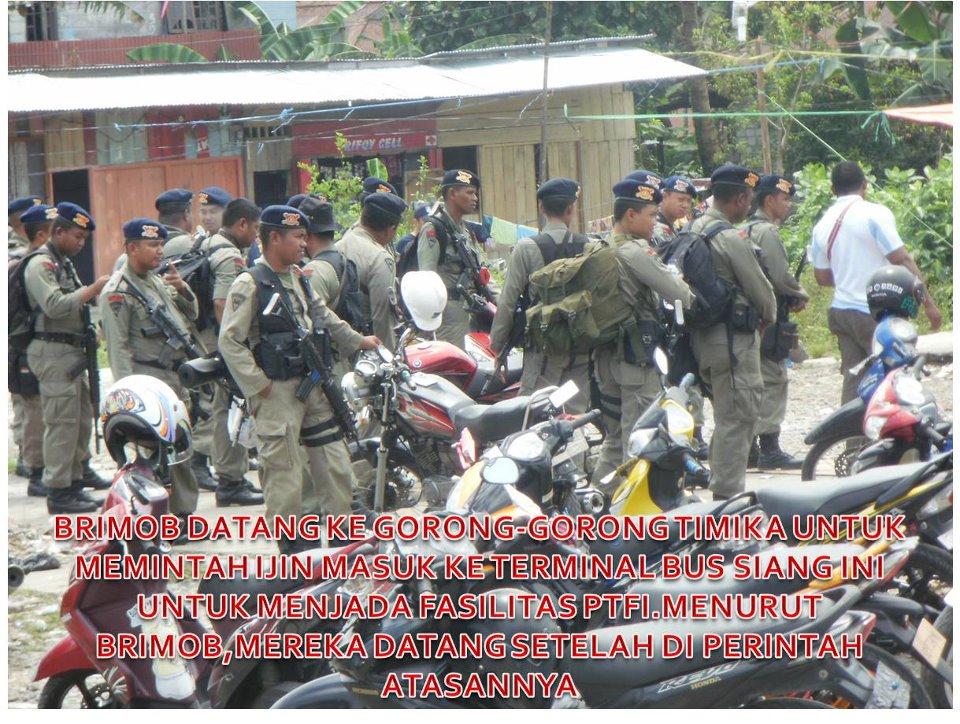
Petrus Ayamiseba who was 36 years old died when he was struck by a burning rod of tin belonging to the police while he was taking part in a demonstration at the Gorong-Gorong Terminal.

During the incident, another person was also killed, namely  Jamil, a member of Brimob.

UN wants to send Special Rapporteur to Indonesia to investigate MIFEE


Bintang Papua, 12 October 2011The UN Commission to Combat Racial Discrimination and Protect the Rights of Indigenous People has sent a letter to the Indonesian ambassador to Geneva, Anwar Kemal, regarding several matters.

In the first place, to agree to invite the UN Special Rapporteur on Human Rights to visit Indonesia in connection with MIFEE, the Merauke Integrated Energy and Food Project in West Papua. In the second place to hold talks with CERD for this matter to be discussed at the forthcoming meeting of the Committee in Geneva from 13 February – 13 March 2012. And thirdly, to to make available comprehensive information regarding all the matters contained in the afore-mentioned latter.

This was made  public following a meeting by a number of NGOs in Jayapura on 12 October which was attended among others by Foker-NGO-Papua, Sawit Watch, Greenpeace, Justuce and Peace Commission/Jayapura, Walhi and Sorpatom in Jayapura on 12 October.

The Coalition of NGOs said that the response of the UN to the MIFEE project had exerted pressure on the Indonesian government to halt all activities related to the MIFEE project and to invite the UN Special Rapporteur on Human Rights to investigate this project before 13 January 2012.

The coalition said that MIFEE would have a strategically significant inpact on the availability of foodstuffs and energy resources in Indonesia.

This project will cover an area of 1.6 million hectares which will be used to produce millions of tons of rice, corn, beans and sugar as well as promote cattle-rearing. Dazzled  by this massive project, they have closed their eyes to a huge problem that will confront the population of Merauke whose land will be consumed by the MIFEE.project.

The MIFEE project is a highly ambitious mega  project of the Indonesian Government based on a slogan to produce food for the whole world. They intend to take control of an area of 1.6m ha of land for agri-business purposes. The resultant food will be exported, meaning that MIFEE is directed towards the export market. Thirty-six companies have already been attracted by the MIFEE project with investment capital to the value of Rp 18.9 trillion, along with domestic capital.

Research undertaken by various organisations has identified a number of problems.

First of all, this project which will cover a total area of  altogether 2m ha of land belonging to the indigenous people will have a direct impact on the traditional rights of the these people.

Furthermore,  this expansion will cut down forests belonging to indigenous people in order to grow  palm oil and will result in the influx of a huge number of people from outside the area, threatening the local people’s livelihoods and destroying their traditional economic practices.

These developments will exert huge pressure on the Malind people and their traditions in particular, and the Papuan people in general, turning them into a minority people in their own land.

In addition, these developments which are supported by various state forces will require the protection of the Indonesian army.

Fourthly, the decisions regarding exploitation of natural resources are hugely dependent on the central government and are being developed in accordance with national laws that ignore the indigenous people, despite the adoption of the Special Autonomy law in 2001, the aim of which was to decentralise decision-making to the provincial level with regard to a number of issues, while nothing has happened regarding the introduction regulations.for the implementation of this law.

Fifthly, it is understood that most of the MIFEE area has been classified as ‘forest’ and placed under the jurisdiction of the forestry department, whose interpretation of the forestry laws impinge on the rights of the indigenous people.

Finally, there are reports that local communities have been manipulated by investors and government officials so as to secure their signatures  to provide the legal basis for certificates affirming their right to the land of the indigenous people.

Three hundred Freeport workers ordered home

Bintang  Papua, 14 October 2011Freeport orders 300 workers to ‘go home’

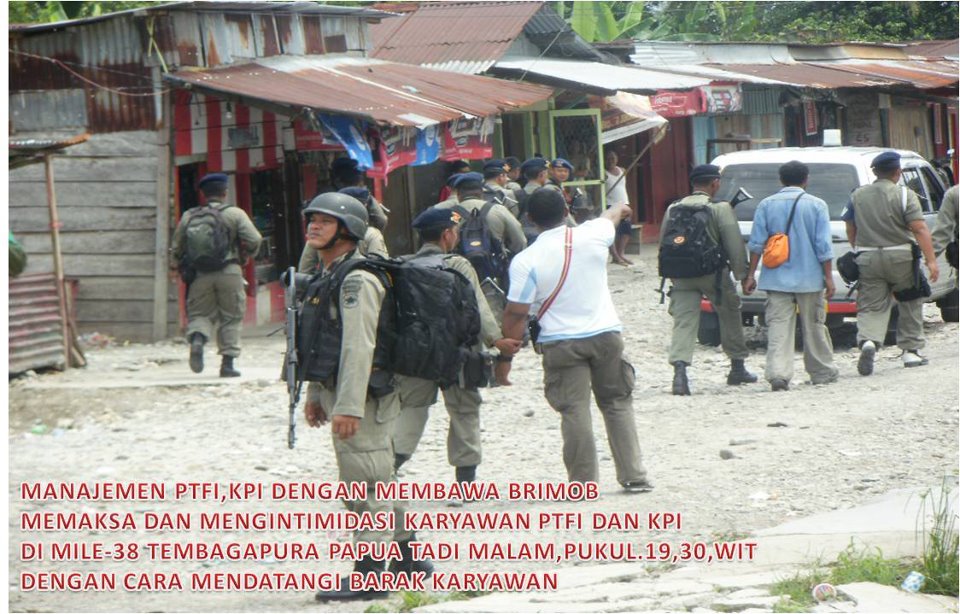
Timika: Reports that workers at Freeport have intimidated and threatened  other workers for refusing to take part in demonstrations and not wanting to go on strike have led to around three hundred Freeport workers being order to go home [dirumahkan’], according to the management of Freeport-Indonesia. Sixty of the three hundred  are staff-level employees joined the strike that commenced on 15 September.

The president-director and CEO of Freeport, Armando Mahler in Timika said on Thursday that the decision to order them home  was taken because they  were involved in intimidating workers who remained at work  and did not join the strike. ‘At the time, many of of the workers felt afraid and threatened. They fled from their barracks and went into hiding. The families of some of the workers who continued to work were also warned that their homes would be burnt down,’  said Armando.

He went on to say that after the strike is over and operations at the Freeport return to normal, the management intends to conduct an investigation to determine what mistakes each of the workers who were ordered home  had made.

Additionally, the director-executive, vice-president  and chief office administrator of the Freeport, Sinta Sirait, said that the decision to order home hundreds of workers meant that the third summons [see below] issued to non-staff employees who had joined the strike was in accordance with the Joint Working Agreement which had been agreed with the workers trade union, the SPSI.

Sinta called on all sides to respect the terms of the agreement that had been reached and not treat it as nothing more than a lip service. ‘We urge the workers not to think that being ordered home and then returning to work is only about establishing good industrial relations with the company.’

Another  manager of the company, John Rumainum said that in a spirit of goodwill, the company had called on the workers to return to work. The first summons was issued on 26 September,  followed by the second summons issued on 29 September and the third summons issued on 4 October.

He went on to say: ‘Those workers who returned to work before the third summons will be exempt from any sanctions But those who returned to work after the third summons, would be treated in accordance with the regulations…

He then said that all the sanctions issued by the company  would be reviewed, once the workers had returned to work.

[Translated and slightly abridged by TAPOL]

[COMMENT: This report reveals the attitude of the company towards hundreds of its employees who were clearly seeking to improve their working conditions during a strike that has been marked by  persistent threats from the company that runs one of the foremost and most profitable mines in the world. TAPOL]

Create a website or blog at WordPress.com

Up ↑