Bobii: Australian PM’s Words Hurt the People of Papua

Opinion/Analysis

By Selpius Bobii in Abepura State Prison

 14 October 2013

“People seeking to grandstand against Indonesia, please, don’t look to do it in Australia, you are not welcome. ………. The situation in West Papua is getting better, not worse” were the words of Australian Prime Minister Tony Abbott on 7 October 2013 after three Papuan citizens scaled the wall and entered the Australian Consulate in Bali(1)

These words of the Prime Minister of Australia are extremely hurtful to the people of the nation of Papua as they are the precise opposite to the truth of the situation in Papua, where things are getting progressively worse for the indigenous population.   Even Lukas Enembe, the Governor of Papua stated that the Province was experiencing a decline in a lot of key areas such as health, education and local economics(2).  Lukas Enembe also witnessed to the well known fact that “Papuans are an increasing minority in their own land. Papuans have been overpowered by other peoples who are not from this land.” (3)

Space for even some minimal semblance of democracy in Papua has been absolutely closed whilst the State of Indonesia continues to commit one after another atrocity against the indigenous people of Papua.  Alpius Mote for instance, aged 17 years, was shot dead by the Indonesian Special Police Unit BRIMOB on 23 September in Waghete, District of Tigi, when a number of locals voiced objection to arbitrary arrests and most insulting ‘over-the’top’ sweeping by armed forces targeting males with long beards and hair. Then there’s the brutal military operations that have been continuing relentlessly for months in Puncak Jaya and also in Paniai to chase those suspected of being part of the TPN/OPM. Operations which have only led to the innocent civilians becoming victims (such as 12 year old Arlince Tabuni who was shot dead on 1 July 2013 in the village of Popumo, Lani Jaya). There has also of late been an escalation in Papua in the level of intimidation and terrorising acts towards the indigenous people of the land and even more so  against Papuan activists (6).

In just these last days the bodies of yet 7 more civilians have been found  – including a 4 year old and 11 year old child – after their vehicle left Sarmi to head towards the city of Sentani near Jayapura but they never arrived (4). All 7 bodies were found in their upturned vehicle and it is believed they had been abducted.  It was reported that they were killed by what has become a common term now in Papua, ‘unknown assailant/s’(5).

In order to hide the many forms of tyrannic oppression in Papua, RI has until this time denied access to both international journalists and international human rights (HAM) workers to visit Papua. Indeed ever since Papua was annexed into the Republic of Indonesia (RI) on 1 May 1963, it has been isolated and closed to these international groups. Indigenous Papuans have been forced to live in this state of being terrorised and yet isolated from the reach of the outside world, experiencing violence and a state of upheaval in their lives. Such that for Papuans it’s like existing in the ‘living hell’ of Indonesia.

The Australian Prime Minister has never experienced the forms of brutal and tyrannic oppression that indigenous Papuans are forced to live under; neither has he seen first-hand the real -life conditions  that indigenous Papuans have been suffering for over 50 years now under the Indonesian Republic. If one has never experienced such oppression and has never seen first-hand the real life conditions of indigenous Papuans but there have been constant reports of brutality and severe oppression for 50 years, then would it not be right that Australia as the current Chair of the United Nations (UN) Security Council should together with other members of the UN Security Council organise for a UN Special Representative to carry out investigation into the alleged human rights violations and the political status of West Papua? Such as was requested formally by the Prime Minister of Vanuatu in his historical speech at the recent 68th session of the annual debate of the U.N General Assembly in New York on 28 September 2013.

The people of Papua can only think that Tony Abbott’s words “The situation in West- Papua is getting better, not worse” must be the result of influence from propaganda and provocation by the Indonesian Government recently when  he firstly visited Jakarta on 30 September and then when he returned again to Bali to attend the APEC Conference in early October. Indeed of late the State of Indonesia has lifted its level of diplomacy with the use of propaganda and provocation towards the international community and in particular key leaders around the world – of which the Australian Prime Minister is one – in their efforts of working to undermine any possibility of sympathy arising towards the problems of Papua. To achieve that end Indonesia has employed no small level of resources and staff.

From the perspective of Papuans the new Australian Prime Minister is not all that different from those in the position before him regarding the issue of Papua. Of course Papuans totally appreciate the importance of the position and interests between the governments of Australia and Indonesia. Furthermore,  Papuans truly understand the Australian Prime Minister’s attitude towards Papua must be one of caution in order to protect bilateral relations between Australia and Indonesia. However Australia as a member of the U.N and what more in the trusted position as the current chair of the UN Security Council, has both a legal and moral obligation to uphold and respect human rights around the world and particularly in those particular regions which there is known to be serious concerns such as Papua. Australia cannot avoid its responsibilities to protect and respect the dignity of humanity where freedoms and the very right to life is being threatened such as is the present threat to the indigenous peoples of Papua who are now known to be heading towards annihilation of their race due to a slow moving genocide.

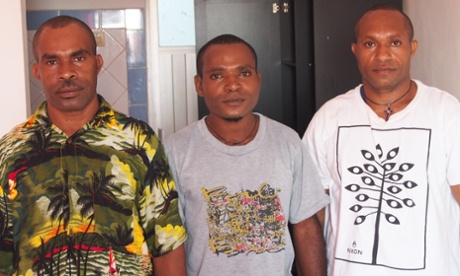
The Australian Government has been in the frontline recently  in regards to the matter of Papua.  On 24 September 2013 seven indigenous Papuans who landed as refugees at Boigi Island in the Torres Strait (including one woman who was pregnant and a 10 year old child) were transferred to Horn Island.  After being interviewed by authorities they were given no choice of staying in Australia and were forced to choose between being sent back to Indonesia or going to PNG. They very swiftly transferred to PNG (7). Then on 6 October 2013 three young Papuan males scaled the wall of the Australian Consulate in Bali and entered the compound so as to seek Australia’s help for Papua. They then also sought refuge for themselves.  Despite the risk they then faced from Indonesia, in the early hours of that same morning before 0700 hours the 3 had been immediately asked to leave the compound with the threat that the police would be called. In being forced to leave the compound after pleading for help for Papua, of course they were terrified about their safety as their lives were then much more at risk, as they well knew the ramifications could mean torture or leading to them ‘disappearing’ as a result of actions by the Indonesian armed forces.  The Australian Senator Richard Di Natale immediately called on the Australian Government to request they be given protection but without response (8). The nation of Papua finds the actions of the Australian Consulate in Bali absolutely unacceptable as the 3 young people had in fact entered the Consulate to seek safety and protection (9).

The Australian Prime Minister subsequently  stated that the Australian Government is going to suppress any activism in Australia that opposes Indonesia in support of West Papua. Abbott’s statement was immediately criticised by Vanuatu’s first and former Prime Minister Ati George Sokomanu who demanded Tony Abbott explained his statement to the leaders of the Pacific (10). Sokomanu stressed that whilst immigration issues could be dealt with by the courts, that Australia must be prepared to discuss questions of human rights. He stated that due to the fact that Australia and New Zealand are the closest neighbours,  “ I think for the sake of the people of West Papua with their rights, that Australia and New Zealand should broaden their view to provide support and do whatever they can to help the people of Papua to achieve their independence”(11).

The Australian and international communities that are concerned about the suffering of indigenous Papuans, are following the political direction of the new Australian cabinet under PM Tony Abbott.  We are yet to see whether as Papua’s closest neighbour, the Australian government will follow a foreign policy that shows some special care in handling cases of human rights violations in Papua and the political status of the land of Papua? Or whether the Australian Government will merely guard its bilateral relations with Indonesia and allow the Republic of Indonesia to continue to act in such ways that it creates marginalisation, discrimination, making a people a minority in their own lands and carries acts of humanitarian evils through its armed forces against the indigenous people of Papua? Actions that together are leading to the annihilation of the ethnic West Papuan race.

Footnotes
1. http://www.smh.com.au/federal-politics/political-news/claim-of-australian-threat-to-west-papuans-in-bali-consulate- protest-20131007-2v4cg.html

2.(Indonesian version) www.tabloidjubi.com/2013/10/12/banyak-kemunduran-di-papua/

3.(Indonesian version) www.tabloidjubi.com/2013/10/12/gubernur-papua-oap-jadi-minoritas/

4. Details of the victims are as follows Bartolomeus Fere (aged 53 years), Agustina Fere (38), Yan Marthen Fere (30), Boas Hawase (35), Elisabet Felle (40), Melinda Felle (11), dan Avia Hawase (4).    (Indonesian version) (www.merdeka.com/peristiwa/7-warga-sentani-papua-diculik-orang-tak-   dikenal.html).

 5. Cenderawasih Post, Edition Monday, 14 October 2013.

 6. Such as for example that experienced by the 4 activists in Fak-Fak on 29 September 2013 Abner Hegemur, Yanto Hindom, Morten Kabes, dan Kaleb Hegemur. The activists were riding home on motor bikes on the main road leading to the town of Fak-Fak after visiting some children alleged to have experienced violence by the armed forces at the Tetar village in the Patipi District outside of Fak-Fak. They were followed throughout their journey home by the Special Forces Unit Densus 88 (the anti-terrorist forces now operating throughout Papua against civilians) accompanied by another 4 armed forces vehicles. A number of the vehicles then located themselves in front of the activist’s motorbikes whilst the remainder followed from behind. Those in front kept changing positions with those behind adding to the terrorizing effect on the 4 riders. This continued throughout their journey until they reached the borders of town of Fak-Fak at which time the vehicles drove off.

(Indonesian version) http://www.majalahselangkah.com/content/teror-dan-intimidasi-terhadap-aktivis-papua-masih-berlanjut

 7. http://www.theguardian.com/world/2013/oct/11/west-papuans-refugee-camp-border

 8. Rofinus Yanggam, Yuvensius Goo and Markus Yerewon

9. http://www.smh.com.au/federal-politics/political-news/claim-of-australian-threat-to-west-papuans-in-bali-consulate-protest-20131007-2v4cg.html

 10. https://vanuatudaily.wordpress.com/2013/10/09/vanuatu-daily-news-digest-9-october-2013/

 11. http://thevoiceofwestpapua.wordpress.com/2013/10/13/abbott-requested-explain-of-he-statement-to-pacific-countries/

Selpius Bobii is the General Chairperson of Front PEPERA & a Papuan Freedom Political Detainee in Abepura Prison, Jayapura


Planned MSG Foreign Ministers visit to West Papua lacks transparency

Exclusive investigation from West Papua Media team

October 12, 2013

(The Hague): As allegations surface of Indonesian military-linked businessmen providing envelopes of “hefty cash” to senior officials in the Solomon Island’s Prime Ministerial delegation during the recent APEC summit in Bali, a high level source inside the Melanesian Spearhead Group has raised concerns over Indonesia’s subversion of the agreed visit of Melanesian Foreign Ministers to West Papua, in an exclusive interview with West Papua Media.

An explosive but carefully worded article in the Solomon Star newspaper on October 11 has alleged that Indonesian officials provided members of Solomon Islands government with large amounts of cash contained in yellow envelopes, during an official dinner hosted in honour of the Prime Minister Gordon Darcy Lilo and his delegation.

According to the Solomon Star report, at least five members of the delegation have admitted to receiving the payments, amongst a total of 17 delegation members alleged to have received the envelopes.  The report, from interviews by journalist Alfred Sasako with a highly placed whistleblower in Honiara, alleged that at least two “names withheld” senior officials received USD$25, 000 each, three others received USD$10, 000  and a final two delegation members received USD$5, 000 each respectively.

“It seems the level of payment is based on seniority, the higher you are, the more you get,” the sources told the Solomon Star.

After the publication of the new allegations, West Papua Media spoke on Saturday to a well-respected customary figure in the Solomon Islands, who described the latest revelations as proof of long-standing suspicions “that Indonesia is involved in a corrupt subversion of Melanesian solidarity on the West Papua issue.  The source described the behaviour of Prime Minister Gordon Darcy Lilo in arranging unilateral visits to West Papua as “an affront to the Melanesian Way that is deliberately undermining the quality of what a properly constituted MSG Fact-finding mission can uncover in West Papua.”

“The Prime Minster is siding with Indonesia to cover up the crimes against the West Papuan people, by diluting the effectiveness of a multilateral fact-finding team to assess the real situation in West Papua.  What other deals is he doing for the Solomon Islands with these Indonesian military businessmen?  Are our islands going to be the next West Papua?” the source told WPM.   The customary source, who had no involvement with the Solomon Star revelations, declined to be identified for this article citing fears of being labelled as the whistleblower.

“This is not about me anyway, this about the questions for all Melanesian people about how far Indonesia is willing to bully or bribe Melanesians, and how some Melanesians like our Prime Minister are potentially having their pockets lined with blood money for turning their backs on the suffering of our Melanesian family in West Papua,” the source told WPM with some indignation.

Prior to the MSG meeting in Noumea in June 2013 the Indonesian and Fijian governments agreed to a multi-lateral visit to West Papua by MSG Foreign Ministers. The proposal was raised at the Noumea meeting by Fiji in part to defer a decision over whether West Papua would be granted membership into the MSG or not. The MSG Ministerial team has undertaken to write a report following their visit. This report will then help guide the MSG’s decision regarding West Papua’s membership. Since June, however, serious doubts have been raised as to how transparent the organising of the MSG Foreign Ministers is, or even whether it will happen at all.

A high-level source inside the MSG who was at the meeting in Noumea but asked not to be named told WPM  on condition of anonymity, that it was highly unlikely that the MSG will revoke Indonesia’s observer status, but that they could give West Papua ‘associative status’, which is a higher level of membership. However, the source then went on to say that it is now “not clear what is happening”.

The concerns are serious. First, no date has been set for the Foreign Ministers visit to West Papua. Second, neither the MSG Secretariat nor Melanesian nations are organising the visit. “The Foreign Ministers all rely on an invitation from the Indonesian government. It is not clear if such an invitation has been issued and it is not clear who will pay for it. My advice to member countries is that each Melanesian country pays for their own visit themselves” said the senior MSG bureaucrat. “That way the Foreign Ministers will not be beholden to the Indonesian government and that their status as independent advisors to the MSG is more likely to be guaranteed.”

Most concerning is that the idea of a multi-lateral visit could be abandoned. “It is possible” said the MSG official “that the foreign ministers could travel to West Papua separately and not as a group”.  This is the most likely possibility given the revelations in the Solomon Star.

Although privately many Melanesian politicians support independence for West Papua the official cautioned against false hopes. “West Papuans should not have high expectations from the forthcoming MSG foreign ministers support.”

At this stage it appears highly unlikely that the Melanesian foreign ministers report will reflect the political reality inside West Papua or the aspirations of the West Papuan people.  This view is reflected in the recent comments from Mr Gordon Lilo, the Prime Minister of the Solomon Islands, who told Indonesia’s Antara state news agency that he is “impressed with the progress” the Indonesian government has made in West Papua.  Mannaseh Sogovare, the Solomon Islands opposition leader, criticised Lilo’s comments saying that he had “probably been overwhelmed by the reception of the hosts and obviously the Indonesians have gone out of their way to put on the wow factor to make sure that Lilo is wooed out of any views that he may have had in support of West Papuan membership of the MSG,” reported Radio New Zealand.

Comment about the corruption of the Fact-Finding process has also been repeatedly sought by West Papua Media from the office of Vanuatu Prime Minister Moana Carcasses, however the Prime Minister was unavailable to comment on the allegations.  However, Carcasses issued a historic and moral challenge to the international community at the United Nations General Assembly in New York in late September, by calling for the appointment of a Special Representative to investigate historical and ongoing of human rights abuses by Indonesia.

‘How can we then ignore hundreds of thousands of West Papuans who have been beaten and murdered? The people of West Papua are looking to the UN as a beacon of hope… Let us, my colleague leaders, with the same moral conviction, yield our support to the plight of West Papuans. It is time for the United Nations to move beyond its periphery and address and rectify some historical errors,” Carcasses told the UN General Assembly.

These are the words that Melanesian leaders may well be reflecting on as they ponder the ramifications of accepting Indonesia’s subversion of the MSG Fact Finding Team process.

As well as sharing his concerns, the senior MSG official also had some practical advice for Papuan leaders. “All of us at the MSG are observing very closely developments inside West Papua. In order for us to assist the West Papuan application for membership Papuan leaders need to present a unified position that is backed up by strong support from civil society. The good news is that there is moral support from inside the MSG. Even senior leaders in the United Nations privately recognise that West Papua is an occupation.”

However, without unity of purpose from West Papuan leaders and strong grassroots support from inside Melanesian countries, the Indonesian government could out-manoeuver West Papua again.

WestPapuaMedia team

PMW: Activists ‘forced’ to leave consulate, call for greater press freedom

by Daniel Drageset, Pacific Media Watch

October 7, 2013

West Papuan student activists Rofinus Yanggam (left), Yuvensius Goo and Markus Jerewon (right) left the Australian consulate in Bali Sunday. Image: Marni Cordell

AUCKLAND (Pacific Media Watch): Three West Papuan student activists entered the Australian consulate in Bali this weekend with calls on Australian Prime Minister Tony Abbott to open up for greater press freedom and push Indonesia to release at least 55 political prisoners jailed in the Indonesian-ruled region.

“We want the Indonesian government to lift the 50 year restriction it has imposed on West Papua.

“We want foreigners, including journalists, diplomats, observers and tourists to be able to visit West Papua freely without asking for special permits,” the West Papuans wrote in an open letter addressed to the Australian people.

The student activists said in the letter they wanted to deliver a message to the leaders attending the 25th Asia-Pacific Economic Cooperation (APEC) summit in Bali this weekend.

Several organisations have asked Australia to give sanctuary to the three West Papuans, but according to Australian Trade Minister Andrew Robb the West Papuans did not seek asylum.

“They left [the consulate] voluntarily so the matter’s been resolved,” Robb said, according to Radio Australia.

The Guardian, however, reported that the consul-general had warned the three West Papuans that the Indonesian army would be called if they did not leave the consulate.

One of the students, Rofinus Yanggam, told the newspaper the group left in fear of their lives.

Calls for sanctuary
Australian independent senator Nick Xenophon called on Foreign Minister Julie Bishop to give sanctuary to the three West Papuans.

“These three young men were not asking for West Papuan independence from Indonesia. All they were asking for is entirely consistent with the Lombok Treaty of 2006, signed by both Australia and Indonesia,” he said, according to AAP.

“Instead of getting sanctuary and help, the Australian government effectively threatened them and now there is serious concern over the activists’ safety,” Xenophon said.

Professor Clinton Fernandes at the University of New South Wales backed Xenophon’s call.

He said when the media circus had moved on after APEC, the trio “may be tried, most certainly they will be beaten, and at some point might be disappeared”.

Rinto Kogoya, co-ordinator of the Alliance of Papuan Students, said it was time the world understood what was happening inside the province, which was officially acquired by Indonesia in 1969.

“The international community doesn’t know the reality in Papua. The military oppresses the civil society – we’re not free to do anything – and I think this is the moment to open democracy to Papua,” he said in The Guardian.

‘Great concern’
Joe Collins, of the Australia West Papua Association (AWPA), was alarmed by the events at the Australian consulate in Bali.

“It’s of great concern that they [the West Papuan students] may have been coerced to leave as the students would have great reason to fear the Indonesian security forces.

“There are ongoing human rights abuses in West Papua and the security forces have been banning and cracking down on recent rallies to try and stop international attention being focused on the territory,” he said in a statement.

AWPA wrote a letter to the consul-general Brett Farmer in Bali yesterday asking for “clarification” regarding the students.

“We understand that they have now left the consulate and we would like clarification from you if they left voluntarily or as some media reports have indicated that they were told that they would be handed over to the Indonesian military if they did not leave,” AWPA wrote in the letter.

Australian Green senator Dr Richard Di Natale has also joined those who have called for Australia to give sanctuary to the three West Papuans.

“By speaking out in this way, these brave West Papuans have put their lives in serious danger.

“If Australia fails to offer them protection, I have grave fears for their safety,” he said in a statement.

‘Stand up to Indonesia’
Yet another senator to voice his support for West Papua this weekend was John Madigan.

“It is about time our government had the courage to stand up to Indonesia, instead of ignoring the issue of West Papuan oppression and the human rights abuses that occur there on a daily basis,” he said in a statement.

He also said he demanded that the Australian government provided sanctuary for the three West Papuans.

The issue of the West Papuan students came just days after pleas from several organisations that Australia should not deport seven West Papuans who arrived in the Torres Strait Islands in northern Queensland recently.

The group of seven, who took part in the recent West Papua Freedom Flotilla sought asylum in Australia, but were deported to Papua New Guinea under a memorandum of understanding between Australia and Papua New Guinea, Radio New Zealand International reported.

Refugee advocates in Australia said the deportation failed to abide by the Refugee Convention that Australia was a party to.

Spokesperson for the West Papua Freedom Flotilla Izzy Brown said she wanted to draw the United Nations’ attention to Australia’s commitment to the Refugee Convention.

“It’s really unfortunate that Australia thinks it can send asylum seekers offshore without due process or just blatantly illegally deported like in this case here, and we really want to try and draw the world’s attention and especially the UN’s attention to Australia’s behaviour in this matter,” she said.

Read the West Papuan students letter to “the people of Australia”

Creative Commons Licence

About the author

PMW contributing editor

Daniel Drageset is a Norwegian radio journalist enrolled in the Master in Communication Studies degree at AUT University.

Destroying sago trees will kill the Papuan people

JUBI,
6 September 2013

Merauke:  A member of the Regional Legislative Assembly of Merauke  has once against drawn attention to the activities now under way  by a company called PT Dongeng Prabawa. The crucial issue he raised relates to  the sago trees  belonging to the people living in various kampungs in the District of Ngguti.

‘I want to say to the company that  if the sago trees which have been protected and looked after by the Marind people for generations are felled  to make way for an investment project, you will be killing the indigenous Papuan people. Sago is the basic foodstuff for the indigenous people and it is unacceptable for the you to destroy their trees.’.

Hendrikus Hengky Ndiken said areas where the sago trees grow must not be dealt with in this way by the company. It is unacceptable for these areas where local people live to be exploited. What are the people going to eat if their source of food is destroyed?

He also insisted that the company abide by the agreement to pay for their land.which amounts to Rp30 billion. They must  pay up now and not pay in instalments. ‘They have billions of rupiahs so how can it be that they cannot  comply with their obligations to the people? If you can’t pay up, then you had better get out, he said.

He went on to say that he had visited a kampung called kampung Senegi and asked the people what they had received from the company. They said that they had received nothing except for a church.

The local district chief Romanus Mbaraks said that not all the trees belonging to the people had been destroyed. In some sacred areas, the people  had guarded their trees. ‘I ask the people to report to us if their sago trees have been destroyed by the company.’

Translated by TAPOL


Papua Ablaze! The Need for a Touch of Hearts

Opinion

by: Selpius Bobii.

Abepura Prison

September 8, 2013

“ In Syria hundreds of civilians are dead from a suspected attack with poison gas on Wednesday 21 August 2013 at a location close to the Syrian capital of Damascus. Meanwhile in Papua hundreds of thousands of Papuan citizens are also dead, having been killed over the time frame of the last 50 years. Killed as a result of military operations both covert and overt, undertaken in a planned, systematic and measurable way since the 1960’s until this time. (For further information see https://westpapuamedia.info/2013/03/30/selpius-bobii-the-annihilation-of-indigenous-west-papuans-a-challenge-and-a-hope/).

The United Nations (UN) Security Council held a sudden meeting to discuss the suspected use of poison gas in Syria and to find out who was responsible and acted swiftly to organise a Fact Finding Team, as the use of any weapon to annihilate people in mass numbers such as a poison gas falls within the category of ‘humanitarian evils’. Meanwhile the USA is considering a military attack against the Syrian Government if it is proven without doubt that they in fact used a weapon of mass destruction was used by the Syrian Government’s military. (Source: www.voaindonesia.com).

The incident in Syria is shocking beyond words and Papuans are also so deeply saddened by this tragic news.  Yet what about the lack of response by the UN to the humanitarian evil that has been continuing for over 50 years now against the people of Papua by the Republic of Indonesia? What is the attitude and actions of the UN towards the situation on Papua? Every hour there are Papuans being killed due to a range of causes that all form part of a systematic and measurable plan of the Indonesian Government that is planned to annihilate the ethnic people of Papua.  Are member states of the UN and other countries of the world going to stand-by forever and allow Indonesia to continue to carry out brutal acts of colonial domination until such time that the ethnic people of Papua are wiped out from the land of their ancestors? (For supporting evidence see: www.scoop.co.nz/stories/HL1308/S00090/genocide-of-ethnic-papuans-for-whom-what-was-un-created.htm).

Perhaps the UN and those other countries are of the opinion that the problem of Papua is not as complicated as the humanitarian problem in Syria, so it doesn’t need their involvement.  However that can only mean that they have not yet looked closely and carefully enough at the situation there.  As Papua has already become a humanitarian emergency: a hidden and horrifying humanitarian emergency that is systemic, planned and measurable.

Papua burns

Papua is ablaze and the first and primary source of that fire is the annexation of the nation of Papua into Indonesia through a military and political invasion in the 1960’s. There were four parties involved in that annexation, four parties that were responsible for  ‘lighting the fire of conflict’ in Papua: Namely Indonesia as the initiator and primary actor in the annexation; the Dutch as both an actor and a victim of aggression; the USA as the designer and primary supporter of the annexation; and the UN as the executor. Whilst Papua is the unceasing victim of those four parties’ conspiracy of economic, political and security interests.

The fire of the ideological political conflict, between the Papuan Mambruk way of looking at the world and the Indonesian Pancasila ideology, creeps through and destroys the seams that hold life together for the nation of Papua. A fire of conflict that in turn has led to a range of smaller fires sparked by the first. This raging fire has burnt through the most basic rights of the indigenous Papuan community, including the very right to life.

A dense smoke has constantly billowed forth from the centre of the fire in the land of Papua. A number of parties have seen that thick smoke but there’s been no response. Of course as we all know where there is smoke there is also fire and conversely where there is fire we know there will be smoke. Similarly where there is conflict of course there are victims and conversely where there are victims we know there is conflict behind that. Until now a number of means have been used by Papuans and the international community in solidarity to try to put out the raging fire of the primary conflict and also the smaller fires that have been sparked. However the flame of conflict has continued to spread relentlessly due to Indonesia together with the support of its various allies  continuing to defend its hold on Papua. In fact they have caused the fire to spread even wider.

To extinguish this fire in the land of Papua it will need the involvement of all parties, and particularly those four primary actors being Indonesia, the Netherlands, USA and the UN together with Papua as the unceasing victim of their conspiracy of interests. The primary fire that must be extinguished  is that of the conflict around the political history of the nation of Papua. For it was this that gave rise to the other fires.  If the primary fire can be extinguished then the smaller fires will also be able to be extinguished. However if the primary fire is not extinguished then so the other smaller fires will also continue to blaze. Until ethnic Papuans are scorched – that is annihilated – in the land of their ancestors.

All those parties of good heart and which hold in high esteem those values which are worthy, have a moral responsibility whether by direct or indirect means to take control of and extinguish the fire of conflict between the supporters of the Pancasila  ideology (those who are pro Indonesia) and the supporters of the Mambruk ideology (those who are pro Papuan independence).

For as long as the fire of conflict continues to blaze between the followers and supporters of the two ideologies, so the innocent human community of Papua is being burnt. For as long as this continues, the tears of blood of the nation of Papua will continue to drip.  Indigenous Papuans must continue despite the cost of lives to redeem the situation and bring about total liberation of Papua; and the voices of liberation crying out from the people of Papua will without ceasing to fill the air until that moment when the faith revolution is realised in the land of Papua.

The nation of Papua has not asked for anything that is the possession of another. We just ask for the acknowledgement of the basic political rights of our people, the nation of Papua. As a nation-state with full independence. Just as other nations and states of the world have already had their independence recognised. This is the faith, the hope and the longing of the nation of Papua.

With all limitations and capabilities that exist within us, the nation of Papua will continue to struggle until that revolution of faith is realised.  Then with those same existing limitations and capacities we will develop our own country of Papua, standing on our own two feet.

It is dearly hoped that the voice of the nation of Papua will be heard and will be responded to by actions of all parties wherever you may be, in order to uphold the values of justice, truth, democracy, honesty, human rights and peace for all.

The prayers and tears of the nation of Papua without ceasing accompany all of those amongst you who care for our situation, wherever you may be located and working to support us.

Solidarity without limits!
Selpius Bobii is the General Chairperson of Front PEPERA West Papua & is a Papuan Freedom Political Detainee in Abepura Prison


Create a website or blog at WordPress.com

Up ↑