Bobii: INDONESIA CAUSES DELAY IN MSG FORUM DECISION ON WEST PAPUAN MEMBERSHIP

by Selpius Bobii in Abepura Prison, West Papua

21 December, 2013

Opinion / Analysis

In June 2013 the Indonesian Coordinating Minister for Politics, Law and Security Djoko Suyanto invited the Melanesian Spearhead Group (MSG) to send a delegation to visit Indonesia(1).  At the 19th Summit of the MSG on 21 June 2013 the MSG leadership determined that the question of the application for MSG membership by West Papua would be decided at the latest within 6 months of that meeting, following receipt of a report on a visit to Indonesia by the MSG member Foreign Ministers.

It is now 6 months to the day since that decision was made and yet the MSG Foreign Ministers have not yet visited Indonesia due to the lack of certainty concerning the invitation from Indonesia.  It is now clear that Indonesia’s supposed invitation was but a political snare to delay the MSG leadership’s decision regarding West Papua’s application for MSG membership.  Meanwhile Indonesia has been busy throughout this 6 months lobbying and making offers to the individual MSG member states in order to influence the outcome of that decision.

Indonesia is extremely sly and cunning in the way it plays its ‘Indonesian puppet’ politics. It was with the very same slyness that enabled Indonesia to succeed in annexing West Papua into the Republic of Indonesia in the 1960s and which has enabled Indonesia to maintain its hold on Papua ever since. Indonesia has undertaken all possible means to influence the international community such that West Papua to this date remains within the region of RI’s power, and Indonesia’s invitation to the MSG in June 2013 was but one of RI’s political strategies to that end.  It was an intentional ploy to cause Papua’s efforts to become a member of the MSG to fail.

From the time news was heard of Indonesia’s invitation to the MSG, the indigenous Papuan community already knew that Indonesia would not follow through in fulfilling its commitment to enable the MSG visit to Jakarta and Papua; and that has now become a reality.  Meanwhile almost all of the member nations of the MSG have fallen right into the snares set by Indonesia, allowing themselves to be manipulated so as to meet Indonesia’s purpose of defeating Papua’s application for MSG membership.

Indonesia has not only tricked the Melanesian nations individually in this way and has tricked them as a united body in the MSG regarding the supposed invitation, but has at the same time deceived the international community in regards to the same. So many have been hoping and waiting for the outcome of this matter, many of whom have made sacrifices to uphold truth, justice and dignity of the West Papuan people.

Indonesia’s deceit of the MSG Forum in this way just serves to heighten the perception in the international community and for some of the MSG members that Indonesia as a state is chronically lying to the world. There have been endless occasions when RI has wilfully lied in order to maintain its hold on West Papua within Indonesia and so many have been deceived by Indonesia’s cunning and sly ways in this regard. The tragic consequence being that as a result many parties have chosen to ignore the urgent humanitarian problems in West Papua, problems the ramifications of which are most horrifying indeed. Problems that Indonesia for 50 years has gone to great efforts to hide from the world.  And so determination of the legal and political status of Papua according to international law has also been delayed.

Discussions in relation to the human rights violations and the legal and political status of the West Papuan nation at the 19th Summit of the MSG in Noumea, gave a breath of fresh air and new hope to the indigenous community of West Papua. To a people who have been under the cruel colonial domination of Indonesia and its allies for over 50 years. It is dearly hoped that this new hope born of the 19th MSG Summit will not just elapse like the passing of time; and that it will not be brought down by the many offers made by the Indonesian government and its allies to the MSG member states.  Rather the Melanesian people of Papua hope and pray that the stated commitment of the 19th MSG forum will be upheld and defended, seeing West Papua given full membership at the MSG and consequently of the Pacific Islands Forum.  Such that in time the problem of Papua can be dealt with by the official mechanisms of the United Nations and the nation of Papua become independent and set free from all forms of tyranny, oppression and enslavement.

The commitment of the MSG Forum at this time is indeed being sorely tested. Will the MSG leadership have the courage to decide in the near future to make West Papua a full member of the MSG without having to wait for a report from a now much delayed visit of the MSG member Foreign Ministers to Indonesia? Or will the MSG leadership delay that decision and succumb to the influence of the cunning politics of Indonesia and its allies?

The indigenous community of Papua and those in the international community who care about the fate of West Papuans, are following the political wake from the last MSG Summit. All are awaiting a decision of certainty on West Papua’s application for MSG membership as a first real and effective step towards eventually bringing the problem of the legal and political status of West Papua to the mechanisms of the United Nations.  As the people of Papua have not struggled for more than 50 years  to take something that rightfully belongs to another, but rather to have the sovereign independence of the people of Papua recognised by the world.

Footnotes:

1. That invitation was conveyed by Suyanto when he met with the Fijian Prime Minister (at that time the Chairperson of the MSG) in Suva, Fiji. 

Selpius Bobii is the  General Chairperson of Front PEPERA.  This article is written from Abepura Prison, Jayapura, Papua, Indonesia

 Related articles

Warinussy: More makar cases in Papua

Comment by Yan Christian Warinussy, senior lawyer in West Papua, recipient of the John Humphreys Freedom Award, 2005
December 13, 2013

The latest treason verdict against seven West Papuans is yet another example of the serious human rights situation in West Papuan, in particular with regard to the right to freedom of expression. The seven men were headed by Isak Kalaiban.

Based on the facts revealed during the course of the trial, it is clear that there was a plan between the accused to freely give expression to their views in a way that is based on the rule of law.
This occurred on 1 May 2013 after Isak and his colleagues brought the families of the accused together on the previous day at their home  in Aimas-Sorong. While they were meeting together,  a police patrol in Sorong began to opened fire at the group of people, as a result of which four people were killed or wounded.
At the trial, the men were charged with treason (makar)  by the court in Sorong before a panel of judges headed by Maria Magdalena Sitanggung.
None of the witnesses questioned at the trial said anything about what had taken place on the day before, 30 April.
For the legal team defending the accused, the question is who indeed is it that perpetrated treason in view of the fact that none of the witnesses who appeared in the trial knew anything about the men who were being charged.
This is yet another case in which the accused were charged under Articles 106, 108  and 110 to prevent people in Sorong from giving free expression to their rights to freedom of expression and freedom of assembly  as provided for by Law 39/1999 on Human Rights and the Universal Declaration of Human Rights.
Translated by Carmel Budiardjo

Shootings, killings, beatings, arrests as Hundreds flee to jungle after Indon Police open fire on peaceful KNPB demo

From the entire West Papua Media team in PNG and West Papua

November 28, 2013

WPM apologises for the delay in posting due to the remote location of the WPM team, and the delays in finding independent witnesses to help in cross-checking of this extreme situation.  This situation is developing and will be updated as more information comes to hand.

Key developments:

  • Indonesian police open fire on peaceful protesters in Jayapura, with at least four gunshot wounds and one death;
  • West Papuan activists and families forced to flee to the jungle for safety;
  • Indonesian security forces conduct scores of raids, sweeps and offensives against West Papuan civilians;
  • Attacks happen during visit of National Police Chief General Sutarman
  • over 200 people arrested across West Papua;
  • Journalists attacked by Indonesian police;

This slideshow requires JavaScript.

Images from the crackdown in Jayapura (Credit:West Papua Media/MS); Images from Arrests in Timika (Credit: KNPBNews.com); and Wamena (Credit: WestPapuaMedia/KNPBNews.com).

Indonesian forces have again opened fire on a peaceful Jayapura gathering of about 500 people held by the West Papua National Committee (KNPB), with the shooting of at least 4 demonstrators, and the confirmed death of at least one, on November 26.  A total of 15 people are still in serious condition in hospitals around Jayapura with a range of wounds sustained during the live fire dispersal by Indonesian police.

In the worst single act of Indonesian state violence since the October 19 2011 crackdown on the Third Papuan Peoples Congress, ongoing sweeps and arrests have been continuing in the time since, causing most members of the KNPB fleeing with their families into the relative safety of the jungle.  Unconfirmed reports have also surface that the police have called in the Indonesian Army (TNI) to hunt for KNPB members.

Correspondents have also reported to West Papua Media that Indonesian radio stations in Papua have been broadcasting repeated messages from the Indonesian police against all pro-independence forces, starting with the KNPB.  “We will use force to break apart the KNPB,” a senior Indonesian Police figure in Papua was heard to say on all Jayapura radio stations early on Wednesday morning.  Unconfirmed reports have said that these broadcasts have been repeated hourly across West Papua, with the National Police Chief also issuing warnings that separatism will not be accepted any more.

The rally was part of a nationwide day of mobilisations in solidarity with the opening of the Free West Papua Campaign office in Papua New Guinea on November 28.  31 people were arrested by Police in Timika, and 3 arrested in Sorong as KNPB chapters there also organised rallies and prayers to support the opening of the PNG office, which is being held with the involvement of thousands of people throughout Papua New Guinea, including senior members of the PNG Parliament.

A rally in Wamena drew several thousand enthusiastic and cheering supporters wearing traditional dress (many bedecked in the banned Morning Star flag) on a long march mass action, led by KNPB Wamena region Chairman, Simion Dabi  This was the only rally where police were vastly outnumbered by participants, and police blockaded several points along the route but did not attempt to prevent the rally from going ahead.

Jayapura
The Jayapura shooting victim, KNPB activist Matthius Tengget from near Oksibil in the Star Mountains, died of his wounds in custody.  However, his body was not retrieved until Wednesday evening after it was dumped into the lake, allegedly by those members of the Brimob paramilitary police units who shot him as they were conducting the dispersal.  At time of writing, his family were conducting his funeral in Sentani.

According to a statement from KNPB General Chairman Victor Yeimo, currently in Abepura prison, “KNPB and family members of the victims are also looking for four (4) other KNPB members that are missing: their whereabouts are unknown or their bodies have not yet been found. Three of the victims carry the Mul surname and the fourth Lambe. We strongly suspect that the police shot them and disposed of their bodies.”

“Until now we are still looking for possible victims of yesterday’s mass action who were most presumably shot and disappeared: in their attempt to disperse yesterday’s demonstration, the Police and the Mobile Brigade fired a lot of shots and they chased many demonstrators towards Buper, the Housing Complex III, Ekspo, until Iyoka and all the way to the edge of Sentani Lake,” said Yeimo.

Up to 15 people were hospitalised from both gunshots and beatings, including a group of three young women from the Yahukimo dormitory who were savagely beaten by police during their arrests.  More reports have also been given that scores of female activists were rounded up and severely beaten by Indonesian police and military officers.

The shootings were under the operational field command of the notorious hardliner Deputy Jayapura Police Chief Kiki Kurnia, Abepura area POlice commander Deky Hursepunny, together with Jayapura Police Chief Alfred Papare, with the Deputy Papua
Police Chief Paulus Waterpauw and Papua Police Chief Tito Karnavian allegedly sighted monitoring the situation from their private Kijang vehicles.

Police have predictably launched a propaganda offensive across its tame colonial media networks in West Papua, accusing the KNPB of conducting a riot.  However, stringers for West Papua Media, independent witnesses in the busy Waena shopping area, and KNPB spokespeople have all vehemently denied riotous behaviour by the protesters, instead describing how a peaceful sit-in was brutally dispersed under the orders of a cohort of four senior police officers, who have been personally responsible for ordering significant and ongoing human rights abuses against KNPB members.

Direct Witness to Brutality
A survivor of Tuesday’s violence fled to Papua New Guinea immediately after the shooting, was directly interviewed by West Papua Media  – unidentified for their own safety – and has described how police opened fire without targeting, instead firing indiscriminately into the crowd.

Before the shooting, a mass of people had gathered in the field outside the Expo Waena bus terminal and market in front of the Museum, mainly sitting and chatting while listening to speeches.  According to the witness, police surrounded the gathering on three sides, and the protest leader Buchtar Tabuni attempted to negotiate with senior police present, including the Alfred Papare, Kiki Kurnia and Deky Hursepunny. As it became clear that police were refusing to negotiate with Tabuni, demonstrators agreed to maintain the peaceful action.

According to the witness, Senior police then yelled to the crowd, ordering them to disperse.  However, almost immediately, and without further warning of escalation of the threat, Police commanders ordered the front ranks of police in front of the bus terminal to open fire.

“When the the shooting started, as I was running, I saw the KapolSek Deky Hursepunny and Kapolresta Alfred Papare standing at the gate, directing his police where to fire,” the witness said.

Upon questioning, the witness testified that police initially fired tear gas, but switched very quickly to automatic weapons.   The witness also confirmed that instead of individually targeting demonstrators, police seemed to be firing wildly into the crowd, firing indiscriminately.

Both the order to open fire without warning, and the subsequent excessive use of firearms against civilians are direct violations of both Indonesian and international law.  International Lawyer Jennifer Robinson, Convener of the International Lawyers for West Papua and currently meeting in PNG, told West Papua Media that “This use of excessive force against KNPB members is in breach of international law and Indonesia’s own police regulations on the use of force”.

“This latest incident falls within a repeated pattern of the use of excessive and lethal force by Indonesian police against peaceful activists in West Papua which is indicative of a broader state policy. Continued impunity for the police involved is unacceptable and the failure to punish gives rise to command and state responsibility,” Robinson said.

Many beatings were meted out on KNPB members by Police during the arrests, with allegations that rifle butts were repeatedly used – a standard practice for the Indonesian police against peaceful demonstrators in Papua.

Plain clothes police special forces, described by the witness as “Polisi Preman” (Police gangsters), then continued two days of terror against West Papuan civilians, some in no way connected with the civil resistance movement.  This campaign, at time of writing, shows no sign of lessening.

“We were running across Waena.  Police used many rental cars and were driving around in balaclavas like terrorists, pointing automatic weapons outside their vehicles, and shooting now around Perumnas 1, causing all who could see it to hide in their houses.  At the same time a black Avanza stopped in front of us, followed by white and red Avanzas, pointing weapons at all Papuans present. We ran, because we knew we were about to be shot – we had to seek safety with Indonesian transmigrants, who were unaware of the situation,” the witness told West Papua Media wearily.

“After police shoot the demonstrators, participants fled to the forest.  Police then conducted a brutal sweep, targeting anyone who was wearing dreadlocks, beard, or even wearing sunglasses, and arresting them all,” the witness said.  Civilians have fled in panic, and the witness described Waena as deserted when they fled.  Families of those at the demonstrations have fled to the jungle.  It is not known of normal social functions are continuing, due to the difficulty in getting direct contact with sources in Jayapura.

Our witness reported that two days prior to the demonstration, Indonesian army helicopters were searching extensively around the hills in areas that would be the the first point of refuge for civilian after any shooting.

The witness survivor believes that this indicated that the shootings by police were premeditated and planned, although West Papua Media has been unable to independently confirm this.  However the attacks on protesters occurred just prior to the arrival at Sentani airport of National Police Chief General Sutarman, who has exploited the lack of honest reportage by colonial media to issue more threats against any Papuans who dare dream they can freely express themselves.

“We will take firm action against groups or individuals wanting to separate Papua from Indonesia because Papua is part of Indonesia,” State media Antara quoted Sutarman telling the colonial press in Jayapura.

Tabloid Jubi reported that the Papua Deputy Police Chief Waterpauw has denied KNPB the right to freedom of expression, permanently. ” I made it clear to the group West Papua National Committee ( KNPB ), immediately stop the steps that are likely to violence . Whatever the form of their intention and desire to perform activities in public hearings, (it) will never be given permission or recommendation to implement it , because we know the purpose of the organisation and their desire is clear , (they) want to form a state , split off and so on , “said Waterpauw on Tuesday ( 26/11 ) evening in Jayapura City police headquarters.

An independent international observer in Jayapura contacted by West Papua Media just prior to publication, speaking on condition of anonymity, went even further than the witness now in PNG, stating unequivocally that the crackdown was a “premeditated, highly engineered manufacturing of consent of the type that Tito Karnavian is such a master of, just like his OTK killings.”

“It beggars belief that Karnavian, hoping to please his boss – or more to the point those who would seek to replace the boss with Karnavian – would not be the engine of of a textbook counterinsurgency operation to smash a pesky bunch of separatists.  The only problem is, those separatists are unarmed and were conducting a peaceful gathering.  It looks like the whole thing was organised for a long time.  It is well beyond time those gangsters were held to account,” the observer said, naming Karnavian, Kurnia, Papare and Waterpauw as the perpetrators of massive human rights abuses against Papuan civilians.

The observer added that they saw the gathering just prior to its dispersal and can vouch for the gathering’s peaceful conduct, but was disturbed at the large number of security forces that were surrounding Waena.  “There were at least ten platoons of Brimob, and hundreds of swanggi (ghosts) everywhere, surrounding on three sides the KNPB sitting in a park,” the observer said – confirming maps drawn by the survivor witness.  “They were itching for brutality.  How is this Policing?”

A total of twenty eight people were arrested, but were released by Wednesday night.  KNPB national spokesperson Wim Rocky Medlama told SuaraPapua.com that they are fed up with the police’s actions, which are arrogant and excessive. “This is too excessive. And I think that the police have much to learn. So that they undertake their duties in accordance with the orders”, as quoted in SuaraPapua.com.

Olga Hamadi, the coordinator of the Commission for Missing Persons and Victims of Violence (KontraS) Papua, also told SuaraPapua that the police’s actions were excessive and the pattern of arrests should stop.

“I’ve only just heard this information. I think that the police are too excessive. Patters of arrests such as this should no longer be necessary. This is included under the rights of each person to express themselves. Moreover this is a democratic country right”, she said in an SMS message sent to Suara Papua, adding that people expressing their views should not be attacked and arrested. “They should be given space. The issue of expressing views in public should not be responded to with arrests and law enforcement. If [the police] are going to be like this it won’t solve the Papuan problem”, said Hamadi.

More arrests
Earlier on Tuesday morning at 8:13 local time. KNPB Secretary-General Ones Suhun was arrested with 6 members of the KNPB (Assa Asso, Okram Wanimbo, Sam Lokobal, Meminda (Mendenas) Sol, Konoru Wenda, and Bonsan Mirin) by Indonesian Police outside the Student dormitories at Putaran Perumnas 3, Waena, Jayapura.  They had just begun to hand out leaflets about the afternoon’s peaceful rally calling for the respect of West Papua’s right to self-determination. Most were released by Wednesday night.

Reports received by West Papua Media overnight from distressed sources fleeing through the jungle have confirmed that a further series of brutal sweeps and raids had occurred all afternoon and evening on Tuesday and continuing through Wednesday, with unconfirmed reports of Puma helicopters being used to find activists.  Hundreds of heavily armed Police were used to raid the offices of the KNPB Secretariat on Tuesday afternoon, also confiscating  all the contents and destroying what was left.

At least thirty more people were reportedly arrested overnight on the 26th, although this has not been independently verified by West Papua Media, however Buchtar Tabuni was moved by his supporters to a safe location.

Across Papua
In Sorong, the KNPB rally was also forcibly broken up by Police, and Marthinus Yohame (regional Chairman of KNPB), Kantius Heselo (Vice chair KNPB Sorong), Natalis Surabut Gebby Mambrasar, Nius Loho and Welem Surabut, were arrested for holding the rally, but were released overnight.

In TImika,  31 people were arrested by a Joint Police and TNI taskforce at Kelly Kwalik’s Cemetery Park at about 8.15 in the morning as they began to gather for their demonstration.  Police also arrested The Chairman of KNPB Region Timika, Steven Itlay and the chair of Mimika’s Parliament, Abihut Degey  while leading peaceful rally in demand the right of Self-determination in West Papua and are being held still at the Police Post, Mile 32. Their names are:
1. Steven Itlay
2. Abihud Degey
3. Billy Hagawal
4. Dony Mote
5. Petrus Bobii
6. Bony Bora
7. Yulianus Edoway
8. Paulus Doo
9. Martinus Pekey
10. Paulina Pakage
11. Agustin Pekey
12. Sony Ukago
13. Daniel Kotouki
14. Seprianus Edoway
15. Argenes Pigay
16. Menase Dimi
17. Timotius Kossay
18. Welius Kogoya
19. Demianus Kogoya
20. Kasianus Kamke
21. Aduart Suruan
22. Melianus Gobay
23. Pais Nasia
24. Makson Kotouki
25. Maria Piligain
26. Markus Entama
27. Yustinus Pigome
28. Sior Heselo
29. Semuel Edoway
30. Agus Itlay
31. Yakonias Womsiwor

Biak also saw its KNPB rally broken up police, with several arrests reported and injuries sustained.  KNPB Biak Chairman Apollos Sroyer reported to West Papua Media that the actions of police were again excessive in preventing a prayer session from going ahead, using scores of police and troops to blockade access to the church.  Police dispersed the crowd later in the afternoon.

In Manokwari, KNPB members were also banned from holding any events in solidarity with the PNG office opening, but were able to negotiate with the hundreds of riot police, and the rally went ahead with several hundred participants, dispersing peacefully after a prayer in the late afternoon.

In remote Yahukimo in the highlands, an action supported by KNPB Yakuhimo in support of the IPWP/ILWP meeting at Parliament Haus in PNG on Nov 27, and FWPPNG office opening in PNG was held in front of the Ruko Putra store.  The action was carried out in face of threats from Brimob officers and a platoon of fully armed TNI of Kodim Wamena 1702 (Battalion 752), and also 15 Kopassus special forces brought in from Jakarta.  They were backed up by a large but unknown number of police from from POLRES Dekei Yahukimo under the command of the local Polresta Eliakin Ap.

The forces presence was was requested by Ones Pahabol, the Yahukimo Bupati (District Head). Ones Pahabol is also the local head of the Committee of the 17th District of the GIDI (Indonesian Evangelical Church), who is considered extremely pro-Indonesian.  According to KNPB sources in Yahukimo, Pahabol’s reason for requesting military support was to break up any KNPB demonstration, and he ordered the dispersal of the KNPB activists because he was prohibiting the expression of the KNPB in public.

However the KNPB reported that even though the local government, police and local church committee refused to give permission for the rally to go ahead, the district head of gidi church did give them permission. However the KNPB commented that it was “as if the church were giving permission to the military to kill their parishioners.  Despite this military threat we give our full support to the IPWP meetings happening in PNG on the 27th – 29th.” said a KNPB spokesperson from Yahukimo.

Media Attacks
Several Journalists were also attacked by police during the Waena dispersal, forcing an apology from the Jayapura police chief Alfred Papare.   Police officers reportedly beat and threatened the journalists at a scene behind the administrative court offices , Waena , Jayapura.  According to a report in SuaraPapua.com, the three West Papuan journalists that suffered intimidation from police, were Aprila Wayar ( tabloidjubi.com ) , Micelle Gobay ( SKH torch Papua ) , and Arnold Belau ( suarapapua.com ), Hengky Yeimo (MajalahSelangkah) as well as a national reporter , Alvarez Oru Maga ( Reuters )

In addition, independent media website Suara Papua has been subjected to a denial of service attack, after they published accounts conflicting from the official police version of the story.  It is believed by many season observers on cyber conflict in Indonesia, that this is the work of a shadowy  cyber- division of the Indonesian police trained and funded by the Australian government, despite the fake outrage generated by the Canberra-Jakarta spy scandal.

In news to hand just before publication, two more bodies have been recovered from around Jayapura suffering gunshot wounds, though it is unconfirmed whether they were victims of the November 26 shootings, or further murders by security forces.

A highly credible source reported to West Papua Media that on November 27 at 3.30pm, a Papuan youth named Ottis Membilang (17), was shot by two TNI soldiers.  According to witnesses, Membilang was standing on the side of the road in front if his home near the Mega store at Waena when 2 TNI members arrived in an unidentified vehicle and shot and killed him for no apparent reason.  This is within metres of the area that West Papua Media’s witnessing survivor of November 26’s violence described troops and police  driving around in Avanzas, wearing balaclavas and threatening to shoot all nearby Papuans.

At the time that the first victim Mathius Tengget was being buried by his family, another body was found at Koya Barat (West Koya), at Wlara Tami near Skouw. KNPB sources have yet to confirmed if the body belongs to one of those missing since Tuesday’s brutality. The Tami River has long been a notorious dumping ground for victims of the Indonesian security forces’ Ninjas, as the river after rain sweeps all bodies far out into the Pacific Ocean into shark infested waters.

More to Come.

West Papua Media

Three Years of MIFEE (part 2): First Villages Feel the Impact as the Plantation Menace Spreads.

First Published October 23, 2013 by our friends at awasMIFEE

looking over BIA concessionThe forest villages of Merauke are as remote as it is possible to imagine in the twenty-first century. Nowhere in Indonesia is further from Jakarta – 3700 kilometres as the crow flies. 662 km of forest and a high mountain range separate Merauke from the Papuan capital, Jayapura, which is also the focus of most of West Papua’s social movements. Many of the villages are not accessible by road, and have no electricity or telecommunications links either. Local indigenous people, who mostly identify as belonging to sub-ethnic groups of the Malind people, get most of what they need from the forests, grasslands and swamps that cover the area.

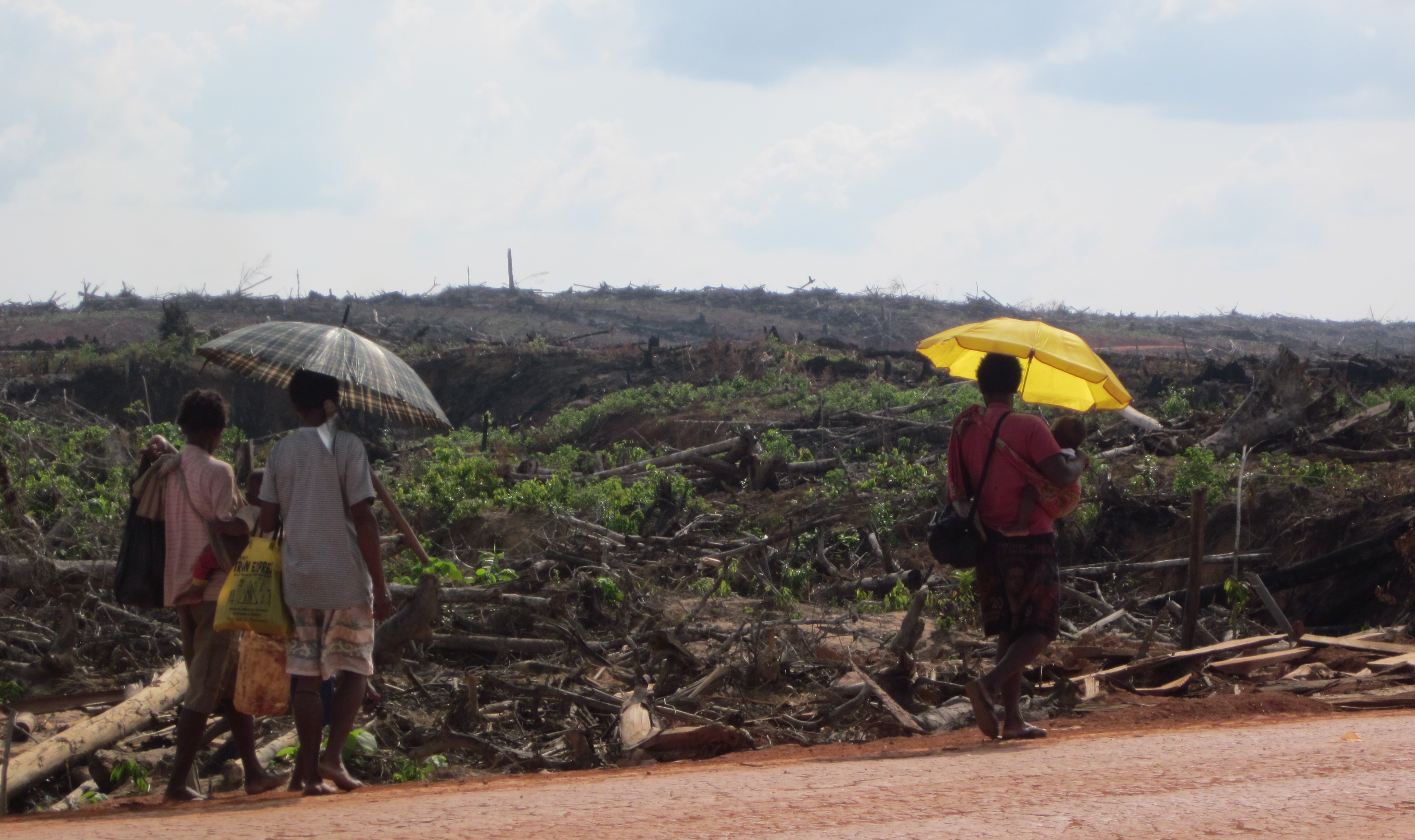
When a convergence of national and local political interests decided that this area was to be intensively developed as a new centre of industrial food and biofuel production, the Malind people faced an immediate threat to their cultural survival. Since the Merauke Integrated Food and Energy Estate (MIFEE) was officially inaugurated three years ago dozens of companies have applied for plantation permits, and proceeded to try and get control over the Malind People’s ancestral lands.

As the area is so remote, and as so many different villages and companies are involved, the impact on the Malind people can easily go unnoticed by those outside the area. Therefore the most basic act of solidarity with the Malind people as they face this huge upheaval in their livelihoods, is to make sure their isolation does not allow the companies to force their way in with impunity, and where possible, allow their voices to reach the wider world.

That is exactly what awasMIFEE has been trying to do since the website was launched in early 2012. However, we realise that not all readers follow the blog posts as obsessively as they are written, and for that reason, felt it might be helpful to provide a summary of the different ways MIFEE has been affecting communities.

Land-grabbing

Under Papuan law, indigenous people have rights over their ancestral land, known as ulayat rights. If a company wants to use that land they have to negotiate access with the ulayat rights holders first. According to Malind tradition, different clans hold the rights to different areas of land, which also become their hunting grounds and place where they look for other foods. Each clan has a chief and companies will try to get the signature of the clan chiefs, by fair means or foul.

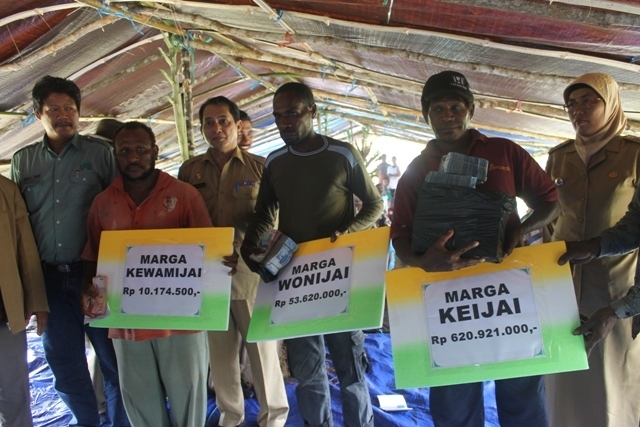
The first companies to make deals often did so through simple deception. For example, in Zanegi village in 2009, Medco gave the villagers 300 million rupiah and a ‘Certificate of Appreciation’. The people interpreted this as a friendly gesture. They did not realise that they were signing away rights to their land, and also agreeing to be compensated for the wood on the land at 2500 Rupiah per cubic meter, a fraction of the price they would get selling individual logs to wood traders.

In other places companies have continued to try to deceive communities by referring to money as ‘appreciation money’ (uang penghargaan) ‘money to open the door’ (uang kelok pintu), ‘ex-gratia payments’ (uang tali asih) and so on. The people are led to believe that the money is a token of encouragement, rather than a legally binding land deal. This has been recorded in villages such as Kaliki and Domande by Rajawali Group companies, and in Bupul and Muting by AMS Ganda group companies.

taliasihelikobel

A slightly different form of coercion has been seen in Kampung Selor and Kampung Onggari, where local people have reported that companies brought clan leaders to Merauke city where they were put up in hotels and provided with money to buy alcohol and the services of prostitutes. Later, when they were drunk, they were asked to sign a land release agreement.

Although the whole village will lose out if the forest is gone, normally companies only focus their efforts on trying to convince community leaders (administrative and traditional village leaders and clan chiefs) to sign away the land. These community leaders have been flown by the company to visit other plantations, in one case (Wilmar) as far away as Sumatra.

Companies have also made promises to build village facilities and these have rarely been honoured. A typical list might include schools, clinics, churches, new houses, roads, electricity supply and sports facilities. However once the deal is signed the new facilities fail to materialise. Or only a church is built.

By the time other companies were ready to make deals, other communities had heard of what happened in Zanegi and were more wary. Some villages decided that they would demand what they considered fair compensation for their land, based on the community’s real needs over the nominal 35-year lifetime of a plantation. For example, in May 2012 four villages said they would only permit Korindo subsidiary PT Dongin Prabhawa to operate if the company gave them 100 billion Rupiah. Sums a plantation company is never going to pay. Making these high demands can be understood as a strategy to resist the plantation plan, but from a community which doesn’t believe that it still has a chance of refusing to sell its land and preventing the company from moving in. Some of those villages have reportedly since settled for a lower sum, others continue to resist.

This feeling of coercion is underlined by the fact that each company is accompanied by military or military police (Brimob) who are present each time the company describes its plans to the community or negotiates a land release agreement. Even if the military are ostensibly present as security guards or witnesses and do not directly threaten the people, their presence alone can be sufficiently intimidating to create the impression that refusing the company’s plans is not a realistic option.

In other cases the military threat has been more direct. Using a technique reminiscent of how plantation companies obtained land in Sumatra during the Suharto era, threatening people as communists, MIFEE companies have been accused of trying to politicise the struggle, by threatening communities that they will be treated as OPM separatists. The military’s violent and indiscriminate repression against alleged OPM members in West Papua is well-known, and is enough to cause widespread panic. These allegations have been reported from the concessions of one of the main oil palm companies, where the guards are all Kopassus members. Most recently, PT Mayora caused panic in Yowid village by making similar allegations. As women and children were preparing to take refuge in the forest, some village elders felt they had no option but to sign the document PT Mayora presented them with.

The amount of compensation that companies have paid has varied, but recently has tended to settle on a standard of 300,000 Rupiah per hectare (about $30). Once shared out between all the families in the clan this is really not very money to compensate the loss of their land which had sustained people all their lives. Even worse, the money is delivered in a lump sum so it is usually finished very fast.

Here is a comparison which shows the low regard in which indigenous communities are held. Siti Hartari Murdaya, one of the owners of a MIFEE company, was recently convicted in a graft case for bribing the district leader for a permit for a 4500 hectare oil palm plantation in Buol, Sulawesi. She paid 1 billion Rupiah  for the permit, which works out as 222,000 Rupiah per hectare. Her company, Hardaya Inti Plantations has yet to reach a settlement with the villagers in the area, but other companies have paid a maximum of 300,000 Rp, not much more than she paid this one official.

Impoverishment.

As the companies move in, local people learn about poverty. Throughout their history, the forest has always been there, with abundant sago groves to provide sustenance and forest animals easy to hunt. Selling forest products such as gambier resin provides some money to buy other essentials. With the forest gone, food is hard to find, ironically for a project that was supposed to ensure a nation’s food security, and people become dependent on the cash economy.

The descent into poverty has been seen most clearly in Zanegi village. With the forest gone, food is hard to find. Interviewed for the video Mama Malind Su Hilang (Our mother is gone), Moses Kaize said that before Medco moved in, a hunter could find meat within about an hour. To hunt a deer now, it would take a full day or even two. Even to find sago the villagers have to travel to temporary camps far from the villages, their sago groves destroyed by the company that promised to preserve them. The village is often empty as everyone is away. Those that find work with the company have no security, they are without contracts and paid enough to feed a family, no more.

Children are reported as suffering from malnutrition, and this has sharply increased since the company moved in. In the first six months of 2013, five young children died of malnutrition or respiratory diseases in Zanegi village.

There are reports that in recent months Medco has started to take responsibility for the disasters it has created in Zanegi and Boepe villages. The company has apparently started supporting teachers and ensuring healthcare and supporting the village economy by preparing land and providing seeds and fertilisers for people to grow vegetables which they can sell through the company.

The process of impoverishment can start before the forest is felled however. As infrastructure is built to support MIFEE and company personnel, their military guards and more transmigrants move onto the Malind people’s land, they also consume forest resources such as meat and fish. This makes it harder for the indigenous people to obtain their subsistence needs from the forest, and face increasing pressure to engage more with the money economy, including selling their land to the companies.

An example is the Inggun Swamp, which was recently split in two by a new road. Original plans were for a bridge to cross the swamp, paid for from the national budget, but in the end earth and concrete were piled up to split the swamp in two. There was no environmental assessment to examine the road’s effect on the local hydrology, ecology, or the subsistence needs of people in nearby Kampung Wayau. Visitors to the area have reported meeting local policemen riding out on their motorbikes to go fishing in the swamp, using the new roads. As such areas become more and more accessible it is likely that people from the urban areas come to hunt and fish. The people from Wayau have not yet agreed to surrender their land to the Wilmar or Hardaya group companies, but if the integrity of the local forest is diminished, their choice is also reduced.

When through choice or coercion communities do eventually sell, the money they receive is a pittance if it is seen as a replacement for all the forest could provide for decades to come, but at the moment it is handed over it is a considerable amount, paid in cash. People know they should use the money wisely, but what options do they really have for investment? More often than not the money is finished almost immediately as traders come up from the city and persuade people to buy goods for vastly inflated prices, leaving the community with nothing once more, except the small compensation for wood as the trees are cut.

Environmental.

Plantation development brings widespread environmental destruction which also directly affects communities. In Zanegi pesticides from Medco’s tree nurseries have entered the swamps, causing the respiratory diseases that contribute to infant mortality and also skin problems.  Villagers further upstream along the Bian and Kumb Rivers also have experienced similar symptoms, possibly caused by the oil palm plantations and transmigration areas in those rivers’ headwaters. Big fish and even crocodiles have been reported as dying in the Bian River, near to Korindo and Daewoo’s oil palm plantations, and also in the Kumb and Digul Rivers. Villagers in the upper Bian River area report that they can no longer use the water for drinking, cooking and bathing, and now have to walk for miles to find clean water.

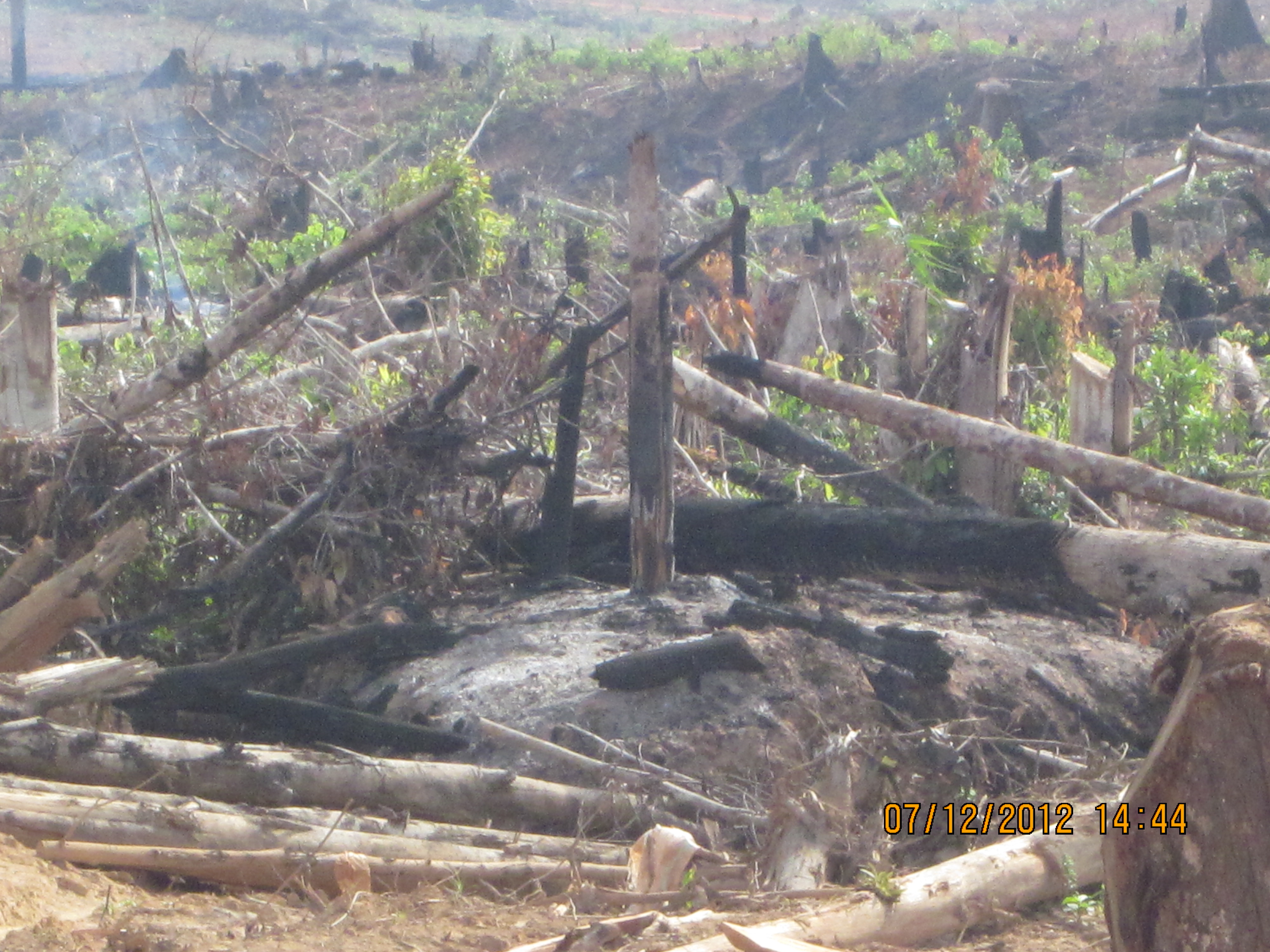
Forests in the Bian valley around PT Bio Inti Agrindo’s concession have also been cleared for oil palm by burning. This illegal practice is widespread all over Indonesia, and is most famous for causing the annual smogs over Sumatra which reach as far as Malaysia and Singapore. Local impacts include air and water pollution, and wildlife killed in the fire.

IMG_1136

Nearer the coast, not far from Rajawali’s sugar plantations, streams near Onggari and Kaiburze have been drying up because of new irrigation canals to service the plantations and agricultural development in the transmigration zone. Birds are reported as disappearing from villages around the MIFEE area, their voices are no longer heard as before.

Conflict

A major impact of MIFEE has also been the conflicts it has provoked between villages, clans and individuals. In Malind society, people know which land each clan has rights to. While they have no maps an unwritten geography has been developed through their history, belief system and collective memory. When the developers move in they bring with them maps drawn up in a Merauke Government office, GPS and other machines to check their position and large amounts of money which they will give to the head of whichever clan can claim each piece of land. Conflict emerges when the precision equipment unearths old disputes. A common example is when one village or clan is recognised as the land owner according to customary law, but another clan or village has been allowed to use the land, even though they have no ownership rights.

When Medco built its wood-chip mill in Kampung Boepe, villagers from Kampung Sanggase accused the company of compensating the wrong people, that the land actually was part of their village’s area, and the people of Boepe were only using it. A long conflict ensued between Medco and the people of the two villages, with Medco eventually settling paying the people of Sanggase as well. Another conflict occurred around Rajawali’s area, where the villagers of Domande who had released their land to the company became engaged in conflict with those from Kampung Onggari, who had resisted signing over their land. In Selil, two clans from different tribes have contested the land which PT Bio Inti Agrindo plans to use for an oil palm plantation. After tribal wars long ago the resolution had been to describe this land as ‘borrowed land’, which the borrower has no right to sell. Normally this would not be a problem, but when the company moves in to develop the land, both groups want compensating. The potential that this conflict could erupt in violence remains high.

Such a conflict starts with suspicion and distrust, adding to the stress of the pressure for change coming from the company, and potentially dividing and weakening the opposition to resist. Violence is also not uncommon. What makes it worse, local people have a strong belief in suanggi or black magic, which is thought to be the cause of all deaths. If someone should die in a village, people will wonder who might have ordered the death.

Once again, the most tragic story comes from Zanegi village. A villager, who also worked on the Medco plantation, had been accused of using suanggi to kill people. Village leaders assembled for an adat meeting, and decided that he would have to be killed to prevent more deaths. Police found out and arrested fifteen people, and seven were eventually sentenced to prison. Whatever the rights or wrongs of their decision, the arrests have only exacerbated the problems for the community as a whole. Many of those arrested were outspoken critics of Medco and other companies, but also having to support prisoners financially has made the village considerably more dependent on Medco and its compensation money than before. A long-running blockade of Medco’s logging operations lost all its momentum around the time of this case, and the company keeps clearing forest as before.

On top of this, three of the seven people sentenced have died while being detained in Merauke prison. Local people put it down to suanggi of course, and indeed it has been reported that the last two deaths were sudden, without a sickness. The relationship between this conflict and the company are complex, but undeniable.

Conflicts can emerge at an even earlier stage, before compensation is paid, even at the moment a company first arrives on the scene. When a company first sends representatives into an area, they often to persuade or employ certain individuals to become pro-plantation and promote their interests, deliberately causing conflict within a village. Villagers in several villages in Tubang, Ilwayab and Okaba have accused two companies PT Astra and PT Mayora of deliberately pursuing this strategy, moving in to the area at an early stage in the investment process in order to create divisions and manipulate suspicions. In some villages they recruited middlemen to act on their behalf, who collaborated with security guards to accuse others of being OPM rebels, as described above. In the same area, villagers from Woboyu village were concerned when they heard news that Welbuti villagers had agreed to work together with PT Astra to map customary land boundaries. There had been an agreement between all the villages in the area not to work together with the companies at all. Any village perceived to break that village could be the trigger for a conflict to erupt, and, because of the belief in suanggi, this could quickly become deadly.

In fear that such conflicts could quickly spiral out of control, people from the area took action in the city, occupying PT Mayora’s office. They argued that the way the two companies had come into the area and started surveying and approaching local people without prior information, was a strategy to cause fear and conflict between local people. If a company wanted to move in, it should sit down first with all involved to discuss their plans. In this particular case, the regency leader said he would command PT Mayora and PT Astra to stop work until further discussions could take place.

Working for the company.

In order to be able to make a living once their land is gone, villagers are lured with promises of work once the plantations are operational, but in reality many of the jobs have gone to migrants who already have training or experience to work on plantations. Local people do not always receive work, and when they do, many times it is without a contract, just hired daily when there is work to be done. Examples of jobs which local people have been hired to do include work connected to corporate social responsibility programmes, supporting survey teams, drivers, security, porters, plantation workers putting seedlings in polythene bags or preparing demonstration plots, stripping bark and operating chainsaws.

When wages are paid they conform to the regional minimum wage for unskilled labour, 1,710,000 Rupiah per month or 70,000 Rupiah per working day. However, in rural Papua prices are much higher than elsewhere in Indonesia, which means that this money is only enough for the most basic day to day expenses such as food.

However, villages where companies have not yet moved in see the change in economy from forest-based to wage labour as a threat to their identity. Malind people see themselves as Anim-ha – ‘the real people’. Now people have coined a phrase when they think about a time that they will be dependent on shops for their food and everything they need for their traditional customs – no longer ‘Anim-ha’, they will be ‘Plastic Malind‘.

In a submission to the UN Commission on Racial Discrimination, twenty-seven organisations made the case that working for MIFEE companies amounts to forced labour, which can legitimately be regarded as a contemporary form of slavery. The basic argument is that when indigenous people’s land is taken from them without their free, prior, informed consent, their traditional livelihood becomes untenable and so they have no option other than to accept whatever work the company, the sole employer in the area, chooses to offer them – in the case of MIFEE, menial and low-paid. If they were offered land as smallholders, as Merauke local government claims to want, the situation is little better, there the same dependency on the company, but it becomes a kind of feudal serfdom.

Women in a Changing Village Economy

A study by the Sajogjo Institute has focussed on the particular issues facing Malind women when the companies move in. It examined the typical household economy before companies move in, where the tasks are divided by gender, the role of both women and men are important. Men hunt, but women have the main responsibility for fishing, and for processing sago starch, although they may be helped by the younger men. While men have the primary responsibility for forest gardens, women also help out. Women also are responsible for main household tasks such as collecting firewood, cooking and cleaning.

malind women

When the forest is gone, the people are dependent on the company to give them work, and in the case of Medco in Zanegi, most of the jobs have been for men. Indeed the company has made it policy not to employ village women after a non-Malind women working as kitchen staff got pregnant by another worker. Women could still get informal work from subcontractors looking after newly planted trees, but when the study was conducted, all the workers were from the outside settler community. Local Malind women claimed they were scared of wild pigs.

Women are also largely excluded from participation in decisions of whether or not to sell the land to companies. Although the Malind usually refer to the land as representing a mother, land ownership under the clan system is patrilineal with a very limited role for women, who have land use rights in certain circumstances, but no land ownership rights. An often-repeated phrase is “to speak of land is to speak of customary law”. Customary law, however, is the terrain of men. Using business logic, when it wants to negotiate a land deal, the company will approach the land owners, ie the male clan chiefs, without considering women’s use rights.

Although they do not have a say in land deals, women are likely to suffer most from the effects of poverty when the companies move in. This has also been seen in Zanegi, where in times of food shortages, women let their husbands and children eat first, and maybe only eat once a day. For the rest of the day, they chew tobacco and betel nut, building up debts with the village store until the next payment for wood compensation arrives, and they are clearly becoming thinner because of this.

Meanwhile, the young men who find work sometimes spend their wages on alcohol and prostitutes. As a result of this five women in Zanegi have tested positive for HIV, probably infected by their husbands. School-age girls have also become targeted for sex by young people working for the company.

Becoming Plastic Malind

Some of the most significant impacts of MIFEE are those that it is most difficult for those of us who are not Malind to grasp, such as changes in social relationships, in identity, in the paradigm in which they are forced to see the world, and eventually in cosmology. To even conceive of the loss of the forest is hard for Malind people to comprehend, because they are the forest, they describe it as their mother. Each clan has totem animals which they are responsible for, for example the Samkakai clan is connected to tree kangaroos. If the forest is gone the kangaroos are gone, if the kangaroos are gone then what becomes of the Samkakai clan?

Here are some words from the Malind Woyu Maklew Anim intellectual forum (SSUMAWOMA) which express the importance of the Malind culture to their sense of identity:

“The Malind Anim culture is not just a dance, a ritual or a carving. It is not a mere representation of a culture, decorated in mud, leaves and vines or other forest fibres. If the Malind Anim culture is not protected and nurtured it will disappear, and with it the Malind Amin people’s sense of self. The Malind Anim culture is indistinguishable from the ways of thinking, feeling and acting that encompass the Malind People’s existence as a whole.”

As companies and more outside migrants move in, this culture is places under stress. Sometimes in subtle but important ways. For example, as transmigrants have set up new villages, they have been given names in the Indonesian language. However these places already had names connected to Malind geography, history and spirituality. When those names are changed, that history gradually becomes forgotten.

Another example: in many parts of Indonesia people like to relax by drinking the sap of the coconut and certain other palm trees, which naturally ferments within a few hours to produce an alcoholic drink, but this has never been part of Malind culture. However, as a short film from Papuan Voices has documented, now a strange new fruit appears to be growing on many coconut trees as people place jerry cans amongst the branches to collect the sap. Elsewhere, police officers bring stronger alcohol to villages which they share with village leaders. Today it is free, maybe tomorrow it will be for sale.

With such an onslaught of plantation companies moving in across the whole Malind land, the survival of the Malind-Anim as a people is under grave threat. In some cases the threat is to people’s direct physical well-being, as has been seen so tragically in Zanegi, in others it is through a process of cultural attrition which severs people from their heritage and leaves them marginalised as underpaid labourers on the very edge of the economy. In almost all cases it is against their will, yet the companies are still there, still looking for a way in.


Police violently break up 3rd Congress NFRPB commemorations across West Papua

October 19, 2013

West Papua Media team and local stringers

Early reports received from West Papua Media stringers have described another serious and violent crackdown across West Papua on October 19 by Indonesian security forces, against peaceful gatherings commemorating the second
Continue reading “Police violently break up 3rd Congress NFRPB commemorations across West Papua”

Create a website or blog at WordPress.com

Up ↑