Growing international solidarity for West Papua freedom campaigns

by Herman Wainggai*

January 21, 2013

Opinion

It is likely that most US citizens who consider themselves informed about global events are aware of the genocides in Rwanda, Bosnia and East Timor, yet it’s likely that few people in the US are aware of the ongoing genocide in West Papua, New Guinea.

In Rwanda, genocide resulted in an estimated 500,000 deaths in a 3-month period; in Bosnia, genocide resulted in an estimated 200,000 deaths in a 3-year period. In East Timor, there were more than 103,000 deaths in a 3-year period; and, in West Papua, New Guinea, there are conservative estimates of 100,000 Melanesian Papuans killed, and 300,000 displaced or missing over a 47-year period. Remarkable is the disparity of time between the Rwanda, Bosnia and East Timor genocides, ranging from 3 months to 3 years, contrasted with the ongoing 50-year genocide of indigenous West Papuans. In the aftermath of the Rwandan 3-month slaughter of 500,000 people, the carnage was blatant, the atrocities flagrant.

In view of the continuing carnage wrought in West Papua by the Indonesian military during the past 50 years, we must wonder why most people in the Western world are oblivious to the indigenous Melanesians’ plight, and what factors are contributing to the protraction of such abuse.

Indonesia’s colonization and military occupation of Dutch-owned West Papua was achieved, and continues, with the blessing of the governments of the United Kingdom, Australia and the United States, and facilitated by the operation of the world’s largest copper and gold mine owned by Freeport-McMoRan Copper and Gold Inc., a US corporation.

In addition, for more than 50 years, some of the world’s largest transnational mining corporations have been exploiting West Papua’s oil and minerals, including Union Oil, Amoco, Agip, Conoco, Phillips, Esso, Texaco, Mobil, Shell, Petromer Trend Exploration, Atlantic Richfield, Sun Oil and Freeport (USA); Oppenheimer (South Africa); Total SA (France); Ingold (Canada); Marathon Oil, Bird’s Head Peninsula (UK); Dominion Mining, Aneka Tambang, BHP, Cudgen RZ, and most critically, Rio Tinto (formerly RTZ-CRA) (Australia/UK).

The exploitation of natural resources by extractive industries results in catastrophic harms to human and environmental health and indigenous societies. Typically, mainstream global media, most of which are in thrall to corporate interests, look the other way when such military/corporate injustices are perpetrated upon indigenous populations.

New Guinea is the second largest island on earth, and one of 20,000-30,000 archipelagos in the South Pacific. The island is divided vertically, with independent Papua New Guinea occupying the eastern section and West Papua, now an unwilling province of Indonesia, occupying the western side. There are more than 250 tribes, more than 270 distinct languages and thousands of different pidgin dialects.

In addition to copper and gold, abundant natural resources include natural gas, oil, timber and fish. These resources profit corporate interests and the Indonesian government without compensation to the Melanesian population, who live in poverty.

In 1969, the Act of Free Choice consultation was held in West Papua to ascertain whether the indigenous Melanesian population preferred to remain a province within the nascent nation of Indonesia or become their own independent nation. The consultation was fraudulent, and free participation by the indigenous people was nil. Only 1025 West Papuans, representing a population of one million, were picked ( by the government of Indonesia )  to vote and it was not implemented in accordance  with international law of the New York Agreement on August 15, 1962 – One Man One Vote. It was a whitewash. Nobody gave a thought to the fact that a million people had their fundamental rights trampled ( CV Narasimhan, Deputy Secretary – General of the United Nations 1961 – 1978 ). Thus, the voiceless West Papuans became a province of Indonesia and the victims of 50 years of oppression.

The people of this forgotten land have struggled for freedom for 50 years under brutal Indonesian occupation. The people of the different tribes are raped, tortured and slaughtered, and their natural environment continues to be degraded. In their efforts to resist this injustice, their leaders have been arrested, tortured and threatened with death. For this reason, many now live in exile, where they continue to be involved in education and activism with the goal of enlisting the international community to join their efforts to achieve justice and freedom.

The Universal Declaration of Human Rights affirms the rights of all people to freedom of opinion and expression, and the right to peaceful assembly and association. Indonesia is a signatory to the International Covenant on Civil and Political Rights (ICCPR), which guarantees the right to freedom of expression and peaceful assembly, and Indonesia’s constitution also declares those rights. However, Indonesia’s continued arrest and incarceration of nonviolent political activists since the 1980s, and the October 19, 2011 arrests of more than 300 civilians during the Third National Congress, including Edison Waromi and Forkorus Yaboisembut, Prime Minister and President, respectively, will not deter Melanesians from their nonviolent struggle to secure self-determination within a democratic framework, and are recognized, respected and supported by the international community.

For this reason, many peaceful demonstrations took place around the world on
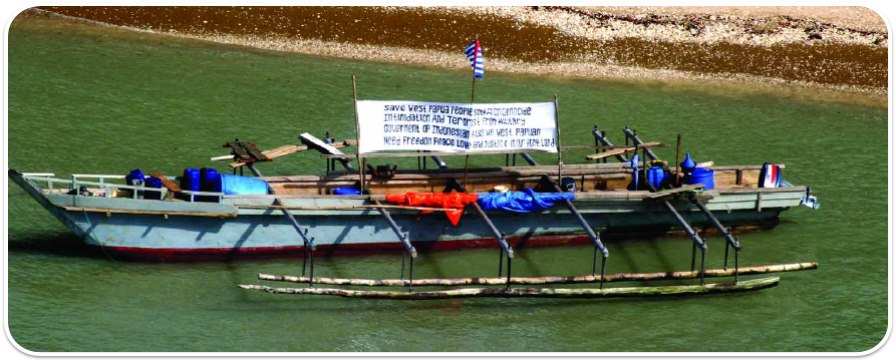
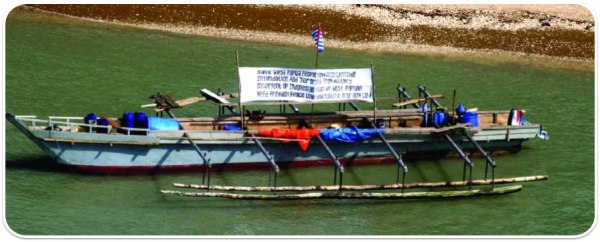
The boat that brought 43 West Papuan Asylum seekers to Australia, putting Papua back on the front page and touching off a diplomatic storm . Photo Damien Baker, Mapoon, Queensland, Australia January 17th, 2006

January 17, 2013. The Demonstrations commemorated the escape to freedom by 43 West Papuan refugees on January 17, 2006, when, after paddling across open ocean for four days and surviving a violent storm, they beached their traditional canoe in Australia and found asylum. Myself – Herman Wainggai  – am one of those 43.

The Free West Papua Political Prisoners Team in Washington DC is a group of academics and human-rights activists who are willing to stand up for justice and work toward a free West Papua that is independent from military and corporate colonization.

Photo :  Free West Papua Political Prisoners Campaign Team, Washington DC, USA
Photo : Free West Papua Political Prisoners Campaign Team, Washington DC, USA

Human Rights Watch reports that Indonesia has incarcerated nearly 100 activists from Maluku and Papua for peacefully voicing their patriotism and political views.  As one of those former political prisoners forced into exile, I am now a visiting scholar at George Mason University, after being imprisoned for more than two years after daring to raise the West Papuan flag. My uncle, Dr. Thom Wainggai, died while imprisoned for the same demonstration of patriotism.

Free West Papua Campaign in Los Angeles, California

“I want to commend Moana Nui for organizing this demonstration on behalf of the people of West Papua to give voice to their fight for freedom and self-determination.  We call on the leaders of all governments to stop supporting human rights abuses, murder, genocide and the military occupation of West Papua. To our brothers and sisters in West Papua: Continue to fight for what you know is right, for your freedom, your culture, for humanity.  Know that, in this fight, you are not alone.” Harold Green.  http://mnaa-ca.org/jan-17-2013-west-papua-action/


Free West Papua Campaign in Melbourne

Foreign Affairs Minister of the Federated Republic of West Papua, Jacob Rumbiak, said international activists are demanding that Indonesia remove its military personnel, and that president Yudhoyono must issue orders to stop the slaughter of West Papua National Committee (KNPB) members.

“Six activists were arrested and tortured in Serui yesterday for handing out pamphlets about today’s rally, including Patris Rosumbre (Vice Governor, Saireri State, Federated Republic of West Papua) and Menase Karubaba,” he said. Rosumbre has since escaped, but the whereabouts of Karubaba are not known, and there is deep concern for his safety.
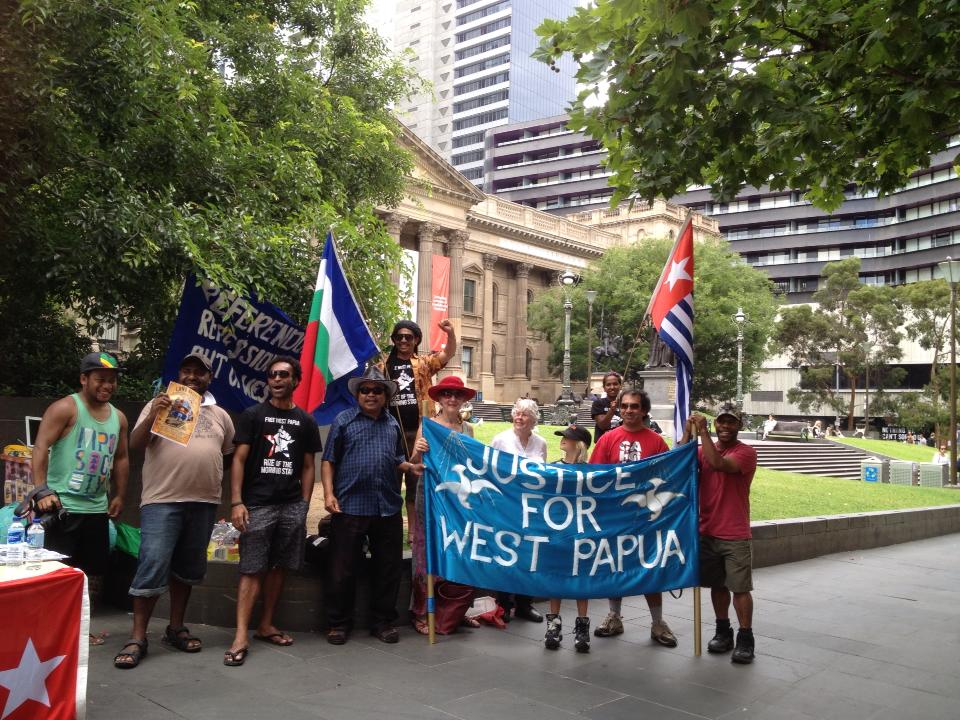
Photo Free West Papua Campaign Melbourne, Australia January 17th, 2013

The Federated Republic of West Papua has called for negotiations with the Indonesian government under the auspices of the United Nations since 2011, and, Rumbiak claims, “Indonesia is losing credibility with its international donors in failing to respond to our invitation.”

Free West Papua Campaign in the Solomon Islands

In a statement from Honiara, Chairman of Solomon Islands for West Papua, Rexy Roses, highlighted that more than 50 years of tyranny and

Photo Rexy Roses, Solomon Islands for West Papua, 17th January 2013

immeasurable human rights abuses suffered by the indigenous people of West Papua at the hands of the occupying Indonesian military forces is more than too much to bear, and it is now time for dialogue and negotiations to end the violence in West Papua and to allow a peaceful referendum. This year will be a challenging one, and we will ensure that the cries of the indigenous Melanesian people of West Papua be heard in every corner of the Pacific and beyond.

Since the recent peaceful demonstration in Yapen Island and Manokwari, I have been told that the military agents are increasing their violent activity in West Papua and in many other places around West Papua. It is not difficult to imagine the impact that tens of thousands of Indonesian troops have on the daily lives of the West Papuan people. This new action by the Indonesian military raises the question: Why would Indonesia send so many troops to West Papua? Is this to intimidate the West Papuan people, to deny us our freedom of speech and prevent us from peacefully gathering in the land of our ancestors to debate and challenge the domination of our land and freedom? This recent West Papua Media report clearly states that the Indonesian government does not provide for the protection of human rights in West Papua.

For West Papuans, daily life is a nightmare, full of pain, suffering, torture, rape and bloodshed. There is no freedom to speak or act freely. The systematic oppression, terror, intimidation, kidnapping, incarceration, poisoning and murder of indigenous Melanesians in West Papua has not changed since I fled the country in 2006. It’s time to support the West Papuan people in their struggle for human rights and political independence.

Herman Wainggai is a West Papuan civil resistance activist based in Washington DC USA, and former political prisoner.  He lectures in strategic non-violence and civil resistance and is a visiting scholar at George Mason University, Washington.


Andreas Harsono: Is Repression Against KNPB Legal?

January 4, 2013

by OKTOVIANUS POGAU of SuaraPapua.Com

https://i0.wp.com/suarapapua.com/wp-content/uploads/2013/01/HARSONO-ANDREAS.jpg
ANDREAS HARSONO, Indonesia Consultant for Human Rights Watch. (FOTO: RIDHA/SuaraPapua)

SUARAPAPUA, Jakarta –  Human Rights Watch (HRW) consultant  for Indonesia, Andreas Harsono, questioned the actions of the Indonesian security forces whose shootings led to the death of 22 members of the West Papua National Committee (KNPB) during the year 2012; 55 people were arrested, and hundreds of others were injured.

‘Given that 22 KNPB members died from shootings, dozens were arrested and unknown hundreds were injured, there has been no transparent judicial process, and no internal mechanism to question police procedures in Papua, we have to raise the question of whether this repression of the KNPB is legal?’.

The statement was re-affirmed by Andreas, when interviewed by suarapapua.com on Thursday 3rd Jan 2013).   According to Harsono , the police may justify their actions by incriminating KNPB members in violence, attacks on transmigrant settlers and security forces, but they still need to make their case transparent.

“The problem for police is working with transparency – can the police show this? At the same time, the KNPB needs to carry out an internal investigation in response to police accusations of involvement in violence’, he said.

Harsono also hopes that the organisation led by Victor Yeimo will quickly announce the outcome of the investigation, along with decisions to dismiss KNPB members found to be involved in acts of violence. As previously quoted, the KNPB head Victor Yeimo has stated that 22 KNPB members were killed in 2012 by Indonesian forces, 55 arrested and many among them are currently listed on the police wanted list.

(Translated by West Papua Media translators)


KNPB: ‘When one is shot dead, a thousand will rise up!’

December 18, 2012
Bintang Papua
(see important editorial note below)

Jayapura: The fatal shooting of an activist of the KNPB, Hubertus Mabel, has been condemned by his family and by the KNPB – National Committee of West Papua – as unlawful. According to the law, if a person is deemed to be engaged in unlawful acts, he should be arrested and charged before a court of law but this did not happen in the case of Mabel and his colleague.

A spokesman for the KNPB, Wim Medlama, said that Hubertus had been immobilised by being shot in the legs. The security forces then pushed him into a police van where he was tortured and stabbed.

When he was arrested along with Natalis Alua, the two of them did nothing to resist arrest yet nevertheless they were shot.

‘We understand,’ said Medlama, ‘that Hubertus was severely beaten and stabbed in the chest. Natalis was also badly injured and is now being treated in hospital,’ said Medlama. He accused the security forces of acting without having any thought for the lives of their victims. ‘The security forces behaved like sadists and won’t even allow members of his family or his KNPB colleagues to see his body or demand an autopsy.’

Hubertus and his colleagues were not involved in the attack on Pirime Lanny Jaya. His activist colleagues believe that the police were feeling very frustrated and had opened fire on Hubertus and his colleague out of a sense of revenge for the deaths of three members of the police force who died during an attack on the Pirime police station.

‘The scenario was to convict Hubertus for showing resistance but this is simply not true.’ According to the law, a person should be taken into custody and brought before the court, not shot dead.’

‘When taking someone’s life, the police should be able produce powerful evidence before taking the law into their own hands like this,’ said Medlama.

If Hubertus did violate the law, he should be tried, not shot dead as happened to Mako Tabuni.

‘What the security forces are trying to do is to stamp out the issue of Papua Merdeka but the way they behave is having precisely the opposite effect, making Papuans more determined than ever to achieve an independent Papua.’

‘For every single Papuan who is murdered, a thousand Papuans will rise up and struggle for their freedom,’ said Medlama

‘They have accused us of being terrorists but we don’t have any bombs yet the allegations still persist. We have no idea what other tricks the security forces have up their sleeves in order to discredit us and the people of Papua, he said.

[Translated by TAPOL]

(West Papua Media Note: despite WPMs article yesterday on the fake journalism (allegedly done by a staff member with connections to Indonesian intelligence agencies) that made it through Bintang Papua’s editorial process, WPM can verify each and every statement made in this report is accurately reported, as we have received independent statements from the KNPB that verify this, and of course WPM broke the original story.  All our syndicated articles from Papuan media outlets must go through the same verification standards as our other sources, and we must take the time to point out that the majority of reporters at Bintang Papua are professional journalists and are not Indonesian intelligence agents.  We do believe there needs to be a tightening of their editorial process however to eliminate fake journalism – same as any media outlet.)


Manokwari Riots: Human rights investigation Report

Report of Human Rights Investigation by Monitoring Team from LP3PH (Institute for Research and Development of Legal Aid), Manokwari, as assembled from various local sources and members of the victim’s family.

December 6, 2012

Wednesday 5 December 2012, the weather was overcast without rain, seeming to restrain the usual busy activities of the local population, government and private company staff, white and blue collar workers, market traders, farmers, fishers, schoolkids and students, plus the security forces: army, police and intelligence.

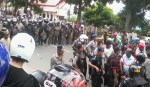
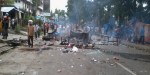
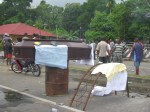
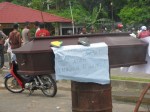
From early morning the atmosphere was tense: from about 07.00 to 09.oo [Papua time] groups of local people could be seen moving to blockade various major road intersections in Manokwari Town.  Primary official routes like Jl. Yos Sudarso, [near Sanggeng in front of the Bank Mandiri, Bank BRI and Bank Papua complex] as far as the three-way intersection on Jl. Merdeka & Jl. Gunung Salju [Makelew Fanindi complex] were blocked by mobs using wood, old tyres set on fire, tables, and tree branches, all thrown on the road. Various intersections of roads heading out to the residential areas of Fanindi beach [beside the Swissbel Hotel], Arkuki [beside the Bahagia store], Sanggeng market, and Jl. Serayu Sanggeng were blockaded by a populace brewing with anger.

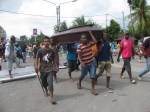
While the atmosphere in Manokwari has been tense there has never been any trouble between groups in civil society or between the local community and the security forces. Several witnesses said that ‘people are very emotional, they are making these protests because of the shooting of Timo Ap’. The police secretively shot and killed Timo Ap, and then took his body to his house in Wirsi, Manokwari.

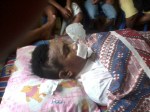
All Photos: LP3PH/West Papua Media

Chronology

A chronology of events has been put together as follows, from various civilian sources including the family of the victim Timotius Ap:

1)      More than 3 days ago the victim Timotius Ap, grandson of the late Timotius Ap, [former area head of Wirsi complex in West Manokwari], returned from Java to Manokwari: in Java he had been staying with family and working as a Marine;

2)      Timo Ap returned home to Manokwari with his wife Iwanggin;

3)     Timo was rarely present at the Wirsi house, he was mostly elsewhere due to being on the DPO [Wanted List], related to various cases that the Police accused him of;

4)     On Tuesday, 4 December 2012, as morning was turning to midday, Timo Ap was hanging out with his friends at Wirsi and wanting to eat areca nuts [?] but after eating them, his friends cannot account for his whereabouts;

5)     By the evening of 4 December, at around 09.00 Papuan time [21.00?] Timo was received and treated at the Dr Azhari Hospital [Navy Hospital] Manokwari;

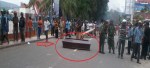
6)     Around 10.00 [22.00?] Papuan time on 4 December, a friend of the family brought a message to Timo’s aunt Nelestin Ap, to ‘please come to the hospital to see Timo, whether he is still alive or already dead’. So then Timo’s aunt and other relatives hurried to the Navy Hospital but on the way they passed police and medical vehicles taking Timo’s corpse home to his grandmother’s house at Jl. Simponi Rindu, Wirsi, West Manokwari;

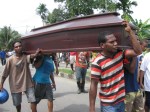
7)     On arriving at the house, there was only the victim’s grandmother, in her 70’s, living alone. She had no idea that her grandson’s body was being brought to her house. ‘The employees bringing in the corpse said nothing at all to the grandmother’, and then those employees just left the coffin there and went off;

8)     After several minutes the aunt and several of the victim’s loved ones arrived, or came back from the hospital and cried hysterically upon seeing the body wearing only underpants and a clean T-shirt that he had been dressed in. His friends said that he had no other clothes apart from the clean T-shirt and underpants he had been dressed in. At the hospital he had been wrapped up in bandages around his chin and neck as though he were injured, but there appeared to be no injury to his neck, chin or head in general. His only wound was discovered to be on his stomach near the centre, where a surgical incision to remove the projectile [bullet] had been stitched up.

9)     By 11.30 the news had started to spread widely, that the victim Timo Ap had been shot dead by Police, and the local community began arriving to pay their respects and condolences.

10)  In the morning at about 06.00 [Papua time] various family members began blockading the route into Wirsi [Jl. Simponi Rindu]. Blockades then spread to various road junctions in Manokwari, while the local daily paper MEDIA PAPUA released in its Headline news that Timo Ap had been shot dead by the OPNAL [Professional Operations Team] of Polsek [Police sector] Manokwari town at Maripi beach, South Manokwari district at about 16.00 Papua time. This was due to his opposing the officers with an improvised pistol; he was killed with a shot to the head;

11)   From around 07.00 to 09.00, Papua time, the community closed off the main roads of Mankwari such as Jl. Yos Sudarso, Jl. Merdeka, the route to Sanggeng settlement, Jl. Siliwangi, Jl. Soedjarwo Condronegoro [?], Jl. Gunung Salju [heading to Ambun];

12)   At the same time, activities in Manokwari came to a complete standstill. The business centre, Hadi department store, Orchid Swalayan, the market, stalls and shops were closed en masse by their owners. Offices also shut their doors – the Manokwari Regency Government office of West Papua province, schools, banks: from early this morning until mid-morning as this report is written;

13)  At 10.00 Papua time, large groups began violent action, smashing shops along the length of Jl. Yos Sudarso and Jl. Merdeka as far as Jl. Siliwangi. Tens of buildings along the road suffered quite serious damage, and many cars and motorbikes were wrecked by the mob;

14)  Around 12.00, as the mob moved towards the town centre right in front of the West Papuan governor’s office, patrols of Brimob [mobile brigade], Dalmas Polres [area police] backed up with Indonesian Army forces were seen closing off the intersection that the crowd wanted to pass;

15)  A local man, Demianus Waney held a megaphone in front of the security forces, asking the crowd to disperse and go home…. ‘I say go home’… said Demianus Waney….. but hearing those words, the crowd became more worked up. In the process of their demonstrations against Demianus Waney, a number of buildings, restaurants owned by transmigrants around the harbour and PT Pelni [national shipping line] became targets of their anger;

16)  The police, Brimob and TNI [Indonesian army] started to rush forward but were stopped by an attempt at negotiation by a priest, who said he had been the victim’s priest [i.e. Timo Ap who had been shot and killed]. However at the same time Demianus Waney said that every avenue had been tried already, inviting the armed forces to action;

17)  The security forces then moved forward to break up the crowd. The police, Brimob and soldiers using trucks, paddy-wagons and Barracuda vehicles moved rapidly to take over the main road that had been controlled by the mob;

18)  Around 13.00, Papua time, the situation had become calm and back to normal.

Papuan human rights activist calls on Komnas HAM chairman to resign

Bintang Papua
5 December 2012
Jayapura: The  pro-independence human rights activist. Sebby Sambom, in a statement published in Bintang Papua, called on the chairman of Komnas HAM, the National Human Rights Commission, Oto Nur Abdullah to resignThis came in response to a statement by Nur Abdullah which, according to Sebby Sambom, appeared to legitimise military operations in Papua.

‘In response to the comment by the chairman of the Komnas HAM, as published  in the mass media on 28 November with regard to military sweepings in the district of Lanny Jaya , we pro-independence activists call on the chairman of Komnas HAM to resign.’

Sambom said that the statement appeared to legitimise the military operations being waged by  the Indonesian military, either directly or indirectly, against the indigenous Papuan people in Pitriver and the highlands region of central Papua.

According to Sebby Sambom and his colleagues, the statement made by the Komnas HAM chairman was dangerous and would  be detrimental to the indigenous people in Papua.

This is why, he said, we make the following demand. ‘The chairman of Komnas HAM should clarify the statement he made  that the events in Lanny Jaya cannot be described as human rights violations.’

He said that the statement fails to take account of international humanitarian law.

He went on to say that  if the chairman of Komnas HAM fails to resign, Komnas HAM should issue an official statement calling on TNI/Polri, the Indonesian army and police, to end their military activities and withdraw from the highlands in central Papua.

‘It is a great pity that the chairman of Komnas HAM fails to understand that  there are regulations regarding the waging of war and he fails to appreciate that his statement could be used as a ‘weapon’ by the security forces. We greatly regret this,’  said Sambom

[Translated by TAPOL]

Create a website or blog at WordPress.com

Up ↑