Komnas HAM on Lack of commitment to solve human rights issues in Papua

JUBI, 8 April 2011 

The deputy chairman of the Papuan branch of Komnas HAM, the National Human Rights Commission, Mathius Murib, has accused the regional authorities of lack of commitment to solve human rights violations in West Papua.

He said that the local government had failed to enact a regional regulation known as Perda regarding human rights .

Komnas HAM has already prepared the draft of a Perda but the provincial governor  and the provincial legislative assembly  have as yet failed to enact it as a regulation.

He cited as examples of the government’s lack of commitment  the fact that the Wasior case in 2001 and the Wamena case in 2003 were still unresolved although Komnas HAM had carried out pro justicia investigations of these cases and had reached the conclusion that both were cases of gross human rights violations. However, the attorney-general’s office had a different opinion about the cases.

Murib made three recommendations that the victims might consider in order to bring such cases to a resolution. They could find ways to use legal mechanisms  within the Indonesian judiciary, adding that it might be possible to bring these cases before an international mechanism.

A second possibility was for the provincial government to enact the Perda regulation as drafted by Komnas HAM.

The third possibility was for Komnas HAM to become a regional human rights commission under the framework of the special autonomy law within the powers of authority of the governor of the province of Papua.

Broadcasting Papua’s Songs of Freedom: Why the international community must support West Papua’s citizen media development

FREE THE PEOPLE? FREE THE MEDIA!

by Nick Chesterfield

A Paper presented at the University of Sydney Centre for Peace and Conflict Studies “Comprehending Papua Conference”, February 22-23, 2011.    This paper will form a chapter of the forthcoming book “Comprehending Papua”, to be published in early 2011 by the University of Sydney Centre for Peace and Conflict Studies.

———

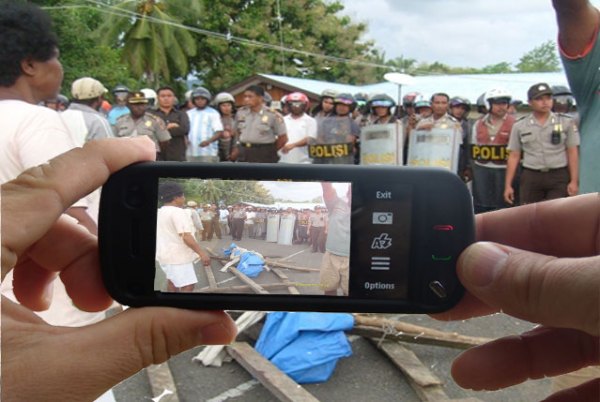
It is almost a cliché today that peoples wishing to free themselves from tyranny are turning in huge numbers to citizen journalism both to tell their stories to the outside world, and to put a formidable brake on the out of sight, out of mind mentality that allows state organs to conduct constant abuse with impunity. The rise of citizen media is giving mainstream journalism the kick it needs to remember its core business of giving voice to the voiceless.  In West Papua, the Voiceless are slowly discovering they can roar.

Just a few weeks ago an event occurred in Tunisia that was to be the spark for the pan-Arab awakening which has just seen yet another dictator ousted, now in Egypt.  After a local trader immolated himself in protest against the Tunisian regime, citizen media succeeded in viralizing the news of this event.  “We could protest for two years here, but without videos no one would take any notice of us,” said a relative of the martyred 25-year-old.

For media activists and journalists reporting Papua, this truth is self-evident, and its acceptance hopefully could ignite the spark of uprising in Papua.  The opportunities presented by the Pan-Arab (and other) awakenings are not being lost on the young generation in Papua.  Social media in Papua is buzzing, unafraid, with vibrant discussions of implications for Papua of the pan-Arabic revolutionary success.  The reality is that a spontaneous awakening and mass politicisation of ordinary Papuans is completely inevitable, and it is being ably assisted by switched-on local people developing their capacity to tell the story to the world.

In researching for several stories over the last few months, my sources have told me in no uncertain terms that they are all ready for a trigger to explode the situation.  The only thing holding back sustained mass action – revolution even – across occupied Papua is the constant bickering between exile groups, the actions of the collaborator elites, desperate to cling to the illusion that Jakarta is not there just to steal their land and send them to the moon, and for those who will put their own interests ahead of those surviving under occupation.

What is a mystery is how this mass consciousness will survive the elite and exile power games that are evident in most transitional polities throughout recent history (and is certainly present in West Papua today); whether those exiles will hijack the efforts of the young generation or listen to the actual wishes of their people; and if Jakarta can be trusted not to unleash the truly evil and deeply entrenched habitual brutality that is its only constant in becoming the new colonialists; or that they will claim their place amongst the civilised by not slaughtering those who want peace. History is a wise teacher, and its lesson is never trust the evil or greedy to reform of its own accord.

To keep these ugly realities in check, West Papua (and the international community) needs a determined, effective, vibrant and fearless citizen and professional media to deliver real-time accountability both internally and internationally.

Real time advocacy is vital for the international community to act to end Papua’s suffering.  Human Rights advocates conduct scientific research into abuses, but because this information does not get out easily, the problems in Papua are only now getting known to the world.

I need to ask you all today an honest question:  without the hard work of journalists in Papua and those outside assisting them to get their voice to international media, would Papua even be in people’s consciousness today?   So why is the international arena concerned with West Papua falling prey to the disease of factionalism and Big Man syndrome, and not in assisting WestPapuan people to get their stories into the living rooms of the world?

Many loud mouthed exiles claim significant legitimacy, but baulk and splutter when asked to prove it.   This has developed a culture of opacity across the exile movement.  A strong and diverse citizen based media across Papua can easily counter exile’s game playing and false claims by ensuring credibility and honesty in social movements. It benefits and strengthens social movements too by giving the skills and practice for sharpening their message, and creating a powerful argument for international support for their aims.  Strong domestic media also removes international government’s excuses for inaction, by seriously raising the credibility and verification bar.

If the international community is serious about improving the lives of Papuan people, it will help develop the capacity of the West Papuan media to tell the story of what is going on, and press Jakarta hard to allow immediate international media access.  After all, with full accountability, what is there to be afraid of?

Largely in response to years of wilful ignorance and self-censorship of the Indonesian created horrors in West Papua by international media, many sectors of Papuan society spontaneously and independently began a dramatic take-up of social media technology, exponentially increasing since 2008. Blogs, social networking and online media outlets are being utilized all over the country, by a young generation of Papuans impatient for real change.  Today’s mass Papuan movement is mainly urban, educated, innovative, nonviolence based, and embracing significantly the power of citizen and social media as a key plank of civil resistance strategy.

Very occasionally West Papua does get in the news, but only through the co-ordination between committed journalists and human rights workers working together and ear-bashing news editors.

Due to the ongoing ban by Indonesia on international media and humanitarian organisations having access to Papua, allegations of abuse are notoriously difficult to verify.  While this ban remains in place, only the most dedicated journalists make the effort to go in undercover.   West Papua Media has been proud to facilitate undercover trips into occupied territory to meet with many West Papuan people prepare to tell their own story. This is getting more difficult by the day so local people are working for a solution.

Live images, videos and online activism by Papuan people have already created tremendous momentum in action and awareness of Papua.  By creating their own media, and their own narrative, Papuan people are reclaiming self-determination denied for so long.

Reporting in West Papua is a highly risky business.   Journalists, Papuan and outsiders alike, are under constant threats for reporting West Papua, with four journalists dying in suspicious circumstance in 2010 alone.  Anywhere journalists report fearlessly they are targets, but most journalists in West Papua simply put up with it, they have no other option.  What can we do to lessen their risk?

Partly in response to this danger and partly to give local journalists a voice globally, West Papua Media (WPMA) (WestPapuaMedia.Info) was started. It aims to provide a professional service to international media covering West Papua, ensuring high quality, verifiable reporting gets into the international media, directly from the ground, and not from those who seek to distort the truth of daily experience in Papua.  By reporting Papuan campaigns to end human rights abuses and bringing these unreported Papuan issues to the front page, we hope to hold the abusers to account. With an ever growing stable of committed and disparate voices from citizen media to professional journalists, West Papua Media is proud and excited to be part of this movement.

Some of our real time work has assisted directly in the prevention of mass acts of violence by the Indonesian security forces, such as our coverage and media advocacy fixing of the July 8-9 Otsus Gagal demos and occupation of the Jayapura DPRP.

Less than ten minutes before the deadline for dispersal of the 2 day rally of over 45,000 people, Indonesian security forces were forced to back down after a BBC report aired, organised by WPMA, which brought international attention the explosively dangerous situation.  Extensive international diplomacy occurred in that 15 minutes and, together with the extreme discipline of the mass protest, enabled the protestors to peaceably leave the scene of the protest without violence.

WPMA has worked very hard raising the media profile of West Papua, with significant joint investigations with major media outlets breaking several key stories in 2010.  None of this would be possible without deep trust from the people of Papua in reporting their stories.  West Papuan citizen media, in conjunction with several colleagues here today, played a key role in alerting the world to deeply heinous cases of abuse.

One was the sourcing, verification and release of the deeply shocking leaked Kostrad torture videos of civilians in Puncak Jaya. The Kiwo incident neatly captures why the Indonesian military cannot be trusted to reform themselves from the inside, and why the role of a robust media is so critical in Papua.

The other was footage of Indonesian BRIMOB police taunting a former political prisoner Yawan Wayeni, having disembowelled him moments before for arguing with them. Both these videos showed the power of citizen media in activating international human rights networks to effectively raise the issue of Papua. Of course, there are many more videos in preparation for release.

A swarm movement cannot have a single media strategy, but media need to understand that it will get media out in its own way too.  The media that had wilfully ignored West Papua’s voice for so long really has no right to dictate how information disseminates, and if it wants to get the stories before others, then it just has to move faster.  Because it is new media techniques that have already, and will propel Papua onto the front page, to make people choke on their cornflakes.

Likewise, evidence dissemination also needs multiple, failsafe distribution routes: Single dissemination routes can easily be shut down or silenced.  West Papuans have tailored their mechanisms to this very effectively; yet this is significantly frustrating outside journalists.  According to many in mainstream media, West Papuans can be their own worst enemy when it comes to disseminating information.  People on the ground do need to get smarter about media distribution strategies, but the media also must adapt to a social and cultural reality.  West Papuan human rights and citizen media are not chaotic: they are maximising the potential audience  for their information.

It is important to understand that no one faction or sector in West Papua can claim dominance or leadership of this mass movement. This is not Congress in India and there is no single Gandhi figure. Rather, this is a movement with thousands of Gandhis.  The civil movement refuses to be based around a single leadership group, and instead features multitudes of groups and tribes all acting autonomously and independently (where everyone knows their role and works their hardest) but which is nevertheless unified under its collective goals.

Such a swarm structure can occasionally present difficulties for those who cannot think outside traditional top-down strategies for national change, which includes traditional media. Rather than being shut out of dialogue by the game playing of unaccountable elites, this type of structure encourages a longer lasting peace by enabling all actors to have their voices heard. It is also a natural strategy to employ in a nation where it is,  for the most part, illegal to congregate in groups.

Other barriers for West Papuan media are much more easily solved with a bit of training, and understanding the enemy (this time the enemy being the unreasonable expectations of media executives far removed from reality).

One issue is the lack of speed with which many West Papuan media activists work, and whilst improving, an event on a day has to be filmed, edited, packaged and disseminated as fast as possible. There are issues of journalistic discipline and professional journalistic practice in new media; safe information gathering, abuse documentation and investigative journalism methodology; information quality assurance; protection of sources, and more.

Effective citizen and professional media training is required to develop awareness of major current and future challenges to safe information dissemination – these are all programs that the West Papua Media network is currently engaged in and it needs help to increase its capacity.

All of this costs money, and requires the international community to understand that the development of indigenous journalism in West Papua is crucial to the protection of human security and peace across the entire Asia-Pacific region.  It requires international institutions in media and academia to get out of their cloisters and get muddy, to actually pool resources and help identify new sources of sustainable funding to start training journalists in innovative new media reportage techniques, and to support their work for the global human interest.  As I said before, West Papua Media already has training programs ready to go, we just need the funds to make them happen.

In West Papua, as across the world, accountability is always the simplest solution to combatting impunity. An aggressive culture of investigative journalism must be encouraged, and the skills to enable it must be developed, to deliver that accountability, be it in human rights, against military business mafias and corruption, human security, environmental protections, etcetera, and to cover (and protect) the desires of a population to determine their own future, in both the current occupation and in any situation for the future.  Both academia and international media must take a strong role in its development, to embed international protections to enable West Papua’s journalists and citizen media to report without fear, hindrance or threat, the stories that are important to West Papuan people and their freedom.

Our hope is that we have a really robust citizen media that can deliver accountability.  We want to stop people from being afraid of speaking out, and we want West Papua’s voice to be its weapon, to broadcast its songs for Freedom.

Nick Chesterfield, editor at westpapuamedia.info, is a human security journalist and activist with extensive experience of the Papua issue through refugee protection, human rights, environmental protection, and citizen media work and safety training. He has conducted many field investigations in the West Papuan region since 1999. Together with citizen media and human rights workers from inside Papua, Chesterfield helped set up West Papua Media in 2008, to counter the wilful lack of coverage of West Papua by the international press.


FYI Open letter to Vice -President Boediono ( who is visiting Australia) concerning human rights and political prisoners in West Papua

Australia West Papua Association (Sydney)
PO Box 28, Spit Junction, Sydney, Australia 2088
Ph/fax 61.2.99601698 email: bunyip@bigpond.net.au

Open letter to Vice -President Boediono

Vice -President Boediono,
C/- Indonesian Consulate
Perth , Western Australia

9 March 2011

Dear Vice -President Boediono,

On behalf of the Australia West Papua Association (Sydney), I am writing to you concerning the human rights situation in West Papua[1].

We are concerned that the human rights situation in West Papua has continued to deteriorate in the past year. One incident in particular highlighted the worsening human rights situation and that was the shocking video footage of West Papuans being tortured by Indonesian soldiers. The video showed several men in military fatigues torturing two Papuans. The soldiers in the video threaten the two men with sharp weapons and pressed a burning bamboo stick against one of the men’s genitals. The torture of the men prompted a wave of international criticism with human rights organisations around the world condemning the actions of the Indonesian military. This incident was not an isolated incident.

A number of military operation also took place in the Puncak Jaya region in the past year and these operations leave the local people traumatised and in fear for their lives. Security forces conduct regular sweeps in the area to pursue members of the Free Papua Movement (OPM) and many reports have pointed out that the security forces have great difficulty distinguishing between what they term separatists and the general public. In further evidence of human rights abuses another report accused the police of burning down the village of Bigiragi in the Puncak Jaya district. The report said that 16 Mobile Brigade officers had burned the village to the ground on October 11. The report said that at least 29 homes were destroyed in the incident leaving at least 150 people homeless. In September 2010 the House of Representatives (DPR) Law Commission deputy chairman, Tjatur Sapto Edy lamented the military operations in the Puncak Jaya Regency following a report by the National Commission for Human Rights (Komnas HAM). Tjatur said there should be no more military operations and such approaches are no longer suitable in a democracy. A report by Komnas HAM’s Papua chapter revealed 29 cases of rights abuses occurred in Puncak Jaya regency from 2004-2010, including the torture and rape of villagers in March 2010 by law enforcers.

AWPA is also concerned about the large number of political prisoners in West Papua, the majority jailed merely because the were involved in peaceful demonstrations where their national flag, the Morning Star was raised.

In July 2007, Indonesia’s Constitutional Court declared unconstitutional articles 154 and 155 of Indonesia’s Criminal Code, commonly known as the “hate sowing” (Haatzai Artikelen) offenses. Articles 154 and 155 criminalized “public expression of feelings of hostility, hatred or contempt toward the government” and prohibited “the expression of such feelings or views through the public media.” These articles have been used to target activists, students, and human rights defenders to try and silence political discussion and limit free expression in Indonesia.

A series of articles from 1999 to 2002 refer to the Human Rights Bill of 1999 . The law concerning protection of human rights of political prisoners is referred to in Article 4 of Law 39 in the Indonesian Constitution in 1999. In that same Law 39 in Article 6 , paras 1 and 2 particular mention is made of protection of rights of Indigenous people, including land rights.

Republic of Indonesia legislation number 39 of 1999 concerning human rights
Article 4
The right to life, the right to not to be tortured, the right to freedom of the individual, to freedom of thought and conscience, the right not to be enslaved, the right to be acknowledged as an individual before the law, and the right not to be prosecuted retroactively under the law are human rights that cannot be diminished under any circumstances whatsoever.
Article 6
(1) In the interests of upholding human rights, the differences and needs of indigenous peoples must be taken into consideration and protected by the law, the public and the Government.
(2) The cultural identity of indigenous peoples, including indigenous land rights, must be upheld, in accordance with the development of the times.

AWPA urges the Indonesian Government to release all West Papuan political prisoners imprisoned under these laws (contrary to Indonesia’s constitution) as a sign of good faith to the West Papuan people.

Yours sincerely

Joe Collins
Secretary
AWPA (Sydney)

[1] AWPA (Sydney) uses the name “West Papua” to refer to the whole of the western half of the Island of New Guinea

West Papua Report March 2011

http://www.etan.org/issues/wpapua/2011/1103wpap.htm

West Papua Report

March 2011

This is the 83rd in a series of monthly reports that focus on developments affecting Papuans. This series is produced by the non-profit West Papua Advocacy Team (WPAT) drawing on media accounts, other NGO assessments, and analysis and reporting from sources within West Papua. This report is co-published with the East Timor and Indonesia Action Network (ETAN). Back issues are posted online at http://etan.org/issues/wpapua/default.htm Questions regarding this report can be addressed to Edmund McWilliams at edmcw@msn.com. If you wish to receive the report via e-mail, send a note to etan@etan.org.

Summary:

Newly obtained video footage reveals Indonesian security forces, including U.S. and Australian-backed Detachment 88 personnel, brutality in operations in West Papua’s Central Highlands. Indonesian NGOs and prominent Papuans have faulted President Yudhoyono’s newly announced approach to dialogue with Papuans with criticism of Jakarta’s failure to end human rights violations and impunity by security forces as a basis for dialogue. Papuans criticized Jakarta’s selection of a limited range of Papuans as dialogue partners and have urged a role for international mediators. A prominent West African leader has announced support for West Papua’s self-determination. The chair of the Papuan Peoples Council (DAP) denounced the Indonesian government’s policy of transmigration. The Asian Legal Resource Center has appealed to the UN Human Rights Council to address continued security force abuse of human rights in West Papua. A Papuan political prisoner who is gong blind as a result of an attack by a prison warder needs urgent care. A report from within West Papua details land grabs by the Indonesian military and “developers” which have targeted Papuans in the Sorong area.  Hamish McDonald considers Papuans’ struggle for self-determination in the light of recent similar successful examples within the international community.

Contents:

New Video Footage Reveals Indonesian Military Brutality

Video footage released in early February reveals previously unseen Indonesian military brutality against Papuan civilians in Kapeso in 2009. The footage was released by West Papua Media and can be viewed here: http://www.youtube.com/watch?v=VD0eFA4scTo

The video shows the late May 2009 raid on the Kapeso airstrip in the village of Kampung Bagusa in Mamberamo regency by troops from Indonesia’s elite police counter-terrorism unit Detachment 88  as well as other security personnel from BRIMOB and other units. Detachment 88 was created at behest of the U.S. government and receives significant U.S. and Australian Government funding and training assistance.

The footage, filmed by a Detachment 88 officer on his mobile phone, shows the immediate aftermath of a raid to retake the airfield which had been occupied for several weeks by a small armed group and a large number of villagers. The bodies of at least five dead are visible on the ground and sporadic gunfire is clearly heard. It appears that the footage was taken well after the killing took place. Footage depicting security personnel taking cover behind desks appears to have been staged to suggest the conflict was continuing.

Disturbing scenes at the end of the footage appear to show two Papuan children tied up and being forced at gunpoint to crawl along the floor by the Indonesian military. The footage continues to show them in apparent pain while the soldiers taunt them. In another scene troops are shown firing at civilians cowering in adjacent brush.

Indonesian authorities have not investigated events surrounding the Kapeso occupation and shooting of civilians by security forces.

West Papua media commented that such footage of brutal Indonesian security force actions, amounting to  ‘trophy footage,’ is rampant among troops operating in the region.

For all media enquiries please contact Nick Chesterfield at West Papua Media on wpmedia_admin@riseup.net or +61409268978

In September 2010, East Timor and Indonesia Action Network (ETAN) and West Papua Advocacy Team (WPAT) called for suspension of U.S. aid to Detachment 88 “pending review of charges leveled against the unit for systemic human rights violations, including use of torture.”

Government’s “Dialogue” Approach with Papuans Faulted

The “Alliance for Papua” on February 25 issued a press statement that critiqued a government plan for dialogue with Papuans. The statement called on the government to better synchronize its plans for the dialogue with the reality of politics in Papua.  (See below for composition of this NGO alliance.)

The initial government approach calls for two presidential assistants to engage in dialogue with Papuans who would be represented by the Papuan branch of  the National Human Rights Commission (Komnas HAM), the Papuan People’s Council (MRP), and the churches. The two presidential assistants are Bambang Darmono and Farid Husein.

The Alliance for Papua urged that the government to create appropriate conditions for dialogue by undertaking to “consistently protect and comply with the basic rights of the Papua people by ensuring that there is no repetition of violations of Papuan human rights.” The alliance also urged that the government review the presence of the TNI security forces and the undercover security operations “that continue to occur.”

According to the alliance, the government also should not proceed with the election of members of the MRP (Majelis Rakyat Papua, Papuan People’s Council). The MRP is an institution that was mandated by Papua’s special autonomy law (OTSUS). The vast majority of the Papuan people have declared that OTSUS has failed “because it has not taken sides with, given protection to, empowered and fulfilled the basic rights of the indigenous Papuan people.”

The alliance points out that the government has nevertheless pressed ahead with the election of a second-term MRP in 15 districts of Papua. The second-term MRP is due to be sworn into office soon. The alliance objects to proceeding with the seating of the MRP because the election of MRP members “has not been transparent and has failed to comply with the [mandated] electoral stages.”  The alliance also contends that the counting of the votes has been deeply fraudulent.

The alliance argues that seating the fraudulently elected MRP members “will only reinforce the Papuan people’s sense of  disappointment towards a government that lacks any understanding and has shown no respect for local Papuan feelings.”

For his part, the outgoing chairperson of the MRP, Forkorus Yoboisembut criticized the government approach to dialogue by arguing that those Papuan groups that the government has announced as dialogue partners are not representative of the people because they don’t fully understand the Papuan problem. He contended that the government approach to dialogue would amount to the government talking to itself ” because they are  all within the same system, and this would solve nothing.” He urged instead that the dialogue be with DAP (Dewan Adat Papua, Papuan Traditional Council)  , the Papuan resistance (OPM), the Papuan parliament, and other Papuan groups.

Separately, the executive director of LP3BH,Yan Christian Warinussy said a neutral party should mediate the Jakarta-Papua talks,  He suggested an international group such as the Henri Dunant Centre or a foreign country with experience in handling conflict resolution, including Aceh.

WPAT Note:  The Alliance for Papua in Jakarta was set up as an expression of solidarity with humanitarianism, in support of fellow human beings in their struggle for justice and truth. The Alliance includes KontraS, ANBTI, IKOHI, Imparsial, Foker LSM Papua, Setara Institute, HRWG, Komnas Perempuan, FNMPP, IPPMAUS, Forum Papua Kalimantan, PGI, Walhi, JIRA, LBH Pers.

West African Leader Supports Papuan Self Determination

WestPan, Canada’s West Papua Action Network, reports that the President of Senegal Abdoulaye Wade has become the first African leader to publicly back West Papua’s bid for self determination, stating that “West Papua is now an issue for all black Africans.”

His comments came in late January during a conference in Senegal’s capital Dakar, attended by Benny Wenda, a West Papuan activist who was granted political asylum by the British Government in 2003. Benny Wenda addressed the audience, telling them about the situation in his homeland. Following his address Wenda presented the President with a Papuan headdress, and was warmly embraced by him. The President then addressed the audience, urging all African nations to take attention to the West Papua issue and do whatever they can to help.

In 1969, when Indonesia, with the backing of the United States, sought UN approval for its annexation of West Papua through the fraudulent “Act of Free Choice,” it encountered significant resistance in West Africa where the memories of colonialism were still strong.

Papuan People’s Council Condemns Transmigration as Harmful to Local People

Responding to a report that the government plans to send more transmigrants to Papua, the chair of Dewan Adat Papua (Papuan People’s Council) Forkorus Yoboisembut https://lists.riseup.net/www/arc/reg.westpapua/2011-02/msg00051.html asserted that continuation of transmigration would transform the Papuan people into a minority in their own lands and trigger conflicts.  “‘As the representative of the adat (traditional) people in Papua, I reject the transmigration program which fails to safeguard the position of the local people,” he said.

Forkorus’s statement came after media reports that the central government has allocated Rp 600 billion to pay for the transmigration of people from Indonesia to a number of so-called “under-populated”  places in the Indonesian archipelago, including Papua. https://lists.riseup.net/www/arc/reg.westpapua/2011-02/msg00068.html

“I hope the central government will consider this matter carefully because the transmigration program to Papua has already resulted in the marginalization of the indigenous people in the context of (so-called) development work,” Forkorus stated.

Forkorus said that the location of transmigrants in many places in Papua has made it difficult for the local communities to preserve their own culture and lifestyles. Development of more luxurious migrant lifestyles, he explained, intensifies the marginalization of the local people.

In addition, because the government has lavished attention on the transmigrants, feelings of envy emerge.

Forkorus also noted that Papuans’  marginalization in their own homeland is evidenced by the cat that vast majority of those now running the economy are non-Papuans.  Forkorus added that Papuans are not yet able to compete with the newcomers in economic affairs.

(WPAT Comment:  Papuans rank at the bottom in Indonesia in terms of central government provision of health care, education services and employment creation. In the province of West Kalimantan, decades of central government driven “transmigration” has transformed the indigenous Dayak into a minority in their homeland and led to conflicts, particularly with Madurese transmigrants, along the lines of Forkorus’s concerns. The policy, abandoned during the Suharto dictatorship due to international condemnation, has been resumed under the Yudhoyono administration despite criticism that it is tantamount to ethnic cleansing.)

Human Rights Council Hears Urgent Appeal Regarding Human Rights Abuse in West Papua

On February 22, the Human Rights Council heard an urgent plea from the Asian Legal Resource Center (ALRC) regarding worsening human rights abuse in West Papua and the impunity accorded perpetrators of that abuse. The statement said in part:

The Asian Legal Resource Centre (ALRC) is seriously concerned by ongoing, widespread human rights violations and  violent acts being committed by the Indonesian security forces in the Papuan highlands in Indonesia. Impunity typically  accompanies even the most serious abuses, as shown by the lack of effective remedies in a case of severe torture that  the ALRC has documented recently. Despite institutional reforms in Indonesia, effective accountability for human rights violations in Papua is lacking, resulting in impunity that then engenders further atrocities.

Impunity and the sense of injustice that it engenders in society are having a strong impact on social stability and cohesion in Papua.  Repression, discrimination and human rights violations by the Indonesian security forces are adding to tensions. Papuans reportedly feel like second-class citizens in Indonesia, even within Papua itself, and face discrimination, poverty and injustice as a result. The military arbitrarily suspect Papuans of being linked with rebel groups and stigmatize them, subjecting them to abuse.

The ALRC statement recounts two of the more flagrant examples of abuse and impunity where military personnel were videoed beating and torturing Papuan civilians (see West Papua Report December 2010). Those prosecuted for this received minimal sentences. The ALRC statement comments:

The government of Indonesia continues to deny the widespread use of violence by the Indonesian military in Papua, and alleges that these violations are rare and isolated, individual cases. However, the ALRC continues to receive further cases of violence against indigenous Papuans, including killings by the police and military, arbitrary arrests, the burning of houses and killing of livestock, which point to a widespread pattern of the use of violence, as well as a policy of intimidation by the Indonesian military.

The statement underscores the inadequacy of the Indonesian military and civilian court systems for addressing the continuing abuses:

Human rights violations and other crimes committed against civilians by members of the military are still only tried by military courts, which lack independence, transparency, a comprehensive penal code incorporating human rights norms, and a system of punishments that are proportional to the severity of the crimes committed.  A military tribunal is not able to hold perpetrators of torture accountable in line with international law standards. Such tribunals cannot invoke any military regulations that prohibit the use of torture. Therefore, perpetrators cannot be tried for committing torture and no remedies can therefore be provided to victims.
Furthermore, the country’s penal code does not include torture as a crime. This means that members of the police that commit torture remain immune from criminal prosecution. Indonesia is therefore failing to comply with its obligations under the Convention Against Torture. Indonesia ratified the Convention against Torture in 1998, but the use of torture is still widespread and systematic…

The ALRC urgently calls for remedial action by the Indonesian government:

Jakarta must ensure that the security forces halt the use of excessive force and violence-based strategies in dealing with  security-related issues in Papua. Allegations of human rights violations must be investigated and any lacuna in legislation and due process must be addressed. For example, torture must be criminalized in line with Indonesia’s international obligations under the Convention Against Torture. Military personnel who are alleged to be responsible for human rights violations against civilians must be tried in civilian courts.

The ALRC also recommended that the Indonesian government undertake steps to reduce tensions and address outstanding injustice:

…the ALRC urges the Indonesian government to heed the call for dialogue made by the Papuan indigenous community and avoid a
further deterioration of the conflict in Papua. Finally, the ALRC calls on the Indonesian government to release all Papuan political prisoners,
in order to show its commitment to a new path towards peace, security and human rights in Papua.

The ALRC underscored the role and responsibility of the international community in addressing the ongoing abuses and impunity:

The ALRC invites the Special Rapporteur on the independence of judges and lawyers to recommend institutional reforms to the government of Indonesia to ensure that members of the military are held accountable by independent courts that uphold human rights and constitutional values and ensure that these are made available to legislators in Indonesia.
The ALRC also requests that the Special Rapporteur on torture and other cruel, inhuman or degrading treatment or punishment follow up with the Indonesian government to ensure the full implementation of the recommendations made to Indonesia during the UPR review regarding the review of the penal code and the full criminalisation of torture.

Note: The Asian Legal Resource Centre is an independent regional non-governmental organization holding general consultative status with the Economic and Social Council of the United Nations. It is the sister organization of the Asian Human Rights Commission. The Hong Kong-based group seeks to strengthen and encourage positive action on legal and human rights issues at the local and national levels throughout Asia.

Journalist Organization Chief Calls for Reporting on Human Rights in West Papua

The chair of the the Papua chapter Alliance of Independent Journalists (AJI) speaking in Jayapura, urged the press in Papua to regularly monitor cases of human rights violations in Papua, according to a report published in February 11 JUBI and translated by TAPOL.

AJI’s Victor Mambor emphasized the importance of the media reporting the human rights situation in Papua saying this can help reduce acts of repression against the civilian population.

He added that many reports about human rights in Papua were only available from NGOs active in the field, and these were frequently quoted in reports that appear in the media. He stressed the importance in ensuring  that these reports are accurate and credible. Journalists should provide the appropriate  references to make it easier for others to investigate the violations that occur.

WPAT Comment:  Reporting on human rights violations in West Papua, particularly in instances where the TNI or police were involved, pose risks for journalists. Manokwari area reporter Ardiansyah Matra was murdered in July 2010 following his investigative reporting regarding police and military coercion targeting civilians in the development of the MIFEE plantation project in Manokwari. AJI has been active in following up on this case. Government restrictions placed on foreign journalists and NGO personnel impede their access to West Papua and reporting on human rights in the region.

Papuan Political Prisoner Denied Adequate Medical Treatment

New concerns have been raised about the inadequate medical treatment afforded Papuan prisoners of conscience Ferdinand Pakage. He is going blind following a beating by prison authorities in 2010.

Peneas Lokbere, chair of SKPHP HAM Papua (Solidarity for the Victims of Human Rights Violations in Papua), told JUBI that his organization is continuing to press for medical treatment for Ferdinand Pakage.  “We will continue to fight for treatment after he was struck in the eye by an official of the Abepura Prison. This caused his eye to bleed and he is now not able to see any more with this eye” said Lokbere.

SKPHP is working with Pakage’s family to press the prison authorities to speed up medical attention to his condition. Lokbere explained that his organization has been demanding treatment for Pakage since last year, when they sought permission for him to go to Jakarta where treatment is available. However, according to Lokbere, Prison Director Liberti Sitinjak refused permission for any transfer of Pakage out of West Papua. Lokbere noted that in 2010, Pakage was told by a doctor at the West Papua General Hospital in Dok II say that he needed to have an operation in Jakarta. The doctor said that his eye was badly damaged and that even if he does get medication in Jakarta, he will continue to be blind.

Pakage was assaulted by prison warders Alberth Toam, Victor Apono and Gustaf Rumaikewi while in detention in Abepura. Toam struck the blow that injured Pakage’s eye. None of the warders has been held responsible for this assault. Pakage is now held in custody with common criminals, including those convicted of violent crimes.

Military and Military-Backed “Developers” Seize Papuan Lands

A Sorong-area leader has illegally transferred Papuan tribal lands to the Indonesian military (TNI) and to non-Papuans. The transferred land is vitally important, affording resources that are key to Papuan survival. Victims include Papuans belonging to various clans and tribes including the Osok, Mambringofok Idik and Fadan peoples in Klamono and Semugu and Kalaibin among others. The TNI has employed terror and intimidation targeting local Papuans to enforce the land transfers. The land sites are located along the Sorong to Klamono road at kilometer markers 16, 38 and 49 in the western end of the territory.

The military and non-Papuan developers will exploit the land for military base construction and oil palm plantation development.  Specifically, local District Chief (Regent) Stefanus Malak provided land to the navy at km 16  and to the army at Km 38 to build a bases (the latter land belongs to the Semugu clan).  Land was also transferred to the TNI, without tribal consent, at Km 49. This site will be used by the TNI to develop a palm oil plantation.

Seizure of land by the TNI, especially through use of force, violates various international obligations undertaken by Indonesia including the UN Declaration on the Rights of Indigenous People Article 30:

“1. Military activities shall not take place in the lands or territories of indigenous peoples, unless justified by a  relevant public interest or otherwise freely agreed to or requested by the indigenous peoples concerned.

“2. States shall undertake effective consultations with the indigenous peoples concerned, through appropriate procedures and in particular through their representative institutions, prior to using their lands or territories for military activities.”

Analysis Considers Papuan Self-Determination Struggle in Context of Similar Recent Successful Efforts

The Sydney Morning Herald on February 26 published an analysis comparing Papua’s struggle for self-determination with some recent anti-colonial struggles. “A Worm Inside the New Indonesia” by veteran journalist Hamish McDonald draws on the experiences of south Sudan and Kosovo, two emerging nation states as potential models for West Papua. McDonald, former Foreign Editor of the Herald with extensive experience in Indonesia, concludes that these developments have had the effect of rendering “respect for the territorial integrity of states and post-colonial boundaries somewhat tattered.”

Indonesia has long insisted that the international community affirmatively express public recognition of its “territorial integrity” in the context of West Papua. Similarly, Indonesia  once demanded international recognition of its territorial integrity to include its annexation of East Timor, though with less success.

McDonald cites Akihisa Matsuno of Osaka University as suggesting that between Kosovo and southern Sudan, the later would appear to offer a more applicable precedent for West Papua. Sudan became independent in 1956 from British rule, but has been in civil war most of the time since. A 2005 peace agreement finally conceded a referendum on independence by the south. This suggests to Matsuno that a lack of integration between territories ruled by the same colonial power can justify a separate state. McDonald writes that ”this means that colonial boundaries are not as absolute as usually assumed.”

There is a broad international consensus that the 1969 Indonesian annexation of West Papua was in violation of its UN mandate to administer the territory and entailed a transparently fraudulent referendum, the “Act of Free Choice.”  McDonald writes that  Richard Chauvel, an Indonesia scholar at Melbourne’s Victoria University, described West Papua as Indonesia’s ”Achilles’ heel” and the conference. Chauvel argued that, notwithstanding Indonesia’s democratic progress since the fall of the Suharto dictatorship, West Papua remains “Indonesia’s last and most intractable regional conflict.” As such, Chauvel contends,  ”Papua has become a battleground between a ‘new’ and an ‘old’ Indonesia. The ‘old’ Indonesia considers that its soldiers torturing fellow Indonesians in a most barbaric manner is an ‘incident’. The ‘new’ Indonesia aspires to the ideals of its founders in working towards becoming a progressive, outward-looking, cosmopolitan, multi-ethnic and multi-faith society.”

McDonald concludes that, as demonstrated by the ongoing developments in the Middle East, “the new media make it harder and harder to draw a veil over suppression. In the Indonesia that is opening up, the exception of West Papua will become more glaring.”

Back issues of West Papua Report
SMH: A Worm Inside the New Indonesia

FYI – Media Information

[With reflections on West Papuan situation.]

The Sydney Morning Herald
February 26, 2011

A Worm Inside the New Indonesia

by HAMISH McDONALD

WITH popular uprisings turfing out rulers in Tunisia, Egypt and perhaps elsewhere in the Arab world, a lot of analysts have focused on fears of ”contagion” in other regions, notably on China’s censorship of news reports about the protest wave in the Middle East.

Yet the Middle East event that might have the most far-reaching effect is not the awakening of the Arab ”street” against authoritarian rulers, but the vote in a United Nations supervised referendum a month earlier.

The largely African people in the south of Sudan voted overwhelming to secede from their Arab-dominated country and form a new nation – a result accepted by the Khartoum government and its main foreign backers, including China.

This has followed the declaration of independence from Serbia by Kosovo in 2008 that was accepted by most of the world and approved by the International Court of Justice, and Russia’s unilateral recognition of Georgia’s South Ossetia and Abkhazia as sovereign states soon afterwards in retaliation. It has left respect for the ”territorial integrity” of states and post-colonial boundaries somewhat tattered.

Already the example is being applied to an intractable issue right on Australia’s border and forming the touchiest part of what many see as our most important foreign relationship – the question of West Papua, the western half of New Guinea now part of Indonesia.

As Akihisa Matsuno, a professor at Osaka University, pointed out this week in a conference at Sydney University’s Institute of Peace and Conflict Studies, South Sudan and Kosovo take West Papua out of the usual context of debate about the rights and wrongs of its decolonisation from Dutch rule in 1962 and ”act of free choice” under Indonesian control in 1969.

Kosovo’s independence was a case of ”remedial secession”: no states claimed the Kosovars had a right to self-determination, there was just no prospect of its peaceful reintegration back into Serbia or the rump Yugoslavia. Protection of people in Kosovo had more weight than Serbia’s territorial integrity.

Sudan became independent in 1956 from British rule, but has been in civil war most of the time since, with a 2005 peace agreement finally conceding a referendum. This suggests lack of integration between territories ruled by the same colonial power can justify a separate state, Matsuno said. ”This means that colonial boundaries are not as absolute as usually assumed.”

Indonesia itself went down this path in 1999 by insisting, for its domestic political reasons, that East Timor’s vote in 1999 was not a delayed act of self-determination that should have been taken just after the Portuguese left in 1975, but a ”popular consultation” with the result put into effect by Indonesia’s legislature. This amounted to conceding a right of secession to its provinces, Matsuno said.

West Papua’s act of free choice was seen as a farce from the beginning. As the historians Pieter Drooglever in Holland and John Saltford in Britain have documented, monitors were kicked out of the territory by the Indonesians in the seven-year interval between the Dutch departure and the ”act” – which was a unanimous public vote by an assembly of 1022 handpicked, bribed and intimidated Papuans in favour of integration with Indonesia.

Revolt has simmered and broken out sporadically ever since. Canberra’s relations with Jakarta went into crisis in 2006 when 43 Papuan independence activists and family members crossed the Torres Strait by motor canoe and requested political asylum.

Richard Chauvel, an Indonesia scholar at Melbourne’s Victoria University, told the conference Jakarta feels Papuan independence is not seen as the threat it was a decade ago when a ”Papuan spring” of breakaway sentiment and protest followed East Timor’s departure. The territory has been broken into two provinces so far, and numerous district governments, Papuan separatists fragmented, and no state bar Vanuatu is questioning Indonesian sovereignty (though the US Congress last September held its first committee hearing on West Papua).

Yet Chauvel says West Papua has become an ”Achilles’ heel” for a democratising Indonesia over the last 10 years. ”Papua is Indonesia’s last and most intractable regional conflict,” he said. ”Papua has become a battleground between a ‘new’ and an ‘old’ Indonesia. The ‘old’ Indonesia considers that its soldiers torturing fellow Indonesians in a most barbaric manner is an ‘incident’. The ‘new’ Indonesia aspires to the ideals of its founders in working towards becoming a progressive,
outward-looking, cosmopolitan, multi-ethnic and multi-faith society.”

President Susilo Bambang Yudhoyono called the recently reported
torture cases ”incidents” by low-level soldiers, not the result of high-up instructions. Chauvel says he is probably correct: ”A more likely explanation is that instructions were not necessary. These acts reflected a deeply ingrained institutional culture of violence in the way members of the security forces interact with Papuans.”

Matsuno argues that South Sudan makes Indonesia’s post-colonial claim to West Papua more shaky, since it too had racial, religious and other differences to the rest of the country and had been administered separately within the former Netherlands East Indies. A ”more moral question” behind self-determination is coming to the fore, he said, the factor of ”failure” in governing.

The Japanese scholar sees echoes of East Timor in the late 1980s, when even foreign policy ”realists” started recognising the failure of Indonesian rule on the ground: serious human rights abuses, foreign media shut out, migrants flooding in, local leaders turning away from government, a younger generation educated in the Indonesian system refusing to identify themselves as Indonesians.

”These young people were increasingly vocal and continued to expose the ‘unsustainability’ of the system,” Matsuno said. ”Indeed the unsustainability of the situation in West Papua seems to be a truth. Only it takes some more time for the world to realise the truth.”

No one expects any outside power to intervene. But as we are seeing in the Arab despotisms, the new media make it harder and harder to draw a veil over suppression. In the Indonesia that is opening up, the exception of West Papua will become more glaring.

Create a website or blog at WordPress.com

Up ↑
