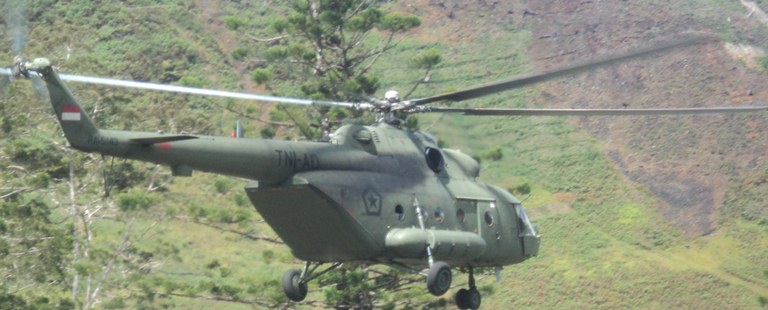
Indonesian Army shoot mother and 3 children in “crossfire” in Kalome, West Papua, as offensive escalates

Map of Puncak Jaya, Papua, Indonesia.
Image via Wikipedia

by Nick Chesterfield, with local sources and agencies

WestPapuaMedia.Info – Indonesian Army (TNI) troops have shot 3 young children and a mother in Puncak Jaya, West Papua, in the latest atrocities carried out during a two-week military offensive aimed at ending armed resistance to Indonesian Rule over the occupied colony.

Ny Dekimira, 50, was hit on the right foot, and the three children – Jitoban Wenda 4, and their neighbors Dekimin Wenda, 3, and Dimison Wenda, 8 – all had bullets hit their left legs after Indonesian troops fired indiscriminately into the honai (huts) just before dawn on July 14, according to local witnesses.

Credible reports about the scale of the offensive are beginning to filter through from the remote and inaccessible area about the scale of the offensive  The Indonesian government has closed off access to the Tingginambut district to both Indonesian and foreign human rights and media observers, and local activists have had to march for days across rugged terrain to get out verified information.   Local human rights observers and Papuan activists have independently reported to West Papua Media that TNI headquarters staff have threatened their safety if they alert journalists to abuses carried out by Indonesian security forces against West Papuan people.

Undeterred, the mass based Papuan activist network West Papua National Committee (KNPB) have accused the Indonesian Military “under the regime of General Susilo Bambang Yudhoyhono”
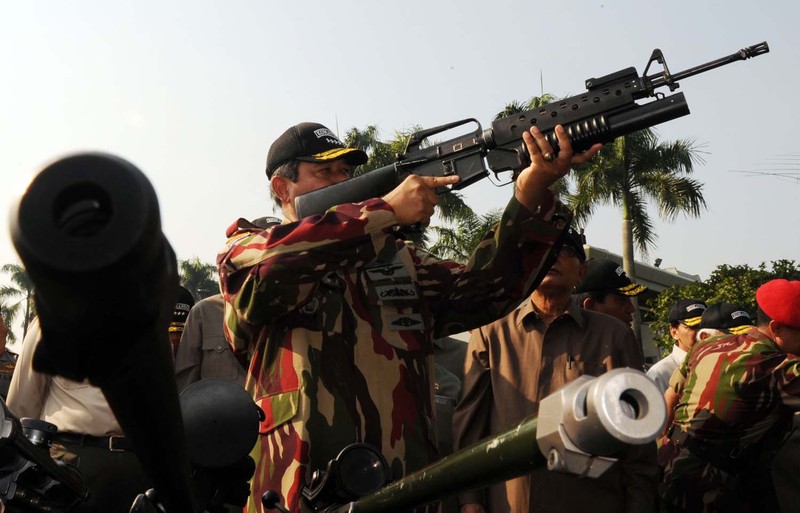
General SBY - Military approach will not solve Papua's problems

of manipulating the situation in Puncak Jaya to conduct military domination and control of the local population, despite the recent public relations offensive that it was engaged in “bakti” social service campaigns to help the people.  According the KNPB, the TNI should not cover up their mistakes and militarism by engaging in social activities – they should cease military activities on civilians altogether.

“Their reasons make no sense, because it’s so funny that the military themselves who set fire to the houses of citizens in almost all settlements, Indonesian military who burned alive the people’s animals, burned residents’ gardens; and now the TNI and Police are trying to justify themselves as heroes by playing a cheap propaganda in the media, ” said a KNPB spokesperson on Saturday.

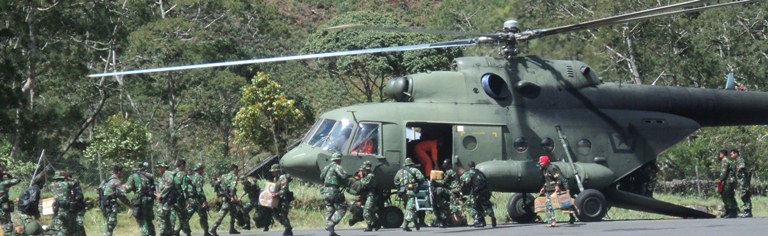
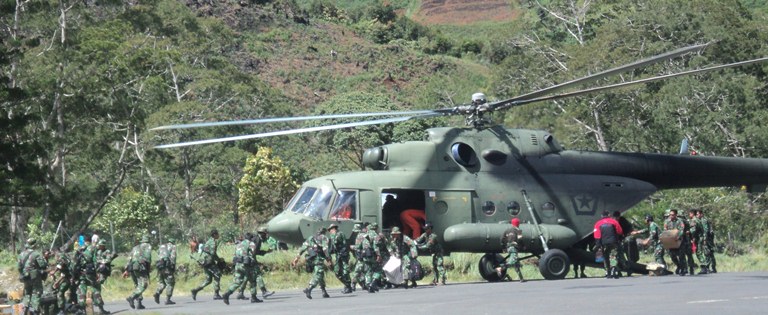
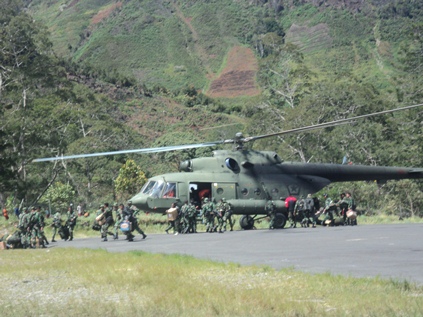
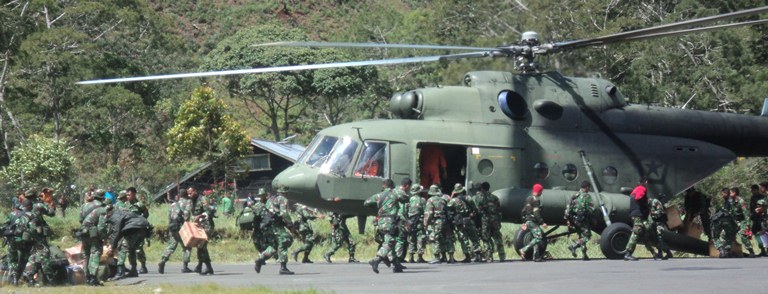
Activists from the area have provided photographs to West Papua Media
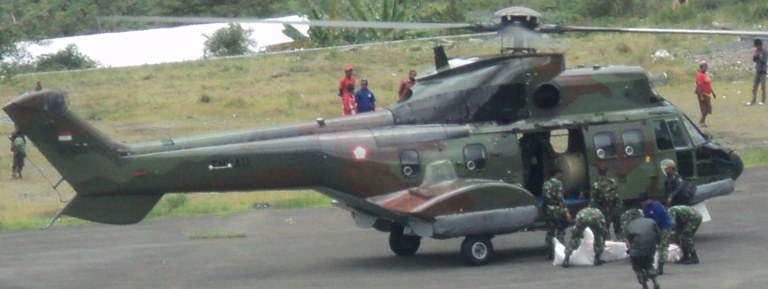
showing the fully armed troops previously working on the Bakti projects suddenly boarding Puma helicopters in transit to the combat zone around Kalome.

TribuneNews.com quoted the TPN Secretary General for the Highlands Area, General Anthony Wenda, saying that villagers reported the shooting in Kalome on July 7 happened before dawn when residents were still asleep. “At that time, we’re on guard night and day in Kalome, and a barrage of bullets from the TNI were directed into a house of children and the elderly,” said Wenda to Tribunnews.com. “We always will be ready to make contact with TNI weapons until we are free, because this is the struggle of our people of West Papua.”

After this shootout, the force reportedly involving over 600 soldiers from the notorious 753 Battalion based in Nabire, have sought to enforce their control over the rugged and remote district.  753 Battlalion’s operations in the Kalome area reached international infamy in 2010 when troops tortured and killed Rev Kindeman Gire, and also with the torture of Tunaliwor Kiwo.  Kiwo’s torture, captured on video and uploaded to Youtube, created outrage that shone an international spotlight on the TNI’s behaviour against civilians in Papua.  The Indonesian government was later caught red-handed as it switched the defendants in the torture trial widely seen as farcical, and ran a military trial on issues of discipline instead of human rights abuses. Since this time, TPN fighters been permanently around the village for protection.  However, the TPN are poorly armed and their hardware is no match for a fully equipped modern military.

The current offensive comes as the Indonesian military is attempting to convince international observers that it is improving its human rights practice.  Last week, as troops were engaging both civilians and fighters from the National Liberation Army (TPN-PB), the commander of the TNI in West Papua,
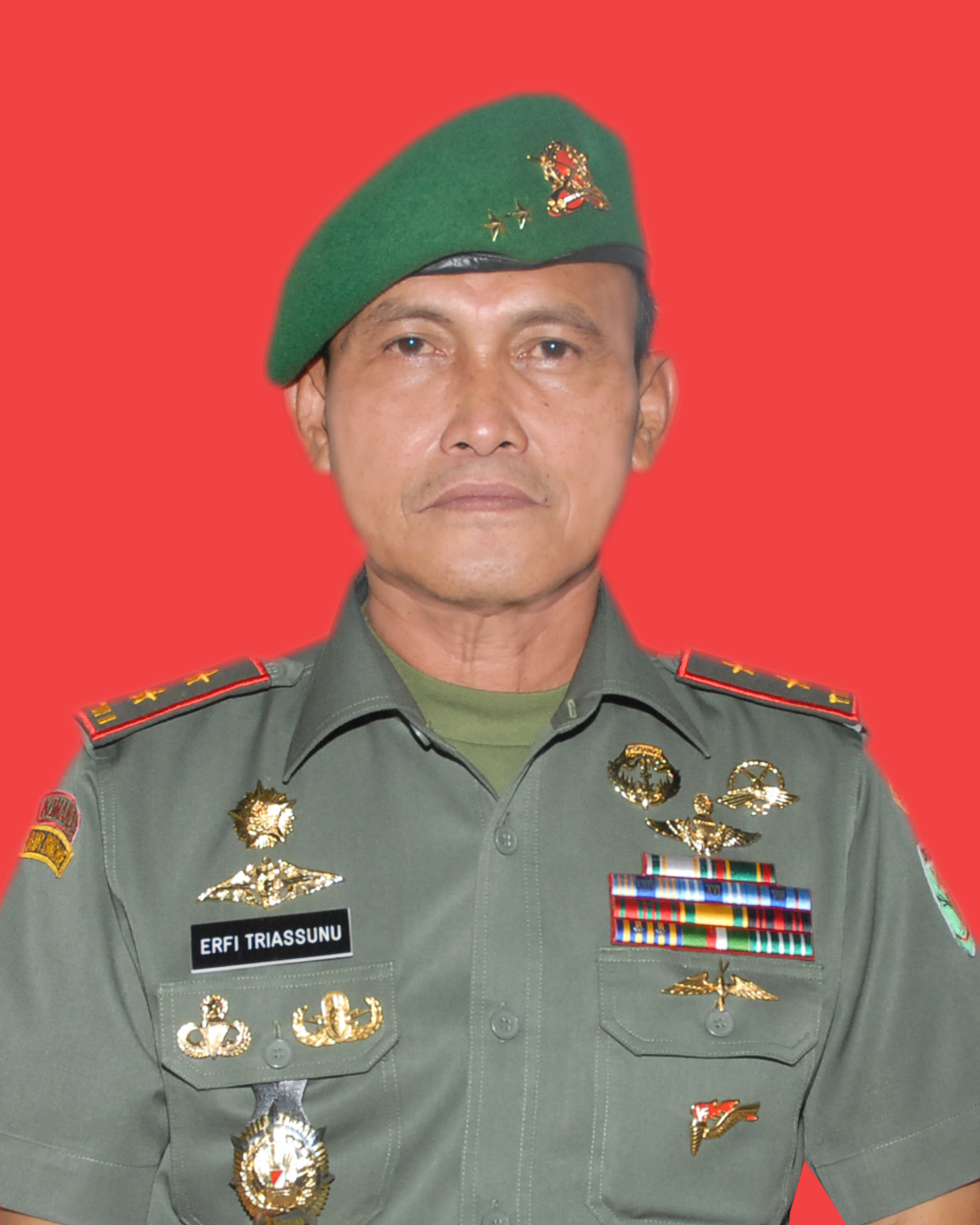
Erfi Triassunu - duplicitous

Major General Erfi Triassunu, was duplicitous in speaking about ending impunity and abuses by its soldiers at the Jakarta-sponsored Papua Peace Network (Jaringan Damai Papua or JDP) conference in Jayapura.  Dr Neles Tebay and the Indonesian Institute of Sciences (LIPI), the organisers of the conference, were apparently unaware of the contradiction at this time, a contributing factor in the boycott or skepticism of the Peace Talks by the majority of Papuan representative organisations.

Yet according to the KNPB, one of the several sectors suspicious of the JDP, this peace process is illegitimate.  “Do not imagine Peace (will be brought) by the JDP, Indonesian Government through Governor, DPRP, TNI or the police in Papua.  Because in reality, Papua is a military zone by their physical and systematic actions done to destroy the Papuans and to control this region for the glory of foreign investors.”

According to Tribunnews.com, Maj-Gen Triassunu conceded that troops may have shot the Kalome villagers.  “The possibility exists, but we have not received a report from our post in Puncak Jaya”. Triassunu denied the incident in Kalome was proof that civilians were targeted.  “We just pursued the TPN OPM in mountainous regions, because Papua is part of the Unitary Republic of Indonesia,” he told Tribune News.

However, the Head of Information Department of the Army (Kadispenad) Brigadier General Wiryantoro would not comment on this allegation.  “It’s related to operations of TNI forces deployment. When it comes to coaching the Army personnel, or related to the pure strength of the army, I can not answer” (Tribunnews.com)

When contacted by West Papua Media, no spokespeople for either the Indonesian military or Police made themselves available for comment on the allegations of the offensive, nor were replies made to telephone voice and text messages, or emailed questions.

West Papua Media also has made a decision to protect the identity of its sources*, as they have reported significant threats to their safety.  Political activists reporting on the events have also come under significant threat.  Victor Yeimo from the KNPB reports that when the Press Conference for local and national journalists to report on the Puncak Jaya incidents was called, phone and physical threats were received from persons claiming to be Pangdam (Indonesian Army Regional Commander), and Police.  Yeimo reports that these callers forced KNPB to cancel the press conference about the case in Puncak Jaya.   “Many journalists did not come after they terrorized by the Indonesian Military,” said Yeimo.

Siege Conditions may create humanitarian crisis

Credible local clandestine activists have relayed reports to West Papua Media of the TNI laying siege to several villages in the immediate area of Kalome, but they cannot get close enough to verify any casualties, displacement or destruction.  With village sieges and actions on other villages in the past having caused significant displacement, local human rights observers fully expect the civilian death toll to rise significantly.

Hundreds of people have reportedly fled to neighbouring villages or to the hills, and observers have expressed concern that in the depths of winter, with their food crops destroyed, locally people internally displaced who may have no alternative to seek refuge in higher ground, may succumb to starvation or exposure.  The areas high in the cloud forests and above the treeline are not suitable for sheltering large numbers of people, as they have been denuded by countless thousands of internally displaced refugees from previous military offensives.

Since the first aerial bombing campaigns by the Indonesian Air Force in 1978 in Puncak Jaya, almost every year from July to August, the TNI has launched offensives against civilians across the highlands.  An identical offensive in 2003 was investigated by Komnas HAM (Indonesian National Human Rights Commission), which found that the Australian-trained Kopassus special forces committed gross human rights abuses and crimes against humanity. Similar offensives occurred in 2005, 2006, and 2007, which forced several thousand people into famine conditions high in the mountains, above the treeline.  Last year also marked a particularly brutal operation, only noted by foreign media due to the inescapable viral distribution of the torture videos.

In light of the allegations of brutality by the TNI in Kalome, independence activists are also challenging the notion that the armed resistance practiced by Tabuni’s forces is terrorism.  According to a KNPB spokesman, “The TPN under the Goliat Tabuni continues to struggle, not for a personal profit nor to legitimise the habit of TNI and POLRI to obtain security protection payments. The struggle is resistance to colonial occupation by  Indonesia of West Papua, especially in Puncak Jaya … the reason the TPN was formed”

The recent deaths of TNI and Police.in Puncak Jaya is the fault of the generals in the view of the KNPB, who say that their policies and command structure sacrifice the members of it security apparatus.  “Victims will continue to fall if SBY and (TNI Command) prioritize militaristic ways to solve West Papua’s problems, by dropping hundreds of soldiers everyday to Puncak Jaya”.

“If SBY does not take  political will to solve the problem of West Papua immediately (by allowing an) act of self determination via a referendum then human rights violations will continue to occur,” stated the KNPB spokesman.

West Papua Media was this week contacted by a retired European missionary who had formerly served in Puncak Jaya regency who was concerned about the current situation.  He offered the following comments on condition of anonymity, as he is concerned for reprisals for his former colleagues:

  “Burning villages, causing people to flee with nothing but the clothes they wear, creating absolute terror amongst ordinary people, condemning babies to die starving and frozen hiding from the soldiers high in the mountains, killing and torturing priests and laymen alike… who are the real terrorists? This is not new, this slaughter happens every year since Indonesia first came – they are not hunting guerrillas, they are hunting Papuans until they are dead.  Whilst we might not always agree with the strategies employed by TPN, and that we pray for a peaceful solution, they are a legitimate army of national liberation there to protect their people in the absence of any international concern.”

West Papua Media will continue to provide monitoring and coverage of this evolving situation.  Please send any tips or corrections to editor<at>westpapuamedia.info

*Please note: bona fide journalists can be provided with sources if they are doing a story on this issue, but for their safety, their identities are strictly not for publication.

Related articles

AHRC: INDONESIA: Torture Report – A heinous act which is not seriously addressed


AHRC-FST-042-2011
July 14, 2011

Report on the practice of torture in Indonesia for the International Day of Support for Victims of Torture from the Commission for the Disappeared and Victims of Violence (KontraS) in Indonesia forwarded by the Asian Human Rights Commission

INDONESIA: Torture: A heinous act which is not seriously addressed

Download the full report at http://www.humanrights.asia/countries/indonesia/reports/ngo/KontraSTortureReport2011.pdf

I. Introduction

One of the serious issue of human rights violations—which is one of the nonderogable rights —that recently arised public attention is torture. First, in early October 2010 shortly before his plane left for the Netherlands, President Susilo Bambang Yudhoyono decided to cancel his state visit in the country. The cancellation was due to the filing of the lawsuit to the local court in the Netherlands by the activists of South Moluccas Republic (RMS/Republik Maluku Selatan) who live there. The lawsuit for one reason was based on charges of torture committed by police officers against those accused of being RMS activists. They were charged with treason when they displayed RMS flag as they performed cakalele dance in front of the president and some foreign guests during his visit to the Moluccas in June 2007. Following the cakalele incident the security forces, including special anti-terrorism unit Detachment 88 immediately arrested and detained hundreds of suspected RMS activists and some of them were allegedly become victims of torture.

Second, only a few weeks later in October 2010 a 10-minute visual documentation—circulating through ‘Youtube’—on torture of two Papuans recorded with mobile phone video tool. In the video, the extremely brutal and inhuman action was obviously conducted by people in military uniforms in order to conduct interrogations. With the rapid spread of that torture video, various Indonesian authorities—including President Susilo Bambang Yudhoyono— promptly responded to it and affirmed the practice of torture by military personnel in Tingginambut, Puncak Jaya, Papua. Many actually considered this video as an explicit example of the allegedly patterned practice of torture in Papua. The appeals of concern about the practice of torture also expressed by both foreign governments and international organizations.

This paper tries to examine the extent to which states implement human rights standards in the relevant international instruments of torture as an obligation of Indonesia post ICCPR and CAT ratification within the past year (July 2010 to June 2011). The implementative obligation is to do prevention efforts (through improvement of legislation, judicial system, and administration of state), ensuring the perpetrators brought to justice and provide redress to victims or their families. The contextual torture issues and problems in Indonesia can be seen from various post-priority agenda of meetings and discussions conducted by Indonesia government with relevant international human rights agencies.

So far Indonesia has made two reports to the Committee Against Torture under the Convention Against Torture, the first (initial report) was in July 2001 and the second (periodic report) in 2005. Unfortunately, Indonesia has not made the first report to the Human Rights Committee, the regulatory body for the ICCPR. In addition to reporting under the treaty body mechanism, there are also the follow-up results on torture based on the report
under the charter body mechanism. Under the mechanism of the UN Human Rights Council there are two follow-up agendas: first, the official country visit follow-up of Special Rapporteur on Torture, Manfred Nowak, conducted on 10-23 November 2007; second, the special meeting to discuss the results of Indonesia Universal Periodic Review/UPR in 9 April 2008 during the Fourth Session of the UN Human Rights Council. As follow-up results from various human rights mechanisms mentioned before, there are several similar recommendation agendas expected to be implemented by Indonesia related to the issue of torture, such as:

  • Torture should be made crime and its definition should be in accordance with Article 1 of the Convention against Torture;
  • The lack of this legal rule would lead to the practice of impunity;
  • There shold be an effort to revise the detention system, whether the duration of detention and the effort to test the validity of such detention;
  • In the context of law enforcement, any evidence or testimony that was made due to a practice of torture;
  • Ensure that victims of torture receive redress (reparation).

In conducting an audit over the issue of torture in Indonesia during the past year (July 2010-June 2011), KontraS took up cases of alleged torture which were directly dealt with. Information on alleged cases of torture would be considered a secondary source that could help clarify the picture of torture practices more broadly. In addition the audit report also discusses several policies, including plans for the creation or legislation revisions, which emerged within the past year.

To read the following sections, please download the full report here:

II. The Lack of Normative Provisions Against Torture
III. The Pattern of Torture Cases
IV. Development of New Legislation Draft Related with Torture Issue
V. Conclusions and Recommendations


Plea for help from Puncak Jaya against TNI military operations

(FORWARDING ON)
(Please note: By republishing this plea for help, West Papua Media does not necessarily explicitly endorse the call for arms.  We believe the situation would be far better served by allowing international journalists, and UN peacekeepers to be sent into this area to prevent this carnage.  However, in the absence of this, all peoples have the right to self-defence and self-determination, and therefore we cannot oppose the legitimate calls to assist in self-defence).
Report from Piron Moribnak
ARMY’S SOCIALISING PROGRAMME IS BEING USED TO CRUSH TPN/OPM LED BY GOLIAT TABUNI IN PUNCAK JAYA

The doubts of  people living in the central highlands about a socialising programme  launched by the commander of Cenderawasih Military Command/XVII to create harmony which has been under way since 2 May 2011 have been confirmed. The programme is nothing more than a shield which became clear when troops involved in the socialising programme suddenly halted these activities and started to conduct sweepings as part of a military operation.

Since 6 – 8 July, fully armed troops have surrounded the headquarters of the TPN/OPM under the command of General Goliat Tabuni in Tingginambut and a battle has been raging since 5 July during which three TNI soldiers were shot in Kalome, district of Tingginambut, and were flown by helicopter to Jayapura.

The TNI’s programme to build houses for the local people and to give sermons at prayer meetings on Sundays as well as to carry out mass medical treatment for local communities  has failed to win the support of the local communities. They have rejected TNI sermons in the churches, while the offer of medical treatment has failed to persuade the local people to get medical treatment free of charge . On the contrary, the local people have chosen to remain silent and have fled from locations where mass medical treatment is on offer. This is because the Papuan people living in Puncak Jaya regard the military as murderers of the Papuan people and have refused to accept these military programmes.

The army’s socialising programme in Puncak Jaya is nothing but a shield and a cover-up of the violation of human rights at a time when human rights are of paramount importance throughout the world.

The TNI is concealing its plan to crush General Goliat Tabuni by means of military operations so as to enable them to counter our doubts about these socialising activities because we have been disrupted and have taken measures to protect ourselves.

It is an irony that we Papuan people do not possess the means to resist the TNI which has all the necessary equipment whereas Goliat Tabuni has nothing more than a few of weapons, making it very difficult for him to mount a proportionate response . Is there a country anywhere in the world that is willing to supply military weapons to Goliath Tabuni to make it possible for him to make a proportionate response?  … if General Goliat is forced to end his struggle … at the hands of the TNI?   [/Several gaps in this sentence make it difficult to decipher the precise meaning. TAPOL/]

We pray that there is nowhere in the world for their protection and that Almighty God will protect us.

This is our response to the call by the chief of police in Puncak Jaya  via the intermediary of the head of the district of Mulia  for the local people to halt all their activities from 8 July and to remain in their homes from 6pm every evening.

NOTE: General Goliat Tabuni  is now seriously cornered because of his lack of weapons and we call for the prayers of the Papuan people everywhere in the fight against the NKRI military and for strength from the Almighty God.

[Translated by TAPOL]

BREAKING NEWS: WAR IN TINGGINAMBUT, WEST PAPUA

REPORTS OF 600 TNI SURROUNDING VILLAGES IN TINGGINAMBUT

by Nick Chesterfield @ Westpapuamedia.info

Monday July 10, 2011

Confirmed reports emerged on Sunday from Puncak Jaya, West Papua, that over 600 Indonesian Army (TNI) troops have been conducting daily full combat operations since July 4 in and around villages in the Tingginambut area.  Troops have reportedly attacked a series of villages said to be the refuge of the West Papuan Guerrilla leader Goliat Tabuni.

Troops from the notorious 753 Nabire battalion have reportedly surrounded the General Headquarters area of the West Papua National Liberation Army (TPN-PB) faction led by Tabuni, and have occupied several villages including Kalome, where three soldiers were shot by unknown assailants last Tuesday.  The Indonesian government news agency Antara reported that armed men stopped TNI soldiers from carrying out what it described as a “routine patrol” in Kalome village.  An exchange of fire occured – it is unclear who shot first – and three TNI were all struck by bullets to their arms sustaining non-life-threatening gunshot injuries.

According to reliable human rights activists in the immediate area, villagers in Kalome were rounded up and subject to harsh treatment by returning soldiers from 753Btn, and reportedly forced to watch as several houses were torched.  West Papua Media has been unable to verify these reports, but 753Btn has a well documented history of burning villages suspected of sympathies or harbouring TPN-PB.  (Extensive video footage of previous village burnings is available to any interested party).

Firefights have been occurring daily between TPN and TNI forces, with local sources describing it as “a 7-day shootout”.  “The current death toll, according to our intelligence data, is that Indonesia have killed 20 TPN fatalities, and according to reports from the field in Puncak Jaya, TPN have claimed five Indonesian military casualties”, said the source upon condition of anonymity.  Several civilian casualties have been reported, though exact figures are unconfirmed.  West Papua Media cannot at this stage confirm exact numbers.

Battalion 753, the battalion responsible for the well documented torture of West Papuan civilians and village burnings across Puncak Jaya in 2010 (including the infamous Tunaliwor Kiwo torture video), has been recently engaged in a much publicised heart-and-minds Bakti (Service) campaign, gardening and house-building cynically named “Love and Peace are Beautiful”, to mend the bridges damaged by the Army’s human rights abuses, torture and village burnings.  It was unclear whether this campaign was mending the houses that 753 had previously burnt down.

Puncak Jaya has been the scene of regular human rights abuses on civilians, with major combat operations ongoing since 2009.  TNI and BRIMOB paramilitary Police, as well as the Australian trained Detachment 88 counter-terrorist unit, have regularly targeted civilians whom they accuse of supporting the guerrilla TPN-PB of Tabuni.

Local sources have expressed fear to West Papua Media that their villages are being targeted for pacification and punitive operations after the failure of a much touted Social service campaign to heal the image of brutality that surrounds the 753 battalion.  It is feared by local activists that civilians are especially at risk as collective punishment for the potential escape of Tabuni’s forces, in a strategy by the TNI designed to flush out the TPN.

According to the adjutant of General Tabuni in a statement sent to West Papua Media, the purpose of the social activities by the TNI was to create a trojan horse for the eradication of armed resistance from Tabuni and his men.  “TNI’s Bakti social mission in Puncak Jaya is really a guise to avoid gross violations of human rights because the TNI Papua Commander was in the area and needed good press”.  According to the Jakarta Globe, the head of the Cenderawasih Military Command, Maj. Gen. Erfi Triassunu, said the TNI would provide psychiatrists to help residents traumatized by the widespread violence in the area.  The campaign was due to run from 2 May to 28 August, but almost all the troops who were building houses are now burning them down again, according to local sources.

Local human rights activists described the failure of this program being caused by the simple issue of trust.  “All their talk of caring for our human rights and welfare is shown to be a lie by this latest operation.  We have never trusted them, but now we trust them even less,” said the human rights worker, who cannot be named for his safety.

The TPN spokesperson was more blunt.  “People doubted the presence of top military who were proclaiming their victory in Puncak Jaya.  The TNI social service campaign is merely a shield.  It was evident from July 6,  that (these) military forces ….suddenly stopped and all directed to Tingginambut to conduct  military sweeps.  All TNI Bakti activities stopped completely. Since July 6 to the 8th all military forces here, with full combat equipment, have surrounded the headquarters of  TPN / OPM…. Tabuni is currently under siege”.

Reports of major abuse by Indonesian security forces in the West Papuan highlands are notoriously difficult to verify, as international human rights monitors and journalists are banned by the Indonesian government from travel to West Papua.

Please stay tuned to West Papua Media for more updates.

westpapuamedia.info

for media enquiries, please call +61450079

AHRC (INDONESIA): Delayed Criminal Code reform prolongs institutional use of torture

FROM ASIAN HUMAN RIGHTS COMMISSION

FOR IMMEDIATE RELEASE
AHRC-STM-083-2011
June 24, 2011

A Statement by the Asian Human Rights Commission on the Occasion of the International Day in Support of Victims of Torture, June 26, 2011

INDONESIA: Delayed Criminal Code reform prolongs institutional use of torture

Has the video showing military torture in Indonesia in October last year created any serious concern for torture in that country? In the video, members of the Indonesian military tortured two indigenous Papuans to obtain information about alleged separatist activities. While some of the perpetrators got a few months of imprisonment for disobeying the orders of their superior, nobody was punished for the torture committed, nor did the victims receive any compensation or medical treatment. The extreme practices shown in the video shocked the public even though numerous cases of torture had been documented by NGOs and the National Human Rights Commission for years.

Torture is frequently used by the Police and the Military to force confessions, intimidate or to obtain information. The infliction of severe pain by public officials for the above and certain other purposes is prohibited in the UN Convention against Torture and Other Cruel, Inhuman or Degrading Treatment or Punishment (full text in English, Bahasa Indonesia). This definition of torture and its prohibition also applies to Indonesia. Experts in and outside the country have repeatedly pointed out the neglect for institutional reform that the government has shown so far to effectively end this medieval practice.

Indonesia decided to ratify the Convention in 1998 and make it thus fully applicable into its legal and institutional system. While this may have appeared as a dedicated choice towards human rights, this promise from 1998 has never been kept. After 13 years, the government and parliament have failed to take even the basic key steps to end torture. As a result, torture continues to be applied.

What are the next steps to end torture? To make torture a crime! Amending the Criminal Code to make an act as defined in the international Convention punishable by law is a minimum requirement. Instead of fulfilling this requirement the government makes reference to maltreatment articles that actually only cover some parts of the problem as well as conduct guidelines for the police, which are neither promoted nor effectively enforced within the service.

Torture can be a convenient methodology for unprofessional members of the police force or the national military to “get things done”. Obtaining confessions, intimidating protesters, threatening minorities, producing quick case reports or to increase the income through bribes. Many dedicated staff in the national police, the national police commission and other related bodies have made considerable efforts to end this practice in their institutions but to support their efforts, more needs to be done.

Moreover, many see the use of torture as a legitimate and necessary mean to deal effectively with any wrongs ranging from petty crimes like theft up to organised terrorism. “Tough crimes need tough responses”, some may respond while forgetting that punishment is not part of the role of the police and military. Punishment for crimes is to be applied after a judicial process has established the guilt of the perpetrator and may then include imprisonment or other forms of non-violent punishments. But leaving an entire justice process in the hands of a police officer cannot be further away from fair trial and a just society.

Sunday June 26, 2011 is the International Day in Support of Victims of Torture. Indonesia has thousands of victims, probably more. Many of them have not committed any crime and the majority of them is poor or from marginalised groups. Persons undergoing serious torture often suffer from the post traumatic stress disorder syndrome, cannot sleep well, relate personally to society and are violated and broken in their heart and soul. Decades of medical research have shown how tremendous and long lasting the impact of torture for the body and mind are for the victims and often also for the perpetrator.

Justice does not need torture as the eradication of the practice proofs in other countries. In fact as long as torture continues in a society, violence prevails. This practice can end if the use of torture is effectively punished and fully prohibited. To fulfil the promise Indonesia made in 1998 to the Indonesian people the Criminal Code needs to be reformed immediately. The victims of torture need our support.

# # #

About AHRC: The Asian Human Rights Commission is a regional non-governmental organisation that monitors human rights in Asia, documents violations and advocates for justice and institutional reform to ensure the protection and promotion of these rights. The Hong Kong-based group was founded in 1984.

Create a website or blog at WordPress.com

Up ↑