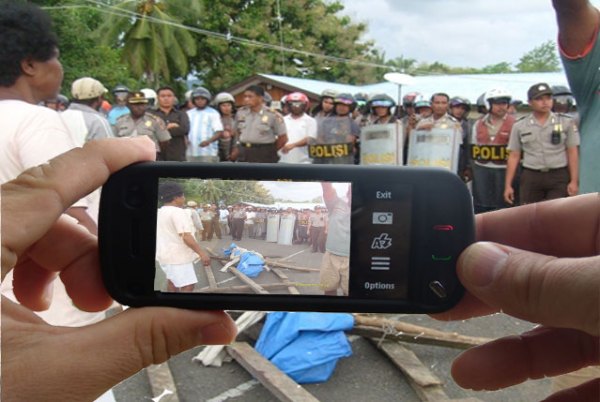
Broadcasting Papua’s Songs of Freedom: Why the international community must support West Papua’s citizen media development

FREE THE PEOPLE? FREE THE MEDIA!

by Nick Chesterfield

A Paper presented at the University of Sydney Centre for Peace and Conflict Studies “Comprehending Papua Conference”, February 22-23, 2011.    This paper will form a chapter of the forthcoming book “Comprehending Papua”, to be published in early 2011 by the University of Sydney Centre for Peace and Conflict Studies.

———

It is almost a cliché today that peoples wishing to free themselves from tyranny are turning in huge numbers to citizen journalism both to tell their stories to the outside world, and to put a formidable brake on the out of sight, out of mind mentality that allows state organs to conduct constant abuse with impunity. The rise of citizen media is giving mainstream journalism the kick it needs to remember its core business of giving voice to the voiceless.  In West Papua, the Voiceless are slowly discovering they can roar.

Just a few weeks ago an event occurred in Tunisia that was to be the spark for the pan-Arab awakening which has just seen yet another dictator ousted, now in Egypt.  After a local trader immolated himself in protest against the Tunisian regime, citizen media succeeded in viralizing the news of this event.  “We could protest for two years here, but without videos no one would take any notice of us,” said a relative of the martyred 25-year-old.

For media activists and journalists reporting Papua, this truth is self-evident, and its acceptance hopefully could ignite the spark of uprising in Papua.  The opportunities presented by the Pan-Arab (and other) awakenings are not being lost on the young generation in Papua.  Social media in Papua is buzzing, unafraid, with vibrant discussions of implications for Papua of the pan-Arabic revolutionary success.  The reality is that a spontaneous awakening and mass politicisation of ordinary Papuans is completely inevitable, and it is being ably assisted by switched-on local people developing their capacity to tell the story to the world.

In researching for several stories over the last few months, my sources have told me in no uncertain terms that they are all ready for a trigger to explode the situation.  The only thing holding back sustained mass action – revolution even – across occupied Papua is the constant bickering between exile groups, the actions of the collaborator elites, desperate to cling to the illusion that Jakarta is not there just to steal their land and send them to the moon, and for those who will put their own interests ahead of those surviving under occupation.

What is a mystery is how this mass consciousness will survive the elite and exile power games that are evident in most transitional polities throughout recent history (and is certainly present in West Papua today); whether those exiles will hijack the efforts of the young generation or listen to the actual wishes of their people; and if Jakarta can be trusted not to unleash the truly evil and deeply entrenched habitual brutality that is its only constant in becoming the new colonialists; or that they will claim their place amongst the civilised by not slaughtering those who want peace. History is a wise teacher, and its lesson is never trust the evil or greedy to reform of its own accord.

To keep these ugly realities in check, West Papua (and the international community) needs a determined, effective, vibrant and fearless citizen and professional media to deliver real-time accountability both internally and internationally.

Real time advocacy is vital for the international community to act to end Papua’s suffering.  Human Rights advocates conduct scientific research into abuses, but because this information does not get out easily, the problems in Papua are only now getting known to the world.

I need to ask you all today an honest question:  without the hard work of journalists in Papua and those outside assisting them to get their voice to international media, would Papua even be in people’s consciousness today?   So why is the international arena concerned with West Papua falling prey to the disease of factionalism and Big Man syndrome, and not in assisting WestPapuan people to get their stories into the living rooms of the world?

Many loud mouthed exiles claim significant legitimacy, but baulk and splutter when asked to prove it.   This has developed a culture of opacity across the exile movement.  A strong and diverse citizen based media across Papua can easily counter exile’s game playing and false claims by ensuring credibility and honesty in social movements. It benefits and strengthens social movements too by giving the skills and practice for sharpening their message, and creating a powerful argument for international support for their aims.  Strong domestic media also removes international government’s excuses for inaction, by seriously raising the credibility and verification bar.

If the international community is serious about improving the lives of Papuan people, it will help develop the capacity of the West Papuan media to tell the story of what is going on, and press Jakarta hard to allow immediate international media access.  After all, with full accountability, what is there to be afraid of?

Largely in response to years of wilful ignorance and self-censorship of the Indonesian created horrors in West Papua by international media, many sectors of Papuan society spontaneously and independently began a dramatic take-up of social media technology, exponentially increasing since 2008. Blogs, social networking and online media outlets are being utilized all over the country, by a young generation of Papuans impatient for real change.  Today’s mass Papuan movement is mainly urban, educated, innovative, nonviolence based, and embracing significantly the power of citizen and social media as a key plank of civil resistance strategy.

Very occasionally West Papua does get in the news, but only through the co-ordination between committed journalists and human rights workers working together and ear-bashing news editors.

Due to the ongoing ban by Indonesia on international media and humanitarian organisations having access to Papua, allegations of abuse are notoriously difficult to verify.  While this ban remains in place, only the most dedicated journalists make the effort to go in undercover.   West Papua Media has been proud to facilitate undercover trips into occupied territory to meet with many West Papuan people prepare to tell their own story. This is getting more difficult by the day so local people are working for a solution.

Live images, videos and online activism by Papuan people have already created tremendous momentum in action and awareness of Papua.  By creating their own media, and their own narrative, Papuan people are reclaiming self-determination denied for so long.

Reporting in West Papua is a highly risky business.   Journalists, Papuan and outsiders alike, are under constant threats for reporting West Papua, with four journalists dying in suspicious circumstance in 2010 alone.  Anywhere journalists report fearlessly they are targets, but most journalists in West Papua simply put up with it, they have no other option.  What can we do to lessen their risk?

Partly in response to this danger and partly to give local journalists a voice globally, West Papua Media (WPMA) (WestPapuaMedia.Info) was started. It aims to provide a professional service to international media covering West Papua, ensuring high quality, verifiable reporting gets into the international media, directly from the ground, and not from those who seek to distort the truth of daily experience in Papua.  By reporting Papuan campaigns to end human rights abuses and bringing these unreported Papuan issues to the front page, we hope to hold the abusers to account. With an ever growing stable of committed and disparate voices from citizen media to professional journalists, West Papua Media is proud and excited to be part of this movement.

Some of our real time work has assisted directly in the prevention of mass acts of violence by the Indonesian security forces, such as our coverage and media advocacy fixing of the July 8-9 Otsus Gagal demos and occupation of the Jayapura DPRP.

Less than ten minutes before the deadline for dispersal of the 2 day rally of over 45,000 people, Indonesian security forces were forced to back down after a BBC report aired, organised by WPMA, which brought international attention the explosively dangerous situation.  Extensive international diplomacy occurred in that 15 minutes and, together with the extreme discipline of the mass protest, enabled the protestors to peaceably leave the scene of the protest without violence.

WPMA has worked very hard raising the media profile of West Papua, with significant joint investigations with major media outlets breaking several key stories in 2010.  None of this would be possible without deep trust from the people of Papua in reporting their stories.  West Papuan citizen media, in conjunction with several colleagues here today, played a key role in alerting the world to deeply heinous cases of abuse.

One was the sourcing, verification and release of the deeply shocking leaked Kostrad torture videos of civilians in Puncak Jaya. The Kiwo incident neatly captures why the Indonesian military cannot be trusted to reform themselves from the inside, and why the role of a robust media is so critical in Papua.

The other was footage of Indonesian BRIMOB police taunting a former political prisoner Yawan Wayeni, having disembowelled him moments before for arguing with them. Both these videos showed the power of citizen media in activating international human rights networks to effectively raise the issue of Papua. Of course, there are many more videos in preparation for release.

A swarm movement cannot have a single media strategy, but media need to understand that it will get media out in its own way too.  The media that had wilfully ignored West Papua’s voice for so long really has no right to dictate how information disseminates, and if it wants to get the stories before others, then it just has to move faster.  Because it is new media techniques that have already, and will propel Papua onto the front page, to make people choke on their cornflakes.

Likewise, evidence dissemination also needs multiple, failsafe distribution routes: Single dissemination routes can easily be shut down or silenced.  West Papuans have tailored their mechanisms to this very effectively; yet this is significantly frustrating outside journalists.  According to many in mainstream media, West Papuans can be their own worst enemy when it comes to disseminating information.  People on the ground do need to get smarter about media distribution strategies, but the media also must adapt to a social and cultural reality.  West Papuan human rights and citizen media are not chaotic: they are maximising the potential audience  for their information.

It is important to understand that no one faction or sector in West Papua can claim dominance or leadership of this mass movement. This is not Congress in India and there is no single Gandhi figure. Rather, this is a movement with thousands of Gandhis.  The civil movement refuses to be based around a single leadership group, and instead features multitudes of groups and tribes all acting autonomously and independently (where everyone knows their role and works their hardest) but which is nevertheless unified under its collective goals.

Such a swarm structure can occasionally present difficulties for those who cannot think outside traditional top-down strategies for national change, which includes traditional media. Rather than being shut out of dialogue by the game playing of unaccountable elites, this type of structure encourages a longer lasting peace by enabling all actors to have their voices heard. It is also a natural strategy to employ in a nation where it is,  for the most part, illegal to congregate in groups.

Other barriers for West Papuan media are much more easily solved with a bit of training, and understanding the enemy (this time the enemy being the unreasonable expectations of media executives far removed from reality).

One issue is the lack of speed with which many West Papuan media activists work, and whilst improving, an event on a day has to be filmed, edited, packaged and disseminated as fast as possible. There are issues of journalistic discipline and professional journalistic practice in new media; safe information gathering, abuse documentation and investigative journalism methodology; information quality assurance; protection of sources, and more.

Effective citizen and professional media training is required to develop awareness of major current and future challenges to safe information dissemination – these are all programs that the West Papua Media network is currently engaged in and it needs help to increase its capacity.

All of this costs money, and requires the international community to understand that the development of indigenous journalism in West Papua is crucial to the protection of human security and peace across the entire Asia-Pacific region.  It requires international institutions in media and academia to get out of their cloisters and get muddy, to actually pool resources and help identify new sources of sustainable funding to start training journalists in innovative new media reportage techniques, and to support their work for the global human interest.  As I said before, West Papua Media already has training programs ready to go, we just need the funds to make them happen.

In West Papua, as across the world, accountability is always the simplest solution to combatting impunity. An aggressive culture of investigative journalism must be encouraged, and the skills to enable it must be developed, to deliver that accountability, be it in human rights, against military business mafias and corruption, human security, environmental protections, etcetera, and to cover (and protect) the desires of a population to determine their own future, in both the current occupation and in any situation for the future.  Both academia and international media must take a strong role in its development, to embed international protections to enable West Papua’s journalists and citizen media to report without fear, hindrance or threat, the stories that are important to West Papuan people and their freedom.

Our hope is that we have a really robust citizen media that can deliver accountability.  We want to stop people from being afraid of speaking out, and we want West Papua’s voice to be its weapon, to broadcast its songs for Freedom.

Nick Chesterfield, editor at westpapuamedia.info, is a human security journalist and activist with extensive experience of the Papua issue through refugee protection, human rights, environmental protection, and citizen media work and safety training. He has conducted many field investigations in the West Papuan region since 1999. Together with citizen media and human rights workers from inside Papua, Chesterfield helped set up West Papua Media in 2008, to counter the wilful lack of coverage of West Papua by the international press.


Papuan churches call for dialogue mediated by third party

Bintang Papua, 11 March 2011

The leaders of a number of churches in Papua have called on the central government to hold a dialogue with indigenous Papuans, stressing that it should be mediated by a neutral third party and held without conditions.

A press release issued by Rev. Benny Giay of the KINGMI Church, Rev
Socratez Sofyan Yoman of the Alliance of Baptist Churches in Papua and the deputy chairman of the GKI Synod, Drs Elly D. Doirebo said:

We church leaders in Papua hereby announce to our congregations and to the general public that we have informed the central government about our rejection of OTSUS (Special Autonomy law) for two consecutive weeks (13-18 February and 28 Feb-3 March). We need to convey a number of important facts as follows:

First, the failure of OTSUS has been acknowledged not only by the
Papuan people but also by the executive and legislature of the central
government, as well as by foreign diplomats and civil society figures
who we met in Indonesia who have been paying close attention to the
development of the Papuan people.

A number of government functionaries who we met at the centre have
blamed government leaders in the Land of Papua as being responsible for the failure of OTSUS.

We do not believe that this is true. The failure of OTSUS reflects the
lack of political will and seriousness on the part of the central
government to do anything to promote the development of the Papuan
people. We made this clear in the Theological Declaration of Papuan
Churches on 26 January 2011 when we said that the central government has failed to promote the development and welfare of the indigenous Papuan people.

Second, bearing in mind that all sides recognise that OTSUS has failed, we continue to urge the government at the centre as well as in the Land of Papua to immediately announce that the swearing in of a second-term MRP will be abandoned because it lacks aspiration and has no firm legal basis. We regard the efforts now being made by the central and regional governments to set up a second-term MRP as arrogant and as a move to force through their will which can only intensify the conflicts between the Papuan people and the Indonesian Government.

Third, we continue to be guided by the people of the Lord who continue to urge the Indonesian government to hold a dialogue with the Papuan people facilitated by a neutral third party, without conditions.

We are well aware that the government of President Susilo Bambang
Yudhoyono was successful in the dialogue it held with the Acehnese
people and that the same can be achieved with the Papuan people.

Dialogue is the most dignified, peaceful and democratic way which has
been widely accepted by the international community as the model for the resolution of conflicts that have occurred in other parts of the country.

Fourth, we reject the creation of UP4B, the Unit for Accelerating
Development in Papua and West Papua, as well as all talk about
‘Constructive Communications’, the aim of which is to conceal the
failure of OTSUS and to obscure the Papuan people’s demand for dialogue.

There should be prior consultation with the Papuan people about all
measures taken by the state for Papua which should be the result of
agreement between the government and the Papuan people.

Fifth, We reject all acts of intimidation and violence perpetrated by
the state in order to silence freedom of expression and democracy in the Land of Papua, such as the stabbing of the journalist Banjir Ambarita.

We therefore urge the police to carry out a thorough investigation of
that stabbing incident and to proceed with the case through legal
channels, in order to give the victim as well as the community in
general in the Land of Papua a sense of peace and justice.

Comprehending West Papua: A report on the CPACS conference in Sydney and surrounding events

University of Sydney Centre for Peace and Conflict Studies

Comprehending Papua Conference

February 22-23, 2011

Comprehending West Papua: A report on the CPACS conference in Sydney and surrounding events


“We are Melanesian, not Indonesian!” and “Free Filip Karma!” chanted a group of West Papuans from around Australia – some refugees, some studying in Australia on scholarships – who had gathered in front of the Indonesian embassy in Maroubra, Sydney, on February 22, 2011. This demonstration urging Indonesia to free West Papuan political prisoners kicked off a week of events in Sydney bringing together academics and other advocates to focus on the status of West Papuan human rights.


Later that evening, a cocktail reception hosted by the West Papua Project at the Centre for Peace and Conflict Studies (CPACS), University of Sydney, followed by a dinner for conference participants, marked a merry beginning to a serious conference on Comprehending West Papua (February 23-4), the sixth in a series of conferences on the topic held by CPACS over a decade.


The conference was opened the following day by Emeritus Professor Stuart Rees and a performance group from the West Papuan community in Melbourne, both of whom graced the conference, respectively, with West Papua-centred revolutionary poetry and songs of inspiration. Up to 80 people attended the conference which convened at International House, with presenters from overseas (The Netherlands, Indonesia, Japan, New Zealand and Vanuatu), and interstate (Victoria and the ACT). Papers from in absentia participants (Paul Barber and Rosa Moiwend from TAPOL based in Surrey, John Saltford from London and Jim Elmslie from South Australia) were presented on their behalf, and Eben Kirksey, currently based in Florida, addressed the conference via video link.


The conference received good media coverage prompting an op ed in the Sydney Morning Herald by Hamish McDonald (http://www.smh.com.au/opinion/politics/a-worm-inside-the-new-); several ABC radio interviews http://www.abc.net.au/ra/asiapac/stories/m1965274.asx; a New Matilda article (http://newmatilda.com/2011/03/03/does-west-papua-have-publicity-problemINTERVIEW), and coverage by Radio New Zealand International and SBS.


Paper highlights covered new interpretations of self-determination, from Akihisa Matsuno, in light of the concept of legitimate sovereignty (rather than decolonization) that guided the independence successes of East Timor, Kosovo and (soon to be) South Sudan; a presentation by Nick Chesterfield on the opportunities afforded for West Papua by new social media currently carrying revolutions in the Arab world; a spectacular analysis of the Australian Museum’s Sentani bark cloth art production by Yvonne Carrillo-Huffman; the outlaying of precise political goals for achieving independence and for post-independence governance by Jacob Rumbiak; and an astute reappraisal of the anti-Act of Free Choice campaigns that took place in West Papua in the 1960s by Dutch historian Pieter Drooglever. The entire collection of papers will be gathered into a book to be published later this year.


West Papuan political positions were represented by Rex Rumakiek and Otto Ondawame from the West Papua National Coalition for Liberation, Jacob Rumbiak and Herman Wainggai from the West Papua National Authority, and Franzalbert Joku and Nick Messet from IGSSARPRI (the Independent Group Supporting the Special Autonomous Region of Papua Within the Republic of Indonesia). Passions ran high as discussions on the different political positions (essentially support for independence or integration) predictably emerged with so much at stake for all, but a respectful atmosphere reigned and peaceful dialogue between parties transpired.

The conference closed with the launch of a beautiful short film titled Mambefor Dance directed by West Papuan Melanie Kapisa, showcasing two young children learning West Papuan dance from imitating bird of paradise rituals. Dr Jude Philp from the Macleay Museum also generously showed conference participants around the University of Sydney’s West Papua collection donated in the 1970s and housed at Fisher Library. Finally, conference participants signed an open letter initiated by Human Rights Watch to Indonesian President Susilo Bambang Yudhoyono, requesting that the prohibitive restrictions on access to West Papua be lifted for researchers, NGOs and foreign media.

That evening at the Amnesty International offices in Sydney, Indonesian Solidarity launched a campaign to free West Papuan political prisoners. The launch was addressed by Human Rights Watch’s Andreas Harsono with a powerful presentation documenting Filip Karma’s imprisonment, and John Dowd, QC, President of the International Commission of Jurists (ICJ) Australia. The week closed on Saturday 26 February with the annual national meeting of the Australia West Papua Association at which campaign decisions to support West Papuan self-determination for 2011-2012 were decided upon, together with West Papuan advisers (and members) Rex Rumakiek, Jacob Rumbiak, and Otto Ondawame.


Cammi Webb-Gannon camelliabell at gmail.com;

SMH: A Worm Inside the New Indonesia

FYI – Media Information

[With reflections on West Papuan situation.]

The Sydney Morning Herald
February 26, 2011

A Worm Inside the New Indonesia

by HAMISH McDONALD

WITH popular uprisings turfing out rulers in Tunisia, Egypt and perhaps elsewhere in the Arab world, a lot of analysts have focused on fears of ”contagion” in other regions, notably on China’s censorship of news reports about the protest wave in the Middle East.

Yet the Middle East event that might have the most far-reaching effect is not the awakening of the Arab ”street” against authoritarian rulers, but the vote in a United Nations supervised referendum a month earlier.

The largely African people in the south of Sudan voted overwhelming to secede from their Arab-dominated country and form a new nation – a result accepted by the Khartoum government and its main foreign backers, including China.

This has followed the declaration of independence from Serbia by Kosovo in 2008 that was accepted by most of the world and approved by the International Court of Justice, and Russia’s unilateral recognition of Georgia’s South Ossetia and Abkhazia as sovereign states soon afterwards in retaliation. It has left respect for the ”territorial integrity” of states and post-colonial boundaries somewhat tattered.

Already the example is being applied to an intractable issue right on Australia’s border and forming the touchiest part of what many see as our most important foreign relationship – the question of West Papua, the western half of New Guinea now part of Indonesia.

As Akihisa Matsuno, a professor at Osaka University, pointed out this week in a conference at Sydney University’s Institute of Peace and Conflict Studies, South Sudan and Kosovo take West Papua out of the usual context of debate about the rights and wrongs of its decolonisation from Dutch rule in 1962 and ”act of free choice” under Indonesian control in 1969.

Kosovo’s independence was a case of ”remedial secession”: no states claimed the Kosovars had a right to self-determination, there was just no prospect of its peaceful reintegration back into Serbia or the rump Yugoslavia. Protection of people in Kosovo had more weight than Serbia’s territorial integrity.

Sudan became independent in 1956 from British rule, but has been in civil war most of the time since, with a 2005 peace agreement finally conceding a referendum. This suggests lack of integration between territories ruled by the same colonial power can justify a separate state, Matsuno said. ”This means that colonial boundaries are not as absolute as usually assumed.”

Indonesia itself went down this path in 1999 by insisting, for its domestic political reasons, that East Timor’s vote in 1999 was not a delayed act of self-determination that should have been taken just after the Portuguese left in 1975, but a ”popular consultation” with the result put into effect by Indonesia’s legislature. This amounted to conceding a right of secession to its provinces, Matsuno said.

West Papua’s act of free choice was seen as a farce from the beginning. As the historians Pieter Drooglever in Holland and John Saltford in Britain have documented, monitors were kicked out of the territory by the Indonesians in the seven-year interval between the Dutch departure and the ”act” – which was a unanimous public vote by an assembly of 1022 handpicked, bribed and intimidated Papuans in favour of integration with Indonesia.

Revolt has simmered and broken out sporadically ever since. Canberra’s relations with Jakarta went into crisis in 2006 when 43 Papuan independence activists and family members crossed the Torres Strait by motor canoe and requested political asylum.

Richard Chauvel, an Indonesia scholar at Melbourne’s Victoria University, told the conference Jakarta feels Papuan independence is not seen as the threat it was a decade ago when a ”Papuan spring” of breakaway sentiment and protest followed East Timor’s departure. The territory has been broken into two provinces so far, and numerous district governments, Papuan separatists fragmented, and no state bar Vanuatu is questioning Indonesian sovereignty (though the US Congress last September held its first committee hearing on West Papua).

Yet Chauvel says West Papua has become an ”Achilles’ heel” for a democratising Indonesia over the last 10 years. ”Papua is Indonesia’s last and most intractable regional conflict,” he said. ”Papua has become a battleground between a ‘new’ and an ‘old’ Indonesia. The ‘old’ Indonesia considers that its soldiers torturing fellow Indonesians in a most barbaric manner is an ‘incident’. The ‘new’ Indonesia aspires to the ideals of its founders in working towards becoming a progressive,
outward-looking, cosmopolitan, multi-ethnic and multi-faith society.”

President Susilo Bambang Yudhoyono called the recently reported
torture cases ”incidents” by low-level soldiers, not the result of high-up instructions. Chauvel says he is probably correct: ”A more likely explanation is that instructions were not necessary. These acts reflected a deeply ingrained institutional culture of violence in the way members of the security forces interact with Papuans.”

Matsuno argues that South Sudan makes Indonesia’s post-colonial claim to West Papua more shaky, since it too had racial, religious and other differences to the rest of the country and had been administered separately within the former Netherlands East Indies. A ”more moral question” behind self-determination is coming to the fore, he said, the factor of ”failure” in governing.

The Japanese scholar sees echoes of East Timor in the late 1980s, when even foreign policy ”realists” started recognising the failure of Indonesian rule on the ground: serious human rights abuses, foreign media shut out, migrants flooding in, local leaders turning away from government, a younger generation educated in the Indonesian system refusing to identify themselves as Indonesians.

”These young people were increasingly vocal and continued to expose the ‘unsustainability’ of the system,” Matsuno said. ”Indeed the unsustainability of the situation in West Papua seems to be a truth. Only it takes some more time for the world to realise the truth.”

No one expects any outside power to intervene. But as we are seeing in the Arab despotisms, the new media make it harder and harder to draw a veil over suppression. In the Indonesia that is opening up, the exception of West Papua will become more glaring.

West Papuans Call For Dialogue With Indonesia

(Note: West Papua Media was a participant in this conference, and a paper calling for development of Papuan media was a key part of this conference also.  Over the next fews weeks, we will be publishing a selection of observations from this conference, and a book will also be forthcoming from CPACS West Papua Project)


ABC News/Radio Australia
Friday, February 25, 2011

West Papuans Call For Dialogue With Indonesia

The ramifications of the fast moving events in Libya and the middle
east could be felt as far away as Papua in Indonesia, a Sydney
Conference has been told.

A movement for greater autonomy or even independence from Indonesia has been active since Papua was absorbed by the Muslim state in 1969.

It has been at times ruthlessly suppressed by successive governments
in Jakarta, fearful of the loss of national unity and rich resources.

But observers say with demands for greater democracy reverberating
around the world there might be a new willingness in Jakarta to take
on board the calls for change.

Presenter: Karon Snowdon

Speakers: Peter King, Centre for Peace and Conflict Studies, Sydney
University; Jacob Rumbiak, coordinator of the foreign office of the
West Papua National Authority; John Otto Ondawame, Vice President of
the West Papuan National Coalition for Liberation.

SNOWDON: Indonesia has faced strong resistance to its rule in Papua,
or West Papua, as it’s also known. The complaints include the appalling human rights record of the security forces, lack of development, resource stripping, cultural insensitivity and unwelcome migrants.
Often these complaints have been ignored or dealt with inadequately,
but perhaps this is changing.

KING: The political situation in Jakarta is now being driven by events
in Papua and also international reaction to what’s happening in Papua.

SNOWDON: Peter King is the convenor of the West Papua Project at the Centre for Peace and Conflict Studies at the University of Sydney,
where he spoke at an international conference on Papua.

Peter King says the government of Susilo Bambang Yudhoyono has been embarrassed by the worldwide release of the video showing Papuan men being tortured by Indonesian security.

And by the symbolic return of special autonomy to Jakarta through huge public demonstrations in June last year. Indonesia’s effort at appeasement, special autonomy has been a failure.

KING: Anybody would be encouraged by what’s gone on in the Middle
East. And the Papuans are even more mobilised than those Arab
populations were – it’s a kind of permanent Papuan mobilisation
against Jakarta. And the tactic so far of cultivating an enriched
elite of bureaucrats and politicians, which has been the main
Indonesian strategy to pacify Papuans, plus the influx of migrants
from outside Papua, that’s not going to wash in the post-Tahir Square
milieu that we’re living in.

SNOWDON: And there has been something of a breakthrough.
Jacob Rumbiak was jailed for nine years, part of the time he spent
with East Timor’s Xanana Gusmao. He returned to Jakarta for the first time this month at the invitation of the Indonesian government. He’s now an academic and the coordinator of the foreign office of the West Papua National Authority, which he calls the transitional government of an independent West Papua. He was afforded high level access over two weeks of talks in Jakarta.

RUMBIAK: Visiting Jakarta is part of how to negotiate with Jakarta
about how to build trust between Jakarta and the people of West Papua.

SNOWDON [TO RUMBIAK]: To what end, independence or just more autonomy for Papua?

RUMBIAK: The aim is based on [democracy]. Let Papuans choose. If they want to integrate with Indonesia, it’s OK, but when they want to [be] independent, that’s the right.

SNOWDON: A lack of unity in the past has set back the resistance movement. John Otto Ondawame, the vice president of the West Papuan National Coalition for Liberation based in Vanuatu says a united call for dialogue for the peaceful resolution of issues with Indonesia mean the old divisions have ended.

ONDAWAME: Papuans are united in their aspirations for political change.

SNOWDON [TO ONDAWAME]: Are the groups working together successfully now?

ONDAWAME: Yes, we’re working together both inside West Papua in the
guerilla camp in the jungle and also in the outside world to raise the
voices of the West Papuans to the international community that we are
united.

SNOWDON: And he calls on the Melanesian Spearhead Group and the
Pacific Island Forum to do more to promote reconciliation between
Indonesia and Papua.

ONDAWAME: These two bodies must stand together to address the issue of West Papua and to send a fact finding mission to investigate the human rights situation in West Papua and other related issues.

SNOWDON [TO ONDAWAME]: Given the recent case of torture case against members the Indonesian military do you see any change in Jakarta and in the president’s office towards a better deal for Papua?

ONDAWAME: The culture of torture [by the] military has continued for
the past 54 years after occupation.

SNOWDON: Is there no improvement?

ONDAWAME: No improvement at all.

Create a website or blog at WordPress.com

Up ↑
