PMW: Activists ‘forced’ to leave consulate, call for greater press freedom

by Daniel Drageset, Pacific Media Watch

October 7, 2013
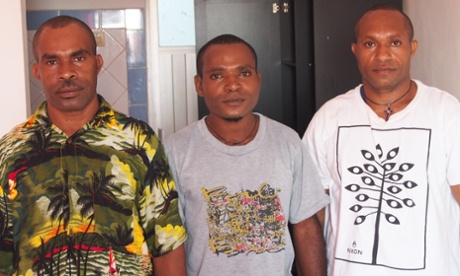
West Papuan student activists Rofinus Yanggam (left), Yuvensius Goo and Markus Jerewon (right) left the Australian consulate in Bali Sunday. Image: Marni Cordell

AUCKLAND (Pacific Media Watch): Three West Papuan student activists entered the Australian consulate in Bali this weekend with calls on Australian Prime Minister Tony Abbott to open up for greater press freedom and push Indonesia to release at least 55 political prisoners jailed in the Indonesian-ruled region.

“We want the Indonesian government to lift the 50 year restriction it has imposed on West Papua.

“We want foreigners, including journalists, diplomats, observers and tourists to be able to visit West Papua freely without asking for special permits,” the West Papuans wrote in an open letter addressed to the Australian people.

The student activists said in the letter they wanted to deliver a message to the leaders attending the 25th Asia-Pacific Economic Cooperation (APEC) summit in Bali this weekend.

Several organisations have asked Australia to give sanctuary to the three West Papuans, but according to Australian Trade Minister Andrew Robb the West Papuans did not seek asylum.

“They left [the consulate] voluntarily so the matter’s been resolved,” Robb said, according to Radio Australia.

The Guardian, however, reported that the consul-general had warned the three West Papuans that the Indonesian army would be called if they did not leave the consulate.

One of the students, Rofinus Yanggam, told the newspaper the group left in fear of their lives.

Calls for sanctuary
Australian independent senator Nick Xenophon called on Foreign Minister Julie Bishop to give sanctuary to the three West Papuans.

“These three young men were not asking for West Papuan independence from Indonesia. All they were asking for is entirely consistent with the Lombok Treaty of 2006, signed by both Australia and Indonesia,” he said, according to AAP.

“Instead of getting sanctuary and help, the Australian government effectively threatened them and now there is serious concern over the activists’ safety,” Xenophon said.

Professor Clinton Fernandes at the University of New South Wales backed Xenophon’s call.

He said when the media circus had moved on after APEC, the trio “may be tried, most certainly they will be beaten, and at some point might be disappeared”.

Rinto Kogoya, co-ordinator of the Alliance of Papuan Students, said it was time the world understood what was happening inside the province, which was officially acquired by Indonesia in 1969.

“The international community doesn’t know the reality in Papua. The military oppresses the civil society – we’re not free to do anything – and I think this is the moment to open democracy to Papua,” he said in The Guardian.

‘Great concern’
Joe Collins, of the Australia West Papua Association (AWPA), was alarmed by the events at the Australian consulate in Bali.

“It’s of great concern that they [the West Papuan students] may have been coerced to leave as the students would have great reason to fear the Indonesian security forces.

“There are ongoing human rights abuses in West Papua and the security forces have been banning and cracking down on recent rallies to try and stop international attention being focused on the territory,” he said in a statement.

AWPA wrote a letter to the consul-general Brett Farmer in Bali yesterday asking for “clarification” regarding the students.

“We understand that they have now left the consulate and we would like clarification from you if they left voluntarily or as some media reports have indicated that they were told that they would be handed over to the Indonesian military if they did not leave,” AWPA wrote in the letter.

Australian Green senator Dr Richard Di Natale has also joined those who have called for Australia to give sanctuary to the three West Papuans.

“By speaking out in this way, these brave West Papuans have put their lives in serious danger.

“If Australia fails to offer them protection, I have grave fears for their safety,” he said in a statement.

‘Stand up to Indonesia’
Yet another senator to voice his support for West Papua this weekend was John Madigan.

“It is about time our government had the courage to stand up to Indonesia, instead of ignoring the issue of West Papuan oppression and the human rights abuses that occur there on a daily basis,” he said in a statement.

He also said he demanded that the Australian government provided sanctuary for the three West Papuans.

The issue of the West Papuan students came just days after pleas from several organisations that Australia should not deport seven West Papuans who arrived in the Torres Strait Islands in northern Queensland recently.

The group of seven, who took part in the recent West Papua Freedom Flotilla sought asylum in Australia, but were deported to Papua New Guinea under a memorandum of understanding between Australia and Papua New Guinea, Radio New Zealand International reported.

Refugee advocates in Australia said the deportation failed to abide by the Refugee Convention that Australia was a party to.

Spokesperson for the West Papua Freedom Flotilla Izzy Brown said she wanted to draw the United Nations’ attention to Australia’s commitment to the Refugee Convention.

“It’s really unfortunate that Australia thinks it can send asylum seekers offshore without due process or just blatantly illegally deported like in this case here, and we really want to try and draw the world’s attention and especially the UN’s attention to Australia’s behaviour in this matter,” she said.

Read the West Papuan students letter to “the people of Australia”

Creative Commons Licence

About the author

PMW contributing editor

Daniel Drageset is a Norwegian radio journalist enrolled in the Master in Communication Studies degree at AUT University.

Warinussy: Treason Charges against Aimas activists lack a proper legal foundation

COMMENT
by Yan Christian Warinussy,
Senior Lawyer and Executive-Director of LP3BH
7 September, 2013
The questioning of the five witnesses that has taken place during the trial of seven civilians in Papua in the Sorong  District Court who have been charged with Treason [makar] in accordance with Articles 106 and  108 of the Indonesian Criminal Code make it increasingly clear that the charges do not have a solid legal  foundation.

Yan Christian Warinussy (Photo: TabloidJubi.com)

This is evident from the  questioning of the five witnesses who were summoned by the Prosecutor on Tuesday, 2 September , namely Adjudant Commissioner [AKP]  Krisistya Artanto Octoberna ( Chief of Narcotics  Investigation at the police station in Sorong) and three others, as well as and a policeman from the same police station named Basuki Rahman.

During their questioning it is clear that they were all involved in the assault operation against the group of civilians from Aimas and they were all  in the vehicle which was on patrol  at the location of the incident. Furthermore, also travelling in the same vehicle was the Head of the Operational Unit of Sorong Police Force.

Two of the witnesses also said that they saw a group of people who arrived to attack a mobile patrol  who were armed with sharp implements but they had not seen the accused men [Isak Kaliaban and his colleagues].

When they  were asked by the legal counsel of the defendants from the Papuan Advocacy Coalition  for Justice in the Aimas Case  whether they possessed letters instructing them to appear, as is required by the Criminal Code, they said in reply that they did have the required documents.

This means that the five witnesses who were summoned by the Prosecutor on 26 August and on 2 September are all members of the Sorong Police Force and moreover, none of these witnesses produced any substantive legal facts which could be used as the basis for charging Isak Kalaiban and his colleagues.with Treason as stipulated in the indictments against the seven accused.

This means that the Investigation Report [BAP] which was drawn up by the Criminal Investigation Unit of the Sorong Police Force by the men being charged had not been correctly established as  required by law which means that their testimony should not have been considered by the panel of judges.which is headed by R.M Christian Kolibu.

Therefore, we, the members of   of the Papuan Advocacy Coalition for Justice in the Aimas Case, herewith state our determination to continue to defend the seven accused men in order to ensure that this case proceeds in strict accordance with the correct legal  procedures  and not in accordance with the manipulated charges being used to charge the seven accused  in accordance with the 1945 Constitution and Law 39/1999 on Basic Human Rights as well as other human rights provisions to which they are entitled in accordance with international  law which have been ratified and adopted by the Indonesian Government as a Member State of the United Nations.

In the forthcoming hearing which will take place on 9 September, the court will proceed to the stage of questioning each of the seven accused  each as witnesses of the other defendants, which is not permitted according to the laws in force and the principles of jurisprudence.

We are of the opinion that  the panel of judges should make it clear that the correct procedures will be adhered to in accordance with the Criminal Procedural Code, bearing in mind that this is what Papuan people would expect regarding the investigation procedures  as required by law in the case against Isak Kalaiban and his colleagues.

[Translated by TAPOL]

Papua Ablaze! The Need for a Touch of Hearts

Opinion

by: Selpius Bobii.

Abepura Prison

September 8, 2013

“ In Syria hundreds of civilians are dead from a suspected attack with poison gas on Wednesday 21 August 2013 at a location close to the Syrian capital of Damascus. Meanwhile in Papua hundreds of thousands of Papuan citizens are also dead, having been killed over the time frame of the last 50 years. Killed as a result of military operations both covert and overt, undertaken in a planned, systematic and measurable way since the 1960’s until this time. (For further information see https://westpapuamedia.info/2013/03/30/selpius-bobii-the-annihilation-of-indigenous-west-papuans-a-challenge-and-a-hope/).

The United Nations (UN) Security Council held a sudden meeting to discuss the suspected use of poison gas in Syria and to find out who was responsible and acted swiftly to organise a Fact Finding Team, as the use of any weapon to annihilate people in mass numbers such as a poison gas falls within the category of ‘humanitarian evils’. Meanwhile the USA is considering a military attack against the Syrian Government if it is proven without doubt that they in fact used a weapon of mass destruction was used by the Syrian Government’s military. (Source: www.voaindonesia.com).

The incident in Syria is shocking beyond words and Papuans are also so deeply saddened by this tragic news.  Yet what about the lack of response by the UN to the humanitarian evil that has been continuing for over 50 years now against the people of Papua by the Republic of Indonesia? What is the attitude and actions of the UN towards the situation on Papua? Every hour there are Papuans being killed due to a range of causes that all form part of a systematic and measurable plan of the Indonesian Government that is planned to annihilate the ethnic people of Papua.  Are member states of the UN and other countries of the world going to stand-by forever and allow Indonesia to continue to carry out brutal acts of colonial domination until such time that the ethnic people of Papua are wiped out from the land of their ancestors? (For supporting evidence see: www.scoop.co.nz/stories/HL1308/S00090/genocide-of-ethnic-papuans-for-whom-what-was-un-created.htm).

Perhaps the UN and those other countries are of the opinion that the problem of Papua is not as complicated as the humanitarian problem in Syria, so it doesn’t need their involvement.  However that can only mean that they have not yet looked closely and carefully enough at the situation there.  As Papua has already become a humanitarian emergency: a hidden and horrifying humanitarian emergency that is systemic, planned and measurable.

Papua burns

Papua is ablaze and the first and primary source of that fire is the annexation of the nation of Papua into Indonesia through a military and political invasion in the 1960’s. There were four parties involved in that annexation, four parties that were responsible for  ‘lighting the fire of conflict’ in Papua: Namely Indonesia as the initiator and primary actor in the annexation; the Dutch as both an actor and a victim of aggression; the USA as the designer and primary supporter of the annexation; and the UN as the executor. Whilst Papua is the unceasing victim of those four parties’ conspiracy of economic, political and security interests.

The fire of the ideological political conflict, between the Papuan Mambruk way of looking at the world and the Indonesian Pancasila ideology, creeps through and destroys the seams that hold life together for the nation of Papua. A fire of conflict that in turn has led to a range of smaller fires sparked by the first. This raging fire has burnt through the most basic rights of the indigenous Papuan community, including the very right to life.

A dense smoke has constantly billowed forth from the centre of the fire in the land of Papua. A number of parties have seen that thick smoke but there’s been no response. Of course as we all know where there is smoke there is also fire and conversely where there is fire we know there will be smoke. Similarly where there is conflict of course there are victims and conversely where there are victims we know there is conflict behind that. Until now a number of means have been used by Papuans and the international community in solidarity to try to put out the raging fire of the primary conflict and also the smaller fires that have been sparked. However the flame of conflict has continued to spread relentlessly due to Indonesia together with the support of its various allies  continuing to defend its hold on Papua. In fact they have caused the fire to spread even wider.

To extinguish this fire in the land of Papua it will need the involvement of all parties, and particularly those four primary actors being Indonesia, the Netherlands, USA and the UN together with Papua as the unceasing victim of their conspiracy of interests. The primary fire that must be extinguished  is that of the conflict around the political history of the nation of Papua. For it was this that gave rise to the other fires.  If the primary fire can be extinguished then the smaller fires will also be able to be extinguished. However if the primary fire is not extinguished then so the other smaller fires will also continue to blaze. Until ethnic Papuans are scorched – that is annihilated – in the land of their ancestors.

All those parties of good heart and which hold in high esteem those values which are worthy, have a moral responsibility whether by direct or indirect means to take control of and extinguish the fire of conflict between the supporters of the Pancasila  ideology (those who are pro Indonesia) and the supporters of the Mambruk ideology (those who are pro Papuan independence).

For as long as the fire of conflict continues to blaze between the followers and supporters of the two ideologies, so the innocent human community of Papua is being burnt. For as long as this continues, the tears of blood of the nation of Papua will continue to drip.  Indigenous Papuans must continue despite the cost of lives to redeem the situation and bring about total liberation of Papua; and the voices of liberation crying out from the people of Papua will without ceasing to fill the air until that moment when the faith revolution is realised in the land of Papua.

The nation of Papua has not asked for anything that is the possession of another. We just ask for the acknowledgement of the basic political rights of our people, the nation of Papua. As a nation-state with full independence. Just as other nations and states of the world have already had their independence recognised. This is the faith, the hope and the longing of the nation of Papua.

With all limitations and capabilities that exist within us, the nation of Papua will continue to struggle until that revolution of faith is realised.  Then with those same existing limitations and capacities we will develop our own country of Papua, standing on our own two feet.

It is dearly hoped that the voice of the nation of Papua will be heard and will be responded to by actions of all parties wherever you may be, in order to uphold the values of justice, truth, democracy, honesty, human rights and peace for all.

The prayers and tears of the nation of Papua without ceasing accompany all of those amongst you who care for our situation, wherever you may be located and working to support us.

Solidarity without limits!
Selpius Bobii is the General Chairperson of Front PEPERA West Papua & is a Papuan Freedom Political Detainee in Abepura Prison


Leading Indonesian NGO Condemns the continued use of Treason Charges against Papuans

by ALDP (Alliance  for Democracy in Papua)

Opinion/Statement

September  6, 2013

68 YEARS SINCE INDONESIA BECAME INDEPENDENT, TREASON [MAKAR] IS STILL BEING USED AGAINST PAPUANS.

The  Indonesian people recently celebrated the 68th anniversary of their independence on 17 August 2013.   What lessons can we draw from this anniversary in order to resolve problems faced by our people who experience so many problems in various parts of the country,  especially in regions where there is conflict such as Aceh and Papua?

Especially with regard to Papua, it is not acceptable for the articles about treason  to be used any more.   This is because for a country that is now based on democratic principles, it clearly violates these principles.  Furthermore, the law on treason which is still included in Indonesia’s Criminal Code is no longer used in the country where it originated [The Netherlands].  The continued use of these articles will only widen the gap between Papua and Indonesia and lead to acts of violence because of  feelings of revenge about history, or may cause friction between different groups of people.

These articles on treason are always held ready for use against activists or anyone who demands justice and the right to express their views in public, in accordance  with the right to freedom of expression.

The treason articles were first included in the Criminal Code in the 19th century. The Dutch Minister of Justice adamantly refused a move to include an article on treason which could be applicable to anyone.  He said:  ‘These articles should be enacted to meet the needs of a colonial territory and should not be applicable to  European countries.’

The articles on treason were adopted by the Dutch colonial government and were based on Article 124 of the British Indian Penal Code.  In 1915. The Indian Supreme Court and the East Punjab High Court declared that they were invalid because they contradicted the Indian Constitution which upheld the principle of freedom of expression.  In The Netherlands, these articles were regarded as being undemocratic.   However, the Dutch East Indies government made use of the articles in their colonial territories.

In this day and age, several decades after Indonesia declared its independence, these articles should no longer be applicable to citizens of the country, including Papuans, bearing in mind that Papua is not a colony of Indonesia. {Eds – This statement does not reflect WPM’s position}

In judicial terms, treason is a unilateral act against the authorities, for the purpose of ensuring that part of its territory falls into enemy hands or should be ceded in order to become part of another state.

The crime of treason  is regulated under Articles 104 to 129 of the Criminal Code – KUHP.  Treason is also classified as a crime against the president and vice-president [the head of state and/or the head of a rival state], against the legitimate government or against government agencies, being involved in espionage on behalf of the enemy, resistance to government officials, rebellion and other activities that are directed against state interests.  Treason is also committed against the government (the head of state and his/her deputy) for the main purpose being to render an individual incapable of governing, to annihilate the country’s independence, to overthrow the government, to change the system of governance by unlawful means, to undermine state sovereignty by  separating part of the country on behalf of another country, or to create an independent state.

The crimes of spreading hatred or incitement are dealt with in Articles  154, 155 and 156 of the Criminal Code. These articles state that ‘public statements which express feelings of hostility or are offensive to the government’ are regarded as crimes as well as public statements which support such sentiments. These articles are punishable for up seven years.

During the era of the late President Soeharto, these articles were frequently used to restrict freedom of expression. They were also used against political opponents, critics, students and human rights defenders in order to silence them. The people in power used these articles like rubber, something which can be pulled in any direction as a way of restricting the right to freedom of expression.

Nowadays, in {after} the era of ‘reformasi’, the articles are frequently used to bring charges against pro-democracy activists.  In Papua. They are used in every way possible against pro-democracy activists on occasions when it has not been possible to charge them for involvement in treasonous activities.

In a report published by Human Rights Watch (HRW) in 2007, ‘Protest and the Punishment of Political Prisoners in Papua’ , Indonesia was mentioned as one of the countries where exceptions and restrictions apply that are in conflict with the basic principle of freedom of opinion. HRW drew attention to the many cases of people being arrested and imprisoned simply because they took part in peaceful protest or for peacefully raising flags. This is in violation of international law on basic human rights.  Indonesian courts frequently apply the law on ‘spreading hatred’ or ‘incitement’  towards people who are exercising their right to freedom of expression. These clauses also violate the spirit of the Indonesian Constitution which was adopted when the country became independent in 1945.

There is a tendency in Papua for a court, having been unable to prove that treason was committed, to use the crime of incitement. The articles about treason  were used when Indonesia was a Dutch colony to charge individuals or groups of people with rebellion. But these days, ‘the articles on treason are used against the civilian population when they publicly express their aspirations,’ said Harry Maturbongs, the former co-ordinator of KontraS.

A lawyer in Papua, Gustaf Kawer, said that the tendency of courts and prosecutors to use the charge of incitement when they are unable to prove that treason has been committed, is a sign that the court is apprehensive and wants to avoid the possibility of people who have been charged making counter-charges against the state, where the case against them had not be proven.

It is often the case that pro-peace Papuan activists who are brought before the courts are charged on several counts for a variety of misdemeanours.  In the trial of Buchtar Tabuni in 2010, he was charged under five articles.  Article 106 and Article 110, as well as Article 160, Article 212 and Article 218, for treason, for incitement and for disobeying an order by an official.  Another group of people were sentenced and convicted for treason. Forkorus Yaboisembut and his colleagues were arrested by the police for organising the Third Papuan People’s Congress on 19 October, 2011.  [After formally declaring the establishment of an independent Federated State of Papua] ‘President’ Forkorus, along with his Prime Minister Edison G. Waromi, were arrested with others who were involved in organising the Congress, Dominikus Surabut, Agus M. Sananay Kraar and Selfius Bobii. They were charged by a team of prosecutors headed by Yulius D.

Even today In 2013, the treason article continues to be used. A group of men were recently charged. They are Klemens Kodimko (71 years old), Obeth Kamesrar (68 years old), Antonius Saruf (62 years old), Obaja Kamesrar (52 years old), Yordan Magablo (42 years old), Hengki Mangamis (39 years ) and Isak Klebin (52 years old) . They were charged at the first hearing of their trial in a court in Sorong on Monday, 19 August 2013.

A spokesman for the police in Papua, I Gede Sumerta Jaya, said that the men were charged with treason because they are leaders of the OPM (Organisasi Papua Merdeka) or of radical groups that are active planning or speaking out in favour of resistance to the legitimate government.

Earlier this year, on 30 April, hundreds of people gathered at a posko  [a small construction] which they had  just set up. They sang together as they gathered there on 30 April to make preparations to celebrate 1 May on the following day.  While they were singing, shooting was heard aimed in the direction of the posko. The shots came from some people aboard an avanza vehicle with darkened windows, accompanied by a police patrol vehicle.

[Translated by TAPOL]

Dozens of Morning Star flags unfurled in NRFPB Demonstration

Bintang Papua
28 August 2013
Manokwari:  Although controversy is still raging about the Freedom Flotilla which has a number of Papuan activists on board,  a group of Papuans who recently proclaimed the establishment of the Federal Republic of the State of West Papua (NRFPB) in Manokwari held a demonstration on 27 August.  The demonstration which was organised by the NRFPB was highlighted by a number of Morning Star flags.  The demonstration started from the office of DAP (Dewan Adat Papua  – Papuan Customary Council) on Jalan Pahlawan and continued until 10am.  In a speech at the demonstration, the deputy governor of NRFPB Markus Yenu called on all Papuans living in Manokwari to welcome the Freedom Flotilla which is sailing from Australia to West Papua.

This slideshow requires JavaScript.

Some of the scenes from the Manokwari August 28 mobilisations in support of the Freedom Flotilla (Photos: WPM stringers/ NFRPB) 

Security forces composed of members of the Indonesian police force mounted a strong guard round the demonstration. The demonstrators marched round the City of Manokwari distributing leaflets proclaiming freedom for the Papuan people.

Morning Star flags were unfurled in several places but the security forces failed to take action.   They just stood along the route without doing anything to confiscate the flags being carried by the demonstrators.

As has previously been reported,  the Freedom Flotilla  with Papuans on board as well as Aboriginals (Australia)  who have expressed deep concern about the situation in West Papua is now sailing towards Papua New Guinea. From there, the Flotilla will sail to Merauke, West Papua.  The Flotilla is due to arrive in West Papua at the beginning of September.

[Translated by TAPOL]

Create a website or blog at WordPress.com

Up ↑
