Photo Report: Mass ralllies show Papuans refuse to accept Indonesian Occupation

by Westpapuamedia.info sources

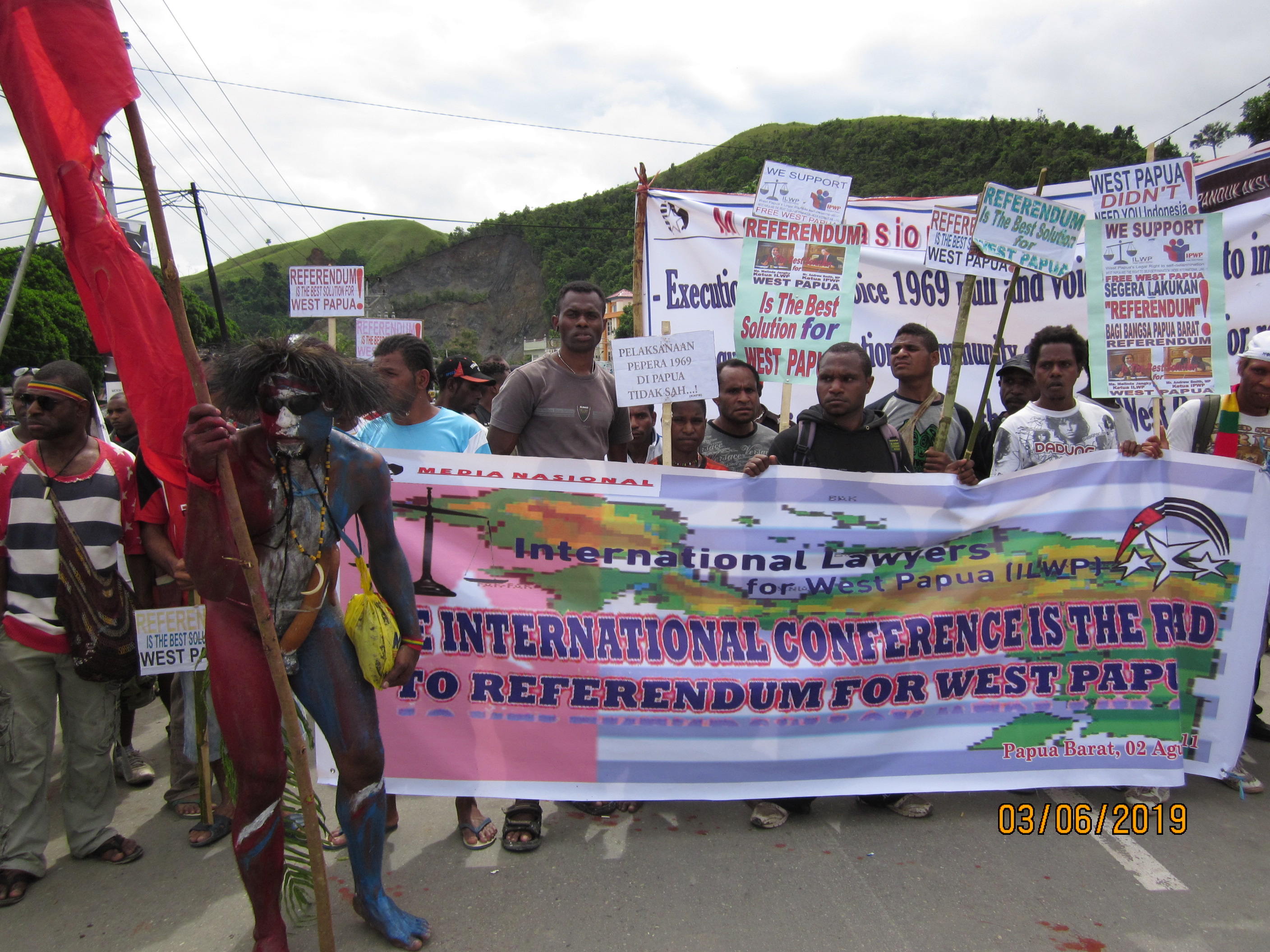
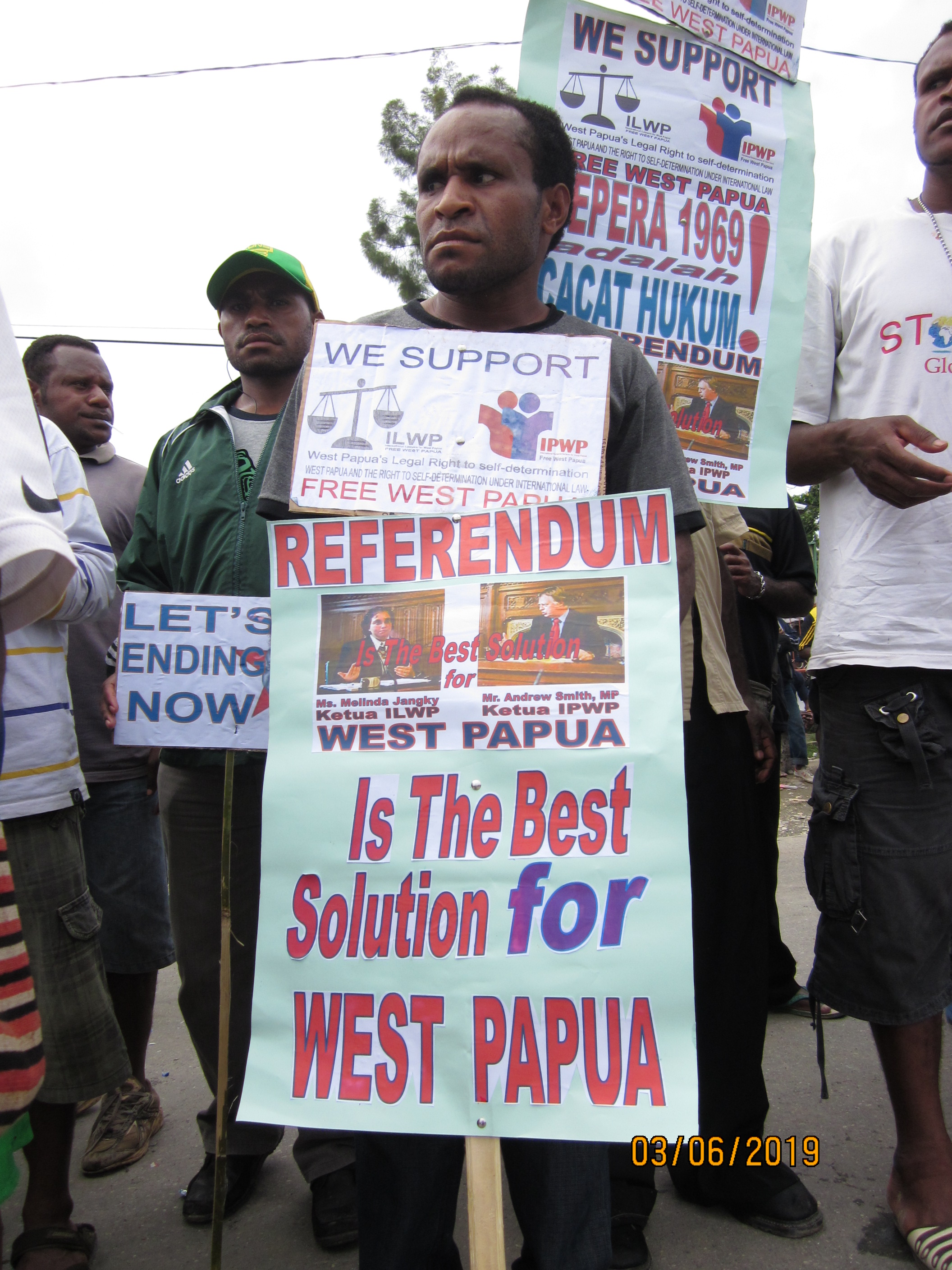
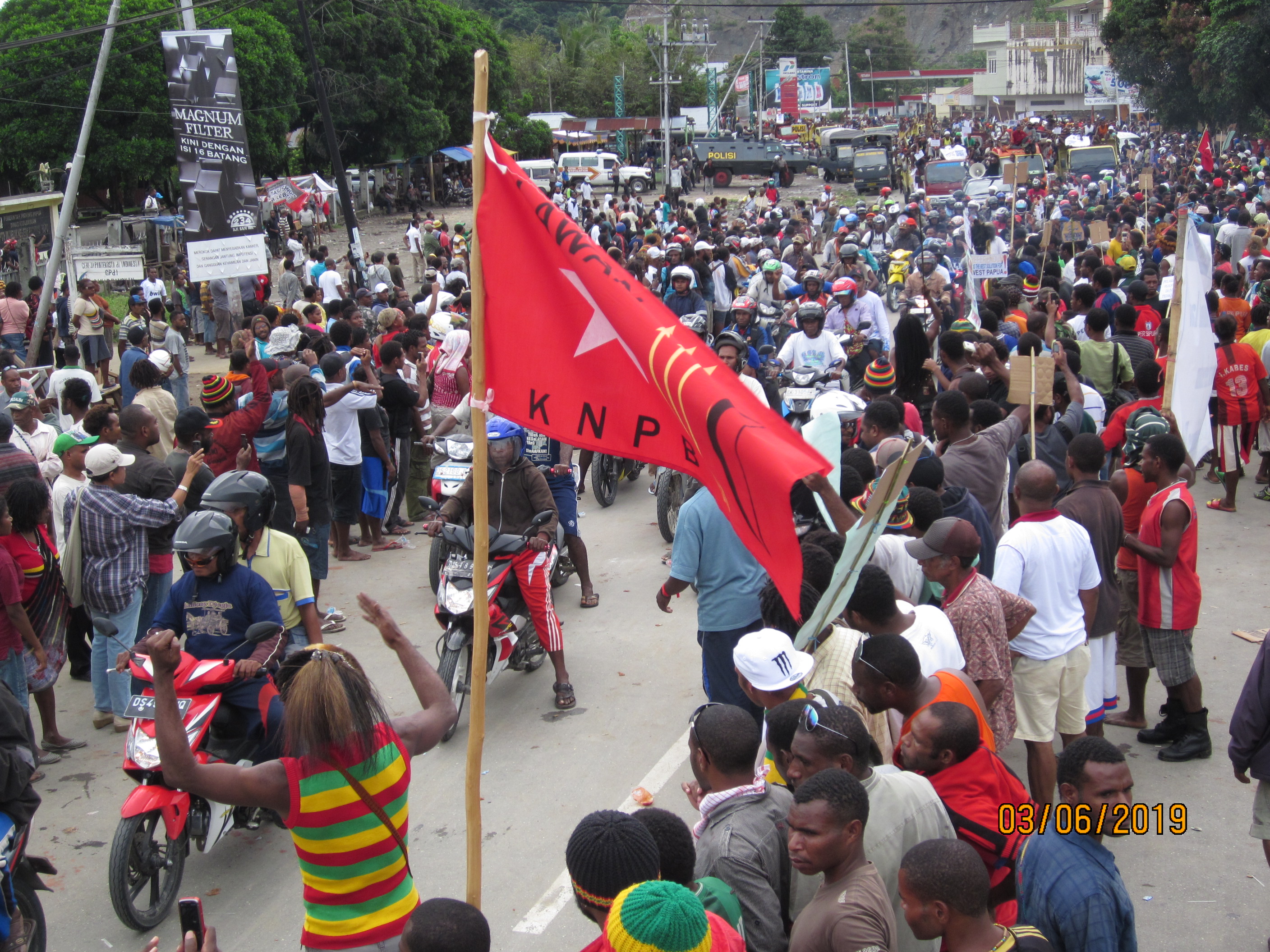
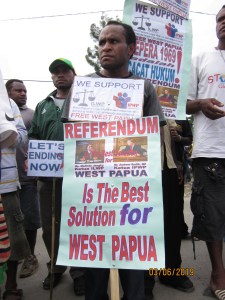
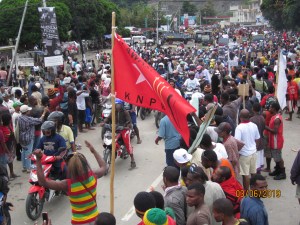
Social Media across West Papua is abuzz with declarations of relief and pride for the successful and peaceful mass mobilisations called by the West Papua National Committee (KNPB) to support the “West Papua: Road to Freedom” conference in in Oxford UK, on August 2.   The Photo Galleries below demonstrate unequivocally the scale of Papuan opposition to Indonesian rule.

Despite threats of heavy-handed Indonesian security force actions preventing free expression, attempts by the army to blocakade demonstrators, and unexplained act of violence suspected by many to be the work of Special Forces prior to mobilsations, tens of thousands of people across Papua took to the streets to demand their universal human rights to self -determination and a Referendum on the future of Papua.  Though vibrant and very loud, the rallies across Papua reportedly proceeded without any violence or provocations from security forces or proxies.

Bukhtar Tabuni, Chairman of KNPB, said “My appeal to all West Papuans living in jungle, in prison, in various parts of Papua and those living in exile that today all West Papuans must show their solidarity to support the KTT ILWP in Oxford. This event is important because it will conclude whether “Act of Free Choice” in 1969 was illegal and because the UN involved in the transfer of West Papua, it is an international issue.”
Terrianus Yoku, President National Congress West Papua National Authority said, “WPNA fully supports the rally organised by KNPB and appeal for international advocacy to monitor the current situation because it’s very volatile and unsafe.”
In Jayapura, the Rally coordinator from KNPB, Bernard Tabuni, explained that by mid afternoon the marchers paralysed Abepura, with traffic jammed, shops and schools closed and the marchers stretching for well over a kilometre with around 15,000 demonstrators.  The marchers were painted with mud on their body and also painted with stylised depictions of the banned Morning Star flag, thereby upholding the agreement with security forces that no flags would be flown.  The marchers were exuberantly singing and chanting, playing traditional instruments along the route, joined in the Long March by over 30 trucks, 20 station wagons, 17 Kijangs, 400 motorbikes of people joined the long march.”
With its roots in ancient Papuan traditions, demonstrators had planned several marches, called Long Marches, to converge on the DPRP – the focal point for the day’s events.  Troops from the TNI and Brimob riot police attempted to blockade one Abepura-bound Long March at Waena, but demonstrators outwitted the security forces by getting into vehicles and driving around them.  Exuberant scenes of yelling and singing greeted the procession of vehicles as they joined the main body at Abepura.
Daniel Wenda, secretary of KNPB, mentioned that four TNI truckloads of red and white uniformed Barisan Merah Putih (Pro-Indonesian militia) also organised a rally outside DPRD office in Jayapura.   Slogans on the banners stated “Reject the ILWP Summit” (KTT ILWP),  “Don’t lie to the people”, “Detain all corruptors.” and also “anti-Corruptor”.  Observers i Papua have taken the BMP slogans with mirth and irony given that their chief, Ramses Ohee, is regularly the beneficiary of corrupt dealings, has extensive illegal business interests, and receives significant funding from the notoriously corrupt Kopassus special forces.
“This demonstration is aimed to attract attention and counter our main rally but we will not be provoked”, said Daniel Wenda.
Bernard Tabuni reported that undercover military intelligence officers were amongst the demonstrators, and four truckloads of fully armed security forces were following behind the marchers.  TNI and Kopassus were also amongst the bystanders with cameras recording every movement.
A screening of a live internet stream from the Road to Freedom conference in Oxford was planned to be held at the grave of Theys Eluay on Tuesday night, but there are conflicting reports on the success of this.
A carload of armed BMP members appeared at the KNPB Secretariat in Waena late on Tuesday evening.  According to Daniel Wenda, the militiamen – a mix of Javanese and older Papuan men – attempted to gain entry, allegedly to abduct Mako Tabuni, KNPB Vice Chairman.  Tabuni was quickly bundled by KNPB security to a safe location.

In Wamena in the Baliem Valley, almost 17,000 people to a mass gathering that saw scenes of exuberance, singing and dancing.  After several hours of speeches and music, demonstrators peacefully dispersed.

In Sarmi, Yakuhimo and Keerom, reports are filtering out that flagraising ceremonies were held successfully without incident.

The slideshow below shows the August 2 actions in (in this order) Abepura, Waena and Wamena; and also those of  the weak counter-demonstration of Barisan Merah Putih militias funded by the Indonesian special forces, Kopassus, that was held close to the DPRP, or (Papua Province People’s Representative Council).

This slideshow requires JavaScript.

WEST PAPUA – INDON SECURITY FORCES FAIL TO BLOCK ACCESS FOR DEMONSTRATIONS ACROSS PAPUA, MILITIAS ON STREETS IN JAYAPURA

by Nick Chesterfield, westpapuamedia.info

Tuesday, August 2, 2011
Jayapura, 1340: The streets of several centres across West Papua are being blockaded today by heavily armed Indonesian security forces in an attempt to prevent a planned gathering of tens of thousands of protestors who are demanding a Referendum on the future of the province.

However, thousands of Papuans have reportedly ignored the strong military presence and are marching the streets of Jayapura, paralyzing the provincial capital with their huge numbers.

The protests, called by the West Papua National Committee (KNPB) and actively supported by the entirety of pro-independence movement, are being held to demonstrate both opposition to Indonesian rule and to the Indonesian-run dialogue process, in favour of legitimate internationally-mediated dialogue that takes into account the wishes of West Papuan people. The demonstrations are demanding a Referendum as the only lasting and credible solution to determine the future of Papua for Papuans.
Outside Jayapura, protests are also being held in Wamena, Biak, Nabire, Manokwari, Paniai, and Timika.

West Papua Media stringers on the ground in Abepura are reporting that the demonstrations outside the main Post Office were being blocked by hundreds of heavily armed riot police and soldiers. This is despite official permits being issued by the Jayapura police for the demonstration to proceed without hindrance.

At 10am local time, three truckloads of soldiers and BRIMOB riot police then decamped and headed to Waena to intercept a long march of several thousand people who were attempting to join together with the Abepura march and then head to Jayapura, in information conveyed to West Papua Media by Daniel Wenda, Secretary General of KNPB. It is unknown at time of writing whether the march has pushed through the security force blockade or if any casualties or arrests have been sustained.

Local human rights sources have reported that a recent spate of violent acts may have succeeded in keeping away crowds of over 10,000 people, with one person stabbed and wounded by a militiaman at a pre-rally gathering in Angkasapura. However in news just to hand, organisers of the rally are reporting that security forces have relented and several thousand people have now successfully joined the demonstration, which is continuing to grow.

With tensions extremely high after the violence, the organisers of today’s rallies across Papua have been at pains to ensure that no symbolic traditional weapons be brought to the gatherings, and have worked with the Dewan Adat Papua to deploy hundreds of peacekeepers from the uniformed Community Security Force of Petapa, or The Guardians of the Land of Papua.

This slideshow requires JavaScript.

Telephone communication to Jayapura has been sporadic with many calls being cut off and SMS communication delayed, making confirmation of events difficult. It is unclear if the security forces are currently preventing West Papuan people from actively communicating to the outside world.

Reports are filtering through that other political actions are occuring throughout Papua simultaneously with the mass protests, with the KNPB suggesting that those who could not make it engage in innovative and non-violent economic disruption actions, such as strikes by ojek drivers, street vendors and bus drivers.

Independence activists are also reporting that members of two pro-Indonesian militias — Besar Merah Putih and Aswain (headed by Euricio Guterres) — have been deployed widely across the Jayapura area in conjunction with security forces.

Witnesses reported that late last night, a PELNI ship suspiciously landed 92 unfamiliar men at the main Jayapura dock, who are widely believed by activists to be members of Kopassus special forces in plain clothes. Activist surveillance of military facilities has indicated that special forces officers have not been seen at regular barracks for the past three days at least.

Suspicions have also been cast on unidentified forces responsible for a spate of violent incidents prior to the nonviolent mobilisations, who are believed to be connected to the Indonesian security forces, in what many observers see as an attempt by the security forces to spread fear, panic and division among the demonstrators to prevent the protests going ahead.

In the early hours of Tuesday morning, an arson attack on the Rectorate of the Cenderawasih University, Abepura, was foiled by Papuan students. The fire was detected before it took hold by alert from student security and was quickly extinguished.

After attacks yesterday by unknown assailants on Indonesian transmigrants in Nafri, Abepura, sources are reporting that one person has been killed and an unknown number injured in another attack in Koya, where SMS reports from credible local sources have described several incidents involving shootings and stabbings.

The Indonesian military has long had a policy of using civilian proxies and plain-clothes agents to carry out acts of violence to provoke civil resistance movements into self-defence. This has often been used as a pretext to engage in a security crackdown, which reinforces military dominance over the region.

Elsewhere in Papua, the mass rally also being held simultaneously in Manokwari was prohibited by security force, according to organisers from the KNPB. However negotiations succeeded in Indonesian security forces relenting, and the rally is currently ongoing with several thousand people participating. This rally marched from the office of Dewan Adat Papua, and is currently outside the Department of Information in Sanggeng. The atmosphere is described as relaxed.

West Papua Media is monitoring events closely, and will provided updates on the situation throughout the day.

MEDIA NOTE:  CONTACTS FOR SPOKESPEOPLE AND STRINGER ON THE GROUND ARE AVAILABLE.  PLEASE CONTACT +61450079106 or editor<@>westpapuamedia.info

Related articles

Papuan students demonstrate outside UNCEN, Jayapura

Bintang Papua, 30 June 2011
An announcement on Thursday about the selection of students at the
state university led to a demonstration being held by students who also
blocked off the Cenderawasih university campus in Waena. The entry to
the campus was blocked off while a small bonfire was burning in the
middles of the road. The demo was organised by the chairman of the
Students Association of Tolikara, supported by students of the faculty
of law at the university.

Speeches were made and leaflets were stuck on the walls, with demands to
the rector of the university.

One of the leaflets said: ‘Why is it that year after year, indigenous
Papuans account for less than 20 percent of the total while the other 80
percent are non-Papuans?

‘We are asking the rector to account for this, bearing in mind an
earlier promise that Papuans would account for 80 percent,’ said Terius
Wakor, co-ordinator of the action. This was a promise made by the rector
of UNCEN, Prof Dr B Kambuya.

‘We indigenous Papuan students feel very disappointed about this
because the rector promised that priority would be given to indigenous
Papuans with 80 percent of the places. Yet what has happened is that
only 5 percent of the Papuans were accepted into the university.’

Another of the students, Thomas CH Syufi, who also took part in the
demo, said: ‘We as representatives of the Executive Board of the
Students, the BEM of the Faculty of Law, strongly support the views of
our colleagues.’

Following the announcement about the students who were selected, he said
that they hoped that the rector would take account of the views of the
indigenous Papuan students, in view of what the rector promised last
year. ‘We very much hope that the rector will take some action with
regard to the Papuan students who did not pass the selection test. He
suggested that there should be another round of testing for a second
group of students to be accepted to the university.

Meanwhile the deputy rector said that while no promises had been made,
there had been a commitment to increase the percentage of indigenous
Papuan students. He said that at this level (the SNMPTN), it was
difficult to have an effect on the selection of students. He told
Bintang Papua that not enough Papuans were available from the IPS, and
very few had registered with the IPA programme.

[Apologies for not knowing what these initials stand for. TAPOL]

Students press for action against widespread corruption in Papua

Bintang Papua, 27 June 2011
PAPUA A PARADISE FOR CORRUPT OFFICIALS

Students urge DPRP to adopt a regulation on combating corruption

Jayapura: Papua is a veritable paradise for people who corrupt the people’s money  while a number of top-level officials behave as if they are beyond the law,’ said Thomas Sugi, chairman of the Students Executive Board of the Faculty  of Law at Cenderawasih University. He was speaking at a demonstration of youth and students outside the  DPRP – Papua Provincial Legislative Assembly.

The students urged the DPRP to draft a regulation, known as a Perdasi, dealing with corruption and stamping it out. It has been estimated that as much as Rp. 28 trillion of OTSUS – special autonomy – funds were embezzled during the eight years from 2002 – 2010 following the adoption of the OTSUS law, according to the findings of the auditing body, BPK published on 18 April 2011.

Sugi said he hoped that such a regulation would act as a dis-incentive for officials of the province  who were thinking of embezzling money that belonged to the people. He said that the students fully support comments made about this problem on a number of occasions by the chief of police of the province, Drs Bekto Suprapto.

But he added that, should the law enforcement agency – the police – be shown to be seeking to protect the corruptors, then they would  press for the adoption of a non-confidence motion in the police chief for failing to keep his promise.

On the same occasion, the chief of police of Jayapura, AKBP Imam Setiawan SIK who had been pressed to support efforts to stamp out corruption in Papua declared that the aims of the demonstration were an inspiration to the law enforcement agencies. He said that they would act with all speed via the judiciary in cases where people in the community alleged that corruption had occurred.and would make regular reports to the general public on the matter.

‘The chief of police of the province also called on local police chiefs at the sub-district level to report at least three cases of corruption a year that were under investigation..’

And for the current year, he said, we would call for at least five cases to be handled.

More capital assistance for Papuan women, officials promise

Financial help to Papuan businesswomen seriously lacking

The press in Papua has recently reported extensively on the allocation
of OTSUS funds to assist Papuans in their business operations, in
particular Papuan women referred to as ‘mama-mama’

On 11 June 2011, the JUBI tabloid newspaper reported that most of the
allocation of OTSUS funds is concentrated on public infrastructure and
government assets but insufficient attention is being paid to local
Papuan traders, including ‘mama-mama.’ The problem was raised in
particular by the head of the Oadate Major Clan, in the district of
Yapen-Waropen, Yulinus Kowela.

He said that OTSUS funds were being allocated almost entirely to
government officials, the government elite, as he called them.
‘Meanwhile, local Papuan traders and indigenous Papuan women continue to
be impoverished and on the margins, because of the nature of the
development according to OTSUS,’ said Yulinus.

‘For many years, we have been saying that OTSUS funds should be used to
combat poverty and improve the living conditions of indigenous Papuans.
But up to the present day, this hasn’t happened, people are asking about
this, including people living in the interior.’

He said that the allocaton of OTSUS funds should take account of the
fate of indigenous Papuan traders and not just focus on building
infrastructure such as road-building and building bridges in all the
districts. ‘The allocation of OTSIS money should be fairer and be used
to improve the conditions of women traders. They need help to be able to
obtain better facilities for their business activities,’ he said.

On 22 June, JUBI reported that the district chief of Merauke, Romanus
Mbaraka spoke of the need to pay attention to the little people and pay
greater attention to their need for capital. He said that the government
was planning to provide capital to groups of businesses, amounting to Rp
500,000 for each group.

At a ceremony in Gedung Negara, he symbolically handed over the money to
one group of traders. He said that the money was being allocated to
groups of businesses because past experience had shown that this was
better than allocating it to individuals. ‘In this way,’ he said, ‘the
monitoring process can be more easily managed.’

He said that the money was not being allocated for free but the groups
would be expected to repay the money but in this way, the groups would
have greater motivation to run their businesses well.’

‘If a business is successful, its earnings will increase, which means
that the government will be willing to help them again. He also said
that teams will be set up to monitor the businesses run by the women
such as those selling crabs or vegetables. This would motivate the
mama-mama to run their businesses well,’ he said.

[COMMENT: It remains to be seen whether this grand promise will bear
fruit in terms of promoting the economic interests of indigenous Papuans
in their never-ending difficulties to compete with the business acumen
of the thousands of Indonesians who flood into Papua and set up
businesses. TAPOL]

Create a website or blog at WordPress.com

Up ↑