OPEN LETTER
Raising Concern and Offer Solution::
One-Year Human Rights Promotion in Papua 2010
To the attention of
President Republic of Indonesia,
Susilo Bambang Yudhoyono
In Jakarta
Dear Mr. President,
We are writing this letter to you to raise our concern over human rights conditions in Papua. We are confirmed that lacking of protection and recognition of Papuans’ rights have led to abusive and violent practice against Papuans. This pratice has persistently cause death to Papuans and left trauma for them and their family. This practice clearly does not reflect the spirit of this country’s constitution to protect whole citizens.
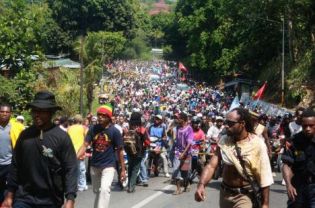
We have recorded that there have been some big issues this year that attract public attention. The issues such as footage violent action against civilians by military in Tinggi Nambut Papua,[1] violence against civilians in Bolakme,[2] ethnic conflict between Papuan highlanders and Yoka people,[3] shooting civilians in Nafri[4], shooting against prisoners in Tanah Hitam,[5] civilians shot dead in Boroway,[6] arrest and detention of Filep Karma and Buchtar Tabuni[7] and the rally of returning special autonomy. Other cases relating to social, economy and culture which potentially bring negative impact on Papuans and destroy Papuan values such as MIFEE in Merauke,[8] Dagewo case in Paniai[9], the transfer of local land in Lereh for palm oil plantation, Freeport case,[10] and many illegal logging cases.
Bsaed on our observation and data collected, the problems mentioned above happen because of the following reasons:
First, government still stigmatisize any Papua groups and individual as separatist as they do resistance against government. Government uses ‘stigmatization of separatist” as powerful strategy to silence Papuans demand and freedom of expression and weaken the critical thinking from Papuans who often criticise the govermnent policy. This strategy is partially successful as it silences resistant movement but in the other side it gives more energy and spirit for more resistance. Also, this unpopular strategy has planted the seeds of hostility and mistrust among Papuans against Indonesia.
Second, Jakarta still plays dominant role in the issue of any policies and their implementations in Papua. Jakarta, as the central power, is still unable to trust any process of development in Papua although Papua has been given special autonomy to manage themselves. MIFEE case, violence against civilians in Bolakme, Tingginambut-Puncak Jaya and Freeport cases are example on how central government still exercise their absolute authority which potentially destroy basic rights of Papua. Central govermnet just interest in investment without considering the basic rights of Papuans and their values
Third, Papua is still considered as conflict area. Therefore, security approach is dominant. Huge number of troops are deployed every year to Papua to secure the border area and investor’s assets. Ironically, the security approach has caused fear and revive the past trauma. People in the border feel fear when they go to bush and forest to hunting, gardening as they might be arrested as being suspected as members of Papua freedom movement (OPM)/ National Freedom Army (TPN).
Fourth, The massive deployment of troops which is to secure investors’ assest has caused human right violations and fear. The rights of people are neglected and intimidation is done when the locals demand their rights and speak critically.
Fifth, Economic problems are still strongly perceived as the main problems in Papua. Therefore, huge amount of money and investment is needed to build Papua to improve their economy. RESPEK ( strategic plan for rural development) program is one example where the program emphasize infrastructure development rather than human resources development. Moreover, suspection among the locals is rising over the use and management of special autonomy fund used for RESPEK program. Also, no efective supervision has led to corruption
Sixth, the policy issued by govermnet and its implementation actually repair the impact not solve the basic problems which has been persisting so long. It is crucial that any policy has ‘solving-problems’ elements. If not, the problems will never be solved.
Based on the description above, we urge Mr. President to take immediate action by ordering central government and localgovernment to do the following:
First, hold peaceful dialog as an effective means to solve the problems in Papua. The dialog Jakarta-Papua which has been initiated by Papua Peace Network Team needs to be supported. The dialog should involved all elements: government, customary community, religious leaders, academics and civil groups.
Second, stop all stigmatization against Papuans and place them a citizens who have rights to be protected by the state. Constitutions guarantee freedom of expression and this should also be applied to Papuans. Some articles in state criminal law and government regulation No. 77 year 2007 about treason and subversion need to be amended as it limits the freedom of expression
Third, revise or redesign security approach to be human rights-based approach as it will recognise the rights of Papuans and protect Papuans from violent acts. The deployment of troops need to be adjusted to the need of the local area and real threat as to save state budget of defense
Fourth, police should exercise their professionalism in keeping the order and promote human rights. The professionalism is shown by giving protection so people feel secure and peaceful in doing their activities. This is important to bring back trust from the people.
Fifth, push the policy that promote human rights and provide justice to the victims of human rights abuses. Government has to take immediate action to establish human rights court and reconciliation and truth commission in Papua as mandated by special autonomy law
Sixth, central government needs to revise public-service related policy because the existing policy does not provide and touch the basic rights of Papuans. There are three public service issues that needs to taken into consideration: education, health and economy where these three areas are directed to empowernment, affirmative action and protection
Seventh, Policies issued for Papua need to have recognition of human rights elements. This is so because all existing policies basically emphasize on economic and welfare problems.
Eighth, governor, Papua legislative (DPRP) and Papua People’s Assembly (MRP) should build good coordination and reponsive to the problems of human rights abuses in Papua. Lack of initiatives and good will from these institutions show that they actually do not have commitment to promote human rights in Papua and potentially increase mistrust among Papuans.
We write this open letter with the hope that immediate action to be taken to solve the problems in Papua. Thanks
Jayapura, 05 January 2010
Institutions support this open letter
Papua Based Institution
Foker LSM Papua, ALDP, Elsham Papua, SKP-KPC, KPKC Sinode GKI Papua, LBH Jayapura, JAPH-HAM Wamena
Jakarta Based Institution
Imparsial, Kontras Jakarta, HRWG, PRAXIS
CC :
1. Menkopulhukan RI
2. Menkokesra RI
3. Menteri Dalam Negeri RI
4. Menteri Luar Negeri RI
5. Menteri Pertahanan RI
6. Panglima TNI
7. Kapolri
8. Jaksa Agung RI
9. Ketua DPR-RI
10. Anggota DPD Provinsi Papua
11. Gubernur Provinsi Papua
12. Gubernur Provinsi Papua Barat
13. Ketua DPRP
14. Ketua MRP
15. Kedutaan Asing
16. lembaga Internasional
17. Jaringan kerja Papua
[1] This video was initially released by Hongkong Based Human Rights group, AHRC and made public through youtube. In the video, it shows that military tortures civilians suspected as members of Papua free movement group. But in fact, the victim is a reverend. Government then response to the incident immediately by forming fact-finding team. Ministry of politics, law and human rights finally acknowledges in the press release that it is true that military has done such a barbaric act. The perpetrators of the torture were finally on trial and sentenced respectively 5 months and 7 months. This very minimum sentence indicates a failure of states to provide justice to the victim
[2] An ambush against military in Yugam, Bolakme, Jayawijaya district on 1 december 2010. This incident has caused two civilians die
[3]This incident took place on 17 November 2010, 35 houses burned and 3 got injured. The highlanders damage the houses in Yoka as they are angered by a song composed by a Yoka man which insult the highlanders. It is also suspected that third party plays role in fueling the conflict. Local government has facilitated a dialog and they have agreed to cease their hostility. .
[4] Group of unknown men shoot civilians in Nafri, Abepura on 28 November 2010. One was dead and 4 seriously injured. The perpetrators are not identified yet.
[5]Friday on 3 December 2010 around 12.00, 4 prisoners and one detainee escape from prison. Miron Wetipo, one of the prisoners is shot dead when trying to escape. One of the prisoner is finally caught while the other three escape.
[6] Rahmat Faisal, an employee at mobile phone counter, found dead by Oktafinaus Yerisitow. The victim was suspected being shot around 13.00 on 13 December 2010
[7] Filep Karma and Buchtar Tabuni were detained as they are suspected as the mastermind of riot in the prison after the death of Wiron Wetipo, a man shot dead while trying to escape from prison. Actually, Filep Karma and Buchtar Tabuni just ask head of law and human rights department about the reason why Wetipo was shot dead
[8]Merauke Integrated Food and Energy Estate (MIFEE) is a joint program between local and national government. This program will place Merauke as global agriculture industry. The program is promising which says that in 2030 Indonesia will have additional reserved food such as rice of 1.95 million ton, corn 2.02 ton, and many other food reservation. Also, Merauke will have income of IDR 124.2 million per capita per year in 2030. The program will bring more people from Java to work in the industry. Sadly, the program has taken people’s land.
[9]Illegal mining in Degowo has happened since 2001 where local do the mining without outside intervention. But since 2003, intervention comes and backed up by military and police. As more outsiders come and do the mining, the locals are moved out and can no longer do traditional mining as they used to do. They are even forced to release their land to investors who are interested in the gold mining. Moreover, prostitutes are brought by investors and military to Degowo to entertain the locals.
[10] Freeport case is the longest and massive exploitation of natural resources in Papua. Although there have been many efforts initiated by Freeport to bring back trust of Papua such as giving Cooperate Social Responsibility (CSR) but the problems and mistrust remain




 West Papua Media Alerts