What should be the role of the Australian government as a member of the UN Security Council ?

Opinion / Analysis
By Herman Wainggai
September 11, 2013

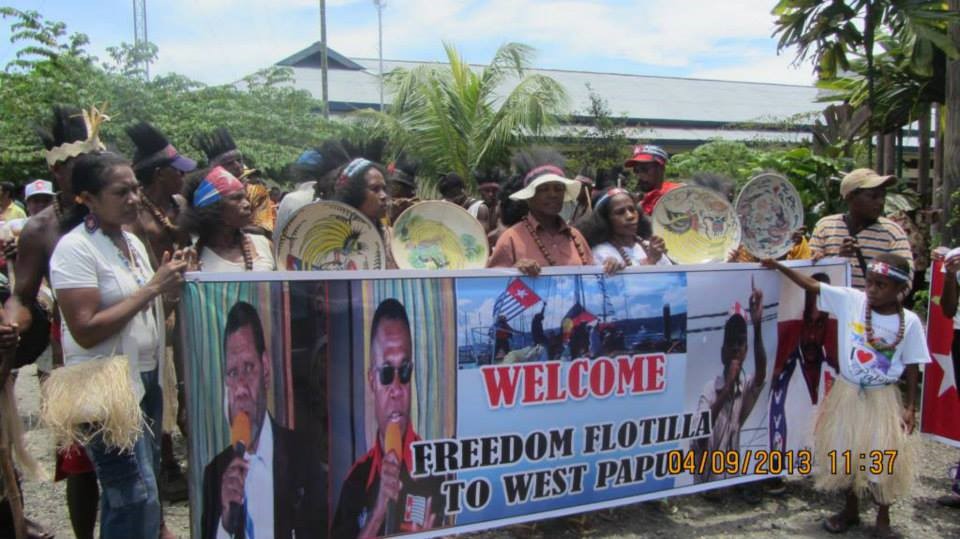
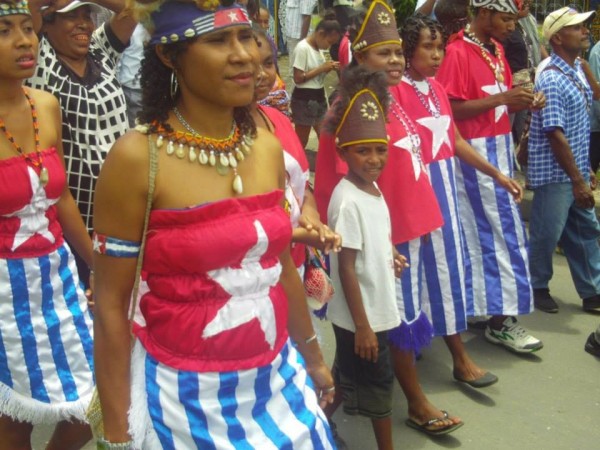
Papuan women wearing the banned Morning Star flag as clothing at Manokwari demo to welcome Flotilla (Photo: West Papua Media stringers)

Knowing  the history of the Indonesian state’s Army and Police invasion of West Papua there is no surprise in the fresh news of increased Indonesian military troops to the region, who are growing rapidly on this Melanesian ground like fertile mushrooms.

The Freedom Flotilla sailboat is currently on its voyage from Australian waters to the land of West Papua , and it has been confirmed that it is due to arrive within the next few days. Throughout the land of West Papua citizens and activists have been holding a number of peaceful demonstrations as a signal to welcome this boat. Thousands of West Papuans have bravely taken to the streets, high in enthusiasm and taking with them a variety of traditional instruments used in West Papua – ukuleles , guitars , drums , flute drums. They are also wearing traditional dress, and along with raising banners of the Freedom Flotilla sailboat, they are also displaying the national symbols of West Papua – the Morning Star flag.

This represents a challenge to and hope for the Indonesian government, that it ‘opens up’; that Jakarta demonstrates that it possesses genuine democratic maturity to negotiate peacefully with the political leaders of West Papua.  The people of West Papua, moreover, sincerely look forward to the newly elected Australian Federal government, especially in its new role as one of the member states of the UN Security Council, to act as a  mediator and by standards of international law help resolve the long running political conflict between the Indonesian government and the people of West Papua.

Demonstration welcoming Freedom Flotilla, Sorong (photo: supplied from Herman Wainggai, NFRPB)

Our hope is that the precise opposite does not happen – that the Australian Government merely lets the Indonesian government continue to unilaterally kill the political, human rights and democracy activists of West Papua. This has been their lot for over 50 years – arrests, kidnapping, detention, shooting, killing, raping, long imprisonments.

The people of West Papua also hope that the Australian government will not forget this tiny Freedom Flotilla who will be facing the storm of the Indonesian military whose numbers have been newly swelled in the border area. Whatever happens, Australia needs to be assured that the people of West Papua will maintain their struggle to govern themselves, and will fight for that freedom by non-violent means.

The Freedom Flotilla to West Papua logo

The history of Indonesian brutality in West Papua over decades must be stopped by the international community, which includes Australia in its significant roles in the UN and  the Asia-Pacific region.  The data has been clearly documented from year to year – how long must West Papuans continue to be slaughtered like animals? The question is very pertinent then – what will be Australia’s role, and the USA and the United Nations – in regards to West Papua?  This land of the Mambruk – the beautiful Crowned Pigeon and symbol of Papua – which we love, shall we close our eyes and stop our ears to the injustices?

In the same way that attention is currently being given to the political situation in Syria, so must attention be given to the little Freedom Flotilla, and to the suffering people of West Papua, who have struggled for freedom and justice under the brutal regime of the military of the Indonesian state

Warinussy: Treason Charges against Aimas activists lack a proper legal foundation

COMMENT
by Yan Christian Warinussy,
Senior Lawyer and Executive-Director of LP3BH
7 September, 2013
The questioning of the five witnesses that has taken place during the trial of seven civilians in Papua in the Sorong  District Court who have been charged with Treason [makar] in accordance with Articles 106 and  108 of the Indonesian Criminal Code make it increasingly clear that the charges do not have a solid legal  foundation.

Yan Christian Warinussy (Photo: TabloidJubi.com)

This is evident from the  questioning of the five witnesses who were summoned by the Prosecutor on Tuesday, 2 September , namely Adjudant Commissioner [AKP]  Krisistya Artanto Octoberna ( Chief of Narcotics  Investigation at the police station in Sorong) and three others, as well as and a policeman from the same police station named Basuki Rahman.

During their questioning it is clear that they were all involved in the assault operation against the group of civilians from Aimas and they were all  in the vehicle which was on patrol  at the location of the incident. Furthermore, also travelling in the same vehicle was the Head of the Operational Unit of Sorong Police Force.

Two of the witnesses also said that they saw a group of people who arrived to attack a mobile patrol  who were armed with sharp implements but they had not seen the accused men [Isak Kaliaban and his colleagues].

When they  were asked by the legal counsel of the defendants from the Papuan Advocacy Coalition  for Justice in the Aimas Case  whether they possessed letters instructing them to appear, as is required by the Criminal Code, they said in reply that they did have the required documents.

This means that the five witnesses who were summoned by the Prosecutor on 26 August and on 2 September are all members of the Sorong Police Force and moreover, none of these witnesses produced any substantive legal facts which could be used as the basis for charging Isak Kalaiban and his colleagues.with Treason as stipulated in the indictments against the seven accused.

This means that the Investigation Report [BAP] which was drawn up by the Criminal Investigation Unit of the Sorong Police Force by the men being charged had not been correctly established as  required by law which means that their testimony should not have been considered by the panel of judges.which is headed by R.M Christian Kolibu.

Therefore, we, the members of   of the Papuan Advocacy Coalition for Justice in the Aimas Case, herewith state our determination to continue to defend the seven accused men in order to ensure that this case proceeds in strict accordance with the correct legal  procedures  and not in accordance with the manipulated charges being used to charge the seven accused  in accordance with the 1945 Constitution and Law 39/1999 on Basic Human Rights as well as other human rights provisions to which they are entitled in accordance with international  law which have been ratified and adopted by the Indonesian Government as a Member State of the United Nations.

In the forthcoming hearing which will take place on 9 September, the court will proceed to the stage of questioning each of the seven accused  each as witnesses of the other defendants, which is not permitted according to the laws in force and the principles of jurisprudence.

We are of the opinion that  the panel of judges should make it clear that the correct procedures will be adhered to in accordance with the Criminal Procedural Code, bearing in mind that this is what Papuan people would expect regarding the investigation procedures  as required by law in the case against Isak Kalaiban and his colleagues.

[Translated by TAPOL]

West Papua Report September 2013

from West Papua Advocacy Team

This is the 113th in a series of monthly reports that focus on developments affecting Papuans. This series is produced by the non-profit West Papua Advocacy Team (WPAT) drawing on media accounts, other NGO assessments, and analysis and reporting from sources within West Papua. This report is co-published by the East Timor and Indonesia Action Network (ETAN). Back issues are posted online at http://www.etan.org/issues/wpapua/default.htm. Questions regarding this report can be addressed to Edmund McWilliams at edmcw@msn.com. If you wish to receive the report directly via e-mail, send a note to etan@etan.org. Link to this issue: http://etan.org/issues/wpapua/2013/1309wpap.htm

The Report leads with “Perspective,” an opinion piece; followed by “Update,” a summary of some developments during the covered period; and then “Chronicle” which includes analyses, statements, new resources, appeals and action alerts related to West Papua. Anyone interested in contributing a “Perspective” or responding to one should write to edmcw@msn.com. The opinions expressed in Perspectives are the author’s and not necessarily those of WPAT or ETAN. For additional news on West Papua see the reg.westpapua listserv archive or on Twitter.

CONTENTS

This month’s PERSPECTIVE is by retired U.S. Foreign Service Officer (and West Papua Report editor) Edmund McWilliams. His analysis assesses the implications of the U.S. government “pivot” to Asia for U.S. policy regarding Indonesia and West Papua. The U.S. re-focus toward Asia and the Pacific involves closer U.S. political, security and economic ties to countries of the region. These enhanced security ties, in particular, will mean diminished U.S. government attention to human rights violations, corruption, and undemocratic behavior by regional militaries the U.S. seeks as “partners,” including Indonesia.

In “UPDATE,” we note the U.S. government’s decision to proceed with the sale of eight Apache helicopters to the Indonesian military. More than 90 NGO’s had urged the sale not go forward, due in part the likelihood that it will employed in West Papua. A “freedom flotilla” has left Australia for West Papua. Indonesian officials have threatened to arrest participants. Jakarta may renege on it pledge to invite Foreign Ministers of the Melanesian Spearhead Group nations to visit Jakarta and West Papua. Indonesian security forces have arrested scores of Papuans who sought peacefully to assert their cultural identity.

In this month’s “CHRONICLE,” we note an open letter by the Australia West Papua Association to the Pacific Islands Forum to take up the issue of West Papua and link to an interview with Benny Wenda carried by Democracy Now!

PERSPECTIVE

Implications of the “Asia Pivot” for U.S. Policy on Indonesia
by Ed McWilliams


The U.S.’s determination to “partner” with the TNI is reminiscent of previous administration’s partnering with corrupt and abusive militaries in the service of earlier geopolitical strategies, notably during the cold war. U.S. support for rightwing military dictatorships, delayed democratic evolution in many countries and perpetuated extraordinary suffering.


Senior U.S. administration officials continue to emphasize U.S. determination to pursue a greater focus on Asia and the Pacific. The “Asia Pivot,” according to senior Pentagon and State Department officials, reflects a growing realization in Washington of burgeoning trade opportunities presented by the economic dynamism of the region. At the same time, Washington is increasingly conscious of security challenges posed by the growing power of the Chinese military, as well as territorial disputes, notably in the South China Sea.

The Obama administration has sought to implement the pivot by strengthening existing security, political and economic ties with states in the region. In the security sector, the Obama administration has built upon relationships with regional forces established during the previous administration in the context of anti-terrorism.

The Obama administration’s expansion of ties to regional military forces, in Indonesia, but also in Vietnam, the Philippines, and Burma (Myanmar) have proceeded notwithstanding well-founded concerns that these security “partners” have well-documented histories of human rights violations, corruption, and undemocratic behavior. A number of these prospective security “partners” have records of repression of minorities. Vietnamese security forces played a key role in Hanoi’s policy of ethnic cleansing of the Montagnards, who have been forcibly displaced from much of their Central Highland homelands to make way for government-subsidized Vietnamese migrants. In Burma, despite significant democratic progress, Burmese security forces continue to carry out repressive measures against tribal groups.

U.S. Defense Secretary Chuck Hagel, second from left, meets with Indonesia President Susilo Bambang Yudhoyono, in Jakarta, Aug. 26, 2013. DOD photo by U.S. Marine Corps Sgt. Aaron Hostutler

The Indonesian military (TNI) is Southeast Asia’s largest military. Thanks to a sprawling commercial empire of both legal and illegal businesses and a long history of a lack of accountability before Indonesia’s civilian court system, it remains largely beyond the control of the civilian government. It also continues to violate human rights with near impunity, as documented by the UN Human Rights Commission, international NGO human rights monitors, and even the U.S. State Department’s own annual human rights reports.

The TNI’s human rights record is most egregious in West Papua, the troubled region forcibly annexed by Indonesia in the 1960’s. That annexation proceeded absent any opportunity for the Papuan people to exercise their right of self-determination. The TNI has been the principal agent through which the Indonesian government has sought to enforce its control of the resource-rich region. The brutality of the TNI-backed occupation of West Papua, the ethnic cleansing entailed by decades of “transmigration” — government subsidized migration from within Indonesia to West Papua which has displaced Papuan peoples from their homes — and policies of malign neglect in the areas of health, education and development have raised credible charges of genocide.

The U.S. administration’s determination to partner with the TNI is reminiscent of previous administration’s partnering with corrupt and abusive militaries in the service of earlier geopolitical strategies, notably in the context of the cold war. U.S. support for the anti-communist Suharto dictatorship and with rightwing military dictatorships in Central and South America, Iran, and elsewhere, delayed democratic evolution in many countries and perpetuated extraordinary suffering.

The Obama administration’s Asia Pivot inevitably must be seen in the context of these earlier strategies which sacrificed human rights concerns, democratization, and principles of civil control of the military on the altar of security objectives. As in the past, the U.S. administration contends that closer U.S. cooperation encourages reform among its security “partners.” The military-to-military relationship with the Indonesian military during the 30-year Suharto dictatorship remained extremely close despite egregious the TNI’s human rights crimes and corruption. Indonesia’s illegal invasion of East Timor in 1975 and the subsequent occupation of that small country remained largely irrelevant to Washington’s pro-Suharto and pro-Indonesian military stance.

The saga of East Timor (now Timor-Leste), in the context of U.S. policy toward Indonesia includes a particular irony. The United States, throughout the Indonesian occupation of East Timor, accepted the occupation, maintaining that East Timor was “an integral part of Indonesia” with the caveat that “no genuine act of self-determination had taken place.” The U.S. consistently ignored Indonesia’s crimes in the territory, except when it was compelled to address them as a consequence of international media attention, such as the in the case of the 1991 Santa Cruz massacre. U.S. Congressional outrage and public pressure over that crime forced restrictions on U.S. military cooperation with Indonesia.  

The sad saga of West Papua contains parallels with that of East Timor. West Papua was also invaded and occupied by the Indonesian military with the backing of the U.S. The West Papuan people, like the East Timorese, have suffered extraordinary repression under Jakarta’s rule. The United States, echoing its previous stance on East Timor, has consistently stated that it regards West Papua as an “integral part” of Indonesia. The U.S. public stance on West Papua, however, differs from its previous position regarding East Timor insofar as the U.S. refuses to acknowledge that Papuans have not been afforded their right to self-determination.

It appears that this long-denied right, along with the Papuan’s right to live free from Indonesian repression, can not be accommodated in the context of Washington’s Asia Pivot. The recent sale of attack helicopters to Indonesia (see below) is the latest example of human rights concerns and fundamental civil rights, including the right to self-determination, being sacrificed on the altar of geo-political expediency.

UPDATE

U.S. Approves Sale Of Apache Helicopters to the TNI

Secretary of Defense Chuck Hagel announced the sale of a squadron of eight Apache attack helicopters to the Indonesian military (TNI),  during a visit to Indonesia. The sale, which includes pilot training, associated radar, and maintenance support, is worth half a billion dollars over 10 years.


The new Apache attack helicopters will greatly augment the capacity of the TNI to pursue “sweeping” operations, extending TNI capacity to stage operations after dark and in ever more remote areas.


According to Indonesian officials, the sale includes no conditions governing how the aircraft are to be used. In the past, the U.S. government has imposed restrictions on the sale of weapons systems to the TNI as a means of reducing the possibility that those systems would be employed against civilians.

Last year, more than 90 international non-governmental organizations wrote to oppose the sale. Long standing U.S. congressional concern over the extremely poor human rights record amassed by the TNI appears not to have been taken into consideration by the U.S. administration. For over a decade, the U.S. sought to build a partnership with the Indonesian military notwithstanding that institution’s abysmal human rights record, corruption, and unwillingness to subordinate itself to civilian government control. An August 27 Jakarta Post report quotes Hagel as stating that he “welcomed the progress Indonesia has made in improving transparency and the protection of human rights.”

The East Timor and Indonesia Action Network (ETAN) and the West Papua Advocacy Team issued a joint statement condemning the sale. The groups said that “The new Apache attack helicopters will greatly augment the capacity of the TNI to pursue “sweeping” operations, extending TNI capacity to stage operations after dark and in ever more remote areas.” The sale of the helicopters “demonstrates that U.S. concern for greater respect for human rights and justice in Indonesia are nothing more than hollow rhetoric.”

Freedom Flotilla to Sail from Australia to West Papua

Police surrounding event in Sorong just prior to arrests of organizers (Photo: NFRPB/WPM sources)

Australian activists are sailing from Australia to Merauke in West Papua to demonstrate international concern over the denial of human and civil rights by Indonesia. The Freedom Flotilla is also as a cultural mission aimed at re-establishing millennia-old ties between the aborigine population of Australia and Papua.

Indonesia has threatened to block the flotilla by force. The flotilla, which has permission from local Papuans to land in their area, has been delayed by mechanical problems. Papuans in Merauke and elsewhere in West Papua have staged massive “welcome” demonstrations in support of the mission. In Sorong, police arrested four West Papuan leaders who organized a welcome ceremony for the flotilla.

Flotilla spokesperson Ruben Blake called Indonesian threats of arrest, force and naval interception “heavy-handed.” He noted that in the past the Indonesian government has gone to great lengths to prevent people from witnessing conditions in West Papua. He expressed concern for the safety of those participating in the peaceful mission:

“We believe that safety of a group of peaceful protesters who are going there on a cultural mission as well as a human rights mission should be respected. These threats that haven’t been ruling out the use of guns and force is a big concern. People around the world should be absolutely concerned about the safety of the people on board the boats.”

The Australian government has warned that it will not extend consular protection or assistance to flotilla participants.

Indonesia Accused of Reneging on Pledge to Invite MSG Delegation

Solomon Islands PM Lilo meets Indonesia President Susilo Bambang Yudhoyono. Photo: Prime Minister’s Office.

Rex Rumakiek, Secretary-General of the West Papua National Coalition for Liberation, accused the Indonesian government of reneging on its promise to invite a delegation of Foreign Ministers of the Melanesian Spearhead Group (MSG) to visit Jakarta and West Papua. Rumakiek, whose group petitioned the recent MSG summit for West Papuan membership, told Radio Australia that rather than inviting an MSG delegation, Jakarta has resorted to inviting the MSG nations to visit individually. Rumakiek noted that the Indonesian government is seeking to divide the group, which has been seeking to formulate a united MSG position on the question of West Papua’s status. Indonesia refunded the US$171,000 cost of a recent state visit by Solomon Islands prime minister to Indonesia.

Security Forces Stage Widespread Arrests as Papuans Assert Cultural Identity

West Papua Media has reported scores of arrests of Papuans who sought to organize peaceful demonstrations commemorating August 15, “a day intended to celebrate Papuan cultural identity and demand rights to free expression be respected.” The demonstrations were billed as “cultural parades,” assertions of Papuan cultural identity in the face of what West Papua Media sources described as a “deliberate campaign of cultural suppression by the Indonesian colonial security forces.”

The parades were held on the anniversary of the 1962 New York Agreement which began the process of Indonesia’s formal take over of West Papua. The parades were also to celebrate the opening of a new Free West Papua Campaign office in The Netherlands.

Despite widely-reported police statements that they would allow the parades to go forward, waves of arrests and other intimidation prevented several from taking place. Nevertheless, the events went ahead in Jayapura, Wamena and Biak.

Opposition to ConocoPhillips

The Forum to Care for Papua’s Natural Resources is opposing plans by ConocoPhillips to explore for oil and gas in West Papua. In a press release issued in Yogyakarta, August 31, the group said that ConocoPhillips “will only aggravate symptoms of social breakdown and environmental damage, as such corporations are only interested in their own profits, and do not care about the environment and Papuan indigenous people.” According to media reports the company reiterated its plan to carry out seismic testing in Boven Digoel and Pegunungan Bintang in 2014.

CHRONICLE

Open letter to Pacific Islands Forum Leaders

The Australia West Papua Association (Sydney) (AWPA) has written an open letter to the Pacific Island Forum (PIF) leaders urged them to discuss the human rights situation in West Papua at the upcoming Pacific Islands Forum in Majuro. Joe Collins of AWPA said, “We would like the Forum Leaders to follow the example of the MSG leaders who at their summit in Noumea, raised concerns about the human rights abuses in West Papua in their official communiqué. They also recognized the right of the West Papuan people to self-determination.”

Guardian Reviews West Papua History

The Guardian, August 29, published an article by Marni Cordell which offered a candid review of West Papua’s history. The article, “The West Papuan independence movement – a history,” notes that the Papuan struggle for self-determination continues, 40 years after a “sham ballot” through which Indonesia annexed West Papua.
 
Benny Wenda Interview

Benny Wenda, human rights defender and advocate for Papuan self-determination now living in exile in the United Kingdom, was interviewed on Democracy Now! in February, 2013. The video and full transcript of the interview were recently made available.

Link to this issue: http://etan.org/issues/wpapua/2013/1308wpap.htm

Back issues of West Papua Report
Leading Indonesian NGO Condemns the continued use of Treason Charges against Papuans

by ALDP (Alliance  for Democracy in Papua)

Opinion/Statement

September  6, 2013

68 YEARS SINCE INDONESIA BECAME INDEPENDENT, TREASON [MAKAR] IS STILL BEING USED AGAINST PAPUANS.

The  Indonesian people recently celebrated the 68th anniversary of their independence on 17 August 2013.   What lessons can we draw from this anniversary in order to resolve problems faced by our people who experience so many problems in various parts of the country,  especially in regions where there is conflict such as Aceh and Papua?

Especially with regard to Papua, it is not acceptable for the articles about treason  to be used any more.   This is because for a country that is now based on democratic principles, it clearly violates these principles.  Furthermore, the law on treason which is still included in Indonesia’s Criminal Code is no longer used in the country where it originated [The Netherlands].  The continued use of these articles will only widen the gap between Papua and Indonesia and lead to acts of violence because of  feelings of revenge about history, or may cause friction between different groups of people.

These articles on treason are always held ready for use against activists or anyone who demands justice and the right to express their views in public, in accordance  with the right to freedom of expression.

The treason articles were first included in the Criminal Code in the 19th century. The Dutch Minister of Justice adamantly refused a move to include an article on treason which could be applicable to anyone.  He said:  ‘These articles should be enacted to meet the needs of a colonial territory and should not be applicable to  European countries.’

The articles on treason were adopted by the Dutch colonial government and were based on Article 124 of the British Indian Penal Code.  In 1915. The Indian Supreme Court and the East Punjab High Court declared that they were invalid because they contradicted the Indian Constitution which upheld the principle of freedom of expression.  In The Netherlands, these articles were regarded as being undemocratic.   However, the Dutch East Indies government made use of the articles in their colonial territories.

In this day and age, several decades after Indonesia declared its independence, these articles should no longer be applicable to citizens of the country, including Papuans, bearing in mind that Papua is not a colony of Indonesia. {Eds – This statement does not reflect WPM’s position}

In judicial terms, treason is a unilateral act against the authorities, for the purpose of ensuring that part of its territory falls into enemy hands or should be ceded in order to become part of another state.

The crime of treason  is regulated under Articles 104 to 129 of the Criminal Code – KUHP.  Treason is also classified as a crime against the president and vice-president [the head of state and/or the head of a rival state], against the legitimate government or against government agencies, being involved in espionage on behalf of the enemy, resistance to government officials, rebellion and other activities that are directed against state interests.  Treason is also committed against the government (the head of state and his/her deputy) for the main purpose being to render an individual incapable of governing, to annihilate the country’s independence, to overthrow the government, to change the system of governance by unlawful means, to undermine state sovereignty by  separating part of the country on behalf of another country, or to create an independent state.

The crimes of spreading hatred or incitement are dealt with in Articles  154, 155 and 156 of the Criminal Code. These articles state that ‘public statements which express feelings of hostility or are offensive to the government’ are regarded as crimes as well as public statements which support such sentiments. These articles are punishable for up seven years.

During the era of the late President Soeharto, these articles were frequently used to restrict freedom of expression. They were also used against political opponents, critics, students and human rights defenders in order to silence them. The people in power used these articles like rubber, something which can be pulled in any direction as a way of restricting the right to freedom of expression.

Nowadays, in {after} the era of ‘reformasi’, the articles are frequently used to bring charges against pro-democracy activists.  In Papua. They are used in every way possible against pro-democracy activists on occasions when it has not been possible to charge them for involvement in treasonous activities.

In a report published by Human Rights Watch (HRW) in 2007, ‘Protest and the Punishment of Political Prisoners in Papua’ , Indonesia was mentioned as one of the countries where exceptions and restrictions apply that are in conflict with the basic principle of freedom of opinion. HRW drew attention to the many cases of people being arrested and imprisoned simply because they took part in peaceful protest or for peacefully raising flags. This is in violation of international law on basic human rights.  Indonesian courts frequently apply the law on ‘spreading hatred’ or ‘incitement’  towards people who are exercising their right to freedom of expression. These clauses also violate the spirit of the Indonesian Constitution which was adopted when the country became independent in 1945.

There is a tendency in Papua for a court, having been unable to prove that treason was committed, to use the crime of incitement. The articles about treason  were used when Indonesia was a Dutch colony to charge individuals or groups of people with rebellion. But these days, ‘the articles on treason are used against the civilian population when they publicly express their aspirations,’ said Harry Maturbongs, the former co-ordinator of KontraS.

A lawyer in Papua, Gustaf Kawer, said that the tendency of courts and prosecutors to use the charge of incitement when they are unable to prove that treason has been committed, is a sign that the court is apprehensive and wants to avoid the possibility of people who have been charged making counter-charges against the state, where the case against them had not be proven.

It is often the case that pro-peace Papuan activists who are brought before the courts are charged on several counts for a variety of misdemeanours.  In the trial of Buchtar Tabuni in 2010, he was charged under five articles.  Article 106 and Article 110, as well as Article 160, Article 212 and Article 218, for treason, for incitement and for disobeying an order by an official.  Another group of people were sentenced and convicted for treason. Forkorus Yaboisembut and his colleagues were arrested by the police for organising the Third Papuan People’s Congress on 19 October, 2011.  [After formally declaring the establishment of an independent Federated State of Papua] ‘President’ Forkorus, along with his Prime Minister Edison G. Waromi, were arrested with others who were involved in organising the Congress, Dominikus Surabut, Agus M. Sananay Kraar and Selfius Bobii. They were charged by a team of prosecutors headed by Yulius D.

Even today In 2013, the treason article continues to be used. A group of men were recently charged. They are Klemens Kodimko (71 years old), Obeth Kamesrar (68 years old), Antonius Saruf (62 years old), Obaja Kamesrar (52 years old), Yordan Magablo (42 years old), Hengki Mangamis (39 years ) and Isak Klebin (52 years old) . They were charged at the first hearing of their trial in a court in Sorong on Monday, 19 August 2013.

A spokesman for the police in Papua, I Gede Sumerta Jaya, said that the men were charged with treason because they are leaders of the OPM (Organisasi Papua Merdeka) or of radical groups that are active planning or speaking out in favour of resistance to the legitimate government.

Earlier this year, on 30 April, hundreds of people gathered at a posko  [a small construction] which they had  just set up. They sang together as they gathered there on 30 April to make preparations to celebrate 1 May on the following day.  While they were singing, shooting was heard aimed in the direction of the posko. The shots came from some people aboard an avanza vehicle with darkened windows, accompanied by a police patrol vehicle.

[Translated by TAPOL]

Sorong Police arrest Papuan customary leaders at Freedom Flotilla ceremony

West Papua Media

August 29, 2013

Indonesian police in Sorong, West Papua, yesterday arrested four leading Papuan customary leaders for organising a welcome celebration and prayer for the safe arrival of the Aboriginal-led Freedom Flotilla, currently sailing from Australia.

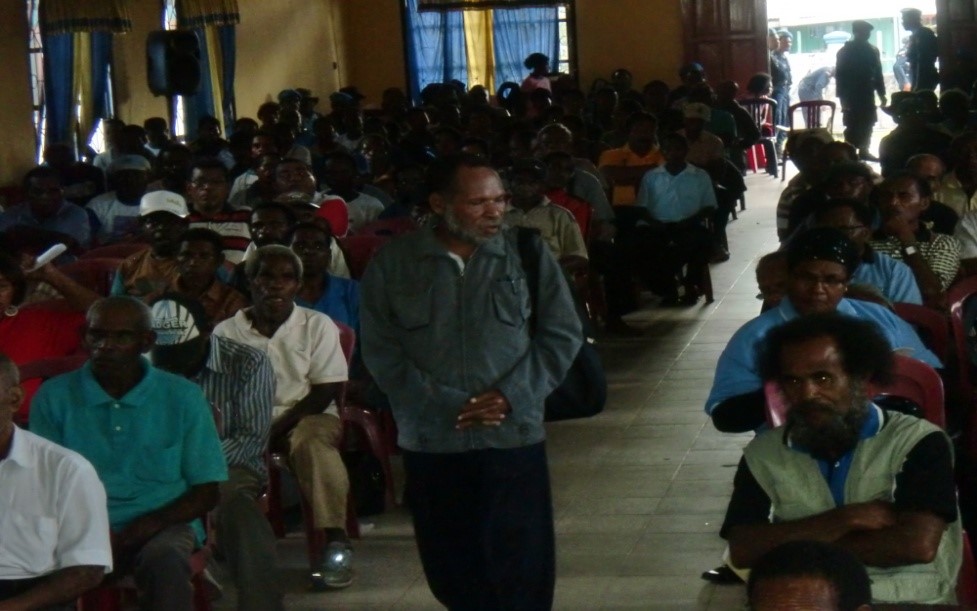
2000 people gathered in Sorong for prayers for the West Papua Freedom Flotilla (Photo: NFRPB/WPM sources)
2000 people gathered in Sorong for prayers for the West Papua Freedom Flotilla. *note – men in blue berets are from Petapa, West Papua’s community security / police force guarding West Papuan civilians against Indonesian police violence. (Photo: NFRPB/WPM sources)

The four were arrested after over 200 armed police surrounded a peaceful prayer gathering at Marantha Church in central Sorong yesterday afternoon, after thousands of local people joined with religious and adat (customary) leaders, and leaders of the self-declared National Federated Republic of West Papua (NFRPB) alternative government, to  express their solidarity with the aims of the Freedom Flotilla.  The Freedom Flotilla is  a journey being conducted with Aboriginal and West Papuan elders and Australian activists to highlight internationally the human rights situation in West Papua and is currently enroute sailing from Australia to West Papua.

Internationally renowned environmental defender, researcher and customary leader, NFRPB Sorong secretary Yohanis Goram,  was arrested together with  Apolos Sewa (Vice chair of Dewan Adat Papua, Greater Sorong),  Amandus Mirino (NFRPB State Secretariat senior worker), and  Samuel Klasjok (NFRPB’s alternative Chief of Police (Security) for  region 3, Doberay).  Sorong Police Chief Harry Goldenhad met with the organisers of the gathering, and initially “approved the activities with the proviso that they did not disturb the peace, and maintained security,” according to witnesses statements provided by established credible sources to West Papua Media.

sorong freedom flotilla congregation police
Police surrounding event just prior to arrests of organisers (Photo: NFRPB/WPM sources)

Over 2000 people had gathered for the solidarity event that spilled outside the large church compound.

About 45 minutes after the prayer meeting had finished, as participants were preparing for a press conference with local media including such as Radar Sorong, West Papua Post, and Fajar Papua, Police Chief Goldenhad took ten heavily armed officers into the church and arrested the four activists.

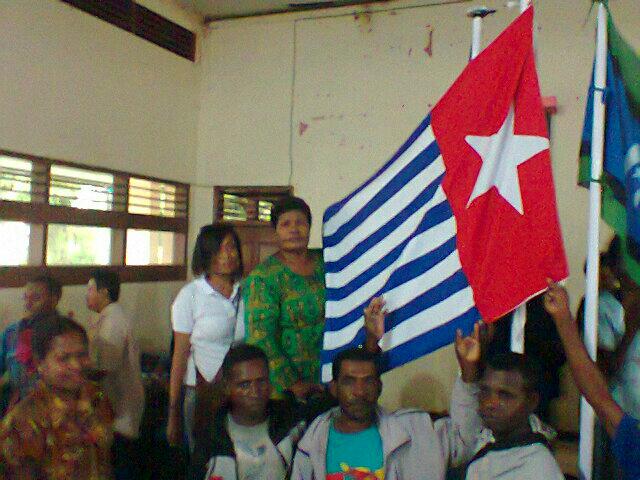
According to local sources who spoke with police and activists, Based on information collected on site, the arrests were made in connection with the unfurling of the Morning Star, Aboriginal, and Torres Straits flags inside the church.

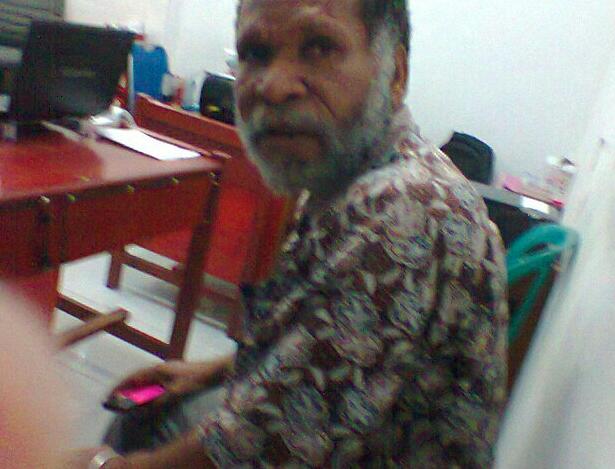
Apolos Sewa in the Police interrogation room (Photo: West Papua Media)
Apolos Sewa in Police interrogation room (Photo: West Papua Media)

The four activists are still being held at Sorong Police headquarters according to local sources, and their condition is unknown.  However grave fears are held for their safety, as these are the first West Papuans to be arrested over a connection to the Freedom Flotilla, which has attracted significant international media interest, and ignited major controversy and comment from Indonesian and Australian government ministers.

International human rights organisations have reacted quickly to the arrests, with Amnesty International (AI) in London expressing concern about the arrests of the four Papuan political activists.  AI’s Indonesia and Timor-Leste Campaigner, Josef Benedict said that AI “believes they have been arrested and detained solely for their peaceful political activism and call for their immediate and unconditional release.”

Activists raise the banned West Papuan Morning Star flag during the ceremony, prompting the arrests of the organisers under makar (treason) provisions Photo: West Papua Media sources)
Activists raise the banned West Papuan Morning Star flag together with the Aboriginal and Torres Strait Islands flags, during the Flotilla ceremony, prompting the arrests of the organisers under makar (treason) provisions Photo: West Papua Media sources)

textsecure-1571866598-1 “Amnesty International calls on the Indonesian authorities to respect the rights of Papuans to freedom of expression and peaceful assembly which are guaranteed in Article 19 and Article 21 of the International Covenant on Civil and Political Rights (ICCPR), to which Indonesia is a state party. Our organisation is concerned that the Indonesian government has consistently failed to make a distinction between violent armed groups and peaceful activists, and between peaceful expression of opinion and acts of physical violence, ” Benedict told West Papua Media by email.

textsecure-1857961604-1Activists on board the  Freedom Flotilla have reacted with dismay at the news of their supporters being targeted inside West Papua, but say this highlights the daily denial of Freedom of Expression for Papuan people, that originally motivated their plans for direct action.

sorong freedom flotilla congregation  2
The Maranatha Church in Sorong during the prayer service (Photo: NFRPB/WPM sources)

Ronny Kareni, the spokesperson for the Freedom Flotilla said “It is shocking and yet not surprising, but completely unacceptable in this day and age that peaceful demonstrations of basic freedom of expression is censored in such an extreme way. We demand the immediate release of the 4 prisoners in Sorong.”

Kareni explained, “The asorong freedom flotilla congregation  1rrests yesterday of the four Papuan leaders are a reflection of the reality that there is no space for democracy in Papua and West Papua Province under the Indonesian occupation, and yet foreign governments are complicit to these ongoing abuses. The Freedom Flotilla to West Papua is aiming to highlight this entrenched long-term brutality that is demonstrated by these arrests.

Arabunna elder, Uncle Kevin Buzzacott, the elder who inspired the journey, said in a statement to West Papua Media, “Indonesian government – you must immediately release those 4 prisoners and not to harm them in any way. They need to be released and not to be harmed because they have not committed a crime. We felt very sad when we seen it in the news today. We are waiting for the other mob to turn up here on Horne Island so we can work out how to respond a bit more but for now we need to ask all Australians to take a firm position on this issue, to be strong for Human Rights in West Papua. They are hurting them everyday, for years and regardless of the Freedom Flotilla this is happening, but we having a go, tryin’ to get the World to see, to look and listen and take a stand for these people. The Papuans have had it rough for too long with Indonesia there and this can’t keep going on. The prisoners must be released immediately”.

Izzy Brown, one of the organisers of the Freedom Flotilla said: “We are dismayed to hear that the peaceful act of prayer has resulted in such extreme actions by the police and military in West Papua, highlighting once more the lack of basic human rights and freedoms that we in Australia take for granted every day. We need immediate international pressure to be placed on the Indonesian government to ensure that no harm comes to these good people who have simply undertaken to express themselves in a democratic way.:

Kareni sums up the feeling of Flotilla members: “This is the time Australia, to stand up for people who are being militarily controlled and attacked for simply trying to have a voice.”

West Papua Media, with local sources

Create a website or blog at WordPress.com

Up ↑