The Arab Spring: a harbinger for a “global spring” against oppressive rule?

(published with especial relevance to West Papua)

by Edmund McWilliams

Democracy, respect for human rights, good governance – these are the themes that have been on the lips of peaceful demonstrators from the Mediterranean to the Arabian sea.

In country after country, Arab men and women, young and old have showed extraordinary courage, facing down dictators and autocrats even when those corrupt leaders have employed the full weight of their armed forces against the unarmed protesters.

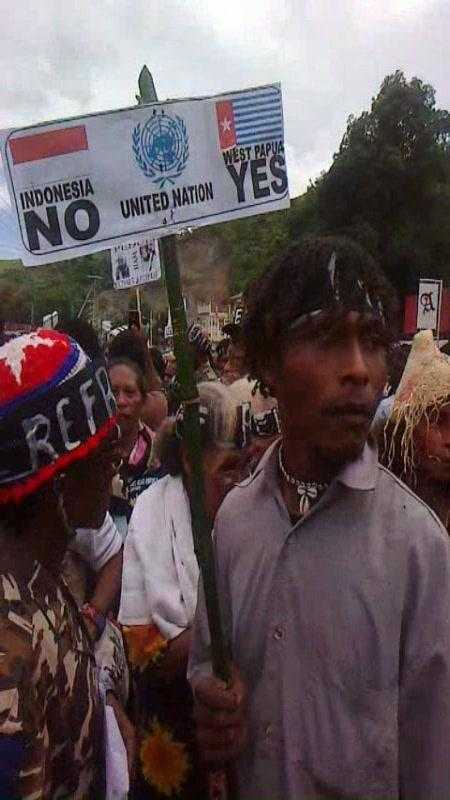
The Choice of Papuan People (Photo courtesy KNPB)

The inspiration of one young Tunisian who sacrificed himself in protest has spread from one Arab nation to another, in each country people coming to the profound realization, ‘if they can do it there, we can do it here.’

The largely peaceful demonstrations have not had an Arab or a Muslim character. Rather, common to all these peaceful revolts is a pent up desire for freedom and a new sense that change is possible.

We have seen similar uprisings which have swept vast areas:  the East European spring in the late 1980’s; the anti-colonial movement that followed World War II.  These, like the “Arab Spring” were trans-cultural, and transnational.   They derived their power from a common frustration with abusive, and sometimes foreign rule and a conviction that, in the words of the revolutionary mantra, “a people united can never be defeated.”

So we are left with the question of whether this movement will be confined to
Arab peoples, and largely to Muslims.  Or will this struggle for democracy and respect for human rights extend to non-Arab and non-Muslim cultures and peoples who also have suffered under brutal rule?  Will Tahrir square be emulated in Beijing, in Tashkent, in Hanoi, in Vientiane, in Rangoon and Pyongyang.  Will the Papuans, Montagnards, Hmong and Karen draw inspiration from the “Arab Spring” and break the colonial chains that have enslaved them to demand genuine autonomy or even full independence?  The physical and cultural distance separating Papuans in the Puncak Jaya or Hmong in Phong Saly from the “Arab Street” may seem to place them
in different worlds but they have a common experience in their suffering under undemocratic rule.

Is the “Arab Spring” a harbinger for a “global spring” that challenges oppressive rule around the world? For now, we can only assume that autocrats around the globe are sleeping more fitfully.

May their nightmares come true.

Edmund McWilliams
Retired senior U.S. Foreign Service Officer

Komnas HAM member warns of potential conflicts in Papua

Bintang Papua 13 April, 2011 

The deputy chairman of the Papua branch of the National Human Rights Commission is afraid that serious conflicts could occur in Papua around such issues as the election of the governor, conflicting views regarding special autonomy/OTSUS and the new Papuan Asembly, the MRP, conflicts between religious groups or between the churches, and the Puncak Jaya case. Other issues that were potentially controversial were the recent shooting dead of two people in the Freeport area, the serous flooding in Paniai and a number of mysterious deaths that have not been investigated.

Mathius Murib conveyed these thoughts to Bintang Papua in an SMS message.

He urged all sides in Papua to remain vigilant, to do everything possible to preserve peace in Papua and not to be provoked into making emotional responses. What is needed, he said, is well-thought out criticism in an era of democratisation and recognition of basic human rights in Indonesia. People should be careful to abide by the laws and regulations.

He expressed the hope that the newly appointed MRP would struggle for the basic rights of the Papuan people and hoped that the members of the new body would acknowledge the struggles waged by the late Agus Alue Alua and his colleagues in the previous MRP.

Priest says OTSUS is accelerating Papuan extermination

(WestPapuaMedia note: we are aware of the allegations of mysterious killings in 2010, however the reports given are not containing enough information to make any detailed report).
JUBI, 6 April 2011 

OTSUS IS ACCELERATING  PAPUAN EXTERMINATION

A priest in Nabire has described the special autonomy law, known as OTSUS, as being a move by the Indonesian government that was intended to accelerate the extermination of the indigenous Papuan people.

The Rev. Daud Auwe said that ‘the intention  is clear from the systematic and violent killings which have taken place up to now.’  He mentioned in particular the case of the Rev. Kindeman Gire in Puncak Jaya, and the shooting of Melkias Agapa and Abetnego Keiya in Nabire. He was speaking at a demonstration of several hundred people outside the office of the Nabire  provincial legislative assembly.

There was also the case of the mysterious killing of ten people in Nabire [no time mentioned] and the killings of 1,435 people  that occurred during the four years from 2006 to 2010.

Another speaker, Yones Douw spoke about the culture of dependency and the destruction of the people’s economy, the appalling condition of education and healthcare facilities for Papuan people, all of which were the result of OTSUS. ‘294 people in Dogiyai died of diarrhoea in 2008, 42 people died of malaria and 41 people died of starvation in the district of Nduga.’

Other factors were the destruction of Papuan culture, the uncontrolled increase in the number of inhabitants that has been occurring annually, all of which has led to a lack of protection for indigenous Papuan people.

Yones also condemned the government’s UP4B programme which is now being promoted by the central government, which he described as a public cover-up for the failures of OTSUS. ‘While there is no legal basis for the UP4B programme, the OTSUS law which is within the legal framework has not been properly implemented by the government.’

FYI Open letter to Vice -President Boediono ( who is visiting Australia) concerning human rights and political prisoners in West Papua

Australia West Papua Association (Sydney)
PO Box 28, Spit Junction, Sydney, Australia 2088
Ph/fax 61.2.99601698 email: bunyip@bigpond.net.au

Open letter to Vice -President Boediono

Vice -President Boediono,
C/- Indonesian Consulate
Perth , Western Australia

9 March 2011

Dear Vice -President Boediono,

On behalf of the Australia West Papua Association (Sydney), I am writing to you concerning the human rights situation in West Papua[1].

We are concerned that the human rights situation in West Papua has continued to deteriorate in the past year. One incident in particular highlighted the worsening human rights situation and that was the shocking video footage of West Papuans being tortured by Indonesian soldiers. The video showed several men in military fatigues torturing two Papuans. The soldiers in the video threaten the two men with sharp weapons and pressed a burning bamboo stick against one of the men’s genitals. The torture of the men prompted a wave of international criticism with human rights organisations around the world condemning the actions of the Indonesian military. This incident was not an isolated incident.

A number of military operation also took place in the Puncak Jaya region in the past year and these operations leave the local people traumatised and in fear for their lives. Security forces conduct regular sweeps in the area to pursue members of the Free Papua Movement (OPM) and many reports have pointed out that the security forces have great difficulty distinguishing between what they term separatists and the general public. In further evidence of human rights abuses another report accused the police of burning down the village of Bigiragi in the Puncak Jaya district. The report said that 16 Mobile Brigade officers had burned the village to the ground on October 11. The report said that at least 29 homes were destroyed in the incident leaving at least 150 people homeless. In September 2010 the House of Representatives (DPR) Law Commission deputy chairman, Tjatur Sapto Edy lamented the military operations in the Puncak Jaya Regency following a report by the National Commission for Human Rights (Komnas HAM). Tjatur said there should be no more military operations and such approaches are no longer suitable in a democracy. A report by Komnas HAM’s Papua chapter revealed 29 cases of rights abuses occurred in Puncak Jaya regency from 2004-2010, including the torture and rape of villagers in March 2010 by law enforcers.

AWPA is also concerned about the large number of political prisoners in West Papua, the majority jailed merely because the were involved in peaceful demonstrations where their national flag, the Morning Star was raised.

In July 2007, Indonesia’s Constitutional Court declared unconstitutional articles 154 and 155 of Indonesia’s Criminal Code, commonly known as the “hate sowing” (Haatzai Artikelen) offenses. Articles 154 and 155 criminalized “public expression of feelings of hostility, hatred or contempt toward the government” and prohibited “the expression of such feelings or views through the public media.” These articles have been used to target activists, students, and human rights defenders to try and silence political discussion and limit free expression in Indonesia.

A series of articles from 1999 to 2002 refer to the Human Rights Bill of 1999 . The law concerning protection of human rights of political prisoners is referred to in Article 4 of Law 39 in the Indonesian Constitution in 1999. In that same Law 39 in Article 6 , paras 1 and 2 particular mention is made of protection of rights of Indigenous people, including land rights.

Republic of Indonesia legislation number 39 of 1999 concerning human rights
Article 4
The right to life, the right to not to be tortured, the right to freedom of the individual, to freedom of thought and conscience, the right not to be enslaved, the right to be acknowledged as an individual before the law, and the right not to be prosecuted retroactively under the law are human rights that cannot be diminished under any circumstances whatsoever.
Article 6
(1) In the interests of upholding human rights, the differences and needs of indigenous peoples must be taken into consideration and protected by the law, the public and the Government.
(2) The cultural identity of indigenous peoples, including indigenous land rights, must be upheld, in accordance with the development of the times.

AWPA urges the Indonesian Government to release all West Papuan political prisoners imprisoned under these laws (contrary to Indonesia’s constitution) as a sign of good faith to the West Papuan people.

Yours sincerely

Joe Collins
Secretary
AWPA (Sydney)

[1] AWPA (Sydney) uses the name “West Papua” to refer to the whole of the western half of the Island of New Guinea

INDONESIA: Widespread impunity in Papua aggravating tensions


Date: 22 February 2011 03:15:24 CET

FOR IMMEDIATE RELEASE
February 22, 2011
ALRC-CWS-16-06-2011

Language(s): English only

HUMAN RIGHTS COUNCIL
Sixteenth session, Agenda Item 4, General Debate

A written statement submitted by the Asian Legal Resource Centre (ALRC), a non-governmental organisation with general consultative status

INDONESIA: Widespread impunity in Papua aggravating tensions

The Asian Legal Resource Centre (ALRC) is seriously concerned by ongoing, widespread human rights violations and violent acts being committed by the Indonesian security forces in the Papuan highlands in Indonesia. Impunity typically accompanies even the most serious abuses, as shown by the lack of effective remedies in a case of severe torture that the ALRC has documented recently. Despite institutional reforms in Indonesia, effective accountability for human rights violations in Papua is lacking, resulting in impunity that then engenders further atrocities.

Impunity and the sense of injustice that it engenders in society are having a strong impact on social stability and cohesion in Papua. Repression, discrimination and human rights violations by the Indonesian security forces are adding to tensions. Papuans reportedly feel like second-class citizens in Indonesia, even within Papua itself, and face discrimination, poverty and injustice as a result. The military arbitrarily suspect Papuans of being linked with rebel groups and stigmatise them, subjecting them to abuse.

Autonomy law rejected

The State has failed to provide justice and remedies and to bring prosperity and equality to Papua through the Special Autonomy Law, despite it being Indonesia’s most resource-rich region. Demonstrations in Jayapura, the capital of the Papuan province, have repeatedly rejected the Special Autonomy Law of 2001, with many civil society speakers having labelled it as being a failure. The autonomy parliament in July 2010 issued a decree formally rejecting the law and demanding a referendum on the political status of the autonomy region. The law was rejected mainly due to it having failed to deliver on any of the key demands of indigenous Papuans since its enactment. These include economic aspects but security and the need for protection against discrimination and human rights violations also figure highly.

The repeated calls by Papuan politicians, church and other civil society leaders for a dialogue between Papua and Jakarta have not been responded to by the government. Given the ongoing grave human rights violations by Indonesian security forces and the deteriorating relations between Papua and Jakarta, the ALRC is concerned that the situation of human rights risks declining seriously in the coming period, unless Indonesia takes meaningful action to address its role in the worsening situation. To be credible in doing this, the Indonesian government and military must ensure that human rights violations are halted and impunity is shown to be being dismantled, with justice being served and reparation being provided to victims.

Torture and impunity — a symbol of abuse and injustice

In the high-profile torture case mentioned above, which remains emblematic of the situation of human rights in Papua at present, Mr. Tuanliwor Kiwo, an indigenous Papuan man, was arbitrarily detained and tortured in May/June2010 by the Indonesian military. Mr. Kiwo was arrested at the Kwanggok Nalime TNI post near Yogorini village on his way from Tingginambut towards Mulia, Papua, Indonesia. During two days of detention, Mr. Kiwo was subjected to several serious forms of torture including burning, beatings and other forms of violence, resulting in serious injuries and Mr. Kiwo falling unconscious. He was able to escape in the morning of the third day. Mr. Kiwo is currently in hiding for security reasons but has given a detailed testimony of his torture in a video recording.1

While cases of torture are often reported from Papua, this case received significant international attention after video footage of the torture2 was published by the Asian Human Rights Commission (AHRC) in October 2010. As a result of the significant public pressure concerning this case, three members of the military were tried in a military tribunal for disobeying their superior’s order to release the victim and were sentenced to between nine and twelve months imprisonment. The ALRC is concerned that the charge and punishment in this case are not commensurate with the gravity of the violation that severe torture represents. Furthermore, the victim has not been provided with any form of remedy. Despite its high profile nature, this case speaks to the Indonesian system’s inability to address torture as a serious crime and human rights violation, and its failure to provide adequate reparation to victims. In less visible cases, even less can be expected, and impunity typically prevails.

In another case of violence by members of the military in the March 2010, that was also published in October 2010, the perpetrators have received sentences of an equally disproportionately low nature. Three solders from the Indonesian military’s Pam Rahwan Yonif 753/Arga Vira Tama squad, based in Nabire, Papua, were given a five-month imprisonment sentence by the military court III/19, Cenderawasih military command in Jayapura in November 2010, for having kicked and beaten arrested indigenous Papuans whom they suspected of involvement in separatist activities. The names of the convicted officers are Chief Pvt Sahminan Husain Lubis, Second Pvt Joko Sulistiono and Second Pvt Dwi Purwanto. Military judge Lt. Col. Adil Karokaro explained in the verdict that the defendants had breached the Indonesian military’s code of conduct by torturing the residents.

The government of Indonesia continues to deny the widespread use of violence by the Indonesian military in Papua, and alleges that these violations are rare and isolated, individual cases. However, the ALRC continues to receive further cases of violence against indigenous Papuans, including killings by the police and military, arbitrary arrests, the burning of houses and killing of livestock, which point to a widespread pattern of the use of violence, as well as a policy of intimidation by the Indonesian military.

Human rights violations and other crimes committed against civilians by members of the military are still only tried by military courts, which lack independence, transparency, a comprehensive penal code incorporating human rights norms, and a system of punishments that are proportional to the severity of the crimes committed. A military tribunal is not able to hold perpetrators of torture accountable in line with international law standards. Such tribunals cannot invoke any military regulations that prohibit the use of torture. Therefore, perpetrators cannot be tried for committing torture and no remedies can therefore be provided to victims.

Furthermore, the country’s penal code does not include torture as a crime. This means that members of the police that commit torture remain immune from criminal prosecution. Indonesia is therefore failing to comply with its obligations under the Convention Against Torture. Indonesia ratified the Convention against Torture in 1998, but the use of torture is still widespread and systematic, as cases received and documented by the ALRC attest. The promised review of the penal code has been delayed for years despite recommendations made to the government of Indonesia, which it accepted, during the Universal Periodic Review in this regard.

From a human rights perspective, it is vital for Indonesia to immediately begin to take credible action to tackle impunity and be seen to be tackling it in an effective way. Jakarta must ensure that the security forces halt the use of excessive force and violence-based strategies in dealing with security-related issues in Papua. Allegations of human rights violations must be investigated and any lacuna in legislation and due process must be addressed. For example, torture must be criminalized in line with Indonesia’s international obligations under the Convention Against Torture. Military personnel who are alleged to be responsible for human rights violations against civilians must be tried in civilian courts.

The ALRC invites the Special Rapporteur on the independence of judges and lawyers to recommend institutional reforms to the government of Indonesia to ensure that members of the military are held accountable by independent courts that uphold human rights and constitutional values and ensure that these are made available to legislators in Indonesia.

The ALRC also requests that the Special Rapporteur on torture and other cruel, inhuman or degrading treatment or punishment follow up with the Indonesian government to ensure the full implementation of the recommendations made to Indonesia during the UPR review regarding the review of the penal code and the full criminalisation of torture.

Furthermore, the ALRC urges the Indonesian government to heed the call for dialogue made by the Papuan indigenous community and avoid a further deterioration of the conflict in Papua. Finally, the ALRC calls on the Indonesian government to release all Papuan political prisoners, in order to show its commitment to a new path towards peace, security and human rights in Papua.

——–

Footnotes:

1 http://www.youtube.com/watch?v=eX5CuZhFFCI
2 http://humanrightsasia.blip.tv/file/4446942/

# # #

About the ALRC: The Asian Legal Resource Centre is an independent regional non-governmental organisation holding general consultative status with the Economic and Social Council of the United Nations. It is the sister organisation of the Asian Human Rights Commission. The Hong Kong-based group seeks to strengthen and encourage positive action on legal and human rights issues at the local and national levels throughout Asia.

International Human Rights Day 2010 – Download our pre-print PDF version of the annual reports here.

—————————–

Asian Human Rights Commission
#701A Westley Square,
48 Hoi Yuen Road, Kwun Tong, Kowloon,
Hongkong S.A.R.
Tel: +(852) – 2698-6339
Fax: +(852) – 2698-6367

URL: humanrights.asia
twitter/youtube/facebook: humanrightsasia
Create a website or blog at WordPress.com

Up ↑
