Filep Karma referred to Jakarta hospital with a suspected colonic tumour: NKRI refuses to pay

from West Papua Media’s correspondent at Abepura Prison (with Eds)

April 16, 2012

Filep Karma referred to Cikini hospital in Jakarta

Papuan political prisoner Filep Karma, in prison for 7 years on treason charges after raising the banned Morning Star independence flag, has been referred to Cikini hospital in Jakarta for three months to undergo medical treatment.

However he must undergo treatment in Jakarta, because Dock 2 hospital in Jayapura lacks colonoscopy equipment to diagnose the condition of Filep Karma. Healthcare in Papua is poorly funded and supplied, if at all, and health workers are rarely paid properly.

Hospitalised in Jayapura’s Dok 2 hospital since 2008, FIlep Karma has been gaoled in atrocious conditions and subjected to early routine torture by Indonesian security forces and prison officers, including beatings causing internal injuries.  His health has been declining since 2008 due to numerous hunger strikes and illness caused by prison conditions in Abepura prison.

Karma has been complaining of a lump in his gut over the last 3 years. Since an operation was performed on 2 November 2011, Karma has continued to pass significant blood in his stools.
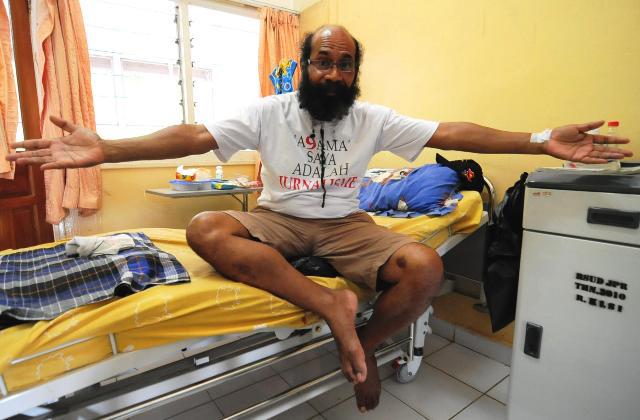
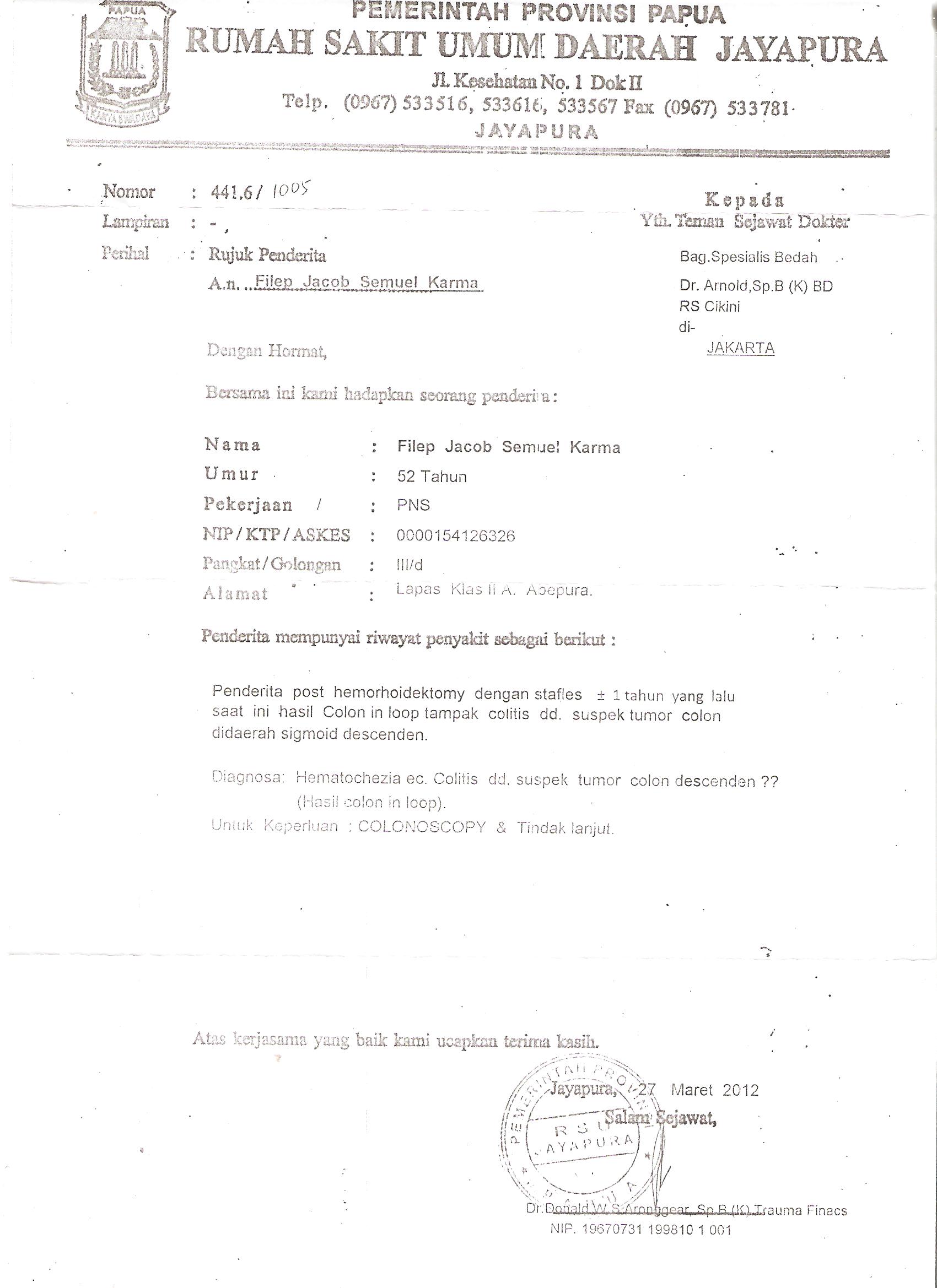
Karma has been referred by the Dok 2 Head of Trauma to the Department of Surgery Specialist, Dr D. Arnold, Sp.B (K) BD, in Cikini. Filep had already been undergoing treatment in Jakarta separately for his prostrate. On 13 April 2012, Dr Hidayathu Samawi, the general practitioner in Abepura prison, called Karma to his rooms. Dr Hidayathu said that Karma must provide a letter of permission from the family to consent to the treatment of Jakarta, and the Letter to commit the family to bear the full cost of treatment and transport to Jakarta.

Karma in this case ask for the Abepura Prison to issue a letter that the prisons are not able to bear the cost of treatment in Jakarta, but Dr. Hidayathu said that the prison would not certify its refusal to bear the cost of treatment in Jakarta.

During prison visiting hours at Abepura, Filep Karma told West Papua Media’s correspondent, “I was detained by the State of Indonesia, for 15 years, why are they unable to bear the cost of my treatment in Jakarta.  My case in July 2010, it was the same, treatment not covered by the State.  Abepura prison officials alone cannot issue a statement that they can’t afford the cost to Jakarta, yet I hardly have the foundation (strength) to have resort to outside solidarity as my only choice to help me for medical expenses to Jakarta,” said Karma.

The Indonesian government has an obligation to provide adequate healthcare to political prisoners.  According to Amnesty International, under Indonesian Government Regulation No. 32/1999 on Terms and Procedures on the Implementation of Prisoners’ Rights in Prisons, all medical costs for treatment of a prisoner at a hospital must be borne by the state, also in accordance with the UN Body of Principles for the Protection of All Persons under Any Form of Detention or Imprisonment (Principle 24) .

In late February, in response to a petition filed by Freedom Now, the United Nations Working Group on Arbitrary Detention issued its opinion that the Government of Indonesia is in violation of international law by detaining Filep Karma. Amongst many other international voices, the Working Group called on the Government of Indonesia to immediately release the human rights advocate.

westpapuamedia

Image

Kimanus Wenda’s tumour operation

andreasharsono.net
22 March 2012

[Translated by TAPOL] 

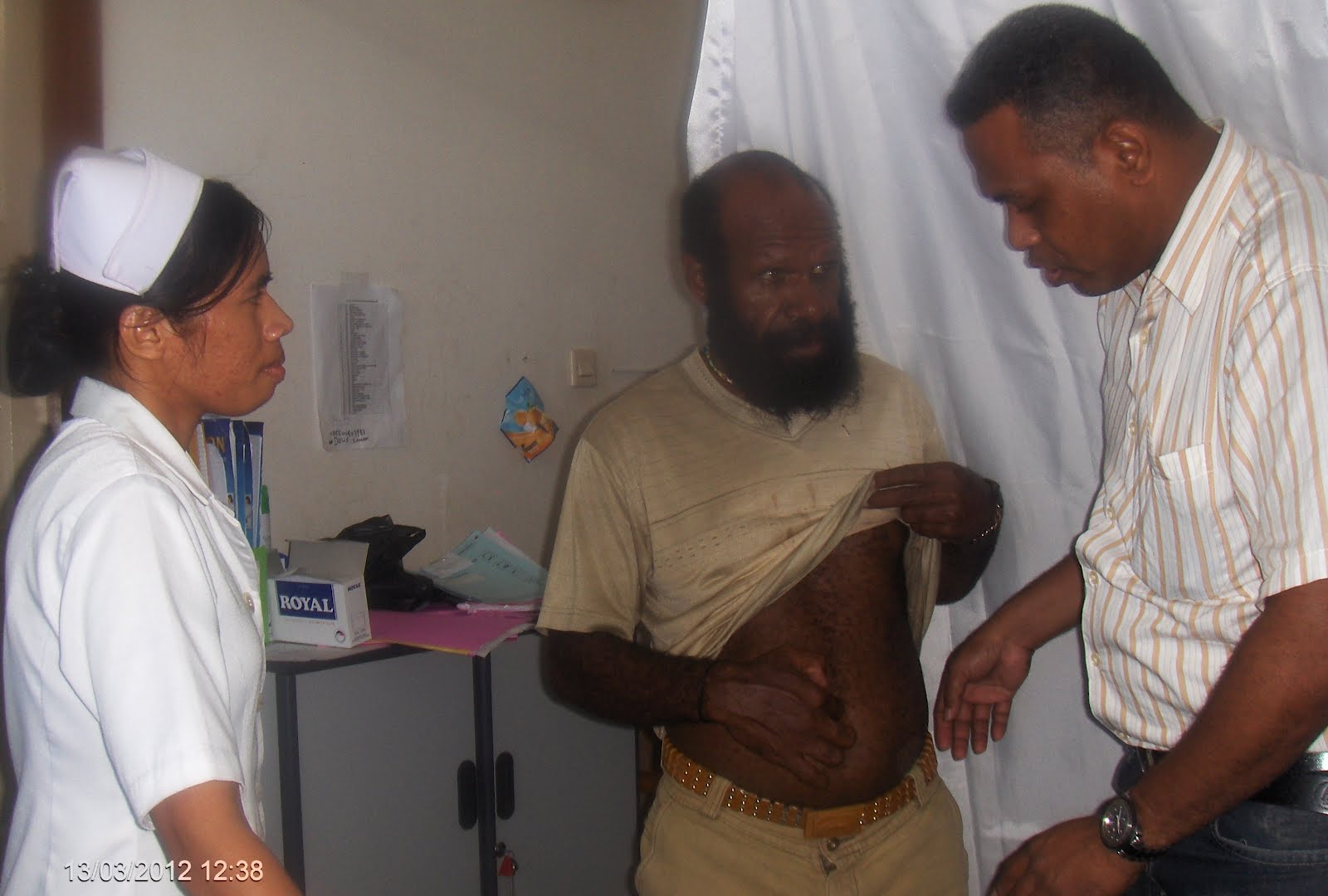
Papuan detainee Kimanus Wenda being examined by the doctor at Dian Harapan Hospital in Waena, Jayapura. ©Peneas Lokbere

KIMANUS WENDA, a prisoner usually detained in Nabire prison had an operation to remove a tumour from his stomach at Dian Harapan Hospital, Waena Jayapura on 14 March 2012.  Wenda is detained for treason (makar) and is serving a 20 year prison sentence.

According to Peneas Lokbere from United for Truth (Bersatu Untuk Kebenaran), an organisation which provides support for political prisoners in Papua, the operation began at 10:00 and lasted for two hours.

“After the operation he was transferred to the inpatient ward. The procedure went well without any obstacles,” said Lokbere.  A growth and a hernia were operated on, and he was given six stitches.

Wenda was hospitalised until Saturday 17 March 2012. On Satuday, Dr Trajanus Lauretius said that Kimanus could go “home” to the jail in Abepura, but that every Tuesday he needs a check-up at the Dian Harapan Hospital.

Lokbere took Wenda to Abepura jail on Saturday afternoon. On Sunday Lokbere came back to bring his medication.   According to Lokbere, Kimanus Wenda said that two staff from the jail came into his cell.  All his belongings – including his clothes and medicines – were turned upside down with no clear reason.  He was offended by being treated in such an impolite manner while he was just recovering from an operation.

Kimanus Wenda is actually listed as a prisoner at Nabire jail.  However he cannot return to Nabire at present because he needs to recover properly first and have the stitches removed from his stomach.

According to the Asian Human Rights Commission, Kimanus Wenda started
to complain of feeling ill in 2010, and was vomiting frequently.  The doctor at Nabire prison examined him and said that he needed to be examined in Jayapura.   However, the Ministry for Justice and Human Rights said that they could not pay for an operation in Jayapura.  They claimed they didn’t have the money to cover the costs of the operation.

An official of Nabire jail disagreed that Wenda was ill.  The proof?  Kimanus Wenda could still play volleyball in the prison field in Nabire.  His obstructive behaviour prompted Peneas Lokbere to gather funds for Wenda’s operation. Various non-governmental organisations have contributed to the cost of the journey, transfer between the Nabire and Abepura prisons, and the medication for Kimanus Wenda.

According to the Facebook page of TAPOL, an organisation which provides support for political prisoners, their internet fundraising campaign using the gofundme.com website raised £2,000, [which included £1,040 in direct donations and an anonymous private donation of £1,000 – TAPOL]. They channelled the funds through Peneas Lokbere and friends in Jayapura.

At present, Lokbere is monitoring Kimanus Wenda’s recovery in Abepura prison.  Once he recovers and the stitches are out, Wenda will return to Nabire prison.  According to Indonesian law, the Indonesian government is responsible for providing prisoners with healthcare.

However, the problem of budgets is often used by the Ministry for Justice and Human Rights as an excuse for not complying with this regulation.

Ironically, the Indonesian government has also banned the International Committee of the Red Cross (ICRC) from working in Papua since March 2009, despite the fact that ICRC often helps the families of prisoners to visit the detainees.  The ICRC also usually gives support for medication for prisoners, no matter who they are.

Peneas Lokbere and TAPOL are now collecting funds for an operation for Jefrai Murib who is currently in Biak prison.   Jefrai Murib is suspected of having suffered a stroke on 19 December 2011.  The left side of his body and his left arm and leg have lost all sensation. Murib has been examined at the Biak General Hospital, where the doctor’s diagnosis was that he needs to be examined at the General Hospital in Jayapura.

http://www.andreasharsono.net/2012/03/operasi-tumor-kimanus-wenda.html

Sambom: ‘Imprisonment will never silence Papuans’

JUBI, 19 March 2012
A leading Papuan human rights  activist has said that the Indonesian government will never be able to silence the Papuan struggle by putting Papuans behind bars. On the contrary, he said, it has the reverse effect by making people more determined than ever.

Sebby Sambom made these comments in an interview with JUBI in connection with the three-year sentence given to Forkorus Yaboisembut and his four colleagues last week.

‘Indonesia has neither the power nor the legal means to punish Papuans by silencing them with regard to their aspirations for an Independent Papua,’ he said.

He said that whenever Papuans take action, they are brought before the court and given a prison sentence. This is the way the government behaves which is simply unacceptable. Even though Papuans have done nothing wrong, they are thrown into prison.’

He said that any Papuan who takes action faces the prospect of being jailed. People keep on being arrested, put on trial and thrown into prison but this will never silence the Papuan people.

He went on to say that  as the number of Papuans being held behind bars goes on increasing , this will help to alert the international community to get involved in solving the Papuan issue.

‘With all these political prisoners,’ he said, ‘international support will become more positive.’

Sebby said that Forkorus  is a loyal Papuan leader who is very serious about the Papuan struggle. ‘He is doing everything he possibly can to bring an end to our sufferings,’ His attitude was very clear from the remarks he made after the verdict was announced. ‘We were pleased with the verdict and our struggle will continue,’ said Sambom.

Translated by TAPOL

Filep Karma undergoing Medical care at Hospital DOK II

by a special correspondent in Abepura for West Papua Media

March 3, 2012

(Edited and abridged in translation by WPM)

Concerns have been raised again over the health of internationally renowned West Papuan political prisoner Filep Karma, after a series of visits to hospital to treat his worsening health, amid atrocious conditions in the notorious Abepura prison.

Filep Karma is a political prisoner sentenced to 15 years imprisonment by Indonesia after being found guilty of makar (treason) for making a speech calling for independence and raising the banned Morning Star flag on December 1st 2004.

(Gaoled in atrocious conditions and subjected to early routine torture by Indonesian security forces and prison officers, including beatings causing internal injuries, Karma’s health has been declining since 2008, also due to numerous hunger strikes and illness caused by prison conditions in Abepura prison.  Additionally, In response to a petition filed by Freedom Now, the United NationsWorking Group on Arbitrary Detention issued its opinion that the Government of Indonesia is in violation of international law by detaining Filep Karma. Amongst many other international voices, the Working Group called on the Government of Indonesia to immediately release the human rights advocate. – WPM)

He underwent medical checkups at Hospital Dock II, and underwent a colonoscopy by a Dr Arnold, on 17 February 2012, to check his intestines. He underwent the check because up until this point he regularly discharged blood when using his bowels. The results of the check were to be taken on February 21st, 2012. At the same time he also was assessed by a neurologist, Dr. Nelly Rumpaisum, because for the previous few days he felt the pain to the right of his hip when getting down to clean clothes, and now also when standing. When undergoing the examination, Fliep was accompanied by two officers and a doctor from Abepura prison. Filep was to return to the Hospital II, to undergo X-rays of his waist.

At this time, Filep cooked his own food in prison. He used a traditional stove himself, with milk cans and axes, lit with coconut oil. ‘Eating my own cooking is better for my health at the moment, because if I eat food from Abepura Prison, there can sometimes be a lot of seasoning, and this is less suitable for the condition of my body while undergoing medical treatment at the moment’, he said.

On 21 February 2012, according to Dr. Donald Arronggear at the time of the colonoscopy results, ”Filep is affected by inflammation of the intestine next to the anus, so that he must eat foods high in fibre, like fruit and vegetables”, he said. He also received various medicines from the doctor to drink when back in prison. He also did x-rays on the right side of the waist, and the results were to be checked again on 24 February 2012.

Filep Karma will undergo physiotherapy

On several weekends, Filep Karma underwent some medical treatment at the Hospital Dok II. He was accompanied by two prison officers and doctors from Abepura Prison. On 24 February 2012, he received sequence number 2 at the polyclinic at Hospital DOK II. Filep took the x-rays to neurologist, Dr. Nelly Rumapaisum. According to Dr. Nelly ”The right side of Filep’s waist, has narrowed. So, it must to undergo physiotherapy for 12 sessions. Filep can no longer lift heavy equipment and also sports is a high-risk”, said Dr. Nelly.

Filep Karma said that ‘my waist has already been sore for a while, but it felt sore for a few weeks so it had to be checked”. Filep Karma also must use a corset after undergoing physiotherapy (a very uncomfortable apparatus in the sweaty conditions of the prison – WPM) . He will undergo regular physiotherapy and will be back and forth to the DOK II Hospital for ongoing care.

“My desire is also to be an inpatient at DOK II Hospital, while undergoing physiotherapy, because the distance between the Prison Abepura and Jayapura is about 60 minutes, which makes me making a little exhausted on the journey”, Karma said.

See Also : FILEP KARMA REFUSES INDONESIA’S REMISSION Aug 20, 2011 – Video report by Cyntia Warwe

3 Papuan prisoners in need of medical treatment for stroke

Papuan prisoners in Biak Jail
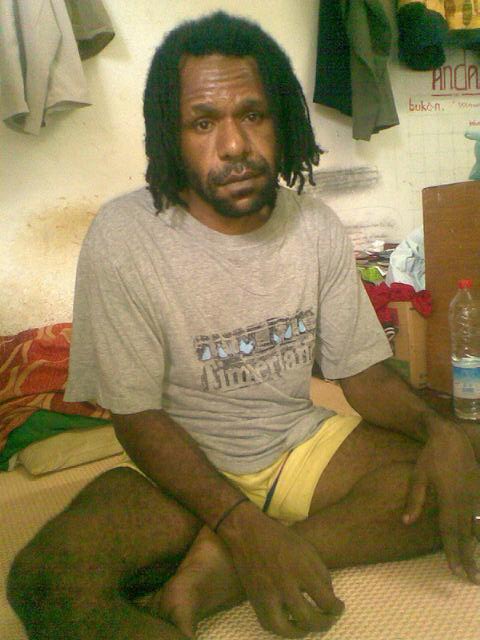
Papuan prisoners in their cell in Biak prison: Numbungga Telengen (black clothes), Jefrai Murib (sleeping) and Apot Lokobal (wearing glasses). Jafrai Murib is thought to have suffered a stroke on 19 December 2011 which has caused paralysis. He can no longer stand.


I am often in and out of prisons to deal with political prisoners, so I know many detainees and their families and lawyers. Last week, I received a message from somebody representing three Papuan prisoners in Biak prison. He said that prisoner Jefrai Murib is thought to have suffered a stroke on the morning of 19 December 2011. He’s paralysed. He can’t walk. When he walks he does so with the aid of his friends. The left side of his body, his left leg and his left arm have lost all sensation.

Jefrai Murib

Murib has had a check-up in Biak General Hospital, where the doctor referred him to Jayapura hospital.  Biak hospital is not as well equipped as Jayapura hospital. Murib is in a cell together with Numbungga Telengen and  Apotnagolik Enos Lokobal.  They were arrested in April 2003 following a raid on a Wamena weapons store. Murib and Telenggen got a life sentence, Lokobal was sentenced to 20 years in jail.

Lokobal also suffers from the same symptoms; the right side of his body has lost all sensation. He has also been seen twice at Biak hospital, on 12 November and 23 November. Lokobal is also suspected of having suffered a stroke. Unlike Jafrai Murib, by last week Apot Lokobal was able to walk again, although his steps are weak and faltering, and he has to be carried when taken to hospital. Lokobal needs more specialised medication. The Indonesian state is responsible for providing healthcare to prisoners. I hope that the health condition of these two prisoners will be taken seriously by the Penitentiary Director General.

In accordance with the doctor’s recommendations, Jefrai Murib should be moved to Abepura jail in Jayapura, and needs to receive medical attention at the Dok Dua Hospital in Jayapura.

Create a website or blog at WordPress.com

Up ↑