Perpetrators of Bloody Wamena Incident should be brought to justice

JUBI, 4 April 2012

The Aliansi Demokrasi Untuk Papua – Democratic Alliance for Papua – has called on the Indonesian government and specifically on the police force  to immediately arrest and charge  the perpetrators of the serious bloody incident  which occurred at the time of an  attack on the ammunition dump of  Kodim – district military command – 1702 in Wamena on 4 April 2003.

Cory Silva, speaking on behalf of the ALDP, said that the government should also provide a clarification about the incident.

She said that incident was a serious tragedy that led to the loss of many lives.

‘As far as we know, the government has failed to acknowledge responsibility for that incident and it has simply been swept under the carpet,’ she told journalists.

She called on Komnas HAM, the National Human Rights Commission, and the Attorney General’s Office, to provide information about any recent developments with regard to the case. It seems to us, she said, that the incident has got stuck somewhere between these two agencies.

‘We urge the government to provide clarifications with regard to any developments concerning the case. This would help explain things to the victims  and to the general public,’

Cory went on to say that the police should arrest the perpetrators and bring them before the court. ‘If at all possible, the persons behind that incident should be arrested and face justice in accordance with the law of the land.’

The deputy director of the ALDP in Jayapura, Yusman Conoras, said the state should accept responsibility for those who became political prisoners  in connection with the case, bearing in mind that they received heavy sentences. ‘Those who were held as tapols in connection with this case need special attention because of the heavy sentences they have had to serve,’ he said.

According to the available  information, the security forces rounded up six persons whose names are as follows: Kanius Murib, Enos Lokobal, Jefrai Murib, Numbunnga Telenggen, Kimanus Wenda and Michael Hesello. They were tried and convicted by the district court in Makasar. They are at present facing proceedings before the Makasar State Court. The first three were sentenced to 20 years, while the other three were given life sentences.

One of the co-defendants, Michael Hesello, fell ill and died  while he was being held in Gunung Sari Prison in Makasar. The others are at present facing proceedings at the Makasar State Court.

[Translated by TAPOL.]

Kimanus Wenda’s tumour operation

andreasharsono.net
22 March 2012

[Translated by TAPOL] 

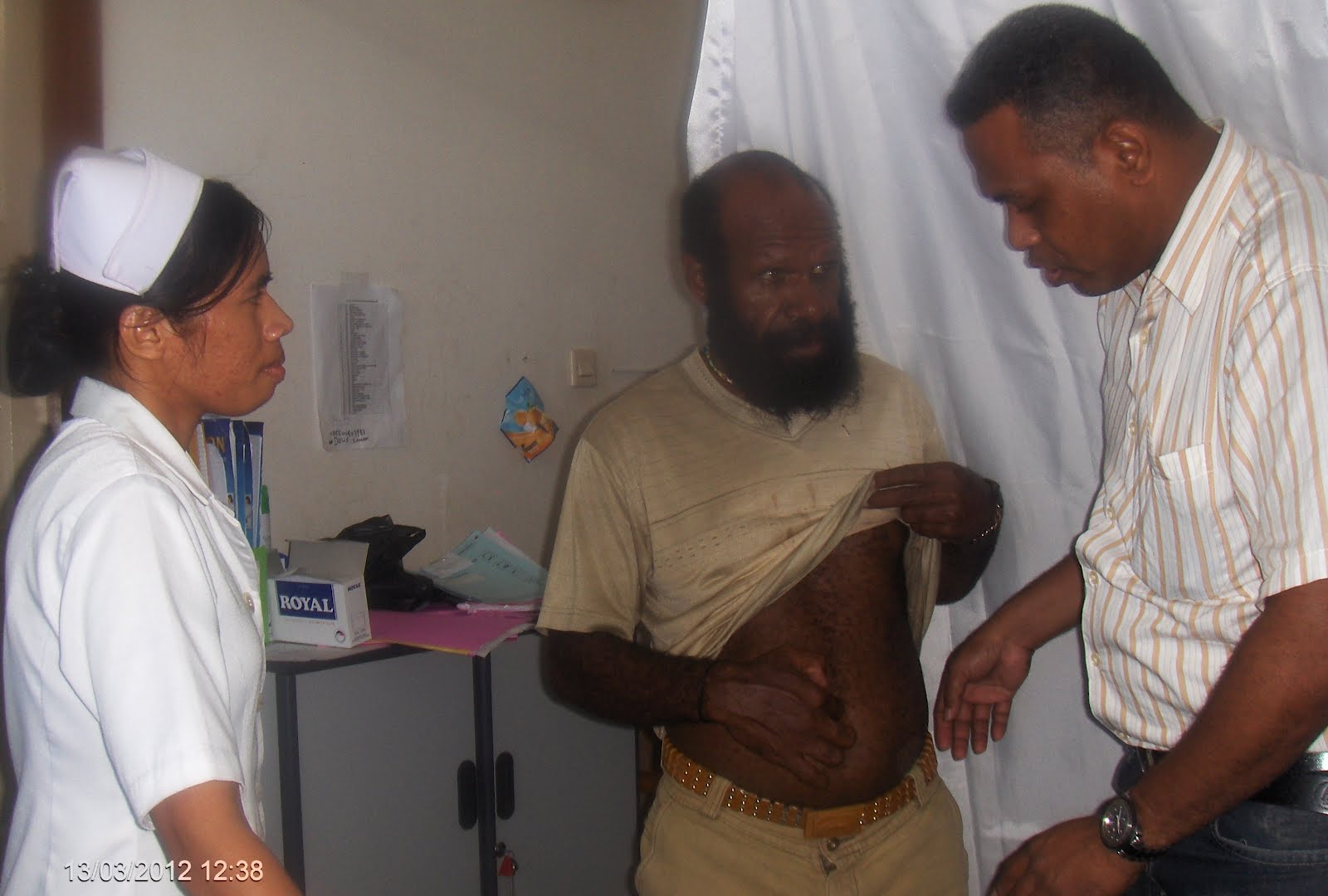
Papuan detainee Kimanus Wenda being examined by the doctor at Dian Harapan Hospital in Waena, Jayapura. ©Peneas Lokbere

KIMANUS WENDA, a prisoner usually detained in Nabire prison had an operation to remove a tumour from his stomach at Dian Harapan Hospital, Waena Jayapura on 14 March 2012.  Wenda is detained for treason (makar) and is serving a 20 year prison sentence.

According to Peneas Lokbere from United for Truth (Bersatu Untuk Kebenaran), an organisation which provides support for political prisoners in Papua, the operation began at 10:00 and lasted for two hours.

“After the operation he was transferred to the inpatient ward. The procedure went well without any obstacles,” said Lokbere.  A growth and a hernia were operated on, and he was given six stitches.

Wenda was hospitalised until Saturday 17 March 2012. On Satuday, Dr Trajanus Lauretius said that Kimanus could go “home” to the jail in Abepura, but that every Tuesday he needs a check-up at the Dian Harapan Hospital.

Lokbere took Wenda to Abepura jail on Saturday afternoon. On Sunday Lokbere came back to bring his medication.   According to Lokbere, Kimanus Wenda said that two staff from the jail came into his cell.  All his belongings – including his clothes and medicines – were turned upside down with no clear reason.  He was offended by being treated in such an impolite manner while he was just recovering from an operation.

Kimanus Wenda is actually listed as a prisoner at Nabire jail.  However he cannot return to Nabire at present because he needs to recover properly first and have the stitches removed from his stomach.

According to the Asian Human Rights Commission, Kimanus Wenda started
to complain of feeling ill in 2010, and was vomiting frequently.  The doctor at Nabire prison examined him and said that he needed to be examined in Jayapura.   However, the Ministry for Justice and Human Rights said that they could not pay for an operation in Jayapura.  They claimed they didn’t have the money to cover the costs of the operation.

An official of Nabire jail disagreed that Wenda was ill.  The proof?  Kimanus Wenda could still play volleyball in the prison field in Nabire.  His obstructive behaviour prompted Peneas Lokbere to gather funds for Wenda’s operation. Various non-governmental organisations have contributed to the cost of the journey, transfer between the Nabire and Abepura prisons, and the medication for Kimanus Wenda.

According to the Facebook page of TAPOL, an organisation which provides support for political prisoners, their internet fundraising campaign using the gofundme.com website raised £2,000, [which included £1,040 in direct donations and an anonymous private donation of £1,000 – TAPOL]. They channelled the funds through Peneas Lokbere and friends in Jayapura.

At present, Lokbere is monitoring Kimanus Wenda’s recovery in Abepura prison.  Once he recovers and the stitches are out, Wenda will return to Nabire prison.  According to Indonesian law, the Indonesian government is responsible for providing prisoners with healthcare.

However, the problem of budgets is often used by the Ministry for Justice and Human Rights as an excuse for not complying with this regulation.

Ironically, the Indonesian government has also banned the International Committee of the Red Cross (ICRC) from working in Papua since March 2009, despite the fact that ICRC often helps the families of prisoners to visit the detainees.  The ICRC also usually gives support for medication for prisoners, no matter who they are.

Peneas Lokbere and TAPOL are now collecting funds for an operation for Jefrai Murib who is currently in Biak prison.   Jefrai Murib is suspected of having suffered a stroke on 19 December 2011.  The left side of his body and his left arm and leg have lost all sensation. Murib has been examined at the Biak General Hospital, where the doctor’s diagnosis was that he needs to be examined at the General Hospital in Jayapura.

http://www.andreasharsono.net/2012/03/operasi-tumor-kimanus-wenda.html

Letters of solidarity flood in their thousands for Filep Karma

by a Special Correspondent for West Papua Media in Abepura

March 19, 2012

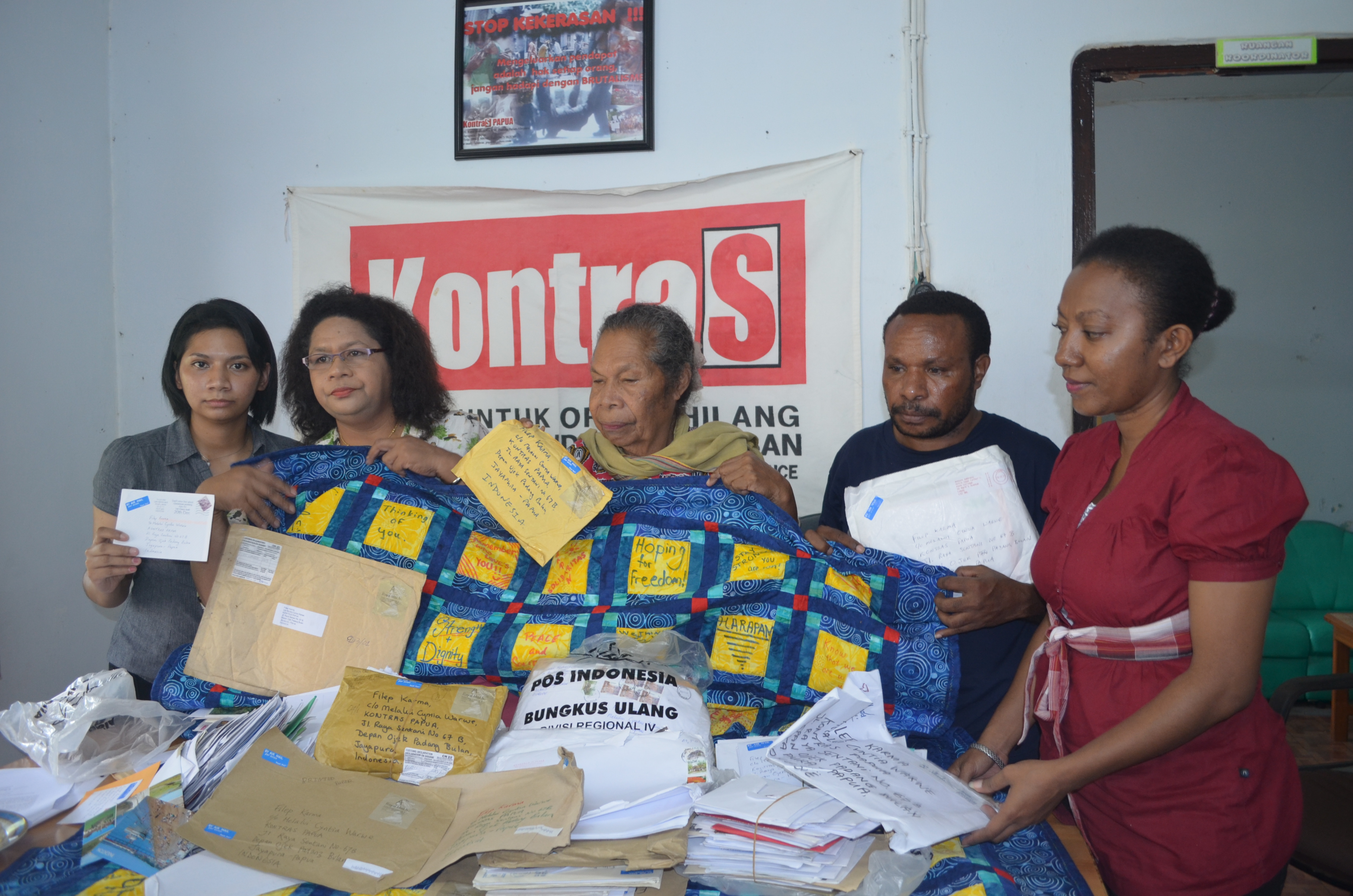
Kontras and Filep Karma's family with some of the nearly 7300 letters sent by international supporters of Karma (Photo: West Papua Media)

Filep Karma, is one of the political prisoners given sentences of 15 years of imprisonment by the government of Indonesia, by raising the Morning Star flag, on December 1, 2004, at Trikora field, Abepura. Ever since a period of 7 years, and 3 months of his prison sentence  have lasted in Abepura prison. During captivity Filep Karma received letters of solidarity sent by the International community through the office of the Commission for missing people and victims of violence in Papua (KontrasPapua).   Nearly 7292 letters of support have been sent in the period of 2011 untill 2012.

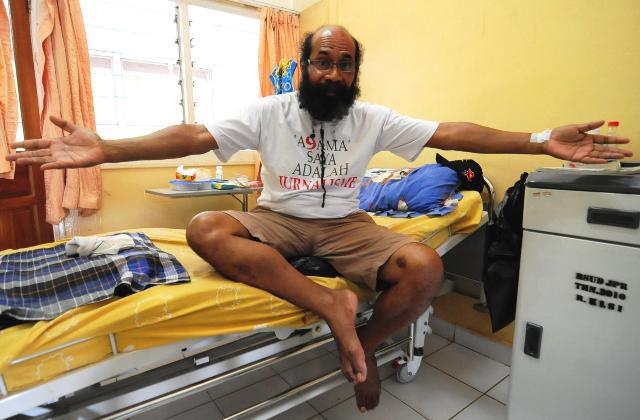
Filep Karma inside the prison hospital (Photo: West Papua Media)

United for the truth (BUK) and Kontras Papua held a Press Conference on March 19, 2012, and immediately submit a letter of support to the family representative of Filep Karma. Andrefina Karma,  Filep Karmas second daughter  said ” International Community support is strong solidarity for the freedom of my father, the people there once a month hold a simple campaign in front of the Indonesian embassy and called for the unconditional release of Filep Karma”, she said.

Letters that came from different parts of the world  proved that there is support for political prisoners in Papua. Olga Hamadi, Director of Kontras Papua says”  the government should not close her eyes  for the injustice suffered by political prisoners in Papua, both in conditions of health and food at the prison, which  received less serious attention”, she said. She also denied the statement by the Minister of Justice and Human Rights Republic of Indonesia during a visit to Papua saying that there are no political prisoners in Papua.

Filep Karma is one of  figures of political prisoners who never made a compromise with the Government of Indonesia. He rejected any form of clemency, amnesty, and abolition that is given by the Government. ” If I receive clemency, that means I ask for forgiveness to the government, but I do not feel guilty at all, I am just making a peaceful protest. Indonesia is a democratic country, am I wrong to fight for the basic rights of indigenous Papuans?

“I will continue to undergo a period of detention up to 15 years in prison, if you want to release me, I ask to be released unconditionaly”, Filep Karma said, as he was undergoing physiotherapy treatment in DOK II general hospital.

westpapuamedia

Filep Karma undergoing Medical care at Hospital DOK II

by a special correspondent in Abepura for West Papua Media

March 3, 2012

(Edited and abridged in translation by WPM)

Concerns have been raised again over the health of internationally renowned West Papuan political prisoner Filep Karma, after a series of visits to hospital to treat his worsening health, amid atrocious conditions in the notorious Abepura prison.

Filep Karma is a political prisoner sentenced to 15 years imprisonment by Indonesia after being found guilty of makar (treason) for making a speech calling for independence and raising the banned Morning Star flag on December 1st 2004.

(Gaoled in atrocious conditions and subjected to early routine torture by Indonesian security forces and prison officers, including beatings causing internal injuries, Karma’s health has been declining since 2008, also due to numerous hunger strikes and illness caused by prison conditions in Abepura prison.  Additionally, In response to a petition filed by Freedom Now, the United NationsWorking Group on Arbitrary Detention issued its opinion that the Government of Indonesia is in violation of international law by detaining Filep Karma. Amongst many other international voices, the Working Group called on the Government of Indonesia to immediately release the human rights advocate. – WPM)

He underwent medical checkups at Hospital Dock II, and underwent a colonoscopy by a Dr Arnold, on 17 February 2012, to check his intestines. He underwent the check because up until this point he regularly discharged blood when using his bowels. The results of the check were to be taken on February 21st, 2012. At the same time he also was assessed by a neurologist, Dr. Nelly Rumpaisum, because for the previous few days he felt the pain to the right of his hip when getting down to clean clothes, and now also when standing. When undergoing the examination, Fliep was accompanied by two officers and a doctor from Abepura prison. Filep was to return to the Hospital II, to undergo X-rays of his waist.

At this time, Filep cooked his own food in prison. He used a traditional stove himself, with milk cans and axes, lit with coconut oil. ‘Eating my own cooking is better for my health at the moment, because if I eat food from Abepura Prison, there can sometimes be a lot of seasoning, and this is less suitable for the condition of my body while undergoing medical treatment at the moment’, he said.

On 21 February 2012, according to Dr. Donald Arronggear at the time of the colonoscopy results, ”Filep is affected by inflammation of the intestine next to the anus, so that he must eat foods high in fibre, like fruit and vegetables”, he said. He also received various medicines from the doctor to drink when back in prison. He also did x-rays on the right side of the waist, and the results were to be checked again on 24 February 2012.

Filep Karma will undergo physiotherapy

On several weekends, Filep Karma underwent some medical treatment at the Hospital Dok II. He was accompanied by two prison officers and doctors from Abepura Prison. On 24 February 2012, he received sequence number 2 at the polyclinic at Hospital DOK II. Filep took the x-rays to neurologist, Dr. Nelly Rumapaisum. According to Dr. Nelly ”The right side of Filep’s waist, has narrowed. So, it must to undergo physiotherapy for 12 sessions. Filep can no longer lift heavy equipment and also sports is a high-risk”, said Dr. Nelly.

Filep Karma said that ‘my waist has already been sore for a while, but it felt sore for a few weeks so it had to be checked”. Filep Karma also must use a corset after undergoing physiotherapy (a very uncomfortable apparatus in the sweaty conditions of the prison – WPM) . He will undergo regular physiotherapy and will be back and forth to the DOK II Hospital for ongoing care.

“My desire is also to be an inpatient at DOK II Hospital, while undergoing physiotherapy, because the distance between the Prison Abepura and Jayapura is about 60 minutes, which makes me making a little exhausted on the journey”, Karma said.

See Also : FILEP KARMA REFUSES INDONESIA’S REMISSION Aug 20, 2011 – Video report by Cyntia Warwe

AHRC: Authorities refuse to treat political prisoner with tumour

January 27, 2012

ASIAN HUMAN RIGHTS COMMISSION – URGENT APPEALS PROGRAMME

Urgent Appeal Case: AHRC-UAC-008-2012

ISSUES: Indigenous people; inhuman and degrading treatment; prison conditions

The Asian Human Rights Commission (AHRC) has received information regarding the condition of Kimanus Wenda, a political prisoner at Nabire prison, Papua, who has a tumor in his stomach and must be operated on. Although Indonesian law clearly notes that it is the state’s obligation to provide medical fees, the Papua legal and human rights department is refusing to pay for Mr. Wenda’s surgery due to a lack of funds. Moreover, the goverment is now claiming that Mr. Wenda does not require surgery, although local activists found the opposite to be true.

CASE NARRATIVE:

According to the information received from KontraS, ALDP and SKPHP, on April 4, 2003, at around 1am, there was a burglary at 1702/ Jayawijaya Wamena military district staff headquarters armory.

Eight perpetrators were arrested in connection to this theft: Yafrai Murib, Numbungga Telenggen, Enos Lokobal, Linus Hiluka, Kanius Murib, Kimanus Wenda, Des Wenda and Mikael Haselo. On January 15, 2004, according to the verdict declared by the Wamena district court, all the victims were found guilty for rebellion under articles 106 and 110 of the Criminal Code. Yafrai Murib and Numbungga Telenggen were sentenced to lifetime imprisonment, while the others were sentenced to 20 years imprisonment. Civil society considers this verdict to not be based on legal facts.

Since 2010, Mr. Wenda has had a tumor in his stomach and is constantly vomiting. He informed the health staff at Nabire prison but was not given any adequate response. On February 2, 2011, the Nabire hospital issued a reference letter regarding Mr. Wenda’s sickness and the need for him to be operated at Jayapura hospital. Two days later, Mr. Wenda’s legal counsel sent a medical leave letter to the head of Papua’s regional office of law and human rights and the head of Nabire prison, but received no response. On September 19, SKPHP met the head of Papua legal and human rights department but the department said it has no money and thus cannot pay for Mr. Wenda’s operation. This violates Indonesian law under Indonesian Government Regulation No. 32/1999 on Terms and Procedures on the Implementation of Prisoners’ Rights in Prisons, which states that it is a state obligation to provide medical fees and treatment. While civil society is now gathering funds to pay for the operation in Jayapura hospital, it is not yet enough.

Furthermore, on December 16, at the hearings between KontraS and the ministry of law and human rights, the staff of Nabire prison said that based on their report and the statement of the prison chief, Mr. Wenda was seen playing volley ball in prison and therefore his stomach tumour is not dangerous and does not need to be operated in Jayapura hospital. However, on December 21, when local activists brought Mr. Wenda to be examined at Nabire hospital, John, the surgery doctor who examined Mr. Wenda, stated that the tumour is severe and should be operated as soon as possible. The government denial to treat Mr. Wenda has resulted in much civil society concern about his safety.

ADDITIONAL INFORMATION:
The AHRC has recorded that political prisoners, especially in Papua, face ill-treatment and torture in prison, as in the case of Fendinand Pakage, who was tortured by a Abepura prison officer in 2008, resulting in permanent damage to his right eye, and in the case of Buchtar Tabuni in 2009, also beaten and tortured by a Abepura prison officer. Political prisoners’ rights are bare fulfilled, especially the right to health, as seen by Filep Karma, who was neglected at Dok II Jayapura hospital although his ureter should be operated.

Furthermore, on August 28, 2007, Mikael Haselo, a political prisoner arrested and charged in the same case as Mr. Wenda, died after being treated at Bayangkara hospital, Makasar, South Sulawesi, due to the complication of some diseases, such as cough, enteritis, bronchitis and lung inflammation.

for suggested actions please visit http://www.humanrights.asia/news/urgent-appeals/AHRC-UAC-008-2012

Create a website or blog at WordPress.com

Up ↑