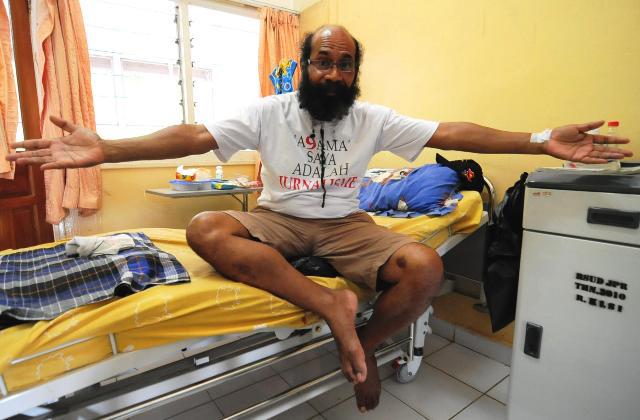
Jefrai Murib has serious medical problems but is not getting the treatment he urgently needs

JUBI, 23 May 2012
The hospital in Jayapura where Jefrai Murib has been getting treatment has been creating difficulties regarding the medical treatment needed by this political prisoner.The chairman of BUK, Bersatu Untuk Keadilan – United for Justice – Peneas Lokbere said that to continue his treatment, he should have been examined again by the doctors on 22 May,  and would need to undergo a course of physiotherapy  and be given medicine that he needs for the paralysis  which has affected  the right side of his body.

According to Lokbere, when he went to the hospital for the treatment he required, he was not allowed to enter the hospital and was told that the doctors who should have been treating him had finished their work at the hospital for the day and had gone home. This happened on two days running and then he was told that he should go to the General Hospital for treatment.

Because of this, said Lokbere, Jefrai had been unable to get the necessary treatment.

He also said that they had asked the prison where  Jefrai is being held to cover the costs of the treatment required, but had failed so far to get the prison to respond to this request. Jefrai has lost the ability to move the right side of his body but was not getting the medical treatment that he urgently requires.

On the following day, 24 May, JUBI reported that Lokbere and his colleagues had decided to try to raise money to cover the costs of Jefrai’s treatment, by asking  for money from people in the streets.

Lokbere said that they were having to do this because the costs of the treatment were currently having to be borne by the prisoner’s family.

Other political prisoners such as Filep Karma and Ferdinand Pakage were also in need of treatment so attempts to raise money for them would have to start as soon as possible.

As regards the condition of Jefrai, the doctors have said that his is an emergency case.He needs treatment for eight hours a week and his condition must be regularly checked by the doctors. ‘He needs help very quickly,’ said Lokbere because his is an emergency case.

—————–
JUBI, 24 May

Jefrai’s lawyer refused entry to meet Jefrai

A doctor who is treating the political prisoner Jefrai Murib ordered Cory Silva, a lawyer acting for the prisoner, to leave the premises of the hospital. The lawyer  had intended to  ask the doctor at the hospital  to make the necessary arrangements for the political prisoner to get the medical treatment that he needs.Examination by doctors had confirmed that Jefrai Murib has high blood pressure and blood clots (this is surely DVT – deep vein thrombosis, caused by excessive periods immobile – Tapol) after having been examined by a team of doctors. ‘The right side of his body is completely unable to function,’ she said. The doctor has suggested a course of physiotherapy for him as the condition had been present for a long time. The doctor said that treatment was urgent in order to prevent the blood clots from spreading to other parts of his body.

His doctor has also approached a physiotherapy specialist, Fernandes who suggested a course of treatment.When Peneas Lokbere tried to make contact with the physiotherapist, he was told that he was not available at the time and the prisoner would need to go elsewhere for treatment. but they had been unable to make contact with a physiotherapist.

When the lawyer was eventually able to contact the specialist, he was told by Fernandes that he should go to the General Hospital. Cory Silva wa criticised for trying to interfere with the prison management ans was ordered to leave the premises.The doctor also said that it was up to the prisoner’s family to handle of the case.

Cory Silva said that  what the doctor had said was quite inappropriate because it was the duty of the prison where Jefrai was being held to take full responsibility for Jefrai getting the necessary treatment.

Peneas Lokbere insisted that it was the responsibility of the doctor at the  prison to make the necessary arrangements and if he was refusing to do so then he should be replaced so as to make sure that the treatment needed by Jefrai could be started as soon as possible

Another of Jefrai’s lawyers, Yusman Conoras  complained that the doctors at the prison clearly had no understanding of the human rights aspect of this matter.  He said that it was the responsibility  of  the prison authorities  to provide the proper treatment for those who are being held in the prison Moreover, a prison should be giving guidance to the people being held in the prison and not just trying to punish the prisoner.

JUBI  reported that as yet, no comment had been forthcoming from the doctor in question.

[Translated and summarised by TAPOL]

Selpius Bobii disappeared briefly by prison authorities objecting to music rehersal

May 3, 2012

by West Papua Media sub-editors*

As preparations were underway for mass non-violent demonstrations across West Papua on Monday, 30 April, an incident occurred simultaneously inside Abepura prison between prison guards and inmates. Local stringers informed West Papua Media that Selpius Bobii, one of the ‘Jayapura Five’ political prisoners (and organisers of the Third Papuan People’s Congress) had a verbal confrontation with a prison officer during lunch time, after prison officials refused his permission for a music rehearsal.

“The incident occurs between prisoners and prison officers April 30th, 2012”, said Gustaf Kawer, legal representative of  the ‘Jayapura Five’  political prisoners.

A simple misunderstanding escalated into armed prison security forces sweeping and raiding inmates’ cells on Monday evening.  West Papua Media was notified through local stringers on Tuesday that around 10pm, Monday, West Papuan local time, Selpius Bobii was taken out from his cell and taken away. Simultaneously, sweeping was carried out inside the prison that left several inmates bruised and beaten, and all inmates locked down indefinitely in isolation in their cells.

The West Papua Media team made direct contact on Tuesday night to the ironically named Head of Abepura Prison, Liberty Sutinja.  Mr. Sutinjah said he “was not at liberty to speak over the phone due to (prison) protocol.”

West Papua Media rang Mr Sutinja again today, Thursday, 03 May 2012, around 11am local time but he refused to speak and switch off his mobile phone after the third attempt.

Mr. Kawer further mentioned that as of Monday, from May 1 to 7, 2012, visits and access to prisoners – including Mr. Yaboisembut and Mr. Waromi – from families, clergy and lawyers are effectively closed.

Kawar urgently calls for the Regional Office and Human Rights Office of Papua Province to open up access to the detainees in accordance with applicable laws and regulations. The regulations regarding visits outlines the terms and procedure guaranteed for prisoners rights to have access and visits whilst in prison.

Article 1, paragraph 32/1999 states that, “every prisoners and juveniles are entitled to receive visits from family, legal counsel or other or appointed person”.

Since Tuesday, unconfirmed reports sent to West Papua Media via SMS are stating that Selpius Bobii was believed to be transferred to Polda Papua – Papua Regional Police prison.

As this article went to press, information was provided by credible legal sources to West Papua Media that Selpius Bobii will be taken back to Abepura prison tomorrow, Friday, 04 May, 2012. According to the source, activities should be back to normal and prison visits from families are reinstated as of 3 May 2012.

westpapuamedia

*West Papua Media’s Editor is away recovering from serious health issues.

Beata Yaboisembut Akim: The woman who accompanies the ‘President’

Suara Perempuan Papua, 25 March – 7 April 2012

[Translation by TAPOL]

Opinion

Surrendering their lives to God, they remain calm when they face trouble

It was during the week of Christ’s sufferings that Forkorus Yaboisembut was found guilty of treason and sentenced to three years imprisonment. His wife, Beata Yaboisembut was at his side throughout the trial. Dressed in dark brown trousers and a blouse, she sat in the courtroom, calmly following the proceedings. She accepted the result with a feeling of relief.

‘Bapak was always telling us to keep calm. We should not feel troubled and feel grateful that our children are already grown up and can understand what is going on. And please remember that this is the week of suffering and we must all think about the sufferings of our Lord.

Lord Jesus suffered much more than this for our sins. And you must be willing to accept my sentence, said Forkorus’. As a mother and as his wife, she expressed her belief in him.

She first met her husband when they were studying together at the Taruna Bakhti Waene College. They were among the first generation of students at the college and graduated in 1975.After graduating, they were both sent to isolated places in West Papua. Mama Beata was sent to Wamena and Forkorus was sent to Sarmi. In 1976, they decided to get married in Jayapura and after getting married, they each returned to their jobs. Mama Beata was given a job at the Oksibil YPPK primary school and worked there for three years.  She was then sent to Sobron, after the kampung where she was working was attacked.

After her husband became active in the Papuan Customary Council (DAP), Mama Beata saw this as a huge responsibility that was to be borne by him.’Bapak is an Ondoafi, part of our tradition and enjoying the trust of the people. He is greatly respected and loved by the people, just like us, his wife and our children.’

He was the third of six siblings. His two brothers are not with him in Sobron. Forkorus also has two younger brothers and a sister who all live in Nabire.

After being elected as the Chairman of DAP, Beata realised that he no longer belonged just to her but belonged to all the Papuan people. ‘This is why Bapak has always told his children to stand on their own feet.’

As his wife, she realised that his election as the chairman of DAP would have many consequences for herself and for their children which is why he has always stressed the importance of their living their own lives independently.

Fortunately, only two of their children are still studying at Cenderawasih University while their oldest daughter is an expert in civil technology, and the sons have completed their studies in architecture. ‘The youngest is now at sixth grade while his older brother should have graduated last month on 15 March. But never mind, as Bapak is now on trial, his needs are our priority.’ Her daughter’s husband has to rely on the wage he earns as a teacher. As for her own husband, he has not been earning anything since last year.

‘I was not there to see Bapak when he was arrested because I had just returned from Sobron.’  She was preparing food for the [Third Papuan People’s] Congress but before anyone could start eating, the security forces destroyed everything that they had prepared.

When she and the other women heard gunshots and saw tear gas bombs exploding, they ran to the mountains around the Zakeus Field. ‘People can be arrested at any time and I was told never to get worried. On that day,’ she said ‘I tried to keep calm and to find my way home to Bapak so that I could be together with him at all of the court hearings while keeping calm.’

‘Forkorus has always told our children to focus on their education and not to follow him on his chosen path. But the children are always deeply concerned about what is happening to him and they always accompany me when I visit him in prison. I know that they readily accept what is happening to their father. Maybe this is the path chosen by our Lord for this country of ours,’ she said.

During the trial, Bapak stayed overnight at the lodgings of their daughter who lives in Waena. It is a small room, 3 x 4 meters, where the three of them slept. Their home in the kampung is being looked after by Mama. The youngest daughter frequently goes back and forth to visit their grandmother. Because their home in Sobron is 80 kilometres from Abepura, Mama decided to stay with her daughter so that it would be easier for her to visit her husband.

She said that during the time she has been attending the court hearings, neither she nor the children have experienced any terror or intimidation. ‘And Bapak is always telling us to keep calm.’

She visits her husband three times a week, on Monday, Wednesday and Saturday. ‘We are only given 15 minutes to sit together, side by side.

That is quite enough for me,’ she says, ‘because I know that the Lord is there with him.’

She is still busy teaching grade 1 and 2 children at the primary school in Sobron. When she visits her husband, she takes him food and clean clothes. ‘As he is not alone in the prison, I always take food for the other prisoners as well.’

She says that her husband is not fussy about the food she brings, as long as she cooks it. She takes him porridge, vegetables and fish and on special occasions, she cooks him some meat. Ever since he has been in prison, Forkorus has never asked her to bring anything. ‘In fact, when I meet him, he always has a present for me, as well as giving me his dirty clothes to be washed,’ she said, with a laugh.

She can also visit him on Sundays but only to take part in a service together. She is not allowed to take anything except a Bible. They have services twice a day, once in the morning at 8am for the Protestants and once in the evening for the Catholics.

Mama always arrives at 7am to say prayers together with her husband.

Sometimes he asks her to stay for another prayer, after her visit to him has ended. so that she too can receive the body and blood of the Lord, Jesus Christ during the Holy Eucharist as she has continued to be a Catholic.

Mama Beata is the third of six brothers and sisters from Kampung Yuruf Keerom where the majority of the people are Catholics. In December, she will be 59 years old. Because of unsatisfactory conditions in the kampung, the people have been forced to move frequently. Only one of her sisters is still living in Yuruf while one of her brothers died in Vanimo. The two other brothers are living in Vanimo.

‘Prayer is the source of our strength. Everything we achieve, all our happiness and sadness  are part of our lives and my family leaves everything to the one who gives life, to the Lord God Creator of all,’ she said, when she was asked what her future plans for her family were.

This is the first in a series of articles by Suara Perempuan Papua commissioned by TAPOL on the impact of the Papua conflict on women

AMNESTY INTERNATIONAL: PRISONER’S MEDICAL TREATMENT PREVENTED

PRESS RELEASE
http://www.amnesty.org/en/library/info/ASA21/017/2012/en
UA: 109/12 Index: ASA 21/017/2012  Indonesia        
Date: 19 April 2012
AMNESTY INTERNATIONAL
URGENT ACTION
PRISONER’S MEDICAL TREATMENT PREVENTED
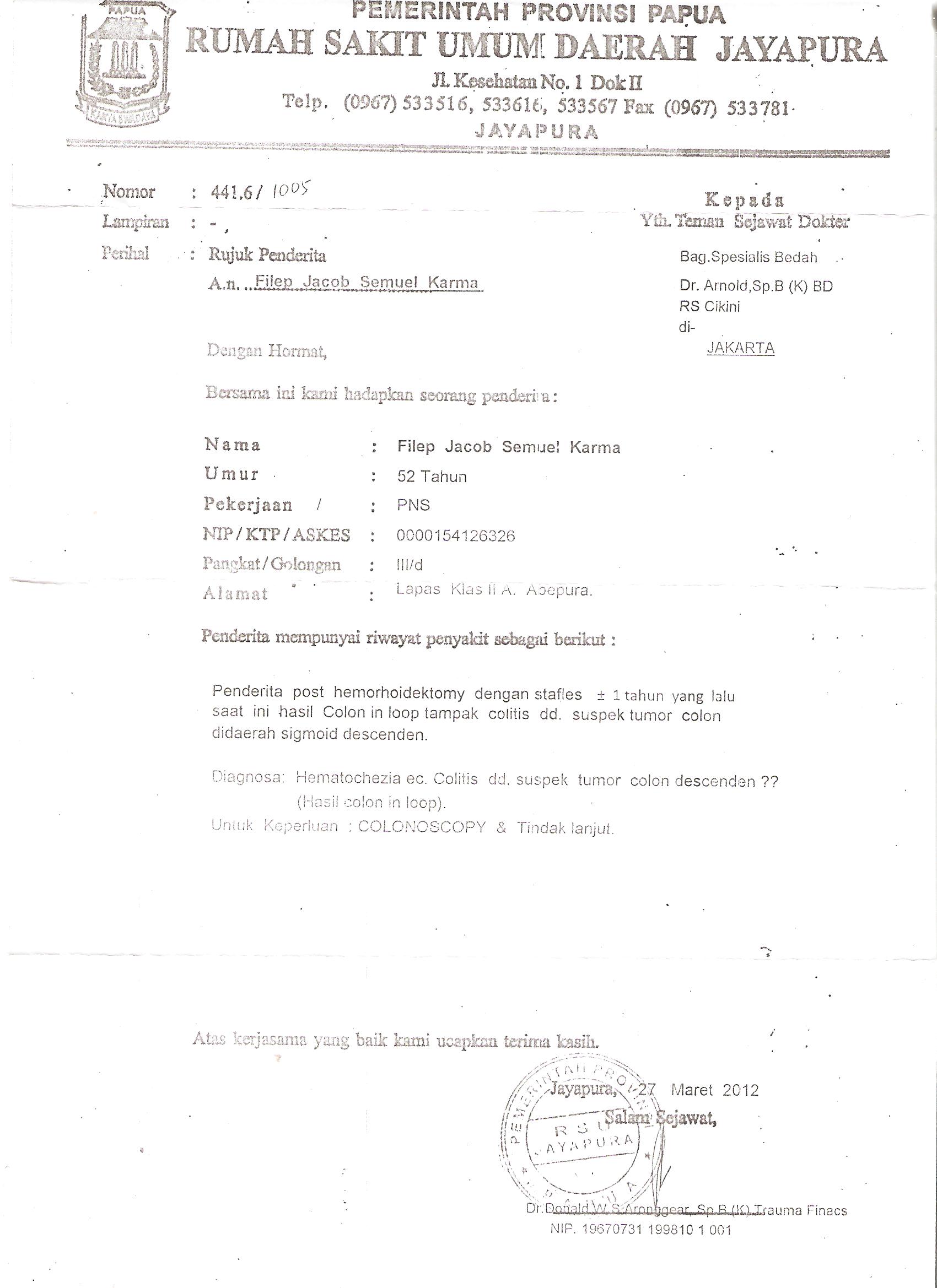
Indonesian prisoner of conscience Filep Karma is in urgent need of medical treatment. He needs to travel to receive this treatment, but the prison authorities have refused to pay for his transport and medical costs.Filep Karma is serving a 15-year sentence at the Abepura prison in Papua province for raising a banned regional flag. Doctors at the Dok Dua hospital in nearby Jayapura conducted a medical examination last month and suspect a tumour of the colon. They have confirmed that he requires a colonoscopy and follow-up treatment. However the necessary equipment is not available in Papua province and they have referred him to the Cikini hospital in the capital, Jakarta. The Abepura prison authorities have given permission for Filep Karma to travel to Jakarta, but they have refused to cover the cost of his medical treatment and travel. By law, all medical costs for treatment of a prisoner at a hospital must be borne by the state (Regulation No. 32/1999 on Terms and Procedures on the Implementation of Prisoners’ Rights in Prisons).

Filep Karma has suffered a number of medical problems in detention, including bronchopneumonia, excess fluid in the lungs and a urinary tract infection. In July 2010 he was sent to a hospital in Jakarta for prostate surgery and other care. In November 2011 he was transferred to the Dok Dua hospital in Papua for an operation after he experienced bleeding haemorrhoids, chronic diarrhoea and blood in his stool. He has continued to pass blood in his stool since the operation. Filep Karma is also undergoing physiotherapy for an injury to his hip bone from a fall he suffered in detention in 2006.

Please write immediately in English, Indonesian or your own language:
– Urging the authorities to ensure that Filep Karma receives full and immediate access to any medical treatment he may require;
– Urging them to cover the cost of such treatment in accordance with the UN Body of Principles for the Protection of All Persons under Any Form of Detention or Imprisonment (Principle 24) and Indonesian regulations;
– Calling on them to release Filep Karma, and all others prisoners of conscience in Indonesia, immediately and unconditionally;
– Urging them to ensure that prison conditions and the treatment of prisoners meet standards provided for in Indonesian law as well as UN Standard Minimum Rules on the Treatment of Prisoners.

PLEASE SEND APPEALS BEFORE 31 MAY 2012 TO:
Head of Abepura Prison
Liberty Sitinjak
Lembaga Pemasyarakatan (Lapas) Abepura
Jl. Kesehatan 11, Jayapura
Papua 99351, Indonesia
Fax: +62 984 24721
Salutation: Dear Liberty Sitinjak

Head of Papuan Provincial Department of Justice and Human Rights
Daniel Biantong
Jl. Raya Abepura No. 37,
Kotaraja – Jayapura 99117,
Papua, Indonesia
Fax: +62 967 586112
Salutation: Dear Daniel Biantong

And copies to:
Director General of Prisons
Drs. Untung Sugiyono
Ministry of Justice and Human Rights
Jl. Veteran No. 11
Jakarta Pusat
Indonesia
Fax: +62 21 3483 2101
       

Additional Information

Filep Karma was arrested on 1 December 2004 after taking part in a peaceful ceremony in Abepura, Papua province. He was among approximately 200 people who took part in the ceremony during which the banned “Morning Star” flag, a symbol of Papuan independence, was raised. He was charged with “rebellion” (makar) under Articles 106 and 110 of the Indonesian Criminal Code, and sentenced to 15 years’ imprisonment on 26 May 2005. His sentence was upheld by the Supreme Court on 27 October 2005. Amnesty International considers him to be a prisoner of conscience.

In November 2011 the UN Working Group on Arbitrary Detention (WGAD) declared Filep Karma’s detention to be arbitrary on the grounds that he was imprisoned for the exercise of his rights to freedom of expression and peaceful assembly – Opinion No. 48/2011 (Indonesia). These rights are guaranteed in the International Covenant on Civil and Political Rights (ICCPR), to which Indonesia is a state party, and in the Indonesian Constitution. The WGAD also found Filep Karma’s detention to be arbitrary because he had been subjected to an unfair trial. Article 14 of the ICCPR guarantees the right to a fair and public hearing by a competent, independent and impartial tribunal established by law.

The Indonesian authorities have an obligation under national law and standards to provide medical treatment to all prisoners in the country. Article 17 of the Indonesian Government Regulation No. 32/1999 on Terms and Procedures on the Implementation of Prisoners’ Rights in Prison requires the prison authorities to provide adequate access to medical treatment. International standards also provide for medical treatment for prisoners. The UN Standard Minimum Rules for the Treatment of Prisoners provides that prisoners needing treatment not available in the prison hospital, clinic or infirmary should be transferred to an appropriate institution outside the prison for assessment and treatment. Principle 24 of the UN Body of Principles for the Protection of All Persons under Any Form of Detention or Imprisonment requires that prison authorities cover the costs of such treatment.

In view of the potentially serious nature of Filep Karma’s medical problem, Amnesty International believes the authorities’ refusal to arrange prompt and appropriate examination and medical care for him could amount to cruel, inhuman or degrading treatment.

UA: 109/12 Index: ASA 21/017/2012 Issue Date: 19 April 2012


Filep Karma referred to Jakarta hospital with a suspected colonic tumour: NKRI refuses to pay

from West Papua Media’s correspondent at Abepura Prison (with Eds)

April 16, 2012

Filep Karma referred to Cikini hospital in Jakarta

Papuan political prisoner Filep Karma, in prison for 7 years on treason charges after raising the banned Morning Star independence flag, has been referred to Cikini hospital in Jakarta for three months to undergo medical treatment.

However he must undergo treatment in Jakarta, because Dock 2 hospital in Jayapura lacks colonoscopy equipment to diagnose the condition of Filep Karma. Healthcare in Papua is poorly funded and supplied, if at all, and health workers are rarely paid properly.

Hospitalised in Jayapura’s Dok 2 hospital since 2008, FIlep Karma has been gaoled in atrocious conditions and subjected to early routine torture by Indonesian security forces and prison officers, including beatings causing internal injuries.  His health has been declining since 2008 due to numerous hunger strikes and illness caused by prison conditions in Abepura prison.

Karma has been complaining of a lump in his gut over the last 3 years. Since an operation was performed on 2 November 2011, Karma has continued to pass significant blood in his stools.

Karma has been referred by the Dok 2 Head of Trauma to the Department of Surgery Specialist, Dr D. Arnold, Sp.B (K) BD, in Cikini. Filep had already been undergoing treatment in Jakarta separately for his prostrate. On 13 April 2012, Dr Hidayathu Samawi, the general practitioner in Abepura prison, called Karma to his rooms. Dr Hidayathu said that Karma must provide a letter of permission from the family to consent to the treatment of Jakarta, and the Letter to commit the family to bear the full cost of treatment and transport to Jakarta.

Karma in this case ask for the Abepura Prison to issue a letter that the prisons are not able to bear the cost of treatment in Jakarta, but Dr. Hidayathu said that the prison would not certify its refusal to bear the cost of treatment in Jakarta.

During prison visiting hours at Abepura, Filep Karma told West Papua Media’s correspondent, “I was detained by the State of Indonesia, for 15 years, why are they unable to bear the cost of my treatment in Jakarta.  My case in July 2010, it was the same, treatment not covered by the State.  Abepura prison officials alone cannot issue a statement that they can’t afford the cost to Jakarta, yet I hardly have the foundation (strength) to have resort to outside solidarity as my only choice to help me for medical expenses to Jakarta,” said Karma.

The Indonesian government has an obligation to provide adequate healthcare to political prisoners.  According to Amnesty International, under Indonesian Government Regulation No. 32/1999 on Terms and Procedures on the Implementation of Prisoners’ Rights in Prisons, all medical costs for treatment of a prisoner at a hospital must be borne by the state, also in accordance with the UN Body of Principles for the Protection of All Persons under Any Form of Detention or Imprisonment (Principle 24) .

In late February, in response to a petition filed by Freedom Now, the United Nations Working Group on Arbitrary Detention issued its opinion that the Government of Indonesia is in violation of international law by detaining Filep Karma. Amongst many other international voices, the Working Group called on the Government of Indonesia to immediately release the human rights advocate.

westpapuamedia


Image

Create a website or blog at WordPress.com

Up ↑