Deadline of 22 March for DPRP to return OTSUS

Bintang Papua, 8 March 2011

[Abridged in translation,]

Several hundred people attended a demonstration in Jayapura on Tuesday 8 March, mostly from the Central Highlands Students Association, urging the provincial legislative assembly, the DPRP, to convene a special session to declare that OTSUS (the special autonomy law) has failed and that it should be sent back to the central government at the latest by 22 March this year.

The demo coordinator Selpius Bobii said that OTSUS had been a complete failure, it should be repealed and the MRP should be disbanded. The government should respond without delay to the eleven recommendations made last June and foreign countries should stop providing money to support OTSUS.

The churches should withdraw their members from the second-term MRP now eing formed. He also called for a halt to all investments in Papua which are exploiting its national resources, including Freeport, MIFEE, the Degeweo mining company, Ilaga and PLTA construction works.

There was also a call to the Pope in the Vatican and the World Council
of Churches in Geneva to pay attention to the serious problems in West Papua in order to save the people from annihilation. The Papuan people and supporters abroad should organise large demonstrations from 22 to 24 March, calling on the executive and legislatures in Papua and West Papua to return OTSUS to Jakarta.

A spokesman for the National Committee of West Papua, KNPB, called on the younger generation of Papuans to show the world that they want freedom. ‘Since Papua became part of Indonesia, there has only been bloodshed, oppression and killings everywhere in Papua,’ he said. Other speakers spoke in the same vein.

Some members and leaders of the DPRP met representatives of the
demonstrators afterwards.

The chairman of Commission A of the DPRP, Ruben Magai said that the
blame for the failure of OTSUS rests with the executive and that the
DPRP has no powers to take decisions to affect the situation.

The demonstrators also took their demands to the governor of the province.

Selpius Bobii also read out a statement saying that they would boycott
the elections now under way for mayor and governor if the national
parliament does not respond to these aspirations. They also threatened to occupy the office of the governor if these demands continue to be ignored. He said that they would wait till 4 April, at which time they would occupy the governor’s office, a statement that was responded to very enthusiastically by the demonstrators.

The Indonesian Government: closing window for peace in West Papua

This article originally appeared at
Jason MacLeod

Just as Indonesia’s president Susilo Bambang Yudhuyono was being feted globally for being a democrat, the Indonesian government was entrenching Papua’s reputation as Indonesia’s last bastion of authoritarian military rule. Now Peace Brigades International has finally been forced out.

The latest casualty in the Indonesian Government’s efforts to seal off West Papua from international scrutiny is Peace Brigades International (PBI). In January this year the international non-government organisation was finally forced out of Indonesia. Since 1981 at the invitation of local people, PBI has been providing unarmed protection to human rights defenders at risk in conflict zones around the world. International accompaniment is literally the embodiment of the international community’s concern. The presence of internationals increases the cost of attacking human rights workers and expands the political space for local activists. All this is made possible by an elaborate communication network. PBI staff meet with local police and military personal as well as their superiors in regional and national capitals to let them know exactly who is being accompanied. This acts as a deterrent. The PBI volunteers are the eyes and ears of the international community, communicating the human rights situation on the ground to an international network of governments and civil society actors. It is a tried and tested approach that has worked in places as diverse as El Salvador, Guatemala, Colombia, Haiti, Sri Lanka and Nepal.

Members of the PBI Indonesia Project were invited by Acehenese activists to accompany them through the darkest days of martial law. Acehenese civil society organisations like Flower Aceh and Koalisi HAM (the Human Rights Coalition) were able to continue their work because of PBI protective accompaniment. It gave local workers a sense that the international community cared about their situation and sent a clear message to the Indonesian army that they were being watched. PBIs protective accompaniment helped expand the space for peace in Aceh in the lead up to the historic Helsinki Peace Agreement. But in West Papua, home to Indonesia’s longest running separatist conflict, the world’s oldest international nonviolence organisation has finally met its match. After years of harassment from the Indonesian security forces the PBI Indonesia Project was closed down.

My colleagues and I helped set up the PBI West Papua project in 2003. I left the organisation in 2004 but kept in close contact with many of the organisers and staff members. One of the reasons PBI responded to an invitation from Papuan human rights defenders was because for years the Indonesian government has closed off access to West Papua to humanitarian organisations, journalists and even diplomats. It is important that Papua is opened up to the international community if human rights are to be addressed. But while the rest of Indonesia moved towards greater democracy, Papua slid back into an authoritarian backwater ruled by the Indonesian security forces as if it was their own private fiefdom. Since PBI established a presence in West Papua Amnesty International, Human Rights Watch, the Dutch NGO CordAid and even the Red Cross have all been denied access. This level of hostility by a State to international scrutiny of a human rights situation is unusual. Even during the height of apartheid, the South African government permitted the Red Cross access to political prisoners. Not so in West Papua.

Prior to being forced out of West Papua, PBI was the only international human rights organisation with a permanent presence in Indonesia’s restive Pacific periphery. A group of long-term international volunteers based in Jayapura, the capital and in Wamena, in the troubled highlands, provided unarmed protection for Indonesian and Papuan human rights defenders and monitored the situation on the ground. PBI helped protect human rights defenders and lawyers trying to expose police brutality during the ‘Bloody Abepura’ trial in 2004. PBI also protected Papuan human rights defenders who were investigating the security forces after they cracked down on Papuans in the wake of the March 16 2006 blockade of the main road outside the University of Cendrawasih in Jayapura.

PBI is governed by a strict mandate. The organisation only supports unarmed actors, they do not take sides and they do not tell Papuans how they should run their struggle. Despite this the Indonesian government was petrified of PBI. I experienced this personally. When I was taken in for questioning in West Papua in 2007 after observing a demonstration in Papua, the very first question the Indonesian police intelligence agent asked me – even before enquiring whether I was a journalist or spy – was “Are you PBI?” By then I had left the organisation but it revealed the depth of the intelligence services concerns about PBI.

Almost from the moment PBI started work in West Papua the Indonesian government acted to restrict PBI’s access and ability to work. In 2009 the organisation was pressured to close the Wamena office in West Papua’s remote highlands, the scene of frequent human rights violations by the Indonesian military. PBI staff were refused permission to work as the police and intelligence services launched an official investigation into the organisation’s status. National Indonesian staff started to receive threatening phone calls. They felt increasingly vulnerable.

By late 2009 all one-on-one protective accompaniment had ceased. In an effort to stay in Papua protective strategies were reduced to regular check-in calls with PBI clients who felt threatened by state security forces. Then on 30 July 2010 Ardiansyah Matra’is’s naked, handcuffed body was found in the River Gudang Arang. His arm had been tied to a tree to prevent his body from floating downstream. Matra’is was a journalist working for Papua’s only national independent paper, Jubi. Matra’is had been critical of illegal logging operations run by the Indonesian military in Merauke and had taken photos of their activities. Matra’is was also a PBI client. His murder was the first time in Indonesia that a current PBI client had been killed.

The writing was on the wall: PBI was no longer making space for peace in Papua. In fact the opposite was happening. The Indonesian government was closing space for peace in Papua, and PBI appeared powerless to halt the slide into greater military impunity. Just as Indonesia’s president Susilo Bambang Yudhuyono was being feted globally for being a democrat, the Indonesian government was entrenching Papua’s reputation as Indonesia’s last bastion of authoritarian military rule.

But the Indonesian government’s restriction of access to West Papua is not just confined to grassroots international nonviolence organisations. Jakarta is even willing to snub the US government. In late 2010 the US Ambassador, Scott Marciel asked the Indonesian government if staff from the Embassy could observe the trial of three soldiers involved in torturing Papuan civilians. The torture, which including burning a man’s genitals with a stick, was filmed on a mobile phone camera and leaked to transnational human rights networks. When the footage was uploaded on to YouTube and featured on domestic and international news networks it generated massive moral outrage not just internationally but inside Indonesia as well. When the trial went ahead last month, Mr. Marciel was notified by the Indonesian government only 24 hours beforehand, not enough time to apply for a surat jalan, a letter of permission to travel to West Papua required by the Indonesian government. It was not an official denial from the Indonesian government but it may as well have been.

The Indonesian government is blocking access for all those who want to shine a light into West Papua. The problem for the Indonesian president, Susilo Bambang Yudhuyono is that he has allowed the Indonesian intelligence services to dominate decision-making processes in West Papua. The intelligence services determine who gets access into West Papua and who does not. They are the ones who assess the applications of foreign NGOs, journalists and even diplomats who want to travel to West Papua. Access to West Papua should be subjected to the rule of law and not to surveillance principles. If democracy and rule of law was present in West Papua, the surat jalan regime would be abolished altogether.

The Indonesian government cannot have it both ways. The human rights situation in West Papua cannot be fine while at the same time the Indonesian government and its intelligence and security forces insist the territory is off limits to foreigners. Either human rights are respected in West Papua or they are not. The closure of PBI in Indonesia only sharpens the international community’s perception that the Indonesian government has something to hide in West Papua.

Jason MacLeod worked for the PBI Indonesia Project from 2000 to 2004. He teaches civil resistance at the University of Queensland.

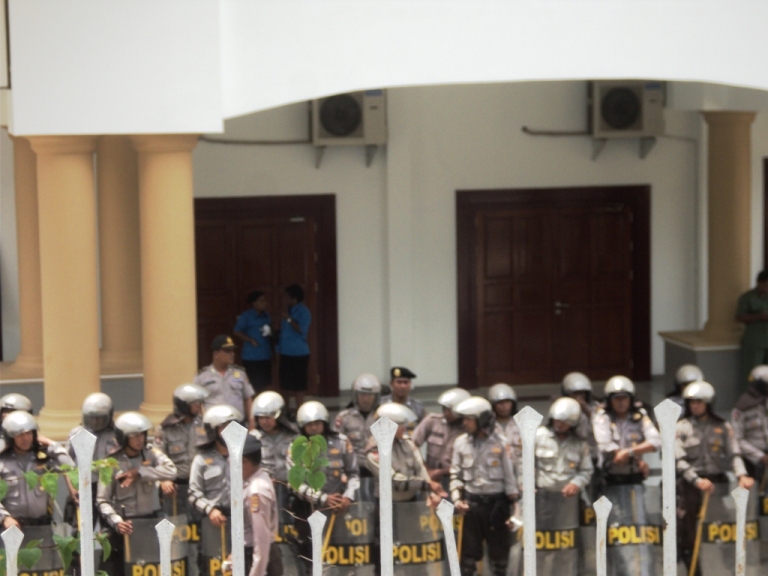
Medical personnel arrested in Jayapura for ‘inciting strike’

Bintang Papua, 15 March 2011

[Abridged in translation into English]

Eight nurses and midwives have been arrested in Jayapura for their
involvement in a strike that resulting in a halt to services at the
general hospital in Jayapura. They face charges of inciting their
colleagues to take part in a strike.

[See earlier reports about the strike of medical personnel who were
protesting against the failure of the authorities to pay incentives that
had been promised more than a year ago.]

The eight persons are being held by the criminal investigation unit of
the Papuan police command. The police claim that there is sufficient
proof that the persons had acted in violation of the law, forcing others
to engage in acts of violence and citing a number of articles in
Indonesia’s criminal code. Media attempts to contact the police for
confirmation of the arrest were unsuccessful.

According to Anum Siregar, one of the lawyers acting for the eight, a
group of fifty personnel from the security forces had gone to the homes of two of the persons and told them that they must report to police headquarters in Papua. The two women, Leni Ebe and Popi Mauri, then contacted the lawyer to inform her of what had happened. The two women then reported to the police as requested, in the company of the lawyer.

The two had earlier received notification from the police that they
would be summoned as witnesses in connection with the strike action of the hospital personnel.

According to Anum Siregar, after being questioned for several hours by
the police as witnesses, the police changed tack and indicated that they were being held as suspects. Soon after, the police took the six others into custody.

According to Bintang Papua, the eight detainees have been subjected to prolonged interrogations while other personnel from the hospital have rallied in support of their colleagues. Anum Siregar accused the police of acting in violation of the rule of law, saying that the medical
personnel were only acting in defence of their legitimate rights. She
also said that the action by the police would have a negative effect on the provision of services for patients at the general hospital.

‘The impact will not be felt by officials in the province because they
never go to the local hospital for treatment on occasions when they fall ill but fly to Jakarta or overseas for treatment.’

She also said that the arrests had led to expressions of solidarity from
members of the medical profession throughout the Land of Papua in
protest against the actions of the police.

Papuan churches call for dialogue mediated by third party

Bintang Papua, 11 March 2011

The leaders of a number of churches in Papua have called on the central government to hold a dialogue with indigenous Papuans, stressing that it should be mediated by a neutral third party and held without conditions.

A press release issued by Rev. Benny Giay of the KINGMI Church, Rev
Socratez Sofyan Yoman of the Alliance of Baptist Churches in Papua and the deputy chairman of the GKI Synod, Drs Elly D. Doirebo said:

We church leaders in Papua hereby announce to our congregations and to the general public that we have informed the central government about our rejection of OTSUS (Special Autonomy law) for two consecutive weeks (13-18 February and 28 Feb-3 March). We need to convey a number of important facts as follows:

First, the failure of OTSUS has been acknowledged not only by the
Papuan people but also by the executive and legislature of the central
government, as well as by foreign diplomats and civil society figures
who we met in Indonesia who have been paying close attention to the
development of the Papuan people.

A number of government functionaries who we met at the centre have
blamed government leaders in the Land of Papua as being responsible for the failure of OTSUS.

We do not believe that this is true. The failure of OTSUS reflects the
lack of political will and seriousness on the part of the central
government to do anything to promote the development of the Papuan
people. We made this clear in the Theological Declaration of Papuan
Churches on 26 January 2011 when we said that the central government has failed to promote the development and welfare of the indigenous Papuan people.

Second, bearing in mind that all sides recognise that OTSUS has failed, we continue to urge the government at the centre as well as in the Land of Papua to immediately announce that the swearing in of a second-term MRP will be abandoned because it lacks aspiration and has no firm legal basis. We regard the efforts now being made by the central and regional governments to set up a second-term MRP as arrogant and as a move to force through their will which can only intensify the conflicts between the Papuan people and the Indonesian Government.

Third, we continue to be guided by the people of the Lord who continue to urge the Indonesian government to hold a dialogue with the Papuan people facilitated by a neutral third party, without conditions.

We are well aware that the government of President Susilo Bambang
Yudhoyono was successful in the dialogue it held with the Acehnese
people and that the same can be achieved with the Papuan people.

Dialogue is the most dignified, peaceful and democratic way which has
been widely accepted by the international community as the model for the resolution of conflicts that have occurred in other parts of the country.

Fourth, we reject the creation of UP4B, the Unit for Accelerating
Development in Papua and West Papua, as well as all talk about
‘Constructive Communications’, the aim of which is to conceal the
failure of OTSUS and to obscure the Papuan people’s demand for dialogue.

There should be prior consultation with the Papuan people about all
measures taken by the state for Papua which should be the result of
agreement between the government and the Papuan people.

Fifth, We reject all acts of intimidation and violence perpetrated by
the state in order to silence freedom of expression and democracy in the Land of Papua, such as the stabbing of the journalist Banjir Ambarita.

We therefore urge the police to carry out a thorough investigation of
that stabbing incident and to proceed with the case through legal
channels, in order to give the victim as well as the community in
general in the Land of Papua a sense of peace and justice.

Sokrates Yoman launches book titled ‘OPM’

JUBI, 12 March 2011

The Rev. Sokratez Sofyan Yoman has launched a new book titled: Otonomi, Pemekaran dan Merdeka [OPM] – Autonomy, Division and Independence. The 136-page book bears a sub-title: ‘Time to Speak the Truth in the Land of Papua’.

Speaking at the launch, the author, who heads the Alliance of Baptist
Churches in Papua, he said that he had taken the decision to write the
book as a calling from God. He said that when he meets his Maker and is asked what he has done and whether he should go to heaven or to hell, he would accept whatever would happen to him.

The book will cost Rp. 30,000 a copy but the author has decided not to sell it through the bookshops. ‘I will ask students to sell it so that
they can earn something from the profit they make selling it.’

Speaking at the launch of the book, Herman Awom said that the
significance of the book could be judged by the fact that past books of his have all been banned.

‘Why are his books banned by the Attorney-General? Because they speak about the experiences of the Papuan people, about their history, about the failure to uphold human rights in Papua and about the use of violence in Papua.’

Herman Awom said that this book was a way for Rev Yoman to deliver his sermons; not all the churches were willing to write in the way that he does. The title of the book in bahasa can be abbreviated to OPM.

Create a website or blog at WordPress.com

Up ↑
