Human rights violations in Papua are very high, according to a three-year survey

JUBI, 20 January 2012

[A photograph at the beginning of the article shows three little boys squatting in the street and inhaling aibon.]

The Papuan branch of Komnas HAM, the National Commission  on Human Rights, believes that violations of economic, social and cultural rights  in Papua are very serious  and can be described as gross human rights violations.

The commission’s chairman for co-ordination, Adriana S. Walli, has drawn together a great deal of information in her review of the prospects for economic, social and cultural rights in Papua which she presented at a Focus Group Discussion which was held in Jayapura on 20 January.

According to Adriana, repression and ECOSOC violations have been perpetrated on a vast scale during the past three years .’These violations are occurring on a daily basis and can be identified as gross violations. However, she said, they are brushed aside as being nothing more than trivia.

She went on to say that there were two indicators for why these violations continue to occur. The first was the prevailing view that these violations were trivial, and the second was the lack of commitment of the government and various related agencies.

While presenting her data, Adriana  said that when she was carrying out her investigations during the past three years, she had come across  a great number of ECOSOC violations, especially in health, economic rights and children’s rights.

She drew attention to the fact that in the various hospitals, little had been done to improve the facilities. Many of the personnel were harking back to Dutch times. The supply of clean water is inadequate while there has been a big increase in the number of street children. Many of these youngsters consume alcohol and sniff dangerous substances such as aibon; they also participate in free sex practices, take drugs and so on.

Small indigenous Papuan traders have great difficulty obtaining credit to grow their businesses while they still use traditional methods to handle their finances.

The chairman of the Papuan branch of Komnas HAM, the National Commission on Human Rights, Julius Ongge, told the gathering that the  government of the province of Papua  must be held responsible for the implementation of ECOSOC rights. When local people call for  their basic rights such as customary rights and their rights to education and health, it is obligatory for the government to respond but what in fact happens is that they come face to face with the security forces.

‘Whenever people make demands for their rights, they confront many alarming accusations  and often have to face lengthy legal processes even they have done nothing wrong,’ he said.

TPN/OPM letter:’We will never surrender’

JUBI, 7 January 2012

 John Magai Yogi and this troops


General John Magai Yogi, the leader of the TPN/OPM Makodam Pemka IV Division in Paniai, declared in a letter that they will not withdraw a single step in their operations against the Indonesian army and police which have been under way since August, 2011. He said that their struggle was a continuation of the struggle of their predecessors to achieve the aspirations of the people of West Papua.

‘We, the TPN/OPM throughout the Land of Papua, will never surrender and will continue to resist the forces of Indonesia  to the very last drop of blood,’ he wrote in the letter dated 5 January.’The only weapons we hold in our hands are Ukaa Mapega, bows and arrows, but we have pledged to God Almighty that we are ready to confront the Brimob troops of the Indonesian police and Densus 88, the elite forces of Indonesia, who are equipped with modern weapons and are at present in control of the district of Paniai’

He made two other points in his letter. The first is: The United Nations, the USA and the Netherlands  will soon be called to account for the mistakes they made in the past which sacrificed the Papuan people. And the second is:  The UN and the USA must speedily resolve the Papuan problem because this problem will never be resolved by means of bargains and Indonesian development activities in Papua.

‘We will never surrender. People living in the kampungs and near the  forests  are always deemed to be part of the TNP/OPM, even though they are just ordinary people. They [the military] are now chasing the TPN/OPM and we are not  free from military pressure in the forests of Paniai because the chief of  police has ordered a large number of  Brimob troops from Kalimantan and Densus 88 to come here and encircle our headquarters. They are threatening our lives. The troops that have been sent here are disrupting our tranquillity and are trying to destroy us, the TPN/OPM,’ he said in the letter.

He went on to write that since the encirclement and attack against their Eduda headquarters on 13 December 2011, members of the TPN/OPM division have held on to their position in the forests of Paniai. ‘This does not mean that we have surrendered.’

The letter concludes with the following words: ‘All people and groups have basic rights which must be respected by everyone, including the right to self-determination. This is the right  which we Papuan people demand from the UN who never listened when our rights were  trampled upon by the forces of Indonesia and the USA.’

Papuan People need not be afraid to talk about Independence

Bintang Papua,6 January 2011Papuans Needn’t be Afraid to Talk about Merdeka-Independence

Biak: A human rights lawyer and advocate has reminded the Papuan people that they needn’t be afraid  to talk about independence for Papua because independence for Papua is a basic human rights  that is legally recognised  and can be fought for by legal, democratic and political means. ‘I say this because  the 1945 Constitution guarantees these rights,’ said Yan Christian Warinussy, executive-director of LP3BH-Manokwari.

He said that the Universal Declaration of Human Rights and the UN Declaration on the Rights of Indigenous People also guarantee these rights. He went on to say that  Papua Merdeka  is the political aspiration of the majority of the Papuan people which must be fought for  by peaceful,dgnfied and democratic means through universal legal and political mechanisms. All components of the Papuan people should unite  and discuss the various developments that provide the background for these aspirations of the Papuan people and should reach agreement on the issues that they should discuss in the context of a Papua-Indonesian dialogue.

The aspiration for Papua Merdeka must be used as the basis in every discussion which should at all times be based on the basic issues that were  agreed upon at the Papuan Peace Conference held from 5 – 7 July 2011 which included political, security, legal issues as well as basic human rights, and social, cultural, economic and environmental rights. He said that these issues were drawn up as the necessary steps towards the Papua-Indonesia Dialogue, with a recommendation about five people as negotiators agreed upon at the people’s conference. A declaration on a peaceful Papua was also agreed  upon as the guidance at the Papuan Peace Congress which was held from 16 – 19 October 2011 in Zacheus-Padang Bulan field, Abepura. Forkorus Yaboisembut was elected as the head, with Edison Waromi as the prime minister and all this was adopted as the strategic position of the  Papuan people on their way forward to the Dialogue.

Other components that were included were the OPM, the Papuan Presidium Council, the West Papua National Coalition for Liberation, the West Papua National Authority, the National Youth Committee  the military wing, the TPN-PB, as well as other organisations in the Land of Papua and overseas*.   He expressed the hope that all these components would come together  and draw up an agenda for this struggle  in a systematic and responsible way, using legal and political mechanisms that are universally recognised. ‘Papuans need not be afraid to talk about their independence,’ he said.

{*West Papua Media note: this list of supporting organisations is referring to the Papua Peace Network meetings, and not to the 3rd Papuan People’s Congress at Zacheus Field: this Congress was not supported by all sectors of the resistance movement including the TPN-OPM and KNPB as they asserted it did not go far enough}

He also said that the Dewan Adat Papua – Customary Papuan Council – would be the people’s organisation that would unite all the various components in the Papuan struggle, in response to the aspirations of the Papuan people

He warned the security forces in the region not to stand in the way of the Papuan people or try to infiltrate the Papuan people in order to prevent them from freely using legal procedures and mechanisms  based on the 1945 Constitution and Law 39/1999 [on human rights] as well as other human rights documents in the course of their discussions on their political rights  in the Land of Papua.

Papuan Political Prisoners Released in FakFak

by Andreas Harsono

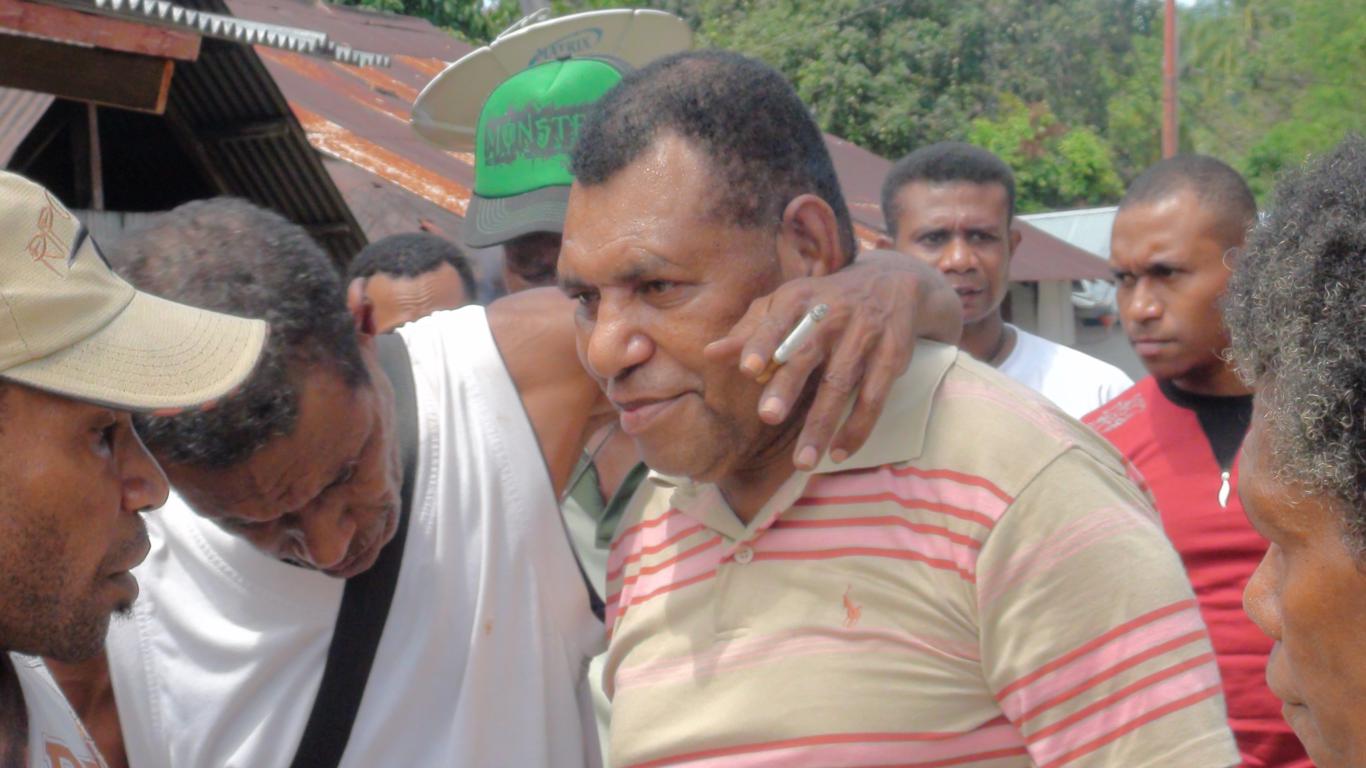
Simon Tuturop has finished his prison sentence in Fakfak. From outside the jail Tuturop said “Having been in prison for years doesn't mean that I will be quiet, instead prison was a place for study and self-reflection about how to build a struggle together with other brothers and sisters. Unity is the key” (Photo @Elsham Advocacy Team & Foker Fakfak)


Five political prisoners, imprisoned for raising the Morning Star flag on 19 July 2008 in front of the Fakfak Act of Free Choice building, were freed today. They were condemned to four years in prison by the Fakfak court and have now been released having served three years, five months and three days of their sentence.

Simon Tuturop, Tadeus Weripang, Benediktus Tuturop, Tomas Nimbitkendik and Teles Piahar were collected from the prison by Freddy Warpopor, the Fakfak Area Coordinator of Foker NGO Papua, and other friends by two minibuses and several motorbikes, according to a Foker NGO press release.

The group left the prison at 09:30. They went to the house of Eligius Warpopor, a community leader in Gewerpe Village, where they were greeted by the people of Gerwerpe. Simon Tuturop made a speech thanking the people of Gewerpe Village, as well as the Papuan Customary Institute (Lembaga Adat Papua), Elsham Papua, Foker NGO, LP3BH Manokwari, Amnesty International and the ICRC. He said that they had helped to greatly reduce their suffering in prison.

Simon Tuturop being welcomed by the people of Gerwerbe Village. Photo @Elsham Advocacy Team & Foker Fakfak

Simon Tuturop, originally from Fakfak, is a leading figure of the non-violent movement for Papua liberation. In 1982 he joined in a proclamation of West Papuan independence in Jayapura. He was sentenced to twelve years in Kalisosok prison, Surabaya. In 1998, as President Suharto fell, Tuturop and other political prisoners across the whole of Indonesia were set free. He then went to work in Aceh, to help with social projects for Achenese people who had become refugees of Indonesia’s war with the Free Aceh Movement (GAM)

On 19 July 2008, Tuturop led a flag-raising of the Morning Star flag where 44 people were arrested by Indonesian police. Five were found guilty by the Indonesian court in Fakfak and convicted of treason under articles 106 and 110 of the Indonesian criminal code. Elsham Papua, LP3BH Manokwari and Foker NGO Papua regard them as innocent prisoners of conscience who did not committed any violent acts. To express a desire for independence is part of the freedom to express political aspirations. It is not a criminal act. These three organisations continued to advocate for them and defend them.

Tadeus Waripang returns to his home in Kampung Wayati. Photo @ Elsham Advocacy Team & Foker Fakfak

The group then continued their journey to Wayati Village to bring Tadeus Weripang back home. The people of Wayati Village and the village chief were already waiting for Tadeus Weripang’s arrival.

Warpopor said, “It was a great welcome, despite the tumultous atmosphere. Some people shed tears.” Village chief Plerius Kondawe gave his thanks to the three organisations.

The villagers asked Freddy Warpopor to explain about President Susilo Bambang Yudhoyono‘s meeting with Papuan church leaders. Warpopor encouraged the villagers to pay attention to any developments which may arise. He said that President Yudhoyono “was already open to dialogue with the Papuan people.”

“Let’s all support this process, so that we can determine the right format that Papuans will later use in the dialogue, and another important thing is that this struggle is a non-violent struggle. Let’s unite to save the country and this land of Papua,”said Warporpor.

Posted by Andreas Harsono

Translated by Tapol

http://www.andreasharsono.net/2011/12/tapol-papua-dibebaskan-di-fakfak.html

3 Papuan prisoners in need of medical treatment for stroke

Papuan prisoners in Biak Jail
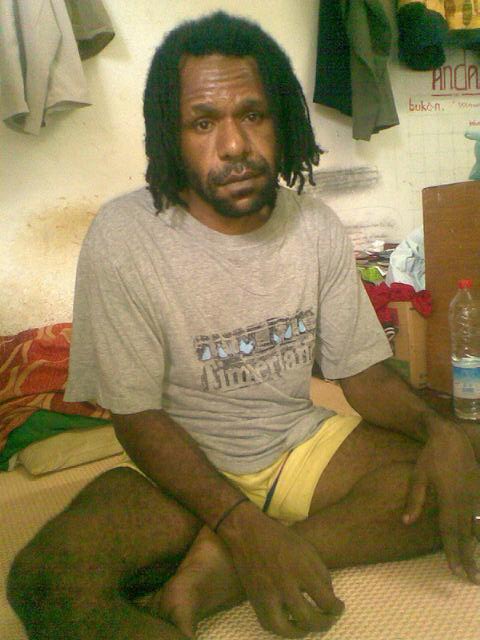
Papuan prisoners in their cell in Biak prison: Numbungga Telengen (black clothes), Jefrai Murib (sleeping) and Apot Lokobal (wearing glasses). Jafrai Murib is thought to have suffered a stroke on 19 December 2011 which has caused paralysis. He can no longer stand.


I am often in and out of prisons to deal with political prisoners, so I know many detainees and their families and lawyers. Last week, I received a message from somebody representing three Papuan prisoners in Biak prison. He said that prisoner Jefrai Murib is thought to have suffered a stroke on the morning of 19 December 2011. He’s paralysed. He can’t walk. When he walks he does so with the aid of his friends. The left side of his body, his left leg and his left arm have lost all sensation.

Jefrai Murib

Murib has had a check-up in Biak General Hospital, where the doctor referred him to Jayapura hospital.  Biak hospital is not as well equipped as Jayapura hospital. Murib is in a cell together with Numbungga Telengen and  Apotnagolik Enos Lokobal.  They were arrested in April 2003 following a raid on a Wamena weapons store. Murib and Telenggen got a life sentence, Lokobal was sentenced to 20 years in jail.

Lokobal also suffers from the same symptoms; the right side of his body has lost all sensation. He has also been seen twice at Biak hospital, on 12 November and 23 November. Lokobal is also suspected of having suffered a stroke. Unlike Jafrai Murib, by last week Apot Lokobal was able to walk again, although his steps are weak and faltering, and he has to be carried when taken to hospital. Lokobal needs more specialised medication. The Indonesian state is responsible for providing healthcare to prisoners. I hope that the health condition of these two prisoners will be taken seriously by the Penitentiary Director General.

In accordance with the doctor’s recommendations, Jefrai Murib should be moved to Abepura jail in Jayapura, and needs to receive medical attention at the Dok Dua Hospital in Jayapura.

Create a website or blog at WordPress.com

Up ↑