It’s Time To Take A Stand On Papua

via NewMatilda.com

21 Oct 2011

It’s Time To Take A Stand On Papua

By Richard Di Natale

rudd and sby

The violence in West Papua this week is deeply worrying – and raises uncomfortable foreign policy questions for the Australian government, writes Senator Richard Di Natale

Yesterday afternoon news reached my office that unarmed Papuans — women, young people, church leaders, academics, tribal elders — and at least one Australian citizen, were being shot at by the Indonesian security forces.

We now know that at least four people are confirmed dead, scores severely wounded and hundreds have been detained at the police station in Jayapura, the capital of West Papua.

We are deeply concerned that a number of these people including Forkorus Yaboisembut, the Chair of the Papuan Customary Council, were beaten or tortured. Their crime? Reading an aspirational declaration of independence and meeting to discuss how West Papuans might peacefully secure basic freedoms that you and I in Australia take for granted.

It is not my place to get into the politics of independence. That is for the Papuans to decide. It must be said, however, that until there is a free and fair vote of all eligible Papuan citizens in the territory, any claim by the Indonesian government that there is democracy in West Papua will be highly contested.

The fact is that the Australian government and many other western countries were party to a fraudulent transfer of sovereignty during the 1960s. That is not hyperbole. It is fact. Professor Pieter Drooglever and Dr John Saltford have separately documented the travesty of justice that unfolded in West Papua during the transfer from Dutch to Indonesia rule. Less than 0.01 per cent of the population participated in the so-called Act of Free Choice in 1969 and those that did were forced to do so.

But this week’s peaceful gathering at Zaccheus Field in Abepura was not about the past. It was about the kind of future that West Papuans want. The Papuans’ desire for freedom is irrepressible. Many of the civil and political rights Papuan people want — like freedom of expression, the release of political prisoners, an opening up of the province to foreign media, and respect of land rights — could be realised within the framework of the Indonesian state. By shooting and jailing Papuans who peacefully demand these legitimate rights, the Indonesian government is creating a bigger problem and fuelling political instability.

These events in our nearest neighbour raise serious questions back home. We are we providing funds, training and equipment to the Indonesian Military (Tentara Nasional Indonesia, or TNI) and the Police force, including the counter-terrorism police (Detachment 88). There is mounting evidence that they are anything but a positive force for human rights in the region. By furthering our close military ties, we become complicit in acts of repression by the TNI such as that unfolding in West Papua today.

The Australian government has been secretive with regards to these links. We don’t know exactly what kind of military assistance is being supplied to the TNI and the police. The Australian government needs to come clean about the extent and nature of our level of defence cooperation with Indonesia. The shootings in West Papua — and indeed in other places in Indonesia — raise serious questions about what, if anything, the Indonesian military and police have learnt from East Timor. And whether our own government has learned anything, either.

One thing we do know from East Timor is that when violence like this occurs and political rights are continually repressed you can guarantee that West Papuan resistance will continue and eventually become a mainstream issue. West Papua is on our doorstep. I hope we can be good neighbours.

We can not ignore West Papua any longer, and we need to send the strongest possible signal to the Indonesian government that violent repression of peaceful meetings, people merely exercising their right to free speech and assembly, is totally unacceptable.

Indonesia insists it is a democracy. Its constitution guarantees all its citizens the right to free speech and free assembly. We should hold them to this promise by immediately suspending all military assistance to and cooperation with Indonesia. There is no compelling evidence that on the balance of things Australia’s military assistance in Indonesia has improved human rights. I fear that our anti-terrorism support is sometimes being used to harasses and intimidate human rights defenders.

I want to be a part of a Parliament that can encourage the Indonesian government and the West Papuan people to find peaceful and democratic ways to address the root causes of conflict in West Papua. Guaranteeing free speech and releasing political prisoners would be a good first step. The President has promised an open dialogue, and he must keep that promise.

In the meantime those of us in Parliament need to seriously reflect on the kind of relationship we want with Indonesia. For the sake of our West Papuan neighbours, and for Australia’s long-held commitment to human rights, we must be prepared to take a bold stand.

1530 21/10/2011 Updates From West Papua

By Newmatilda.com and westpapuamedia.info

CURRENT:
Arrests
Anywhere between 300 and 800 activists arrested, most released
Core group of 5 in custody at least but could be more, all feared tortured:

– Forkorus Yaboisembut – elected as leader of the broad based movement for peace and justice – possibly paralysed witnessed by another detainee
– Edison Waromi – deputy leader
– Argus Krar
– Selfius Bobii
– Dominikus Sorabut

Released
– Abraham Kareni (who’s son lives in Melbourne) with fractured skull

Charges include treason, rebellion, crimes of hatred against the state. These are colonial laws left over from the Dutch era and they carry long sentences — in some cases up to 20 years.

Police violence, dead and wounded
DFAT have confirmed four people are confirmed dead, activists claim six
People identified (all from Petapa or family of:
– Dani Kabepa
– Yakovus Sabonsaba
– Mathias Maidepa
– Martinus Siep
– Tanepi Kobeta
– One additional unidentified member of Petapa, the West Papuan paramilitary guard formed to protect Forkorus Yaboisembut, the man delegates elected as their leader.


Claims:
– Numerous people have been savagely beaten, many are in hiding for fear of arrest or worse
– Unverified claims people were shot at point-blank range and bundled into armoured personnel carriers and other vehicles.
– Five people at the Dian Harapan Hospital suffering several wounds: ”One is a woman, Ana Ana Adi, 41. She has got wounds at her right thigh. Pilatus Wetipo, 40, was shot in the right leg. Wiler Hobi (22) has some wounds in his head because of being beaten by the weapon, the other two have blistered wounds
– four people in Sabron Yaru wounded

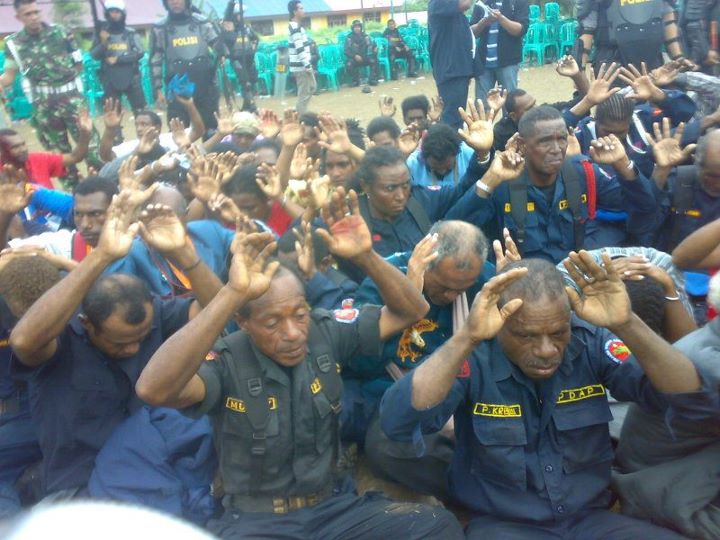
  • Members of the community security force (Petapa) are arrested. Photo: West Papua Media Alerts

Reports of violence by Indonesian troops continue to emerge from West Papua. New Matilda is in contact with local sources. We’re publishing regular updates on the situation here. (Warning: graphic content)

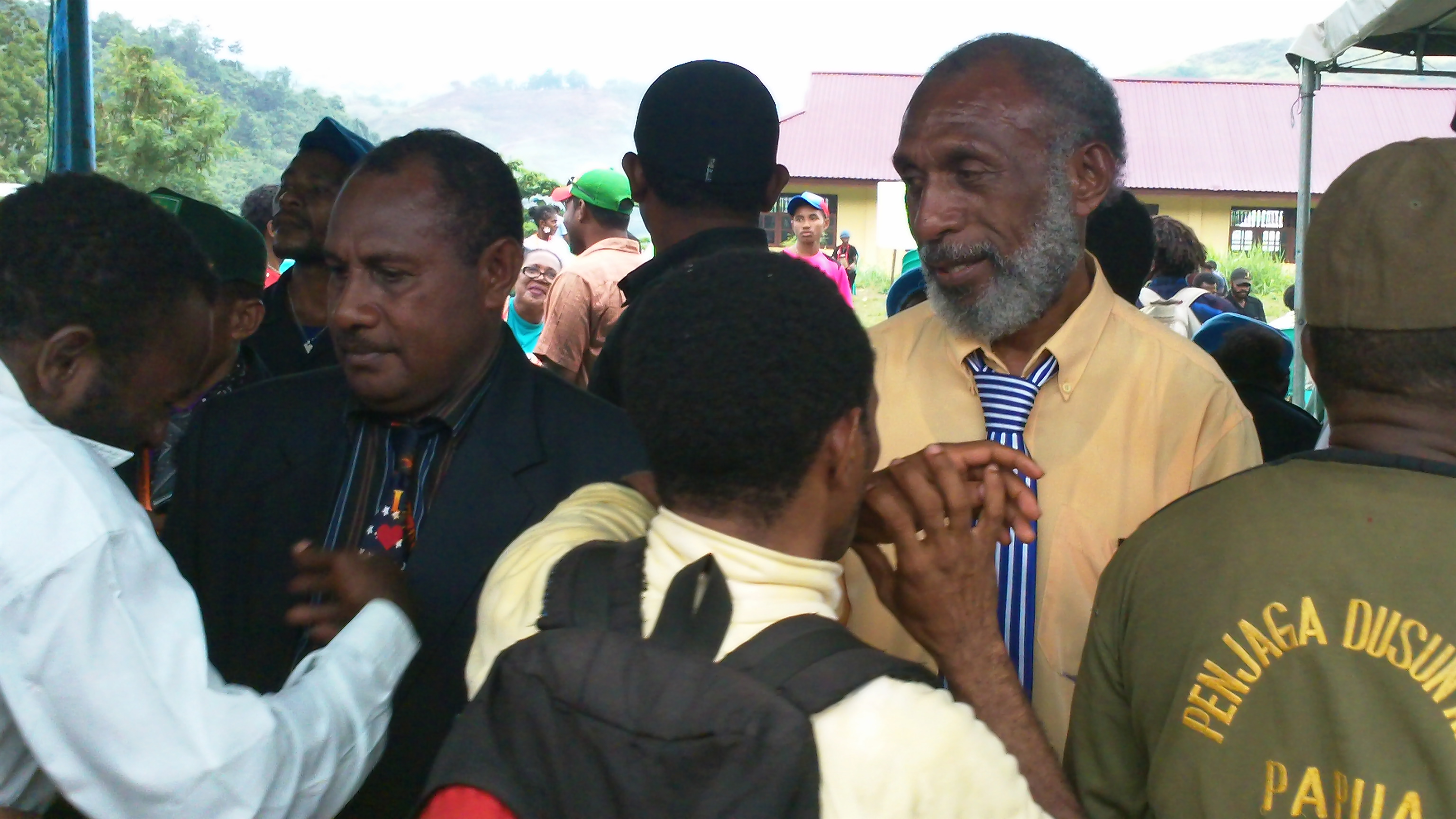
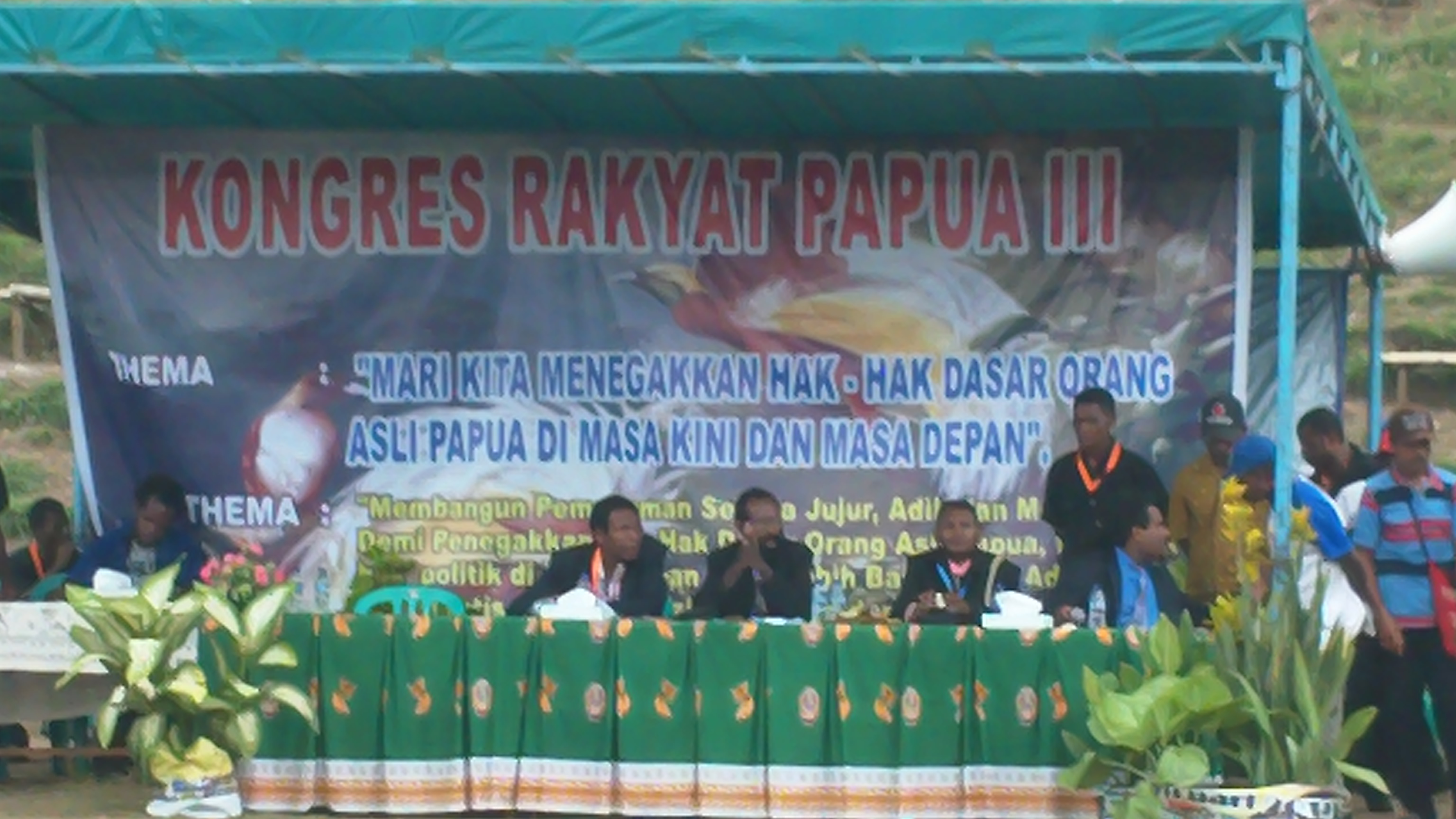
On Thursday, New Matilda published a report on the violence at the Third People’s Congress in West Papua. Indonesia military and police opened fire on participants and took activists and leaders into custody. Reports of fatalities and injuries continue to emerge from Jayapura.

Read Alex Rayfield’s initial report here.

New Matilda is in contact with local sources and will continue to update this page as new information emerges.

UPDATE, Friday 21 October, 10am:
This is a phone interview with journalist Alex Rayfield.

“Ferry Marisan, the director of Elsham — a leading human rights organisation based in the capital, Jayapura — has said that six people are confirmed dead.

“We think that a couple of people were shot as the security forces raided the stage, and some later. There are also lots of people with gunshot wounds, some of whom are in hiding and too scared to get medical assistance.

“We’ve had multiple reports that there were 800 people in jail. Many of those have been released, but a core group is still detained, charged with a range of offences including treason, rebellion, crimes of hatred against the state. These are colonial laws left over from the Dutch era and they carry long sentences — in some cases up to 20 years.

“It’s important for people to know that [Congress] is not a radical fringe movement. It’s made up of mainstream Papuan society: academics, church leaders and senior tribal leaders. In fact the radical fringe stayed away from this event because they think it’s not radical enough. So if the Indonesian government thinks this is a minority view, they are sadly mistaken. It is a mainstream view.

“Meanwhile, we should add for Australian audiences, that the strike continues at the Freeport mine [which is part owned by Anglo-Australian company Rio Tinto]. The two events are intimately connected.”

For more information on the Freeport strikes read New Matilda’s coverage here andhere.

UPDATE Friday 21 October, 4.30PM
These photos were sent by a credible source to West Papua Media Alerts and allegedly show injuries suffered in police custody. They have not been verified by New Matilda.

Photo: West Papua Media Alerts

Photo: West Papua Media Alerts

Photo: West Papua Media Alerts

MORE INFORMATION
Listen to an interview with Elsham’s Ferry Marisan here.

Read Amesty International’s statement on the incident here.

Read an article on Australia’s foreign policy response by Greens spokesperson on West Papua, Richard di Natale, here.

Third National Papua Congress Declaration

[as received in english from Papua National Consensus Team. This was scanned copy. Typos not corrected. – JMM]DECLARATION

FORMING FEDERAL STATE OF WEST PAPUA

On this day Wednesday ,19 October 2011 at the Third National Papua Congress, the people of Papua in Country of West Papua declare:

I.

Proclamation recover and Restore the independence and sovereign of West Papua which was lost to Indonesia annexation on December 1, 1961.

II.

Going into effect Constitution of Federal of West Papua by forming Governance of Federal State of West papua in the form of lifting President and elect Leader of Governance-The Prime Minister.

III.

Government of Federal State of West Papua guarantees the rights of live and rights of endeavor of everyone in the Country of West Papua.

IV.

Indonesia immediately terminates its occupation of West Papua pacifically and prestigious as civilized nation and member of the United Nations.

V.

The Nation Members of the United Nations to confess the Independence of the nation of Papua parallel with the other independences in the globe.

VI.

United Nations Security Council immediately register the Federal State of West Papua becomes the permanent or regular member state of the United Nations

VII.

Authorized the mandate to Papua National Leadership for run of the power of governance, Legislative, Judicative and Commander in Chief of Defense and also as soon as during one year carry out the general Election to chosen the Prime Minister of definitive Governance.

The People of West Papua greatly appreciate on your understanding of the historic injustice that we have suffered and are most grateful for your goverment’s support and recognize for restoration of our sovereign righs.

God Bless us all Sincerely

Forkorus Yaboisembut, SPd.
Head of Papua Customary Law Council Executor of Presidency of West Papua

CC:
1.Secertary General of United Nations
2. The President of United States
3. President of Indonesia
4. Netherland Kingdom
5. Pope in Vatican- Rome
6 .US Members of Congress and Senate

Amnesty: RELEASE PARTICIPANTS OF PEACEFUL GATHERING IN PAPUA

AMNESTY INTERNATIONAL

PUBLIC STATEMENT
Index: ASA 21/033/2011
20 October 2011
Indonesia: R elease participants of peaceful gathering in Papua
Amnesty International calls for the immediate and unconditional release of at least fourteen people who are currently being detained and interrogated by the police in Papua. They were arrested yesterday for participating in the Third Papuan People’s congress, a peaceful gathering held in Abepura, Papua province. Five of them, including Forkorus Yaboisembut, Edison Waromi, August Makbrawen Sananay Kraar, Dominikus Sorabut, and Gat Wenda have been charged for ‘rebellion’ and ‘incitement’ under Articles 106, 110 and 160 of the Criminal Code, which carry up to life imprisonment.
On the afternoon of 19 October 2011, the final day of the congress, military and police units approached the venue and started firing shots into the air to break up the peaceful gathering. This caused widespread panic among the participants who began to flee. As they fled, police units from the Jayapura City police station and the regional police headquarters fired tear gas and then arbitrarily arrested an estimated 300 hundred participants. The participants were held overnight at the regional police headquarters but most have now been released without charge.
Police and military officers allegedly beat participants with their pistols, rattan canes and batons during the arrest. The bodies of two participants, Melkias Kadepa, a student, and Yakobus Samonsabra, were found near the area of the congress with bullet wounds. Later that evening, security forces raided the Sang Surya seminary in Abepura arresting one person and allegedly firing bullets in one of the rooms.
The Indonesian government must immediately investigate allegations of excessive use of force to forcibly disperse the participants and investigate allegations of ill-treatment against some of them. There should also be an independent, impartial and prompt investigation into the deaths of Melkias Kadepa and Yakobus Samonsabra. If the investigations find that there were human rights violations involving the security forces, then those responsible, including persons with command responsibility, should be prosecuted in proceedings which meet international standards of fairness, and victims provided with reparations.
The reported heavy handed actions of the Indonesian security forces to disperse the peaceful gathering is a clear violation of the rights to freedom of expression, opinion and peaceful assembly which are guaranteed under the International Covenant on Civil and Political Rights (ICCPR), to which Indonesia is a state party, as well as the Indonesian Constitution. While the Indonesian government has the duty and the right to maintain public order, it must ensure that any restrictions to freedom of expression and peaceful assembly are no more than is permitted under international human rights law.
Further, the UN Basic Principles on the Use of Force and Firearms state that law enforcement officials must apply non-violent means before resorting to the use of force and firearms. The 2009 Indonesian Police Regulation on the Use of Force also highlights the need to respect the principles of legality, necessity and proportionality when using force.
Several thousand people representing various tribes from all over Papua attended the Third Papuan People’s congress from 17- 19 October 2011. Organisers had informed the Jayapura police of the gathering as required by law. At the peaceful gathering, participants reportedly raised the prohibited Morning Star flag, a symbol of Papuan independence, and made declarations of independence. During the period of the congress there was a build up of an estimated 500 military and police personnel surrounding the venue. In recent years, over a hundred people have been arrested, charged or detained for peacefully raising the Morning Star flag in Papua.
Amnesty International takes no position whatsoever on the political status of any province of Indonesia, including calls for independence. However the organization believes that the right to freedom of expression includes the right to peacefully advocate referendums, independence or any other political solutions that do not involve incitement to discrimination, hostility or violence.

SBS RADIO: Oubreak of violence reported in Papua

By Greg Dyett

interviews with West Papua Media and Asian Human Rights Commission

Download Episode  Duration00:03:33 Download3MB

Papuans attend a protest march in support of self-determination in July, 2010 (Getty Images)

Reports from the Indonesian province of Papua suggest that at least two people died when police and paramilitary troops open fired on crowds attending the Third Papuan People’s Congress.

Up to 20,000 people had reportedly gathered to hear the delegates talk about self-determination.

The violence is reported to have taken place after the Congress declared independence and elected two men as their president and prime minister.

Greg Dyett reports.

Create a website or blog at WordPress.com

Up ↑