RA: Freeport mine strike ends (interview with West Papua Media)

”]
  • Updated December 28, 2011 07:58:41

Thousands of workers at Freeport mine in Indonesia have ended their three-month strike for better wages, after a signing a pay-rise deal with the company.

Production at Freeport‘s giant gold and copper mine in Papua has been at a standstill since workers began their industrial action. The workers are expected to return to work this week, but there are reports the Papuan police chief will charge protest organisers with sedition.

Presenter: Melanie Arnost
Editor of West Papua Media Nick Chesterfield

CHESTERFIELD: It’s seen to be a bit of a bitter sweet victory because whilst there have been ceremonies to enable peaceful resolution, the company, Freeport has given very little ground on the original demands and the Indonesian police in Papua have decided that they’re also going to charge the union leaders and the organisers with sedition.
ARNOST: What does this mean for the workers?
CHESTERFIELD: Well sedition is basically the charge under which everyone in West Papua gets charged if they raise the Morning Star flag. What it means is basically between 10 to 15 years in prison, and it’s not exactly a good faith act by the police. So there’s a lot of people who are going to be fearful. It’s designed by the police to stop anyone from taking legitimate industrial action by making out that it’s treasonous.
ARNOST: And how many workers are we talking about that look like they’ll be charged?
CHESTERFIELD: Well at the moment it’s looking at the union organisers, certainly the heads of the union and key organisers who’ve been manning the blockades and doing the education out there and doing what union organisers do on the ground during strikes. Whether or not they charge everyone, this is a question that the workers certainly want to have answered, and also one of their conditions in returning to work is there’s going to be no sanction on them for going on strike. There’s no real gains in wage justice for any of the workers there, I mean they were initially going for quite a significant pay rise, and in the end they’re getting less than seven dollars an hour for their efforts.
ARNOST: So why did they decide to end the strike?
CHESTERFIELD: At the end of the day companies like Freeport and the Freeport mine which is the most profitable mine on earth, it’s the largest gold and copper mine on earth. It doesn’t want to pay its workers, not its indigenous workers anyway. There’s an understanding simply that there was no willingness on behalf of management to even budge even a few cents. So any money is better than no money.
ARNOST: So these seven dollars, is that what they were originally being paid in the first place?
CHESTERFIELD: Look they were originally being paid about a dollar 50 to three dollars an hour. So certainly there have been a few increases but it’s far less than what they’re asking for and there’s no real guarantees of safety and security, and especially security from these ongoing attacks by unknown forces, which the police and military seem to not want to solve.
ARNOST: When do you expect the workers will return to work?
CHESTERFIELD: It could be any day but nothing is entirely guaranteed until we get the pictures from the ground really.
ARNOST: It’s said to be the longest in recent Indonesian history this strike, so do you predict something like this happening again?
CHESTERFIELD: Look certainly there’s an appetite for industrial action in Indonesia and certainly in West Papua. Certainly the Freeport Mine’s got to be separated in some way obviously from the independence struggle in West Papua, but there’s certainly issues of corporate behaviour and corporate impact on surrounding environments and surrounding social dislocation that workers have really switched on to. You can’t unlearn what you’ve gone through in a situation like that, so certainly there’s more of a willingness to take this kind of action. And they’ve certainly learnt a lot of lessons from it.

Time to change Australia’s involvement in West Papua offensive

PRESS RELEASE: ACT FOR PEACE

Act For Peace
http://www.actforpeace.org.au/Be_Informed/Latest_News/Time_to_change_Australia_s_involvement_in_West_Papua_offens.aspx?cat=West%20Papua

23/12/2011 11:03:39 AM

Reports are emerging this week that the helicopters from which 17 West Papuans were recently shot are those of an Australian-owned mining company, Paniai Gold. Further, this ongoing Indonesian offensive involves counter-terrorism unit Detachment 88, which has been trained by Australia.

This Indonesian joint military-police offensive reportedly also burned down the villages of Toko, Badawo, Dogouto, Obayoweta, Dey, and Wamanik, with 20,000 people now displaced. Images reported in Australian and international media show more troops being deployed to West Papua.

Act for Peace is calling on the Australian Government to urgently request that the Indonesian authorities cease any attacks impacting civilians, and that Indonesia and Paniai Gold account for their alleged actions relating to the civilian deaths and forced displacement.

Media is strictly controlled in the region, making the need to pursue a full account more important. The large-scale offensive is in retaliation to the killing of two Indonesian police by Papuan guerrillas in Paniai.

Prior to this operation, in October six unarmed protesters were reportedly killed and many more injured at the Third Papuan People’s Congress.

Act for Peace, the international aid agency of the National Council of Churches in Australia, is also concerned at the targeting of church leaders and communities and the occupation of church buildings, in particular the Kingmi Theological College in Paniai, harassment of Kingmi Church of Papua Moderator the Rev. Benny Giay, and the attack on staff, students and destruction of property at the Catholic Church’s Fajar Timur Theological College in Abepura by the Indonesian police and military on October 19.

We also call on the international community to ensure the Indonesian authorities allow church and Congress leaders in West Papua freedom of expression of their views and rights without fear of persecution.

Act for Peace has supported programs in West Papua including training young community leaders, raising awareness of and helping to prevent the spread of HIV/AIDS and growing small businesses to help strengthen the West Papuan economy.

West Papua is the western half of the island of New Guinea, with an indigenous Melanesian population. December 1, 2011 marks the 50th anniversary of the declaration of West Papuan independence from Holland. It was forcibly taken over by Indonesia a year later.

Reports show more than 100,000 Papuans are estimated to have died from military operations since Indonesia took control. State-sponsored migration from other parts of Indonesia has now left the indigenous Melanesians a minority in West Papua.

It is time Australia, as a good international citizen concerned about the protection of civilians, did more to ensure the safety of our neighbours.

Alistair Gee
Executive Director, Act for Peace

Human Rights Commission urges police chief to withdraw his troops from Paniai

JUBI, 17 December 2011The National Human Rights Commission (Komnas HAM) has urged the chief of police  to immediately withdraw his Brimob troops  from the district of Paniai and not to send any more troops there.

This request is made in a letter signed by the deputy head of Komnas HAM, M. Ridha Saleh, which is a follow-up of the complaint made by   the chairman f the Regional Traditional Council (DAD)  in Paniai several days ago. He said that the complaint  was made  because of two recent incidents involving members of the police force. One was shooting in the vicinity of the copper-and-gold mine in Degheuwo which led to the death of a civilian and the other relates to the situation following the dispatch of 150 additional Brimob troops who arrived in Enarotali  on 11-14 November 2011

In the second place, the Brimob post which was set up in the midst of several kampungs. should be removed.

Thirdly, to immediately conduct an investigation into what caused the death of Mateus Tenouye. Fourthly, to restore a conducive situation so as to enable the people in the district of Paniai to go about their daily activities.

And fifthly, to speedily hold dialogue with all parties involved in conflicts and to help the community to resolve problems that have occurred in the district of Paniai.

‘This request is in accordance with the authority rested in Komnas HAM according to Article 89, para (3) of Law on Human Rights 39/1999,’ the letter said. Copies of the letter have been sent to the chairman of Komnas HAM, the chief of police in Papua based in Jayapura and to the Paniai chief of police in Madi.

Komnas HAM very much hopes that the situation of the people in Paniai will be more conducive, bearing in mind that all people have the right to live in peace and tranquillity and to be protected against threats of fear, in accordance with article 15, para (30) of Law 39/1999.

Komnas HAM also calls upon all people to do everything possible to safeguard a conducive situation for people living in Paniai.

‘The chief of police needs to re-evaluate  the policy of sending additional  Brimob troops to Papua, particularly to Paniai. His troops must be withdrawn  because the people there are very upset, especially because of the attack on Eduda several days ago which has only intensified these fears and are having a significant impact   because people are unable to organise activities  in preparation for Christmas Day which is fast approaching.’

At the present time, there are hundreds of Brimob troops and police in Eduda, which is the headquarters of TPN/OPM, after managing to occupy the area.

Calls for the withdrawal of these troops  have also be made by others, especially since, in the past couple of days, operations in the area have intensified  in an attempt to hunt down the group of John Magai Yogi, who recently moved into the forest.

Strike at Freeport settled, even as mine’s scars linger

by John M. Miller | December 17, 2011

This week the union and the U.S.-based mining corporation Freeport-McMoRan announced a settlement to a three-month long strike at its Grasberg mine in West Papua. Workers are expected to be back at work within days. Although the strike has been settled, Freeport and its activities remain controversial in West Papua and Indonesia.

The workers’ union settled for a 40 percent wage increase over two years, as well as additional housing and other benefits. The workers will also receive wages lost during the strike in the guise of a one-time three month “signing bonus.” Prior to the strike, which began on September 15, workers at Grasburg were the lowest paid at any Freeport facility. The company also has mines in the U.S., South America and the Congo. (A two-month strike at Freeport’s Cerro Verde mine in Peru was suspended at the end of November pending government mediation.)

Juli Parorrongan, a spokesperson for the union, said that pre-strike monthly wages range from $361 to $605 a month. He expressed dissatisfaction with the agreement to the Jakarta Post:

However, we decided to agree on the increase because we have to consider the humanitarian aspect, given that the striking workers have not been paid by Freeport for the last three months. We were forced to agree to end the strike, but this is not the end of our struggle.

Workers had blockaded roads in the area at key points and were accused of cutting the pipeline which carries mining concentrate to the port from where it is loaded and shipped for processing. By the end of the strike, the mine was operating at 5 percent of capacity.

Two striking worker was killed and others were injured on October 10 when police opened fire at a large demonstration in Timika, the town near the mine. Attacks by unknown gunmen on a vehicle carrying police and Freeport personnel led to more deaths and injury to two others. Such attacks along the road to the mine are a relatively common occurrence, and it is not clear if the latest ones were related to the strike. These assaults against security and Freeport personnel are believed to result from conflicts among police, military and Freeport security personnel feuding over the spoils from extortion targeting Freeport, as well as conflict over freelance gold-mining efforts by local people. While these attacks are often blamed on poorly armed guerrillas fighting for independence, local police recently said that the shooters were “well trained.”

The strike by 8,000 employees at the controversial open pit mine halted production costing the Indonesian government $8 million per day in taxes, royalties and dividends, which helped to broker an end to the strike.

In the U.S., Occupy Phoenix, the East Timor and Indonesia Action Network, the IWW and United Steelworkers (USW) demonstrated in support of the strikers at Freeport’s Phoenix, Arizona headquarters in late October.

The USW, which represents workers at Freeport’s Chino mine in New Mexico, urged the U.S. Department of Justice to investigate reports that the company was making illegal payments to the police in West Papua. In a letter to Justice’s Criminal Division, the union wrote:

The Indonesian police have recently been quoted in the Indonesian media admitting that they accepted millions of dollars from PT Freeport Indonesia to provide security for the miner’s operations in Papua, Indonesia, and the National Police Chief Gen. Timur Pradopo referred to the payments as “lunch money” paid in addition to state allocated security funding, stating “It was operational funding given directly to the police personnel to help them make ends meet.”

Human rights groups estimated that the payments raised salaries of the police near the mine between a quarter and one half. The payments are illegal under Indonesia law, where official corruption is a major problem. They are illegal in the U.S. if not reported. The Foreign Corrupt Practices Act also “bans companies from paying foreign officials to do or omit to do an act in violation of his or her lawful duty,” the union wrote. It called the payments bribes:

intended to persuade the personnel to act in defense of Freeport-McMoRan’s interests even when those interests conflict with the police and military personnel’s lawful duty to protect Indonesian people…

Five years ago, the company was investigated for payments allegedly made to the Indonesian military The company reported $1.6 million in payments in 2008 to provide a “monthly allowance” to police and soldiers for security at the mine.

In addition to its labor strike, Freeport faces challenges on a number of other fronts.

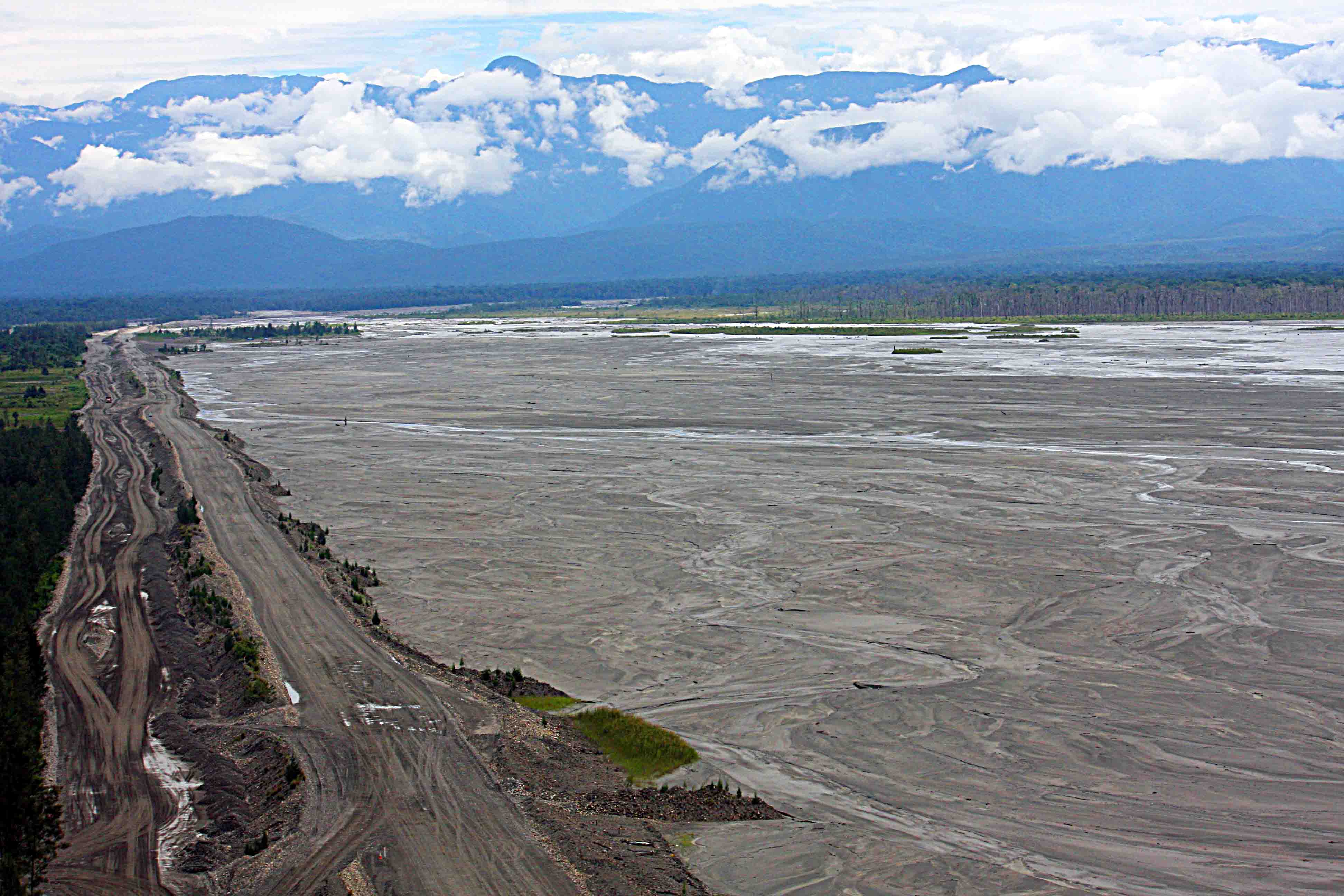
The Grasburg mine has been an unmitigated environmental disaster. The disposal of millions of tons of tailings and other mine waste has decimated forests and destroyed an entire river system. Local inhabitants have been marginalized by an influx of outsiders. The company’s human rights and environmental practices have long been criticized by major institutional investors. Norway’s government pension fund, divested its Freeport holdings in February 2006. In 2008, it divested from Rio Tinto, a minority owner of the mine. The deep scars from the mining operation can be seen from space.

Last year, the about 90 Amungme tribe members, who live near the mining complex, filed a lawsuit arguing that Freeport had seized their lands illegally. According to the Jakarta Globe, they are “seeking $32.5 billion in material and non-material damages for the alleged illegal acquisition of its ancestral land” in an Indonesian court.

Despite its poor labor, environmental and human rights record, Freeport sometimes receives high marks from those who monitor “corporate socially responsibility.” Recently, Corporate Responsibility Magazine had named Freeport as the U.S.’s 24th-best corporate citizen. “How is this possible?” askedDavid Webster, an assistant professor of International Studies at the University of Regina in Canada. “Well, the survey’s methodology seems to pay no heed to human rights performance.  Only human rights rhetoric matters.”

Unsurprisingly, the Freeport mine is a lightening rod for the pro-independence movement in Papua. The company gained its mining permits in 1967, as Indonesia­with U.S. backing­was undermining West Papuan aspirations for self-determination. (While West Papua and Indonesia share a Dutch colonial heritage, West Papua was not included in Indonesia on independence.) At the time, Indonesia was administering the territory under a U.N. mandate brokered by the U.S. in preparation for an act of self-determination (which was a farce when it finally took place two years later). Under these circumstances, many West Papuans view the granting of mining rights by the Suharto dictatorship as illegal and the outflow of mining profits as theft that has left indigenous Papuans impoverished. These grievances have fueled broad sentiment for greater control over these and other resources, and Timika is a hot bed of pro-independence sentiment.

Meanwhile, the U.S. government has staunchly defended Freeport since it first arrived in West Papua. In Jakarta, the U.S. embassy:

has conspired with Freeport management to defeat legal challenges as well as media and Congressional inquiries into human rights violations and other illegal acts carried out by security forces under Freeport pay and direction. In 2002, it conspired with Freeport and with the Indonesian government to limit and delay an investigation of an attack that cost the lives of three teachers, including two from the U.S.

The Freeport strike brought renewed attention to the company and to West Papua. It came at a time of increasing unrest and repression in West Papua over its political status. The strike also came at a time of increasing labor unrestthroughout Indonesia.

In mid-November, Occupy Jakarta’s general assembly adopted a resolution on Papua. Key points are withdrawal of security forces from the region and an end to violence to against Papuans. It called for Freeport to be brought to “justice for human rights violations, environmental damage and violence towards workers,” and putting the future of the Freeport mine in the hands of its workers and local people.

John M. Miller is National Coordinator of the East Timor and Indonesia Action Network, which co-publishes the monthly West Papua Report.

http://wagingnonviolence.org/2011/12/strike-at-freeport-settled-even-as-mines-scars-linger/
Website: http://www.etan.org

Forkorus Yaboisembut rejects charge of treason

Bintang Papua, 16 December 2011
Abridged in translation
After spending 56 days in  police custody,  Forkorus Yaboisembut along with four others, has finally been charged with treason. He is now being held in Abepura Prison.

The charge was strongly rejected by Gustav Kawar as one of their legal team. They say that police interrogators insisted that the five men be  charged even though  the police would need first to consider the incident in which they were involved right from the start.

Before the Papuan Peace Congress was held, the committee sent a letter of notification  to the police  requesting  permission for the congress to be held, and had also sent a letter to the minister for legal, political and security affairs  requesting him to be the keynote speaker at the congress, which the minister had agreed to, and had instructed the director-general of the ministry to open the congress.

‘How can this be said to be treason when there have been letters received from the police and the minister?,’ said the lawyers.

Even though the police interrogators have said that the documents for the trial are now complete, the lawyers will make a formal complaint, stressing that  what their clients had done was to express their opinions which is guaranteed  under the Universal Declaration of Human Rights and the Covenant on Civil and Political Rights .

The lawyer said that their client(s)  had not yet signed any documents relating to the trial.Yet even so, the police interrogators consider that the documents are complete and have been submitted to the prosecutor’s  office..

He said that  usually when someone is charged with treason, there should have been an attack, but the Congress proceeded  peacefully  and came to a conclusion according to the aspirations of the Papuan people  who want to exercise their right to self-determination and to set up a state of West Papua.

When Forkorus and  his colleagues arrived at the prosecutor’s office, they were sent straight for interrogation by the prosecutor, Maskel Rombolangi, and were accompanied by their lawyer, Anum Siregar, and there was a request that the men should be held in custody  at the detention centre of the police.  This was firmly rejected by Selpius Bobii, accompanied by Domingus Serabut. Things then became quite tense . The five accused  were taken to the prosecutor’s office in Jayapura  for proceedings to continue.

‘We dont yet know whether they will be sent back to police custody,’ said the lawyers.

Gustav Kawar said that the five accused are: Forkorus Yaboisembut, Edison Waromi, Selpius Bobii, Domingus Sarabut and Agus Krat who have been charged under Article 106  with treason and for incitement under article 160 of the Penal Code. After the Congress, the five men and Gat Wenda  were arrested by the police after they had been involved in proclaiming the State of West Papua on 19 October in Abepura. At the sime time, three members of PETAPA, were killed. The first charge could result in sentences of twenty year or life , while the second charge can lead  to a six-year sentence.

One of the lawyers of Forkorus, Anum Siregar said that since 7 December, they had refused to be interrogated on the basis of an international covenant and rejected the charge of treason . Anum Siregar said that her clients had refused to be held at the police detention centres because they did not feel safe there and moreover, their families had not been permitted to visit them. The detained men said that they would prefer to be held at Abepura Prison because their families would be able to visit them and they felt safer there.

When the men met a reporter from Bintang Papua,  they said had been ill and had be treated violently , They also rejected medication provided by the police  and wanted to be treated by doctors at the general hospital. Finally, the men were handed over to the authorities at Abepura Prison  and they have been given medical check-ups.

Create a website or blog at WordPress.com

Up ↑
