Perpetrators of Bloody Wamena Incident should be brought to justice

JUBI, 4 April 2012

The Aliansi Demokrasi Untuk Papua – Democratic Alliance for Papua – has called on the Indonesian government and specifically on the police force  to immediately arrest and charge  the perpetrators of the serious bloody incident  which occurred at the time of an  attack on the ammunition dump of  Kodim – district military command – 1702 in Wamena on 4 April 2003.

Cory Silva, speaking on behalf of the ALDP, said that the government should also provide a clarification about the incident.

She said that incident was a serious tragedy that led to the loss of many lives.

‘As far as we know, the government has failed to acknowledge responsibility for that incident and it has simply been swept under the carpet,’ she told journalists.

She called on Komnas HAM, the National Human Rights Commission, and the Attorney General’s Office, to provide information about any recent developments with regard to the case. It seems to us, she said, that the incident has got stuck somewhere between these two agencies.

‘We urge the government to provide clarifications with regard to any developments concerning the case. This would help explain things to the victims  and to the general public,’

Cory went on to say that the police should arrest the perpetrators and bring them before the court. ‘If at all possible, the persons behind that incident should be arrested and face justice in accordance with the law of the land.’

The deputy director of the ALDP in Jayapura, Yusman Conoras, said the state should accept responsibility for those who became political prisoners  in connection with the case, bearing in mind that they received heavy sentences. ‘Those who were held as tapols in connection with this case need special attention because of the heavy sentences they have had to serve,’ he said.

According to the available  information, the security forces rounded up six persons whose names are as follows: Kanius Murib, Enos Lokobal, Jefrai Murib, Numbunnga Telenggen, Kimanus Wenda and Michael Hesello. They were tried and convicted by the district court in Makasar. They are at present facing proceedings before the Makasar State Court. The first three were sentenced to 20 years, while the other three were given life sentences.

One of the co-defendants, Michael Hesello, fell ill and died  while he was being held in Gunung Sari Prison in Makasar. The others are at present facing proceedings at the Makasar State Court.

[Translated by TAPOL.]

KNPB denies that violence occurred during its demonstrations

Bintang Papua, 1 April, 2012
The KNPB – National Committee for West Papua– has denied allegations that violence occurred during demonstrations which it organised  recently. In response to the decision by journalists to boycott activities organised by the KNPB which was recently announced, Mako Tabuni, the chairman of the national committee of the KNPB said at a press conference that the majority of journalists who operate in Jayapura are well known to the KNPB, and when people threw things at journalists, this occurred because the supporters of the KNPB were unable to  recognise who were genuine journalists and who were not journalists but were members of the security forces in civilian dress who were posing as journalists.’We deny allegations that every time we organise demonstration, violence occurs. The truth is that when things are thrown  and people are chased as happened on 20 March, these were members of the security forces wearing civilian clothing who were posing as journalists.’

Tabuni said that the KNPB would undertake to clarify any of the incidents that occurred during the demonstration which took place on 20 March.. ‘Ever since the KNPB has undertaken to promote the aspirations of the Papuan people, nothing has been done to harm national or local journalists, although some misunderstandings did occur.. Our activists and militants always do everything they can to protect journalists in all our activities, and we deeply regret what happened during our demonstration on 20 March.’

He referred to demonstrations which the KNPB organised on 2 May and 2 August 2011 when there were allegations that violence occurred and that someone at  demonstration had  stabbed a student.He denied that this had happened. He said that they had immediately gone to the  police in Jayapura to ask about this allegation , but were referred to the police in Abepura. However none of them had produced any proof that such incident had occurred,.They also went to the hospital in Abepura to ask whether anyone who had been stabbed was being treated there, but there was no one being treated.

He said that it was very regrettable  that such a report had appeared in the media  who should be independent and neutral, and should not report something without having proof that it happened.

He also said it was very unfortunate that reports in the media about the demonstrations organised by the KNPB on 20 March had been greatly exaggerated

Meanwhile it has been announced that the KNPB  will organise a Cultural Festival on 2 April on Taman Imbi, Jayapura.

Buchtar Tabuni will be held responsible for demos calling for a referendum

Bintang Papua,
2 April 2012

Jayapura: Instead of holding one demonstration as had been planned by the the KNPB (National Committee for West Papua), they held two demonstrations in two different places. One took place in Taman Imbi while the other took place in Abepura. The deputy police chief, Brig.General Waterpauw said that they would hold Buchtar Tabuni responsible for these demonstrations. ‘The police will hold Buchtar Tabuni responsible for this because he was the co-ordinator of the demonstration held by  the KNPB which proceeded in violation of the agreement that they would only hold one demonstration in one place, in Taman Imbi,’ said Waterpauw.

He said that thousands of KNPB supporters had taken part in the demos in two places. In addition, he said, they were carrying a variety of weapons such as arrows, knives and spears, which had spread fear among the people.

Asked whether he intended to summon Tabuni, he said this was not yet clear but the matter would be attended to as quickly as possible.

The demos caused traffic jams as many main roads in the town centre were closed off.

Thousands of supporters of the KNPB held a demonstration in front of the post office in Abepura as well as near the traffic lights by the Abepura police office on Monday, 2 April. The demonstrators called for a referendum and urged the Indonesian government to recognise the Federal State of West Papua. The demonstrators also welcomed the establishment of International Parliamentarians for West Papua by Benny Wenda, a Papua who has  been living for a long time in The Netherlands. The IPWP will be formally set up in a parliament to support the Papuan struggle and for West Papua to secede from the Indonesian Republic.

[The report then goes into great detail about how the demonstrations proceeded in different parts of the city.]

Speaking to the crowds, Buchtar Tabuni said: ‘This demonstration is an action to express the KNPB’s support for the establishment of the IPWP in The Netherlands.’ He apologised to shopkeepers who had closed their shops along the roads where the demonstrations took place.

The chairman of the KNPB  also explained that  they were wearing traditional dress and carrying traditional weapons to show to other people (ie non-Papuans) that we have our own identity.

‘Today, the West Papuan people will determine their own future which is why the KNPB has held a peaceful demonstrations with our own cultural attributes and in support of the establishment of the IPWP.’ He went on to say that  the Regional People’s Parliament had set up commissions  and said that the most effective weapon of all was the strength of the West Papuan people to confront the colonial power, the state of Indonesia.

‘The  Papuan people have set up their own political institutions and have asked the government of the Netherlands to place the issue onto the agenda of the United Nations.

He said that West Papua will get its freedom and this must be recognised by the international community so that we, the Papuan people, can determine our own future on the basis of one principle: it is better for us to be struck down  in defending the people of West Papua than being struck down at the hands of Indonesia, the colonial power.

He said that West Papua had been incorporated  into the Republic of Indonesia in a process that violated international standards, in conflict with the principles of the rule of law and international human rights. The countries responsible for this were the USA, The Netherlands and Indonesia as well as the United Nations, in pursuance of their own economic and political interests.

‘This is why were firmly declare that the West Papuan people will devote all their energies to holding a referendum , to establish political institutions that  conform with the wishes of the people of West Papua and we call on the Dutch government to speedily take the issue back to the United Nations.’

[The report then gave the names of 21 local Papuan organisations (PRD) the chair-persons of which had signed the statement issued by Buchtar Tabuni and said that all the leaders of the KNPB took part in demonstration.]

Meanwhile units of the police and Brimob in armoured vehicles and armed with a variety of weapons stood on guard in various points places near the DPRP office and in Taman Imbi.

Many people left their offices for home earlier than usual and discussions were taking place between members  members of the DPRP.

Hundreds of people had blocked the roads causing big traffic jams .

[Abridged  translation by TAPOL of a very long article that appeared in Bintang Papua.]

Kimanus Wenda’s tumour operation

andreasharsono.net
22 March 2012

[Translated by TAPOL] 

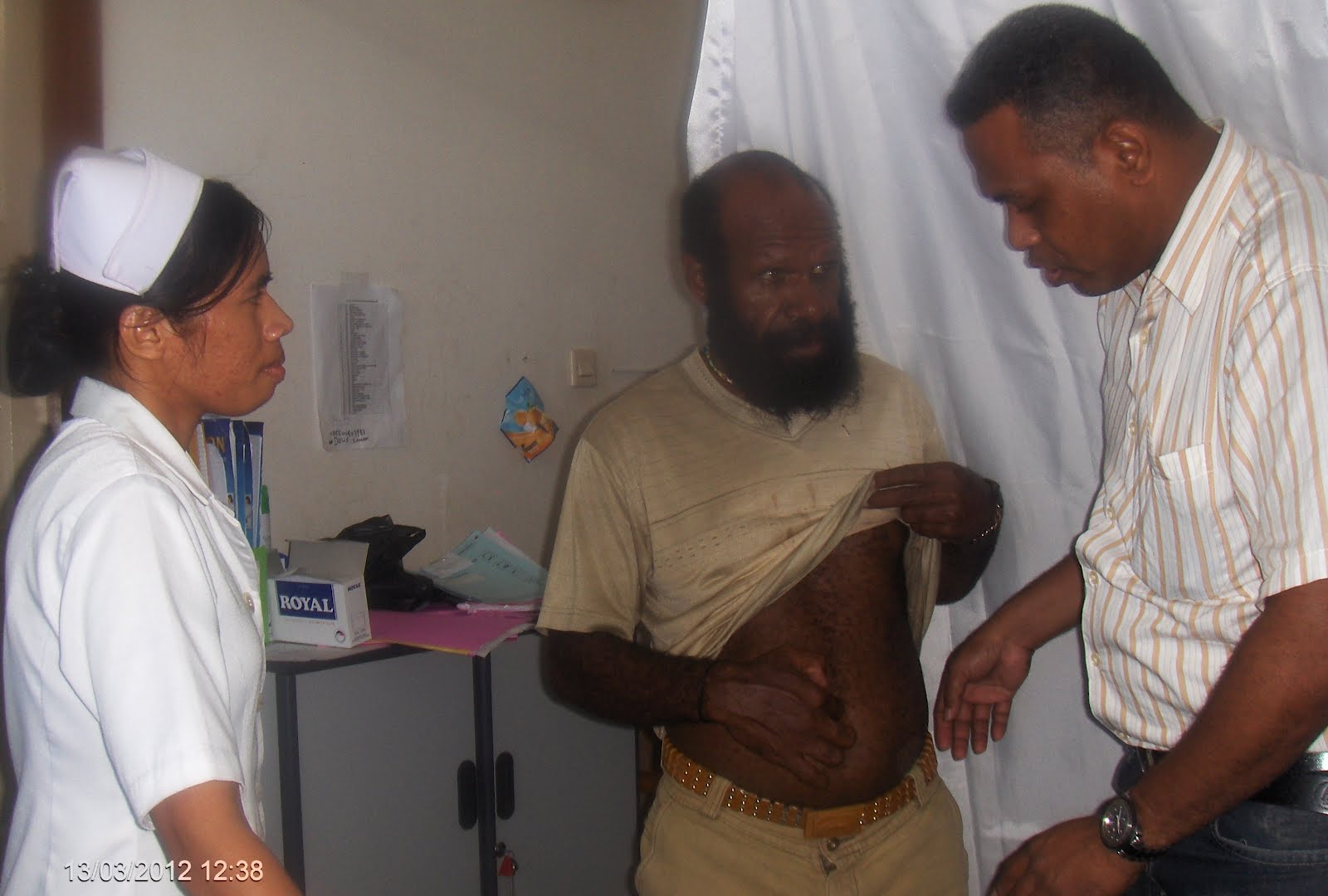
Papuan detainee Kimanus Wenda being examined by the doctor at Dian Harapan Hospital in Waena, Jayapura. ©Peneas Lokbere

KIMANUS WENDA, a prisoner usually detained in Nabire prison had an operation to remove a tumour from his stomach at Dian Harapan Hospital, Waena Jayapura on 14 March 2012.  Wenda is detained for treason (makar) and is serving a 20 year prison sentence.

According to Peneas Lokbere from United for Truth (Bersatu Untuk Kebenaran), an organisation which provides support for political prisoners in Papua, the operation began at 10:00 and lasted for two hours.

“After the operation he was transferred to the inpatient ward. The procedure went well without any obstacles,” said Lokbere.  A growth and a hernia were operated on, and he was given six stitches.

Wenda was hospitalised until Saturday 17 March 2012. On Satuday, Dr Trajanus Lauretius said that Kimanus could go “home” to the jail in Abepura, but that every Tuesday he needs a check-up at the Dian Harapan Hospital.

Lokbere took Wenda to Abepura jail on Saturday afternoon. On Sunday Lokbere came back to bring his medication.   According to Lokbere, Kimanus Wenda said that two staff from the jail came into his cell.  All his belongings – including his clothes and medicines – were turned upside down with no clear reason.  He was offended by being treated in such an impolite manner while he was just recovering from an operation.

Kimanus Wenda is actually listed as a prisoner at Nabire jail.  However he cannot return to Nabire at present because he needs to recover properly first and have the stitches removed from his stomach.

According to the Asian Human Rights Commission, Kimanus Wenda started
to complain of feeling ill in 2010, and was vomiting frequently.  The doctor at Nabire prison examined him and said that he needed to be examined in Jayapura.   However, the Ministry for Justice and Human Rights said that they could not pay for an operation in Jayapura.  They claimed they didn’t have the money to cover the costs of the operation.

An official of Nabire jail disagreed that Wenda was ill.  The proof?  Kimanus Wenda could still play volleyball in the prison field in Nabire.  His obstructive behaviour prompted Peneas Lokbere to gather funds for Wenda’s operation. Various non-governmental organisations have contributed to the cost of the journey, transfer between the Nabire and Abepura prisons, and the medication for Kimanus Wenda.

According to the Facebook page of TAPOL, an organisation which provides support for political prisoners, their internet fundraising campaign using the gofundme.com website raised £2,000, [which included £1,040 in direct donations and an anonymous private donation of £1,000 – TAPOL]. They channelled the funds through Peneas Lokbere and friends in Jayapura.

At present, Lokbere is monitoring Kimanus Wenda’s recovery in Abepura prison.  Once he recovers and the stitches are out, Wenda will return to Nabire prison.  According to Indonesian law, the Indonesian government is responsible for providing prisoners with healthcare.

However, the problem of budgets is often used by the Ministry for Justice and Human Rights as an excuse for not complying with this regulation.

Ironically, the Indonesian government has also banned the International Committee of the Red Cross (ICRC) from working in Papua since March 2009, despite the fact that ICRC often helps the families of prisoners to visit the detainees.  The ICRC also usually gives support for medication for prisoners, no matter who they are.

Peneas Lokbere and TAPOL are now collecting funds for an operation for Jefrai Murib who is currently in Biak prison.   Jefrai Murib is suspected of having suffered a stroke on 19 December 2011.  The left side of his body and his left arm and leg have lost all sensation. Murib has been examined at the Biak General Hospital, where the doctor’s diagnosis was that he needs to be examined at the General Hospital in Jayapura.

http://www.andreasharsono.net/2012/03/operasi-tumor-kimanus-wenda.html

Medical personnel seriously lacking in Papua

JUBI, 2 April 2012

Taking into account the vastness of the territory of the Province of Papua, there is a serious shortage of medical personnel here. Moreover, the ratio between the number of medical personnel and the number of hospitals and clinics is also far too low.

‘If you take into account the number of hospitals, clinics and medical centres, I reckon that the shortage of medical personnel amounts to as much as 2,700,’ said the Head of the Provincial Medical Services in Papua, Josef Rinta Rachatmaka.

He said that as a way of reducing this shortage, the Provincial Medical Services intends, in co-ordination with the Agency for Personnel Education and Training in the Province of Papua, to look more closely at the data about healthcare personnel in the area.

‘On the basis of our present calculations, the number of healthcare personnel in Papua is very low indeed.. With 20 hospitals, 310 clinics and 760 healthcare centres, we need a further 2,700 medical personnel,’ he said. He said in particular that there was a need for more medical personnel in the medical health centres that are spread right across the territory.

He said that the shortage would become even more acute if new hospitals were built. The medical personnel includes the number of doctors, midwives, dieticians and so on. The key factor in any healthcare provision is that there is the right number of personnel. However many medicaments and however much money is available, if there are not enough personnel, then nothing will function properly. While agreeing that there are enough facilities, the most important thing is to have enough medical personnel. ‘Many of the facilities we have here are standing empty.’

He went on to say that whenever there are plans to build new hospitals, if the personnel are simply taken from those at the already existing facilities, this would only lead to a further lack of personnel. He said that they plan to open up new diploma courses for nurses, midwives and dieticians.’We very much hope that, as new healthcare facilities are built, there will be a sufficient number of personnel and not continue with the situation as it is at present.’

[Abridged in translation by TAPOL]

Create a website or blog at WordPress.com

Up ↑