Mass Rallies across West Papua challenge anniversary of Indonesian invasion

Ten Thousand Defy Police bans to march; flotilla of war canoes fly banned flags

from West Papua Media and local sources

May 1, 2012

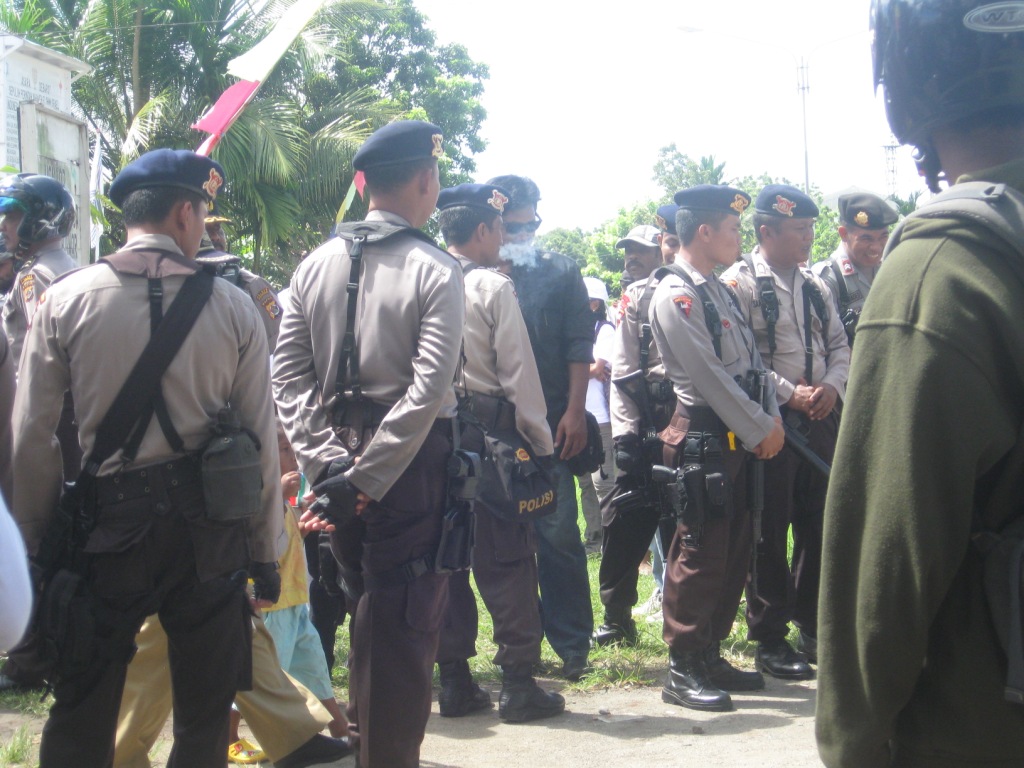
Indonesian security forces are currently preparing to disperse a mass  demonstration near Serui, as tens of thousands of people take to the streets across West Papua to reject the Indonesian annexation of West Papua
on May 1 1963.

The yearly demonstration are being held by two sectors of West Papua civil resistance _ the West Papua National Committee (KNPB) in Jayapura, Puncak Jaya and Sorong, and the Federated Republic of West Papua (FRWP) has organised similar rallies in Manokwari, Yapen Island, and Fak-fak. Indonesian Police have generally allowed the rallies to occur across Papua, however in Yapen, Police have banned all gatherings from occuring across Yapen, and have reportedly blockaded all marches.

According to the FRWP, Head of Police in Serui Regency, Roycke Harry Langie S.IK MH, refused permission for the Federated Republic of West Papua to hold its rally, even while citing rights under Indonesian regulation No. 9/1998 concerning free speech in public spaces.

“The Police Commander’s order not only violates Regulation No. 9, but also Article 28 of the Indonesian Constitution 1945” said Jacob Rumbiak, Head of Foreign Affairs for FRWP.

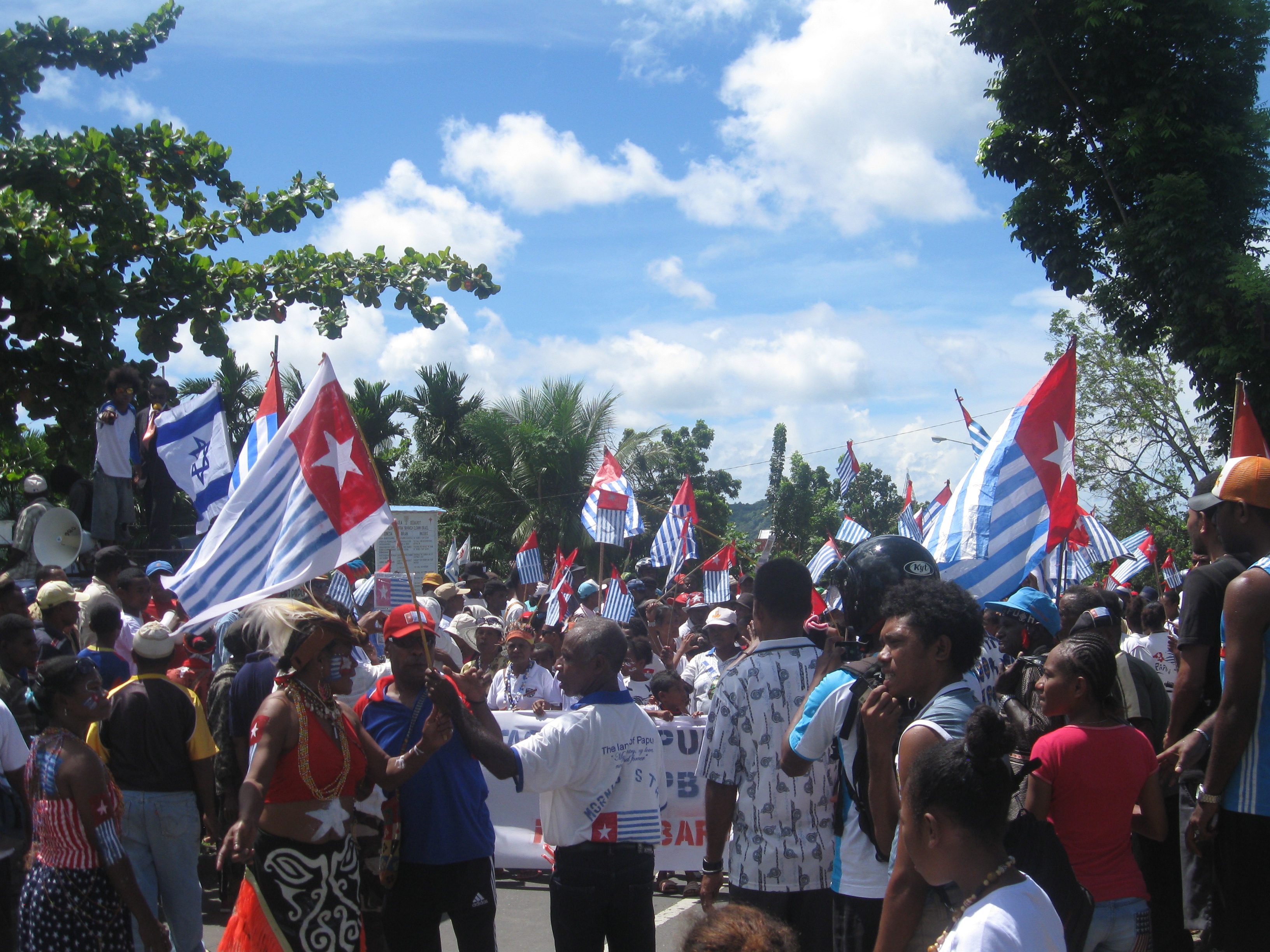
Despite this ban, over 10,000 people have reportedly gathered at Wombai Beach outside Serui on Yapen. According to West Papua Media sources spoken to by phone, Ten Canoes (large outrigger war canoes) flying Morning Star flags, full of demonstrators from outlying islands, are about to land. However the Kapolres Roycke Harry Langie, is at the time publication using a loudhailer to try to force the boats to furl their flags and Morning Star paraphernalia, though it is understood that the boat crews are refusing to do. The situation is described as tense and dynamic, with the chance for armed Naval action occuring against the war canoes. However permission has just been granted for the rally to continue until 2pm local time, when a forces dispersal would be made if not already done.

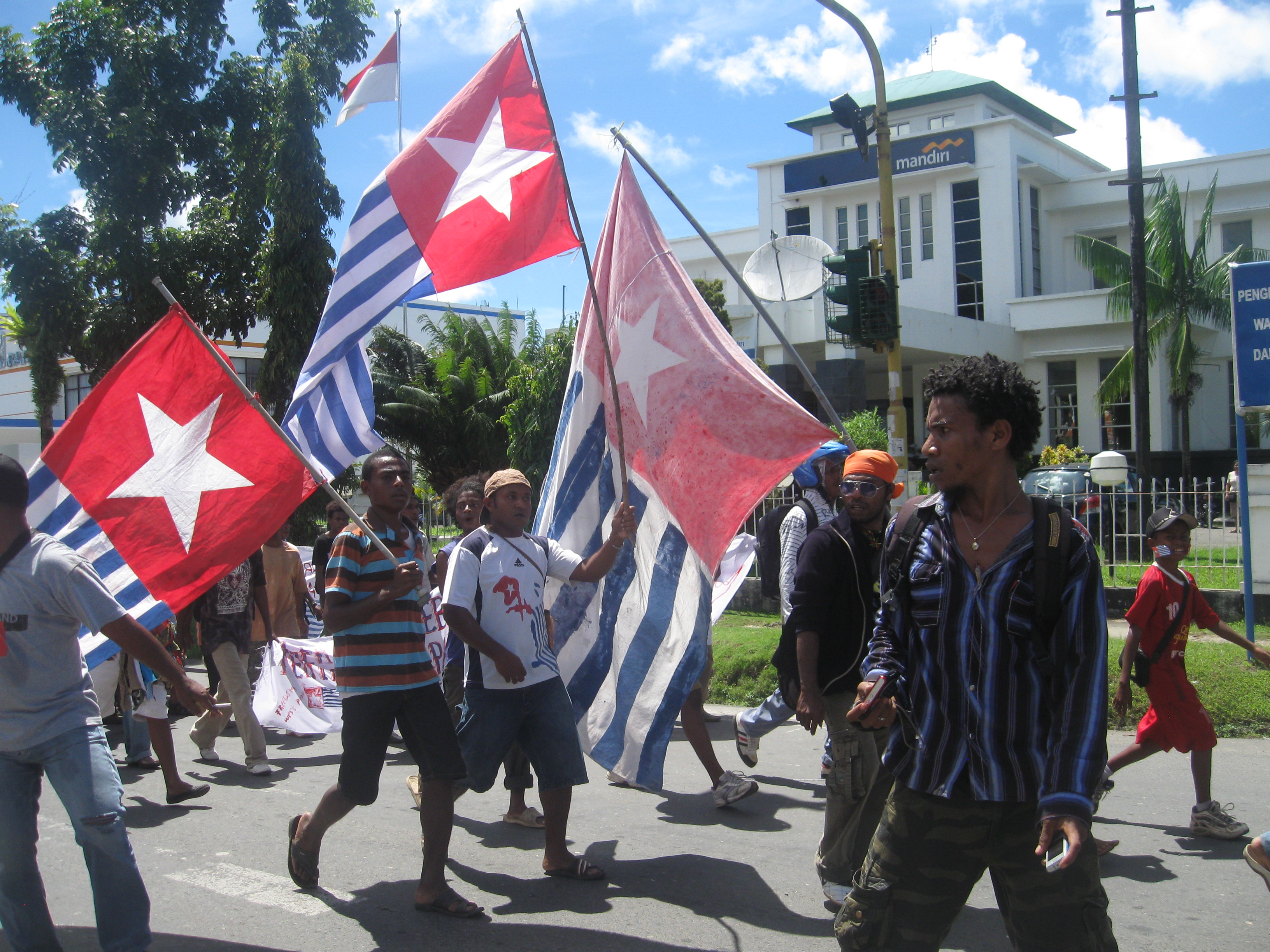
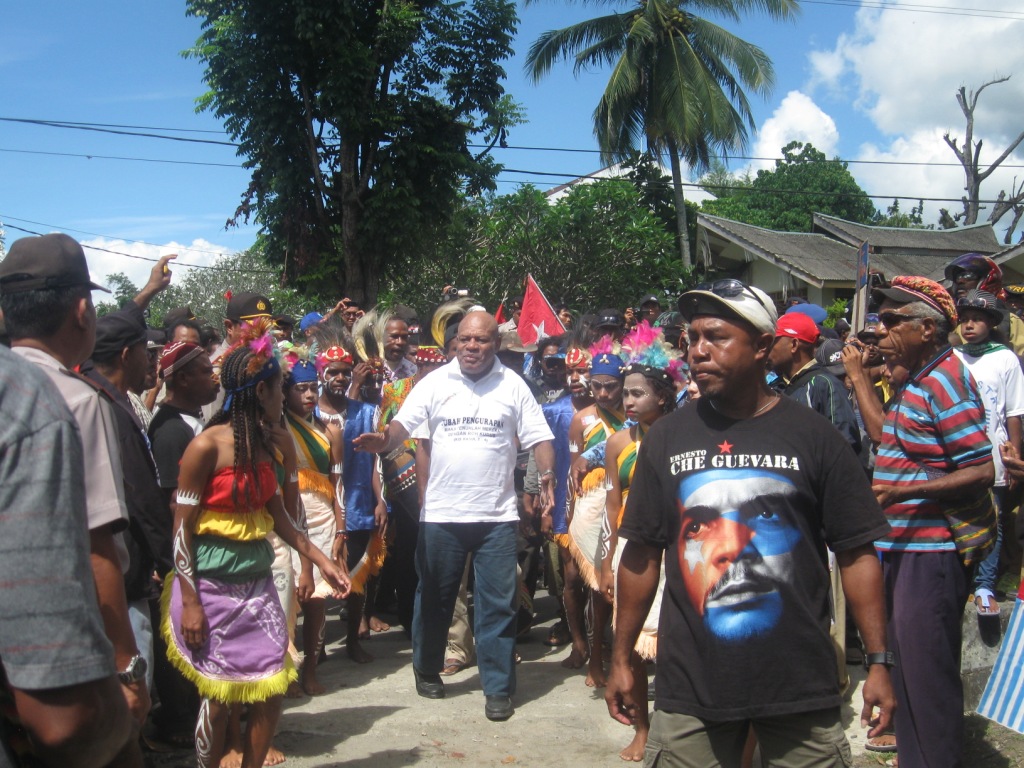
In Manokwari already about 30 morning star flags have been raised in from of the Manokwari district DAP office. Around 20 have been raised during a Long march fromm the UNIPA university campus to the DAP office.  Up to 5000 people are now believed to have gathered listening to speeches and carrying on more Long marches.

Photos from Manokwari below:

No news has yet been confimred from Jayapura at this stage.

This is a developing situation – more updates as they come to hand. Please stay tuned.

West Papua Media


Indonesia conducts more culpable targetting of leading Papuan politicians

 PRESS RELEASE – FEDERATED REPUBLIC OF WEST PAPUA

1 May 2012

The Indonesian Republic’s top-level intelligence of its special forces (KOPASSUS) held a secret meeting in Manokwari on Friday 27 April 2012 to finalize plans for the kidnapping and assasination of key leaders of the Federated Republic of West Papua.

The leak shows those named for elimination as President Forkorus Yaboisembut and Prime Minister Edison Waromi.  Other listed are Aluis Aso and Sius Ayemi; Hendrik Warmetan, Edison Kendi and Daud Abon from Serui;  Markus Yenu and Billy Auparay from Manokwari.

At its inauguration on 19 October 2011, the Federated Republic of West Papua outlined its intention—and policy—of charging politicians as well as military commanders for war crimes.

Today on 1 May 2012, in non-violent rallies across the territory, the Republic is demanding concerted action by the Netherlands, the United States, and the United Nations in down-grading the level of Indonesian militarism and governance in West Papua.

Head of Police in Serui Regency, Roycke Harry Langie S.IK MH, refused permission for the Federated Republic of West Papua to hold its rally, even while citing rights under Indonesian regulation No. 9/1998 concerning free speech in public spaces.

“The Police Commander’s order not only violates Regulation No. 9, but also Article 28 of the Indonesian Constitution 1945” said Jacob Rumbiak.

“The Indonesian government is jammed between the political sophistication of the Papuan Republic and the Australian, American, and British governments fiscal support for its Special Autonomy projects” he added.

Interviews available (English, Indonesian) – Please contact West Papua Media

(West Papua Media has spoken with Markus Yenu, one of those targeted, and he has confirmed that he has personally seen the intelligence documents, and is fearful for his safety.)

An Agribusiness Attack in West Papua: Unravelling the Merauke Integrated Food and Energy Estate

PRESS RELEASE FROM awasMIFEE

April 25, 2012

Announcing the publication of a new report into a major land grab in West Papua:

“An Agribusiness Attack in West Papua: Unravelling the Merauke
Integrated Food and Energy Estate” is now online at:
http://awasmifee.potager.org
(direct pdf download: http://awasmifee.potager.org/uploads/2012/03/mifee_en.pdf )

AwasMIFEE

The Merauke Integrated Food and Energy Estate (MIFEE) is a vast mega-project, a plan for over a million hectares of plantations and industrialised agriculture that threatens the people and environment across the southern part of West Papua. Indonesian and foreign companies have each claimed their share of the land, and offer the local Malind people next-to-nothing in exchange for the forest that has sustained them for countless generations.

West Papua, where the MIFEE project is set to take place, is a conflict zone. The Papuan people have been struggling for decades for their freedom and self-determination. West Papua is also the next frontier for Indonesia’s plantations industry – after Sumatra and Borneo’s forests have been decimated for the pulp and oil-palm industries, now Papua becomes the target. Although some plantations already exist, MIFEE represents another order of magnitude, opening the floodgates to development projects across Papua in which the losers will be the Papuan people.

awasMIFEE! has been created as an act of solidarity with the social and ecological struggles of the people of Merauke and elsewhere in West Papua. We believe that it is important that people outside of West Papua also know what is happening in Merauke. However, information available about MIFEE can be confusing – much of it comes from different companies and government bodies, and each have their own way of describing the project that fits with their own interests and objectives.

By compiling information from different sources, such as reports from the villages affected, from NGOs and other groups, from Papuan, Indonesian and financial media, from local and national government, and from company websites, we have tried to unravel what MIFEE is likely to mean for the people of Merauke. We hope that a more coherent understanding of how this land grab is taking shape will be of interest to people who are interested in West Papua, in the defence of forests and forest peoples, in the struggles against agro-fuels and against the growth of industrialised agriculture.

Most of all we hope that this information can be the catalyst for action! Our initiative is independent, unconnected to the programs of any NGO, and we hope it can also be a source of inspiration.

The report “An Agribusiness Attack in West Papua : Unravelling the
Merauke Integrated Food and Energy Estate” is an attempt to give an
overview of the situation in April 2012. It focusses on the following areas:

  • Background information – to understand MIFEE in the context of West
  • Papua, it’s history and struggles, and the local Malind people.
  • What is MIFEE – how MIFEE presents itself as the answer to Indonesia’s food security needs. But is it actually just an excuse for oil palm and logging companies to conquer new territory? A look at the difference between the propaganda and the reality of development in Merauke.
  • Reports from villages: A summary of news of what has been happening on the ground around the MIFEE project area, compiled from reports of NGOs that have visited the area, local media and letters sent from villagers.
  • Company Profiles: Tracing where the money comes from behind each proposed plantation.
    • Which of Indonesia’s top business conglomerates are involved?
    • How South Korean companies have been buying up plantations.
    • How Australia’s top-selling sugar brand is connected to forest destruction in Papua.

News of further developments will be posted on the website, and from
time to time updates containing news of all recent developments will be published.

[awasMIFEE minta ma’af karena versi Bahasa Indonesia belum siap. Laporan masih dalam proses terjemahan. Semoga dalam waktu dekat kami akan menerbit versi Bahasa Indonesia]

Journalists and foreign NGOs banned from visiting Papua

JUBI, 22nd April 2012

During the course of 2010 – 2011, the Indonesian Government has restricted the number of foreign journalists who are given access to enter Papua and report on the situation there.  As well as journalists, a number of foreign NGOs have been prevented from functioning in West Papua.

All this was said in a report issued by the Faith-Based Network on West Papua, Franciscan International, Papua Land of Peace and the Asian Human Rights Commission which was launched at the P3W Aula in Padang Bulan on 21 April. The report states that in January 2011, Peace Brigades International (PBI) closed its operations in Papua and left Indonesia.

After working in the province for six years,  the lack of legality for its work and visa problems were among the factors that made it impossible for the PBI to offer protection for human rights defenders who were under threat. Two years earlier, in 2008, the International Committee of the Red Cross was ordered by the Indonesian Government to close its offices in Papua and Aceh..

The report also states that even though some foreign journalists were granted permits to vist many parts of Indonesia, access to Papua was restricted. Journalists who were granted access were followed and restricted in their activities. In May, 2010, the French journalist Baudouin Koenig was arrested by the Indonesian police because he was taking photos of a peaceful demonstration in the city of Jayapura. even though he was in possession of a journalist’s visa that permitted him to write  reports about all parts of Indonesia, including the provinces of Papua and West Papua.

Kristina Naubauer, the co-ordinator of the Faith-Based Network on Papua, said that up to this day, the world at large knows nothing about Papua because the Indonesian Government refuses to grant access to foreign journalists, to human rights activists and to other observers from outside Indonesia.

‘Up to this day, when we people from outside Indonesia give talks about Papua, no-one knows anything about Papua. People ask us, ‘Where is Papua?’  she said during the launch of the report about human rights in Papua in 2010 – 2011.

[Translated by TAPOL]

Beata Yaboisembut Akim: The woman who accompanies the ‘President’

Suara Perempuan Papua, 25 March – 7 April 2012

[Translation by TAPOL]

Opinion

Surrendering their lives to God, they remain calm when they face trouble

It was during the week of Christ’s sufferings that Forkorus Yaboisembut was found guilty of treason and sentenced to three years imprisonment. His wife, Beata Yaboisembut was at his side throughout the trial. Dressed in dark brown trousers and a blouse, she sat in the courtroom, calmly following the proceedings. She accepted the result with a feeling of relief.

‘Bapak was always telling us to keep calm. We should not feel troubled and feel grateful that our children are already grown up and can understand what is going on. And please remember that this is the week of suffering and we must all think about the sufferings of our Lord.

Lord Jesus suffered much more than this for our sins. And you must be willing to accept my sentence, said Forkorus’. As a mother and as his wife, she expressed her belief in him.

She first met her husband when they were studying together at the Taruna Bakhti Waene College. They were among the first generation of students at the college and graduated in 1975.After graduating, they were both sent to isolated places in West Papua. Mama Beata was sent to Wamena and Forkorus was sent to Sarmi. In 1976, they decided to get married in Jayapura and after getting married, they each returned to their jobs. Mama Beata was given a job at the Oksibil YPPK primary school and worked there for three years.  She was then sent to Sobron, after the kampung where she was working was attacked.

After her husband became active in the Papuan Customary Council (DAP), Mama Beata saw this as a huge responsibility that was to be borne by him.’Bapak is an Ondoafi, part of our tradition and enjoying the trust of the people. He is greatly respected and loved by the people, just like us, his wife and our children.’

He was the third of six siblings. His two brothers are not with him in Sobron. Forkorus also has two younger brothers and a sister who all live in Nabire.

After being elected as the Chairman of DAP, Beata realised that he no longer belonged just to her but belonged to all the Papuan people. ‘This is why Bapak has always told his children to stand on their own feet.’

As his wife, she realised that his election as the chairman of DAP would have many consequences for herself and for their children which is why he has always stressed the importance of their living their own lives independently.

Fortunately, only two of their children are still studying at Cenderawasih University while their oldest daughter is an expert in civil technology, and the sons have completed their studies in architecture. ‘The youngest is now at sixth grade while his older brother should have graduated last month on 15 March. But never mind, as Bapak is now on trial, his needs are our priority.’ Her daughter’s husband has to rely on the wage he earns as a teacher. As for her own husband, he has not been earning anything since last year.

‘I was not there to see Bapak when he was arrested because I had just returned from Sobron.’  She was preparing food for the [Third Papuan People’s] Congress but before anyone could start eating, the security forces destroyed everything that they had prepared.

When she and the other women heard gunshots and saw tear gas bombs exploding, they ran to the mountains around the Zakeus Field. ‘People can be arrested at any time and I was told never to get worried. On that day,’ she said ‘I tried to keep calm and to find my way home to Bapak so that I could be together with him at all of the court hearings while keeping calm.’

‘Forkorus has always told our children to focus on their education and not to follow him on his chosen path. But the children are always deeply concerned about what is happening to him and they always accompany me when I visit him in prison. I know that they readily accept what is happening to their father. Maybe this is the path chosen by our Lord for this country of ours,’ she said.

During the trial, Bapak stayed overnight at the lodgings of their daughter who lives in Waena. It is a small room, 3 x 4 meters, where the three of them slept. Their home in the kampung is being looked after by Mama. The youngest daughter frequently goes back and forth to visit their grandmother. Because their home in Sobron is 80 kilometres from Abepura, Mama decided to stay with her daughter so that it would be easier for her to visit her husband.

She said that during the time she has been attending the court hearings, neither she nor the children have experienced any terror or intimidation. ‘And Bapak is always telling us to keep calm.’

She visits her husband three times a week, on Monday, Wednesday and Saturday. ‘We are only given 15 minutes to sit together, side by side.

That is quite enough for me,’ she says, ‘because I know that the Lord is there with him.’

She is still busy teaching grade 1 and 2 children at the primary school in Sobron. When she visits her husband, she takes him food and clean clothes. ‘As he is not alone in the prison, I always take food for the other prisoners as well.’

She says that her husband is not fussy about the food she brings, as long as she cooks it. She takes him porridge, vegetables and fish and on special occasions, she cooks him some meat. Ever since he has been in prison, Forkorus has never asked her to bring anything. ‘In fact, when I meet him, he always has a present for me, as well as giving me his dirty clothes to be washed,’ she said, with a laugh.

She can also visit him on Sundays but only to take part in a service together. She is not allowed to take anything except a Bible. They have services twice a day, once in the morning at 8am for the Protestants and once in the evening for the Catholics.

Mama always arrives at 7am to say prayers together with her husband.

Sometimes he asks her to stay for another prayer, after her visit to him has ended. so that she too can receive the body and blood of the Lord, Jesus Christ during the Holy Eucharist as she has continued to be a Catholic.

Mama Beata is the third of six brothers and sisters from Kampung Yuruf Keerom where the majority of the people are Catholics. In December, she will be 59 years old. Because of unsatisfactory conditions in the kampung, the people have been forced to move frequently. Only one of her sisters is still living in Yuruf while one of her brothers died in Vanimo. The two other brothers are living in Vanimo.

‘Prayer is the source of our strength. Everything we achieve, all our happiness and sadness  are part of our lives and my family leaves everything to the one who gives life, to the Lord God Creator of all,’ she said, when she was asked what her future plans for her family were.

This is the first in a series of articles by Suara Perempuan Papua commissioned by TAPOL on the impact of the Papua conflict on women

Create a website or blog at WordPress.com

Up ↑