JUBI: PAPUANS URGED NOT STAND FOR MRP

JUBI, 10 February 2011

PAPUANS URGED NOT STAND FOR MRP

The legal aid organisation, LP3BH, has called on Papuans not to agree
to be nominated for a seat on the MRP (Papuan People’s Assembly) in the forthcoming elections. They should also reject the entire nominations process which is now being organised by two agencies, the Kesbangpol and the LMA.

Speaking on behalf of the LP3BH, its executive director, Yan Christian
Warinussy urged Papuans to reject any offers to be nominated for the
MRP. He said that by accepting nominations, Papuans would be indicating that they support the election of a new MRP. If Papuans refuse to be nominated, this will thwart the efforts of the government to continue with the election process.

He said that by adopting such a position, Papuans will be showing that they do not support the efforts currently under way throughout West
Papua to elect members of a new MRP in all parts of the territory.

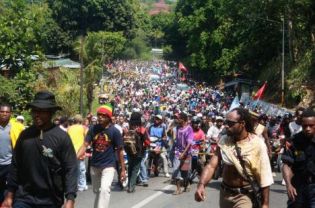
On 26 January 2011, thousands of Papuans from a variety of communities and churches took part in a demonstration calling on the Papuan provincial council, the DPRP, to halt the election of members of the MRP. The demonstrators called on the DPRP, the central government and the provincial government to respond to the eleven recommendations adopted on 9 June 2010 by the grand assembly of Papuan communities and the MRP.

[These recommendations included the call for a referendum to be held in West Papua, for the Special Autonomy Law 21/2001 to be handed back to the government and for a dialogue between the Papuan people and the Indonesian government. The first MRP was set up in 2006 in accordance with the provisions of this law. Since late last year, there have been many demonstrations in West Papua calling for the ‘return’ of the special autonomy law to the government.]

JUBI: New unit (UP4B) to be set up in Papua

JUBI, 9 February 2011

New unit (UP4B) to be set up in Papua

A new unit, UP4B -Unit Percepatan Pembangunan Papua dan Papua Barat – a Unit to Accelerate Development in Papua and West Papua – is to be set up in March this year for the purpose of handling a number of political and human rights problems as well as development which is still virtually stagnant.

‘As members of the Papuan Peace Network – JDP – we have decided to help the government in setting set up this body,’ said Muridan Widjojo of LIPI., the Indonesian Institute of Sciences.

Muridan said that LIPI had decided to get involved in this and help the
government, in the hope that this new body will not confine itself to
dealing only with social and economic issues such as development projects but will also prioritise the issue of human rights violations
and the political situation throughout West Papua so that these issues can be properly addressed.

‘We hope that the establishment of this body will be supported by all
those involved, so as to ensure that it does not confine itself only to
social issues but will also deal with the issue of human rights which
also needs to be prioritised.’

Muridan also said that the JDP hopes that the UP4B will be able to
advance the process of dialogue between the indigenous Papuan people (OAP) and the Indonesian government, mediated by a neutral international party, in order to get to the root of the problem. These problems should not be allowed to go on festering without end which can only mean that stability and the welfare of the Papuan people will continue to be disturbed.

————————–

[Another JUBI article reports that Muridan has called on the Indonesian president to deal seriously with the issue of dialogue between Indonesian and Papua, and will set up a special team for this purpose. We hope to post the item in full soon. TAPOL]

JUBI: Defining “orang asli” in Papua

The following item is from the newspaper JUBI and was published earlier this month (apologies for not having the precise date).

BPS criteria regarding orang asli Papua is strongly rejected

In connection with the criteria that were used by the Central Bureau of Statistics (Biro Pusat Statistik, BPS) for West Papua in the publication of its data about the census which was held some time ago, DAP (Dewan Adat Papua – Papuan Traditional Counsel) regards the criteria as incorrect.

He said: ‘Those said to be OAP – orang asli Papua- indigenous Papuans – are persons whose father and mother are OAP, because in accordance with the word ‘asli’, it must mean that there has been no inter-marriage whatsoever,’ said Forkorus Yaboisembut, the chairman of DAP.

He said that according to DAP, the status of OAP includes only two
criteria, which is that both the father and mother are orang asli
Papua, or the father is OAP but the mother is from outside. Persons who mother is OAP but whose father is not, cannot be said to be OAP.

According to Forkorus: ‘Their lives would also need to be considered to
see whether they have struggled and done anything in favour of Papuan interests. A referendum could not be held about the future of Papua if they were not to vote for independence,’ he said. ‘It was very clear that someone cannot be declared to be OAP without the knowledge of DAP, bearing in mind that DAP occupies the position of the protector of Papuan traditional rights in Papua.’

For the first time last year, the BPS produced six criteria for determining who is OAP, as follows:

1. Persons whose father and mother are both OAP.
2. Persons whose father but not the mother is OAP.
3. The mother is an OAP but not the father.
4. Neither parent is an OAP but they have been acknowledged as OAP.
5. Neither parent is Papuan but they have been recognised according to ‘marga’ or ‘keret’ as OAP.
6. The person has been domiciled in Papua for 35 years.

According to this definition, the number of Papuans in the province of
Papua Barat (West Papua) was given as being 51,.67 percent, of the total population of 760,000.

In view of all this, DAP hopes that the BPS will speedily correct their
data, because it is not possible for instance to say that an OAP can
include people who have lived in the province for a very long time.

JUBI on deplorable human rights situation in West Papua

JUBI, 8 February 2011

The National Human Rights Commission [Komnas HAM] in Papua has called on the Indonesian government to take responsibility for a number of human
rights violations that have occurred in West Papua.

‘It is for the government to resolve these problems,’ said Matius Murib,’ who insisted that the government must take responsibility for this situation. He said that if the government fails to do anything, the number of violations will continue to increase. ‘There is no other way out of the problem,’ he said. It was, he said a matter for the central and also the provincial governments.

He said he has the impression that the state has simply washed its hands of the issue. Nothing is being done about it. The evidence is, he said, that the provincial government has issued no special regulation to strengthen the hands of the local Komnas HAM. There was a need for a regulation that would strengthen the legal position of Komnas HAM.

———————–

JUBI 8 February 2011

KontraS, the Commission for the Disappeared and the Victims of Violence,
has raised the issue of the formation of a Commission on Truth and Reconciliation and a Human Rights Court in Papua.

Speaking on behalf of the Commission, Harry Maturbongs said that these two bodies should be set up in accordance with the Special Autonomy Law for Papua, 21/2001.

He also said that people were still waiting for the solution to a number of past serious human rights violations, such as the Wasior case and the case of the assault on an ammunition dump several years ago.

[Apologies for the brevity of these translations, but the printouts are almost illegible. Tapol]

AFP: Papuans Rally for Independence from Indonesia

Thousands of Papuans march in a rally in Jayapura on July 8, 2010 to urge the provincial parliament to demand a referendum on self-determination, and reject the region's special autonomy within Indonesia. (AFP Photo/Banjir Ambarita)

Hundreds of Papuans have protested in Jayapura rejecting the region’s special autonomy within Indonesia and demanding a referendum on self-determination.

Carrying a wooden coffin covered with a black cloth which said “Special Autonomy is Dead in Papua,” more than 1000 activists, students and church leaders protested on Wednesday in front of the provincial parliament, witnesses said.

“Independence for Papua, reject special autonomy,” they shouted.

“Indonesia the coloniser, Indonesia the oppressor, Indonesia the robber.”

They also called for the upper house of tribal leaders called the Papua People’s Assembly (MRP) to be disbanded.

“The MRP had done nothing to improve the welfare of Papuans. Our people are poor in their own land,” protest coordinator Selpius Bobi said.

“We reject special autonomy as that is the Indonesian government’s policy which has never supported the natives. We want a referendum that will allow us to determine our own fate,” he added.

Papua’s special autonomy status, introduced in 2001 after the fall of former president Suharto’s military dictatorship, has seen powers including control of most tax revenue from natural resources devolved to the provincial government.

However many Papuans say it has failed to improve their rights and activists accuse the Indonesian military of acting with brutal impunity against the indigenous Melanesian majority in the far-eastern region.

A court martial jailed three Indonesian soldiers on Monday for up to 10 months for abuse and insubordination after graphic video footage showed them torturing civilians in Papua.

The sentences were criticised by the United States and rights campaigners as too lenient.

Foreign media and aid workers are not allowed into Papua and West Papua provinces to investigate allegations of human rights abuses against the indigenous people.

Papua has been the scene of a low-level insurgency for decades and despite Indonesia’s vast security presence in the region, Jakarta remains extremely sensitive about any sign of separatism.

Indonesia has sent mixed messages about its willingness to loosen its grip on Papua, offering talks with separatist rebels on the one hand while jailing and killing their leaders on the other.
© 2011 AFP

Create a website or blog at WordPress.com

Up ↑