UN wants to send Special Rapporteur to Indonesia to investigate MIFEE


Bintang Papua, 12 October 2011The UN Commission to Combat Racial Discrimination and Protect the Rights of Indigenous People has sent a letter to the Indonesian ambassador to Geneva, Anwar Kemal, regarding several matters.

In the first place, to agree to invite the UN Special Rapporteur on Human Rights to visit Indonesia in connection with MIFEE, the Merauke Integrated Energy and Food Project in West Papua. In the second place to hold talks with CERD for this matter to be discussed at the forthcoming meeting of the Committee in Geneva from 13 February – 13 March 2012. And thirdly, to to make available comprehensive information regarding all the matters contained in the afore-mentioned latter.

This was made  public following a meeting by a number of NGOs in Jayapura on 12 October which was attended among others by Foker-NGO-Papua, Sawit Watch, Greenpeace, Justuce and Peace Commission/Jayapura, Walhi and Sorpatom in Jayapura on 12 October.

The Coalition of NGOs said that the response of the UN to the MIFEE project had exerted pressure on the Indonesian government to halt all activities related to the MIFEE project and to invite the UN Special Rapporteur on Human Rights to investigate this project before 13 January 2012.

The coalition said that MIFEE would have a strategically significant inpact on the availability of foodstuffs and energy resources in Indonesia.

This project will cover an area of 1.6 million hectares which will be used to produce millions of tons of rice, corn, beans and sugar as well as promote cattle-rearing. Dazzled  by this massive project, they have closed their eyes to a huge problem that will confront the population of Merauke whose land will be consumed by the MIFEE.project.

The MIFEE project is a highly ambitious mega  project of the Indonesian Government based on a slogan to produce food for the whole world. They intend to take control of an area of 1.6m ha of land for agri-business purposes. The resultant food will be exported, meaning that MIFEE is directed towards the export market. Thirty-six companies have already been attracted by the MIFEE project with investment capital to the value of Rp 18.9 trillion, along with domestic capital.

Research undertaken by various organisations has identified a number of problems.

First of all, this project which will cover a total area of  altogether 2m ha of land belonging to the indigenous people will have a direct impact on the traditional rights of the these people.

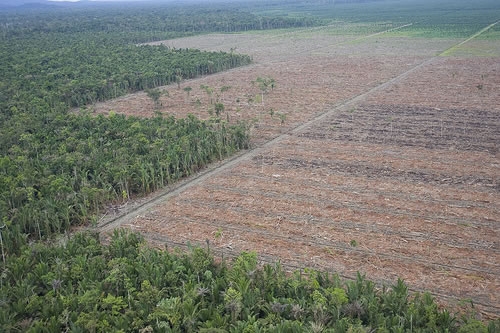
Furthermore,  this expansion will cut down forests belonging to indigenous people in order to grow  palm oil and will result in the influx of a huge number of people from outside the area, threatening the local people’s livelihoods and destroying their traditional economic practices.

These developments will exert huge pressure on the Malind people and their traditions in particular, and the Papuan people in general, turning them into a minority people in their own land.

In addition, these developments which are supported by various state forces will require the protection of the Indonesian army.

Fourthly, the decisions regarding exploitation of natural resources are hugely dependent on the central government and are being developed in accordance with national laws that ignore the indigenous people, despite the adoption of the Special Autonomy law in 2001, the aim of which was to decentralise decision-making to the provincial level with regard to a number of issues, while nothing has happened regarding the introduction regulations.for the implementation of this law.

Fifthly, it is understood that most of the MIFEE area has been classified as ‘forest’ and placed under the jurisdiction of the forestry department, whose interpretation of the forestry laws impinge on the rights of the indigenous people.

Finally, there are reports that local communities have been manipulated by investors and government officials so as to secure their signatures  to provide the legal basis for certificates affirming their right to the land of the indigenous people.

IRONIC SURVIVAL: Surviving MIFEE

Alex Mahuze is a Malind tribesman and a sago farmer in Merauke. His clan has for generations lived in harmony with nature. The arrival of the Merauke Integrated Food and Energy Estate (MIFEE) program has forced him to earn money through other means, which ironically harms the environment. He lost his lands and his culture is threatened, but Alex fights on.

[vimeo http://www.vimeo.com/29128486 w=500&h=400]

Originally at EngageMediaengagemedia.org/​Members/​papuanvoicesmerauke/​videos/​ironic_survival/​view

Re-uploaded by westpapuamedia as courtesy to Papuan Voices Merauke and EngageMedia: EngageMedia cannot share effectively due to software restrictions in embedding iframes across many platforms. This is temporary fix to help get it out further.

video information
produced by Papuan Voices [Merauke}
contact write the producer
produced Sep 15, 2011
distributor Papuan Voices [Merauke}

* Sago, or Metroxylon sagu is a species of palm in the genus Metroxylon. It tolerates a wide variety of soils and may reach 30 meters in height. Several other species of the genus metroxylon, particularly metroxylon salomonense and metroxylon amicarum, are also used as sources of sago through Melanesia and Micronesia. In addition to its use as a food source, the leaves and spathe of the sago palm are used for construction materials and for thatching roofs, and the fibre can be made into rope.

* Merauke Integrated Food and Energy Estate – MIFEE – was announced on 18 February 2010 by the former Bupati of Merauke, J.G Gebze and officially launched on 11 August 2010 by the Minister of Agriculture, Siswono Yodohusodo on behalf of the Indonesian President. The project involves 36 investors, 13 of whom are already operating in the area. MIFEE covers an area of 2.5 million hectares and plans to bring into the area a work force of four million people.

Tempo: Papua MIFEE Project Faces Criticism

http://www.tempointeractive.com/hg/nasional/2011/08/15/brk,20110815-351921,uk.html

TEMPO InteractiveJakarta:The Merauke Integrated Food and Energy Estate (MIFEE) Program has been accused of disenfranchising local farmers in Papua. Berry N. Furqon, director of the Indonesian Forum for the Environment (Walhi), said that more than 100,000 ha of forest had been cut down for the project, including the sago forest on which the locals depend upon.

Abet Nego Tarigan, executive director of Sawit Watch, called on the United Nations to cancel the project. Abet said the MIFEE could endanger Indonesia as it allows companies rather than farmers to control the food supply.

The MIFEE project was inaugurated by Agriculture Minister Suswono on August 11 last year. The program sees plantations in Merauke managed by companies that also manage the local farmers. One million ha, divided in five clusters, has been allocated for the program.

As many as 32 companies have obtained principle licenses and will operate in a range of plantation sectors, namely palm oil, sugar cane and corn among others. Companies that have invested in the program include Wilmar, Sinarmas, Bakrie Sumatera Plantation, Medco, Bangun Cipta Sarana and Artha Graha.

NUR ROCHMI

————————————–

2) Indonesia Turns Back on Papua Food Bowl Plan
Faisal Maliki Baskoro | August 15, 2011

After two years with little progress, the government is considering shifting the location of its planned food estate to East Kalimantan from Papua because of the availability of land.

Suswono, the agriculture minister, on Monday said there was 200,000 hectares of land in East Kalimantan that could be used as an agriculture cluster. Under its plan, the Merauke Food Industrial Estate would have about 2 million hectares.

“The principle of the food estate is finding enough land for an agricultural zone. It doesn’t have to be in Papua,” he said. “[The East Kalimantan site] may not as big as Merauke, but it is more feasible. It has been two years since we floated the plan, but there has been no progress at all.”

Suswono said land clearance regulations were partly to blame for the slow progress.

“The construction of the Merauke food estate was obstructed by lack of regulation to clear necessary land,’’ Suswono said.

The government annually imports 2 million tons each of rice and soybean, and the nation needs to be able to feed its people without importing food, he said.

He said the government and potential investors would seek suitable areas for producing the two crops.

“The land in East Kalimantan is good for planting rice,” he said. To grow soybean, the ministry would need at least 500,000 hectares, and the government was still looking for land in Kalimantan.

While East Kalimantan has 200,000 hectares of land free, the West Kalimantan administration said it could provide 100,000 hectares of land, he said.

Suswono said farmland would not interfere with the preservation of forests. “We will be using open land, and probably convert production forests to farms. We will also empower local people to get involved in the program.”

Ecosystem in Merauke must be preserved, says agricultural expert


JUBI, 11 August 2011
The District of Merauke has a very rich ecosystem  which needs to be  preserved and protected. The problem is that when forests are cleared, this damages much of the ecosystem and virtually destroys it.
Drs Sudirman, an agricultural expert at the provincial administration of Merauke district, speaking during a technical guidance event  in Wasur, said that as the  population increases, land will be cleared everywhere  which will have a very damaging impact on the ecosystem in forested regions.
‘One example: When forests were cleared to make way for the MIFEE (Merauke Integrated Food and Energy Estate) project, recently, a significant part of the ecosystem was lost and much of is it already dead. It is the responsibility of everyone concerned  to think about the best way to deal with this problem so as to ensure that the ecosystem is not damaged.’ he said.
He said that the TH Wasur region in particular has a large number of species which means that it is the responsibility of everyone, including the original inhabitants of the district, to play their part in preserving  the ecosystem.

Cabinet minister visits Merauke to promote the MIFEE project

JUBI: 27 June 2011

On his first visit to Merauke to see preparations for MIFEE, the Merauke Integrated Food and Energy Estate, Marie Pangestu, the Minister of Industry and Trade said that the customary rights of the local community should be dealt with first, by issuing certificates, in connection with the MIFEE project that is being developed in the district of Merauke. The land which will be used for planting must be suitable for whatever crops are to be grown there.

The minister was speaking to journalists after flying over the land that will be used for the MIFEE project.

‘I have been closely following the discussions and reports about this projects which have been taking place at the centre. And now, I have come to see things for myself at close range and I have come to the conclusion that the land is very suitable indeed for agricultural production. ‘

He also said that he had received a short account from the Merauke governmental chief about the plans being made for the project, as well as measures for its implementation and land usage. Companies planning to invest can now go ahead to acquire the necessary licences and start planting their crops.

He went on to say that it was now necessary to build the necessary infrastructure, in particular harbours to support the project once it gets underway. For instance, he said, investors who intend to establish palm oil plantations will need harbours of their own.

[COMMENT: The central government will clearly be investing huge sums of money to promote the interests of companies planning to invest in MIFEE. Not at all clear what is meant by issuing certificates to the local communities whose customary rights to the land will be sacrificed as investors are invited to grab their land with little regard for the loss of their livelihoods based on hunting and fishing. No mention either about whether the rightful owners of the land will be granted any compensation for the loss of their land and the destruction of their livelihoods. TAPOL]

Create a website or blog at WordPress.com

Up ↑