Treason trials hand down guilty verdict on Congress leaders: reports

from West Papua Media sources in Jayapura

March 16, 2012
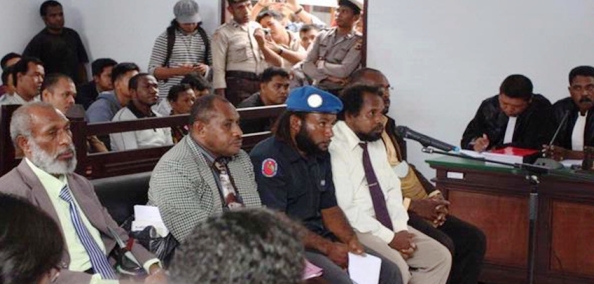
Papuan leaders accused of treason on trial in Jayapura, January 30, 2012

(Jayapura):  Hundreds of security forces are on the streets around Jaypura, West Papua, in a show of force as an Indonesian court found five Congress leaders guilty of Makar (treason), and sentenced the defendants each to three years in prison.

The five defendants, Forkorus Yaboisembut, Edison Waromi, Selfius Bobii, Dominikus Sorabut, and Agus Kraar, were leaders and organisers of the Third Papuan People’s Congress held on October 19 2011, which was brutally broken up by Indonesian security forces after Forkorus  – the Chairman of the Papuan Tribal Council elected as President of the Federated Republic of West Papua – unilaterally reaffirmed West Papua’s independence from Indonesia.

Today’s hearing at the Jayapura Class 1A District Court, the 15th hearing in a trial described by international observers of “descending into farce”, closed after the panel of judges led by Jack Johan Oktavianus declared that the defendants had committed treason under Article 106 of the Indonesian Criminal Code.

During the trial, several Indonesian Brimob paramilitary police officers who opened fire on the Congress gathering, admitted they had no proof that the accused had committed treason before they opened fire on unarmed civilians.

No member of the Indonesian security forces, who during the breakup of Congress were filmed committing acts of brutality and violence on unarmed civilians, were criminally charged and so far have not receive any sanction for the unprovoked attack.

On March 14, another defendant from the Third Papuan Peoples’, Gat Wenda, was also found guilty of makar charges, but was sentence to five months gaol, less time he has already served since his arrest.

Lawyers for the defendants, themselves under threat of prosecution and harassment by Indonesian security forces for their advocacy for the accused, have planned to appeal the decisions, saying “we think this decision is a disaster.”

In SMS messages sent from the legal team to West Papua Media, senior lawyer Olga Hamadi said “we think the judgement from the full bench is out of tune with what actually happened.  We will appeal this to the High Court”.

Gustaf Kawer, another senior member of the legal team, also told West Papua Media via SMS that “the judges considered ambiguous and inconsistent testimony.  (Yet) there is evidence of free expression and democracy that was ruled,” Kawar said, referring to the democratic rights and obligations adhered to by the Congress leaders.

A massive show of military hardware has caused major fear on the streets of Jayapura, with most poeple staying away from demonstrations for fear of an imminent military crackdown.  600 Heavily armed Brimob riot police and 300 Indonesian army soldiers are surrounding the streets around the court, backed up by several water cannon, 13 Barracuda armoured vehicles, and seven Army Panzers (assault vehicles).

Security forces today have, according to local civil resistance sources, used this show of force to actively prevent supporters of the accused to attend court.

The atmosphere has been described as highly tense with Papuan supporters of the convicted men outraged, but terrified, according to SMS messages from sources on the ground.

westpapuamedia

This is a developing situation – please stay tuned.

HRW: Five Papuans Convicted for Peaceful Protest

English: Human Rights Watch logo Русский: Лого...
Image via Wikipedia

For Immediate Release

From HUMAN RIGHTS WATCH

Indonesia: Five Papuans Convicted for Peaceful Protest
Amend Treason Law to Uphold Free Speech

(New York, March 16, 2012) – The Indonesian government should drop the politically motivated treason charges against five Papuan activists who were convicted on March 16, 2012, and order their release, Human Rights Watch said today.

The district court in Jayapura, the Papuan provincial capital, convicted the five men and sentenced them to three years in prison for statements made at a Papuan People’s Congress in October 2011. The demonstration was brutally suppressed by the authorities, leaving at least three people dead. The five men convicted on March 16 are Selpius Bobii, a social media activist, August Sananay Kraar, a civil servant, Dominikus Sorabut, a filmmaker, Edison Waromi, a former political prisoner, and Forkorus Yaboisembut, a Papuan tribal leader.

“If the Indonesian government wants to make an example out of these people, then it should free them as a symbol of its commitment to free expression,” said Elaine Pearson, deputy Asia director at Human Rights Watch. “Instead, the legacy of the Papuan Congress crackdown will be five unjust convictions, while those responsible for the violence go unpunished.”

On October 19, 2011, in Jayapura, Indonesian security forces used excessive force to break up a three-day People’s Congress demonstration supporting independence for Papua, Human Rights Watch said. After Yaboisembut, one of the leaders, read aloud the 1961 Papua Declaration of Independence, police and the army fired warning shots to disperse the approximately 1,000 Papuans gathered. The security forces then used batons and in some instances firearms against the demonstrators, killing at least three and injuring more than 90 others. Witnesses said that demonstrators had been struck on the head and several suffered gunshot wounds.

Following the incident, 17 police officers, including the Jayapura police chief, Imam Setiawan and seven of his subordinates, were given written warnings for committing a disciplinary infraction by not giving priority to the protection of civilians. However, no other action was taken against police or military personnel for possible misuse of force.

The trial of the five activists raised serious due process concerns, Human Rights Watch said. During the trial, the defense told the court that police questioned their clients in the first 24 hours of arrest without the presence of lawyers. The defense also alleged that the men were beaten by police while in custody. Police allegedly kicked Yaboisembut in the chest and beat his head with a rifle butt. Sorabut testified that the police beat him on his head with a pistol and struck his body repeatedly with an M-16 assault rifle. Kraar said he was hit by police twice on the head with a pistol.

Human Rights Watch renewed its call for the Indonesian government to release all political prisoners and allow human rights organizations and foreign journalists unimpeded access to Papua.

The Indonesian Criminal Code should be amended to ensure that no one is prosecuted for treason for exercising their rights to peaceful protest protected under the Indonesian constitution and international law, Human Rights Watch said. The constitution, in article 28(e), states, “Every person shall have the right to the freedom of association and expression of opinion.” Article 28(f) provides, “Every person shall have the right to communicate and obtain information for the development of his/her personal life and his/her social environment, and shall have the right to seek, acquire, possess, keep, process, and convey information by using all available channels.” The International Covenant on Civil and Political Rights, which Indonesia ratified in 2006, similarly protects the rights to free expression and peaceful assembly.

Human Rights Watch takes no position on claims to self-determination in Papua. Consistent with international law, however, Human Rights Watch supports the right of everyone, including independence supporters, to express their political views peacefully without fear of arrest or other forms of reprisal.

“Throwing activists in prison on charges of treason will just reinforce Papuans’ beliefs that the Indonesian government uses the law for political purposes,” Pearson said. “And while the government is busy prosecuting peaceful protesters, it seems to have had no time to investigate adequately the violence against them.”

To read the October 28, 2011 Human Rights Watch news release, “Indonesia: Independent Investigation Needed Into Papua Violence,” please visit:
http://www.hrw.org/news/2011/10/28/indonesia-independent-investigation-needed-papua-violence

To read Human Rights Watch’s report on political prisoners in Indonesia, please visit:
http://www.hrw.org/reports/2010/06/23/prosecuting-political-aspiration-0

For more Human Rights Watch reporting on Indonesia, please visit:
http://www.hrw.org/asia/indonesia


Stop criminalising lawyers and human rights activists in makar cases

JUBI, 5 March 2012
Chairman of the Garda KPP P Bovit Bofra (Jubi / Arjuna)


Bearing in mind the continual terrorising of defence lawyers during the makar (treason) trial  [now under way in Jayapura] and  of human rights activists as well as journalists covering the trial, the central executive of GARDA-P , the Movement for People’s Democracy has called upon the security forces to put an end to all of their attempts to silence these people.

In a press release issued by GARDA-P on 5 March, it called for an end to the criminalisation of the lawyers defending Forkorus Yabisembut and his four co-defendants. They also urged the Indonesian government to  dismiss the head of the Public Prosecutors Office, Julius D Teuf, SH and replace him because he has been deliberately attempting to criminalise the defence team of Forkorus and his co-defendants.

‘We also call on the prosecutors to stop their questioning during which they have made offensive and insulting remarks  about the defendants and also about the Papuan people during the trial.We call for the unconditional release of the defendants and for an end to all the violence and  prohibitions  against journalists wanting to report the trial hearings because the trial is being held in public.’

GARDA-P said that during makar trials in Papua, the defence lawyers  are always being subjected to threats and terror by the security forces because they are defending persons who are being charged with makar.

Not only the lawyers but also the judges  are threatened and subjected  to interruptions, to ensure that the hearings comply with the interests of the state. Not only that, but also the bags of the defence lawyers are searched  before they enter the court.for the trial of Forkorus and his co-defendants.

GARDA-P  also said that the police on duty frequently carry weapons outside the courthouse in order to terrorise the defendants and their lawyers. and seek to threaten journalists who are reporting the trial which is open to the public.

GARDA-P regards these actions as being attempts to influence the court proceedings  in order to ensure that the police and the prosecutors make heavier demands for those facing  makar charges.

‘During the hearing on 24 February, while witnesses were being questioned, the prosecutor was constantly interrupting the questioning which greatly angered the defence lawyer, Gustaf Kawar, with the prosecutor now seeking to exclude Gustaf Kawar from the defence team. Such actions are an attempt to cause division (among the lawyers) and to make things more difficult for the defendants.’

‘Saying that there are no political prisoners in Papua is a Lie’

Bintang Papua, 7 March 2012Following a statement that has just been made by Amir Syamsuddin, the Minister for Law and Human Rights claiming that there are no political prisoners (tapol/napol) in Papua, various human rights groups as well as Mama Yosepha, the Director of  the Human Rights and Anti-Violence Foundation, and Markus Haluk, a well-known Papuan human rights activist, have responded.

Mama Yosepha and Markus Haluk said: ‘This statement by the Minister for Law and Human Rights shows the extent of the lies being made in public, which came after the dialogue organised by Amnesty International  last November. The Minister said that there were no political prisoners in Papua, only criminal prisoners. This is in line with the racist policies that are used against the Papuan people,’ said Markus Haluk.

Mama Yosepha and Markus Haluk said: ‘We are well aware of the denials and lies continually being spread by the Indonesian government through the Minister for Law and Human Rights. This is happening systematically in relation to the true facts that are known to the Papuan people. Since late 2011, five political prisoners have been on trial, Forkorus and his four colleagues, who are facing the charge of makar – treason – in connection with the declaration made by the Federal Republic of West Papua in October 2011 on Zakheus Square, Jayapura. In addition, from 2008 – 2010, sixteen political prisoners have been in custody in Manokwari while in Fak-Fak there are as many as sixteen prisoners, as well as fifteen in Nabire, four in Mamberamo Raya, one in Biak who is being held in  Abepura prison, and of all these, four are convicted prisoners, plus another six in Timika , which means that from 2008 to the present there have been 67 political prisoners.’

Markus went on to say that there are around ten political prisoners being held in connection with the assault on the ammunition dump in Wamena in 2003 who are now in  custody in Nabire and Biak prisons,while Filep Karma has been in custody since 2004, having been sentenced to fifteen years  and is being held in Abepura Prison, which brings the total since 2008 to seventy-two tapols and napols (tapol refers to detainees, while napol refers to convicted prisoners).

The fact that there are political prisoners in  Papua  was officially acknowledged by the head of  the Papua office of the Ministry of Law and Human Rights, Drs Daniel Biantong in 2010, when he produced a list of 25 persons registered as tapol and napol throughout Papua.

‘The demands for sentencing have varied from eleven months to life imprisonment. This can be broken down as follows: one person for eleven months, two persons for three years, three persons for five years, one person for six years, one person for ten years and one person for fourteen years, as well as three persons who  were sentenced to fifteen years, five who were sentenced to seventeen years, four to twenty years, while two were given life sentences. In all these cases, the prisoners were charged with makar under Article 106 of the Criminal Code,’ he said.

If we go farther back, said Markus,  following the dialogue held on 26 February 1999 during the presidency of B.J.Habibie , all political prisoners who were then being held in Papua were released. However, one year later, in 2000, many Papuan leaders  and ordinary Papuans were arrested and put on trial for makar, and this has been going on up to the present day.

Mama Yosepha,  said: ‘We human rights activists in Papua  have been firmly insisting that there are tapols and napols in Papua, and they are not criminal prisoners. We urge on the Indonesian government to stop spreading lies  and making racist remarks, like talking about murders, arrests and detentions with regard to Papuan leaders and ordinary Papuans here in the Land of Papua. Instead they should release Papuan leaders such as Forkorus Yaboisembut and Edison Waromi as well as the three others with them and lift the makar charges that are being made against all five of them.’

She went on to say: ‘Bearing in mind the statement made by the Minister for Law and Human Rights last  year and then on 5 March 2012, and bearing in mind too that Indonesia is now a Democratic State,what should happen is that the Indonesian government should release all the political prisoners who are now being held throughout Papua  as well as outside Papua.’

She went on to add: ‘We urge the Indonesian government to allow complete access for diplomats, journalists, human rights workers, members of Senates and congresses [around the world] to visit Papua.’

Filep Karma undergoing Medical care at Hospital DOK II

by a special correspondent in Abepura for West Papua Media

March 3, 2012

(Edited and abridged in translation by WPM)

Concerns have been raised again over the health of internationally renowned West Papuan political prisoner Filep Karma, after a series of visits to hospital to treat his worsening health, amid atrocious conditions in the notorious Abepura prison.

Filep Karma is a political prisoner sentenced to 15 years imprisonment by Indonesia after being found guilty of makar (treason) for making a speech calling for independence and raising the banned Morning Star flag on December 1st 2004.

(Gaoled in atrocious conditions and subjected to early routine torture by Indonesian security forces and prison officers, including beatings causing internal injuries, Karma’s health has been declining since 2008, also due to numerous hunger strikes and illness caused by prison conditions in Abepura prison.  Additionally, In response to a petition filed by Freedom Now, the United NationsWorking Group on Arbitrary Detention issued its opinion that the Government of Indonesia is in violation of international law by detaining Filep Karma. Amongst many other international voices, the Working Group called on the Government of Indonesia to immediately release the human rights advocate. – WPM)

He underwent medical checkups at Hospital Dock II, and underwent a colonoscopy by a Dr Arnold, on 17 February 2012, to check his intestines. He underwent the check because up until this point he regularly discharged blood when using his bowels. The results of the check were to be taken on February 21st, 2012. At the same time he also was assessed by a neurologist, Dr. Nelly Rumpaisum, because for the previous few days he felt the pain to the right of his hip when getting down to clean clothes, and now also when standing. When undergoing the examination, Fliep was accompanied by two officers and a doctor from Abepura prison. Filep was to return to the Hospital II, to undergo X-rays of his waist.

At this time, Filep cooked his own food in prison. He used a traditional stove himself, with milk cans and axes, lit with coconut oil. ‘Eating my own cooking is better for my health at the moment, because if I eat food from Abepura Prison, there can sometimes be a lot of seasoning, and this is less suitable for the condition of my body while undergoing medical treatment at the moment’, he said.

On 21 February 2012, according to Dr. Donald Arronggear at the time of the colonoscopy results, ”Filep is affected by inflammation of the intestine next to the anus, so that he must eat foods high in fibre, like fruit and vegetables”, he said. He also received various medicines from the doctor to drink when back in prison. He also did x-rays on the right side of the waist, and the results were to be checked again on 24 February 2012.

Filep Karma will undergo physiotherapy

On several weekends, Filep Karma underwent some medical treatment at the Hospital Dok II. He was accompanied by two prison officers and doctors from Abepura Prison. On 24 February 2012, he received sequence number 2 at the polyclinic at Hospital DOK II. Filep took the x-rays to neurologist, Dr. Nelly Rumapaisum. According to Dr. Nelly ”The right side of Filep’s waist, has narrowed. So, it must to undergo physiotherapy for 12 sessions. Filep can no longer lift heavy equipment and also sports is a high-risk”, said Dr. Nelly.

Filep Karma said that ‘my waist has already been sore for a while, but it felt sore for a few weeks so it had to be checked”. Filep Karma also must use a corset after undergoing physiotherapy (a very uncomfortable apparatus in the sweaty conditions of the prison – WPM) . He will undergo regular physiotherapy and will be back and forth to the DOK II Hospital for ongoing care.

“My desire is also to be an inpatient at DOK II Hospital, while undergoing physiotherapy, because the distance between the Prison Abepura and Jayapura is about 60 minutes, which makes me making a little exhausted on the journey”, Karma said.

See Also : FILEP KARMA REFUSES INDONESIA’S REMISSION Aug 20, 2011 – Video report by Cyntia Warwe

Create a website or blog at WordPress.com

Up ↑
