By Nick Chesterfield from West Papua Media with local sources
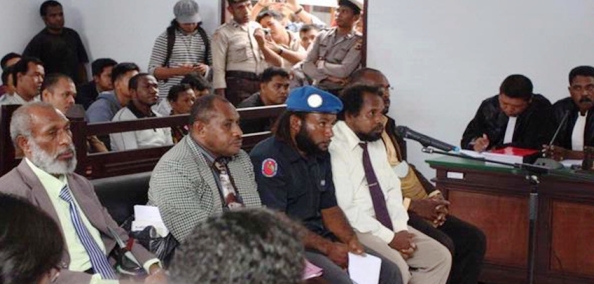
(Jayapura) The treason trial against the leaders of the Third Papuan People’s Congress in Jayapura was adjourned on Monday until February 8, after a short hearing that Indonesian authorities moved at the last moment preventing many supporters from attending.
The five defendants, President of the Federated Republic of West Papua (FRWP) Forkorus Yaboisembut, Prime Minister Edison Waromi, together with Congress organisers Selpius Bobii, Dominikus Sorabut and Agus Sananay were charged with makar or treason under Article 106 of KUHP (the Indonesian Criminal Code) for their declaration of an independent West Papua at the close of the Third Papuan People’s Congress on October 19 last year.
Papuan leaders accused of treason on trial in Jayapura, January 30, 2012
The historic Congress was violently broken up by Indonesian security forces using live fire and excessive violence, with at least seven people killed, hundreds beaten and tortured, despite official permission for the event to be held. Indonesian security officers involved were given minor disciplinary sanction, with most perpetrators of violence enjoying complete impunity despite footage of the Indonesian security force violence being broadcast internationally.
Initial reports from witnesses inside the trial early in the day claimed that the team of judges argued with the defence legal team about the need to know the political position of the defendant’s, despite the fact that in a treason trial this would be self-evident. Yaboisembut and Waromi then fundamentally rejected the charges against them, arguing that their actions were not treason“.
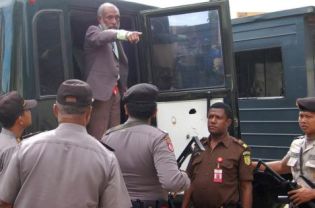
Forkorus Yobeisembut (Jakarta Globe)
According to Forkorus as reported by the Jakarta Post, “What we have been doing is seeking our own independence. Thus, we have cheated no one,”. Forkorus argued that Indonesian occupation of his homeland was the real issue, and that ”this problem is not the problem of separatism and rebellion or treason”. Both Forkorus and Waromi said that the issue of Papua should be tried in international courts as the Indonesian state did not have jurisdiction over Papua.
Forkorus Yaboisembut (Jakarta Globe)
in a short statement sent to West Papua Media, the defendant’s legal team said that the judge asked Forkorus and the accused understood the indictment. “He answered that, yes, he understood what the prosecutors read but did not understand the charges of treason against them.”
“Forkorus then asked for time to read a statement to the assembly to process the rejection of the law, (the request of) which was then approved by a judge. Our attorneys will do the rebuttal (exception) to the indictment dated 8th February 2012,” according to the legal team led by Hamadi.
(Photo: Efraim Joteni)
Bintang Papua reported that another one of the lawyers for the accused, Gustaf Kawer,said that up to 32 lawyers from across Papua and Indonesia had offered pro-bono defence of the treason accused. He said: ‘I am convinced that the large number of lawyers who are attracted by the case is a good sign of interest in the need to find a solution to the problem of Papua.’
Forkorus Yaboisembut and Edison Waromi media interview after trial.(Photo: Efraim Joteni)
The Panel of Judges hearing the trial are Chairman of the Jayapura District Court of Class IA, Jayapura, Papua, Jack John Octovianus, SH. MH,; assisted by I Ketut Nyoman S, SH. MH. Syor Mambrasar, SH. MH. Orpah Marthina, SH. and Willem Marco Erari, SH.
Outside the court hearing, almost 400 hundred heavily armed riot police and a similar number of Army and Kopassus personnel were guarding the courthouse venue from dawn (0600) with close to a dozen armoured assault vehicles, mounted with heavy machine guns, according to participants.
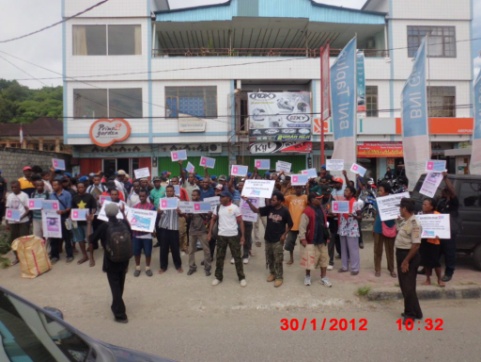
Protest in support of West Papuan leaders in trial for treason (Photo: Efraim Joteni)Protest in support of West Papuan leaders in trial for treason (Photo: Efraim Joteni)
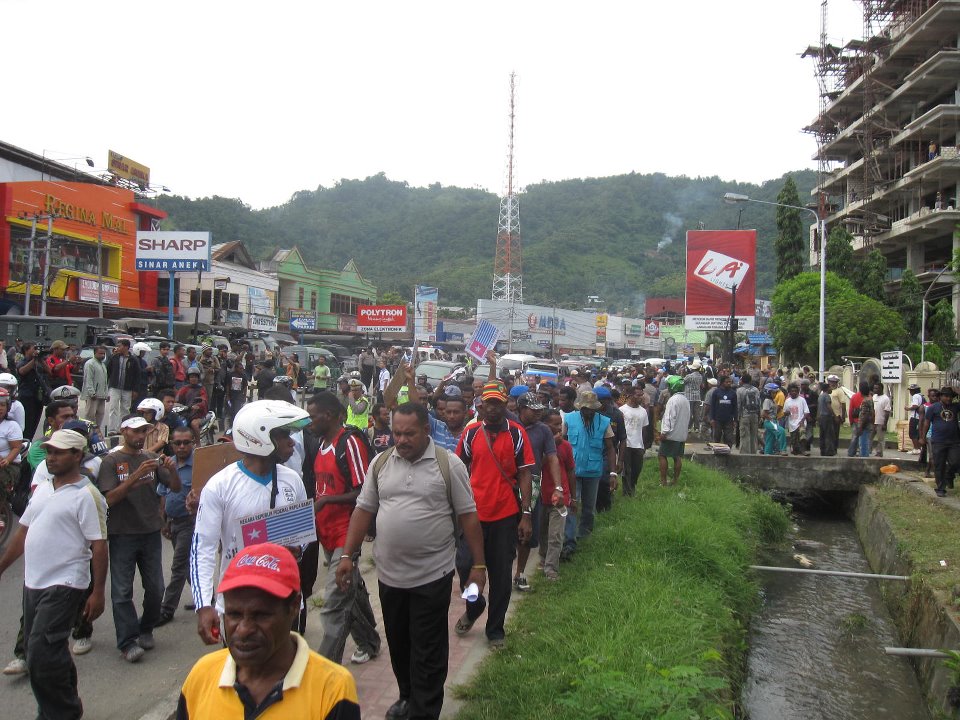
Participants in the protest claimed to West Papua Media via SMS that security forces were acting in a heavy-handed manner, describing their actions as “wild and aggressive”. “This display of armour makes thousands of ordinary people in Jayapura traumatized and afraid to come to action,” said Jack Wainggai, the spokesman for the Prime Minister of the FRWP, Edison Waromi, on trial for treason today. Organisers had aimed for several thousand people to attend, but amid heavy Indonesian security that discouraged solidarity protests by West Papuan supporters of the defendants, only 500-600 braved the heavy armour and “state intimidation” outside the court.
Protest in support of West Papuan leaders in trial for treason (Photo: Efraim Joteni)Brimob outside makar trial (Photo: West Papua Media)Brimob outside makar trial (Photo: West Papua Media)one of almost a dozen armoured vehicles securing outside court venue Jan 30 2012 Jayapura (Photo: West Papua Media)
Despite promises by Indonesian authorities that the trials would be open, the presiding judges secretly started proceedings at 8.30 am before supporter could arrive. In a press statement before the trial, Bintang Papua reported that Olga Hamadi of Kontras Papua said, “The five men will face charges under Article 106 of the Criminal Code for subversion. Based on past experience, there are concerns regarding security during the trial which will be open to the public, meaning that anyone wishing to attend the trial will be able to do so.” Hamadi urged all present to restrain themselves and ensure that conditions surrounding the trial are conducive.
Speculation has mounted amongst local observers that the trial may be moved from Jayapura to metropolitan Indonesia to reduce any potential political flashpoint it will cause amongst pro-independence forces in Papua, with the prosecutor’s office formally warning of such a move should unrest occur. Conversely though, any shift would create more opportunities for international observers to be present at the trial, a basic condition called for by the defence and international human rights monitors.
After the adjournment, the few hundred that did attend were able to disperse peacefully without an Indonesian security force crackdown, but tension still remains high in Jayapura as armed troops are still deployed on the streets the following day.
Elsewhere in Papua, solidarity actions were held with the treason trials against the Congress leaders. In Manokwari, orations were held calling for international peacekeepers to be deployed to protect West Papuan people from Indonesian state violence. Calls were also made in Manokwari for neutral international mediators for dialogue between Jakarta and the Federated Republic of West Papua.
Harrowing accounts of terror and intimidation are emerging from villagers and human rights workers in the remote Paniai district in West Papua overnight, as a massive Indonesian military assault against National Liberation Army guerrillas continues.
Local human rights and church sources are reporting that ordinary villagers are being subjected to significant human rights abuses by a combined Indonesian police and military force, and have called for immediate international intervention in West Papua to stop the violence.
Over four full strength combat battalions of Indonesian army (TNI) Kostrad commandos from Battalion 753, Brimob paramilitary police, and elite counter-terrorism troops from Detachment 88 – all units armed, trained, and supplied by the Australian Government – were deployed in an offensive to surround the headquarters of the Paniai Free Papua National Liberation Army (TPN-OPM), under the command of General Jhon Yogi.
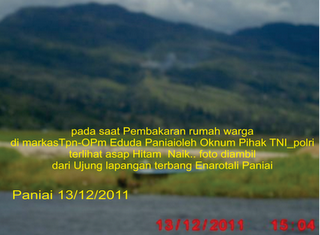
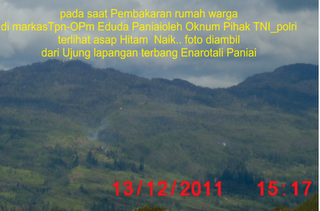
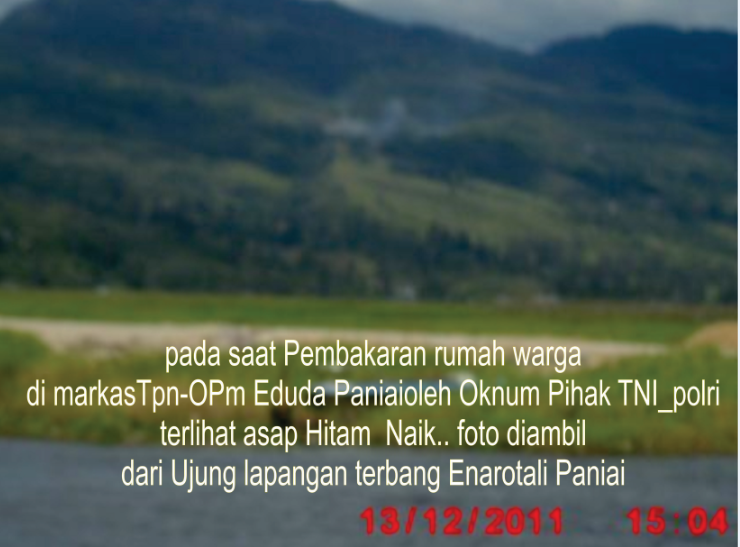
TPN/OPM headquarters Markas Eduda burning after TNI attack, 13/12/2011, Paniai, PapuaPaniai villages burning after TNI attack, 13/12/2011, Paniai, PapuaTPN/OPM headquarters Markas Eduda burning after TNI attack, 13/12/2011, Paniai, Papua
Punitive village burnings and raids are continuing in remote villages around the TPN/OPM headquarters of Markas Eduda. At the time of writing, seventy-five houses, six schools, and about 25 other buildings have been recorded as burnt down in a total of 27 villages by Indonesian security forces.
Eighteen people are now confirmed dead – fifteen from gunshot wounds, and three refugees who allegedly succumbed to starvation in the so-called care centres under the control of security forces. The victims’ names from the attack in Eduda are:
Dead:
Tapupai Gobay (30) was shot in the chest.
Tawe Bunai Awe (30) head crushed*.
Uwi Gobay (35) was shot in the abdomen.
Wate Nawipa (25) was shot in the back.
Martinus Gobay (29) head crushed*.
Owdei Yeimo (35) was shot in the back.
Ruben Gobay (25) was shot in the abdomen.
Paul Gobay (42) was shot in the abdomen.
Bernadus Yogi (23) was shot in the chest.
Demianus Yogi (15) was shot in the back.
Simon Kogoya (40) was shot in the abdomen.
Simon Yogi (30) was shot in the head.
Luke Kudiai (25) was shot in the chest.
Alfius Magai (20) head crushed*
Note: those with “head crushed” allegedly sustained these fatal injuries through severe beatings with rifle butts and “boot stamping”, according to sources
Wounded:
Paschal Kudiai (15) hit by a bullet in the head.
Martinus Kudiai (30) was shot in the hand.
David Mote (40) was shot in the thigh.
Amandus Kudiai (43) was shot in the arm.
Yohan Yogi (21) was shot in the leg.
Mon Yogi (20) was shot in the back.
Credible reports have also confirmed that two civilian “company” helicopters were provided to Security forces, and were allegedly used to drop live grenades and chemical dispersal weapons onto villages surrounding Eduda, and strafe villages with sniper and machine-gun fire on December 13, 14, and 15. Several independent witnesses have claimed to West Papua Media, and reported elsewhere across social media, that the helicopters are well known in the area for local non-military operations.
"Company" Helicopter alleged by local sources to be used in Indonesia security force offensive in Paniai. Source claims photo taken on Dec 13 aas helicopter was circling group. This photo is not independently verified, however analysis shows the image is consistent with independent witness descriptions, and the terrain and weather conditions are consistent with other photos supplied. (West Papua Media source)
Witnesses interviewed by local human rights workers have claimed that at 0800 local time on December 13, the Company helicopter launched CS gas salvos into the village of Markas Eduda, the TPN headquarters, to flush out villagers and guerrillas. According to a separate account sent to West Papua Media by TPN/OPM sources, the helicopters landed troops and occupied Eduda for most of the day, with guerrillas taking to forests in retreat. In retaliation, TPN/OPM fighters shot at the helicopters, unsuccessfully, and several hours of intense fighting ensued which was suspended when Free Papua fighters witnessed many village houses and schools being simultaneously burnt in the surrounding area. According to the TPN/OPM source, villages were set on fire around Eduda and gunshots were heard for the rest of the day and through the night. Free Papua fighters have retreated to the forest and are awaiting orders for their next moves, according to the source.
Villagers from across Paniai are continuing to be displaced by the operations, forced to flee en masse into areas around Enaratoli, on the opposite side of Lake Paniai. As reported on December 14 by West Papua Media, over 131 villages have been abandoned causing at least 10800 Paniai villagers to flee the military operations.
Church sources have further reported that refugees seeking shelter in the Enaratoli area are enduring worsening conditions without any relief. Armed Indonesian security forces have established a police supervised secure “Care Centre” at Uwatawogi Hall in Enaratoli, and have crammed into it 1715 people from Kopabutu and Dagouto villages. According to local activists in reports to West Papua Media, local residents are being threatened with arrest and beatings if they try to provide detainees with adequate humanitarian relief. Police are also preventing people held at the hall from leaving for food or sanitation needs, according to sources. At the time of writing, three people have died at the “care Centre” since December 9 from Diarrhoea. They are :
OTOLINCEA DEGEI age 2 years , died 8:20pm, 9/12/11;
YULIMINA GOBAI Age 4, died 3pm, 14/12/2011;
ANNA DEGEI Age 47, died 1030pm, 14/12/2011.
No food, sanitation or medical aid has been made available by any government agency to give relief to this large number of internally displaced people.
Over 9000 refugees are either hiding in the forest or seeking shelter with their own extended families in the region area. Those with their families are considered safe, however their needs and conditions are difficult to monitor and assess given their isolation
Local teachers have also been in contact with West Papua Media’s stringers. Since 27 November 2011, teaching and learning activities have been suspended indefinitely in all village schools surrounding Markas Eduda. Schools such as SD YPPK in Badao Dei, Yimouto, and Obayauweta villages have been suspended, as has Primary, Junior High, “shop” (trade school) and Elementary Instruction in the towns of Dagouto, and Uwani. The students of these schools have been evacuated with their parents.
A teacher in junior YPPGI Uwani said while repression was occurring in the villages that: “For while we have closed the schools, because school children are frightened and fled with their parents. In addition, we as teachers do not feel safe to make teaching and learning activities. All the teachers have fled Paniai district, and to Nabire. “
On December 15, the army / police battalions have returned to the villages of Uwamani, Dei and Obaipugaida to prepare a major attack for a new phase of the campaign. It is believed strongly by local activists that the “company” helicopter will still be used in addition to Unconfirmed reports have been received by West Papua Mediathat the Indonesian arsenal against civilians in Paniai includes one Mil Mi-24 SuperHind gunship, one of two usually stationed near Jayapura.
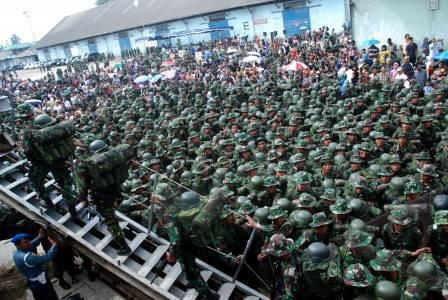
650 Kostrad troops from Battalion 142 being deployed from Palembang to Paniai in Papua, boarding their troop ship on December 9, 2011
West Papua National Committee (KNPB) activists in Paniai reported on December 15 that after the assaults on villages, the Indonesian military forces are now arresting, intimidating and carrying out interrogation on all residents across the districts of Toko, Kopabaida and Uwamani. According the KNPB, Indonesian police have arrested scores of children and adults, and are conducting brutal and physical interrogations and questioning from 11.00 am until the end of the day
The offensive was ongoing throughout December 15, with Indonesian security forces opening fire in many locations around Eduda. Overnight, from 0200 to 0600, heavy gunfire erupted across the Degeuwo River valley. Human rights sources in villages and also with refugees conveyed reports that people were being shot at by snipers if they were moving anywhere after dark, even to collect, food, water, or to secure pigs. It is not known how many people were killed during the night, but local source are expecting the toll to rise.
According to a report provided tonight by a local pilot, Indonesian security forces shot eleven times into houses in the village of Gekoo, where mourners were gathering for a the funeral of a local man who died from illness. Villagers alleged that some bullets even landed in their cooking fires, exploding their food pots.
Witnesses reported a series of helicopter raids from 11am on December 15, with helicopters being used to machine-gun the villages of Obaiyepa and Uwaman. Human rights workers have been unable to access these areas to see if any casualties were sustained.
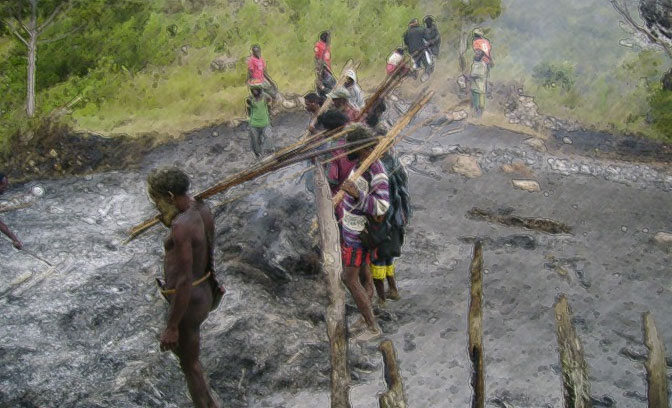
Unidentified village burnt down 13, dec 2011, near Eduda, Paniai
Helicopters landed at Eduda ceremony ground 11 times from 11:00 to 13:00 hours, and residents suspect logistics, ammunition and additional forces were being deployed.
The area around Paniai has been long subject to conflict and heavy Indonesian military offensives against civilians, however in recent months the Indonesian police have taken charge of punitive operations against West Papuans harbouring pro-independence sympathies. The conflict has recently escalated over land rights and the control of local gold mining operations, with Brimob deeply involved in both joint venture security, and direct involvement in gold businesses and associated activities. The Australian gold mining company Paniai Gold is also operating in the Degeuwo River region.
Indonesian soldiers in Paniai, December 2011
Civilians in the foothills are in panic and reliving the trauma of past operations, according to the report from a local pilot. “They are concerned emotions again will open in Wegeuto of the 1982 war Memoria Passionis (memory of suffering) and again when the Army conducted ongoing military operations (DOM – Daerah Operasi Militer) from 1989-1993 across the Badauwo area, near Eduda, ” the source said via email. He explained that during the last DOM period the army accused and stigmatised civilians as being members of the TPN-OPM, and subsequently tortured thousands of villagers. Human rights sources at the time documented villagers being waterboarded / tortured for 24 hours; residents’ houses burned, raped girls and married women, extrajudicial killings, burning off fingers, moustaches and beards, pulling fingernails and quartering villagers with armoured vehicles. Troops also conducted burning and destroying food gardens, killing livestock and pets, and fouling water supplies.
Residents are concerned that the current angry and emotional behaviour by the TNI-police toward TPN / OPM will be vented on civilians living on the slope of the hamlet Wegeuto especially, directly adjacent to Markas Eduda. In a message delivered to West Papua Media local villagers have pleaded for International Advocacy to get Military and Police immediately withdrawn from Eduda and Paniai in general.
Much trauma is being felt by civilians across Paniai as a result of the offensive. Independent journalist Sonny Dogopia, from Papuan Voices , interviewed local villagers by telephone on December 14. Magda Tekege, a housewife from Deiyai District, said civil society is very scared and depressed. ” Here also TNI / Police beat us and put us under surveillance, and are one full alert status, ” she explained. Deiyai Magda called the situation unusual , “this is probably due to invasion by TNI / police in Paniai, therefore Deiyai also suffer the effects.”
Reports from Tuesday described the exercises that the Australian trained, funded and armed Brimob Gegana unit, upon arriving in Enaratoli proceeded to take over the streets immediately, causing normal town life to be immediately disrupted as local people emptied the streets to hide.
On December 6, Human rights, church sources and local activists had independently claimed that 542 people have been forcibly evacuated by troops from the Special Gegana Brimob “Counter” terrorist police unit. The villages of Dagouto and Kopabatu and surrounding hamlets in the Dagoutu Paniai district were evicted after the Gegana unit decided it wanted to expand a new headquarters facility to deploy in the offensive against Jhon Yogi, the local leader of the armed guerrilla unit of the National Liberation Army (TPN-OPM).
The Gegana unit, a specialised elite anti-terrorist unit of the Indonesian police has been deployed heavily across Papua to crackdown on pro-independence activists engaged in non-violent resistance, as well as to eliminate the armed struggle groups. Gegana is one of several elite Indonesian police units that receives arms, funding, and training from the Australian Government, and was blamed on December 3 for burning down a church and school in Wandenggobak, in the highland regency of Puncak Jaya.
As this article was going to press, an update was received from a trusted human rights worker in Paniai. “At 2300 in the evening, Brimob Coconut Battalion 2 burned down buildings of Paniai Districts’ tourism assets, located in Bukit Dupia, in the same location as the Regent’s residence. This evening in Paniai the situation is very tense”. TPN fighters reportedly have returned fire on the attack and heavy fighting is still occurring,
The situation is ongoing and developing and West Papua Media will continue to closely monitor events.
Please urgently help us continue this work. @westpapuamedia ia working tirelessly to end impunity in Papua with effective journalism. But we need your help – PLEASE DONATE NOW wp.me/P1aPlR-116
According to the police in Timika, the people involved in the shootings that have occurred during the past month or so in the vicinity of Freeport are certainly well-trained.
‘Our investigations in the places where these shootings have occurred reveal that they have been using firearms. The result of the shootings aimed at vehicles in which the victims were driving suggests that they are well trained in the use of firearms,’ said the head of the Criminal Research Unit, AKP Toni Sarjaka, speaking to journalists in Timika.
Pressed to explain whether these people were well trained, he said: ‘Well yes, indeed. In some cases a single shot hit the driver of the car, and killed him instantly.’
During the month of October, there have been four victims of shooting in the Freeport area and in some cases, the victim was killed by a single shot.’
He went on to say that the police were still investigating the killings and were currently speaking to witnesses.
In addition to those who have been killed, a number of people have been injured. But as yet, the police have not been able to identify the persons who carried out the shootings.
IN the aftermath of October’s brutal crackdown by Indonesian police on the Third Papuan People’s Congress, local pro-independence committees have organised mass civil resistance in most towns across West Papua to commemorate its 50th anniversary of Independence, tragically cut short by Indonesia’s invasion in 1963.
The banned symbol of West Papua’s independence, the Morning Star flag, will be raised in provocative actions that occupying Indonesian security forces have deemed as an act of rebellion, and have threatened to shoot to kill anyone participating.
Flagraising ceremonies are scheduled to be held in almost twenty centres across Papua and West Papua provinces, including Jayapura, Wamena and Timika. Massive shows of force have been reported from Indonesian forces to prevent local people from taking part in planned events.
Tensions are high across the Bird’s Head Penninsula of West Papua as hundreds of paramilitary police (Brimob) seconded to the area exchanged gunfire with local units of National Liberation Army (TPN) and conducted heavy handed searches of homes and villages.
Shots were exchanged from 3pm local time on November 29 in the farming and gold panning village of Markus Eduda between Brimob personel and the village based unit of the National Liberation Army (TPN), led by Jhon Yogi. An estmiated 300 Brimob personel, who are not usually based in the area, are currently stationed in the western villages of Dagouto, Pasir Putih and Bibida.
On November 30 Indonesian soldiers were stationed at the location in the nearby city of Nabire nominated as the venue for a peaceful “praise and worship only” commemeration ceremony, with no flag raising.
Other previously unreported events in the area include escalating fear in villages, since combined military and police forces opened fire in the village of Madi Paniai on August 15, 2011.
Local human rights workers say that since the August shooting, residents of Madi Paniai and the neighbouring villages of Ugi, Weya and Aga have been living in fear, especially people who had fled to the area from other parts of Papua because of its relative safety.
They added that armed personnel were searching homes, rummaging through people’s belongings supposedly looking for sharp tools, and confiscating needles, knives, shovels, arrows and machetes.
They added that the continued presence of the police and military forces and the intimidating and invasive searches were causing widespread distress and prompting people to move to other villages.
According to latest reports the residents of Dagouto, Muyadebe, Uwamani and Badauwo have fled, deserting the villages.
Massive troop buildup
Around Jayapura, several thousand Papuans are expected to attend the 50th anniversary celebrations in Sentani, at the grave of slain independence leader Theys Eluay, who was murdered by Kopassus special forces officers in 2001.
Negotiations with police are still ongoing to allow a gathering and prayer fellowship after organisers were prohibited to raise the Morning Star At time of writing, Permission had still been refused by Jayapura Police to allow any gatherings.
Local sources have described urban centres across Papua as being like cemetaries with people staying off the streets whilst security force personnel are conducting shows of force.
In Manokwari, a prayer vigil and flagraising is planned together with a nonviolent mass demonstration, but statements from hardline leaders from the guerrilla National Liberation Army (TPN/OPM) have threatened to play into hands of Indonesian security forces planning a crackdown on flagraisers.
On Wednesday night, Manokwari was described as a “Blood Danger Zone” by organisers of independence celebrations after Richard Jouweni, a commander of the TPN, declared he would use violence against security forces to ensure the banned Morning Star would fly. Indonesian military commanders in Manokwari have prohibited local organisers from carrying out flagraisings, however these calls are likely to be defied. The location of the ceremonies are still unknown, while civilians in nearby villages have already started arriving in Manokwari town centre for the events.
Concerns are mounting of significant bloodshed in Serui and Waropen. Papuan and Indonesian media and human rights workers have reportedly been barred from the centres off the north coast, and the head of police has issued warnings to anyone engaging in political expression. The police chief in Serui, Daniel Pryo Dwiatmoko, Kepala Kapolres (+6282198480889, +6282198683246) said on November 29 in a interview on Radio Republic Indonesia “If Papuans wish to talk about independence of a nation-state, find another place to talk… We will permit no event regarding flag raising, if there is, its shoot to kill on sight”.
This statement is an eerie echo of Ali Murtopo, the architect of Suharto’s military takeover of West Papua, who in 1969 told the 1025 imprisoned delegates to the contentious Act of “free” Choice – the disputed process by which Indonesia took over West Papua – “We do not want you Papuan’s, we just want your land. If you want a country of your own, you can go to the moon. Vote for Indonesia,’ or we will cut out your accursed tongues”.
In Nabire and Biak, prayer gatherings will take place instead of flag raising due to fear.
In Merauke, on the edge of the Torres Strait, 1600 troops from the Indonesian army were airdropped down on November 29, and unconfirmed reports have filtered through of flagraising actions near the vast Merauke Integrate Food and Energy Estate.
The Australian trained Indonesian special force unit Kopassus is also deploying significantly across Papua to crackdown on peaceful free expression. Confirmed reports from disgruntled Kopassus sources to West Papua Media are describing 213 troops (2 companies) being deployed in Keerom and Jayapura, and another two companies of Kopassus have been deployed in Yakuhimo regency in the Highlands. Local human rights sources have described these Kopassus groups as “waiting around for a chance to crackdown”.
International media and human rights organisations are banned from Papua by Jakarta, however close monitoring of the situation is occurring through international media in conjunction with citizen media sources.
The Australian Government, while deepening ties with the Indonesian military despite widespread international condemnation of it’s human rights abuses, claimed to West Papua Media that Australia and Indonesia regularly exchange views on the situation in Papua. According to a spokesperson for the Australian Foreign Minister Kevin Rudd, “The Australian Government closely follows developments in the Papuan provinces … and encourages all concerned to act with restraint”. No mention was made of the need for Indonesian forces to allow peaceful political expression to occur without escalation.
West Papua Media will be monitoring this developing situation closely, and encourages other journalists to maintain close contact with us.
These written warnings are a slap on the wrist. They do not provide accountability for the deaths of three people, or for the use of excessive and unnecessary force against a peaceful gathering.
”
Sam Zarifi, Amnesty International’s Director for the Asia-Pacific
Wed, 23/11/2011
The fact that eight Indonesian police officers involved in a violent crackdown on a peaceful gathering that left three dead have only been given written warnings, is a failure of human rights accountability, Amnesty International said today.The warnings were given after an internal disciplinary hearing on 22 November found that the officers violated the police Disciplinary Code.On the afternoon of 19 October 2011, police and military units violently dispersed peaceful participants of the Third Papuan People’s Congress, a nationalist gathering being held in Abepura, Papua province.
The bodies of Demianus Daniel, Yakobus Samonsabara, and Max Asa Yeuw were later found near the Congress area.
“These written warnings are a slap on the wrist. They do not provide accountability for the deaths of three people, nor for the use of excessive and unnecessary force against a peaceful gathering,” said Sam Zarifi, Amnesty International’s Asia-Pacific Director.
Some 300 participants were arbitrarily arrested and ill-treated at the end of the Congress. Most were released the following day but six have been charged and are currently awaiting trial.
Amnesty International has called on the authorities to act on the findings of the Indonesian National Human Rights Commission (Komnas HAM) that rights violations were committed by security forces, and to prosecute those responsible.
“Even though the Indonesian authorities have a responsibility to prosecute human rights violators, this is yet another example of how in Indonesia, human rights crimes committed by police officers never reach civilian courts, but are dealt with through inhouse disciplinary hearings,” said Sam Zarifi.
“Internal disciplinary procedures are for dealing with minor offences, not serious human rights violations.”
Amnesty International also urges the Indonesian authorities to set up an independent police complaints mechanism to deal with human rights violations by police officers.
Current bodies such as the National Police Commission or the National Human Rights Commission do not have the powers to deal effectively with complaints about police abuses, nor to provide reparations to victims.
A Komnas HAM investigation team found a range of human rights violations were allegedly committed by the Indonesian security forces on 19 October, including opening fire on the peaceful Papuan gathering and beating and kicking participants.
It was reported on 7 November that the President’s office had rejected the Komnas HAM findings, stating that the police were still handling the case.
On 22 November, an internal police disciplinary hearing in Jayapura, Papua found the former Jayapura Police Chief Iman Setiawan guilty of violating the Disciplinary Code for “his inability to co-ordinate police officers under his command”.
Seven police officers from Jayapura City were also found guilty of violating the code for not “protecting and servicing the community with the best of their ability” and “degrading the honour and dignity of the state and the police”. They were all each given a written warning.
The disciplinary hearings for the seven police officers were reportedly held behind closed doors.










 West Papua Media Alerts