WEST PAPUA – INDON SECURITY FORCES FAIL TO BLOCK ACCESS FOR DEMONSTRATIONS ACROSS PAPUA, MILITIAS ON STREETS IN JAYAPURA

by Nick Chesterfield, westpapuamedia.info

Tuesday, August 2, 2011
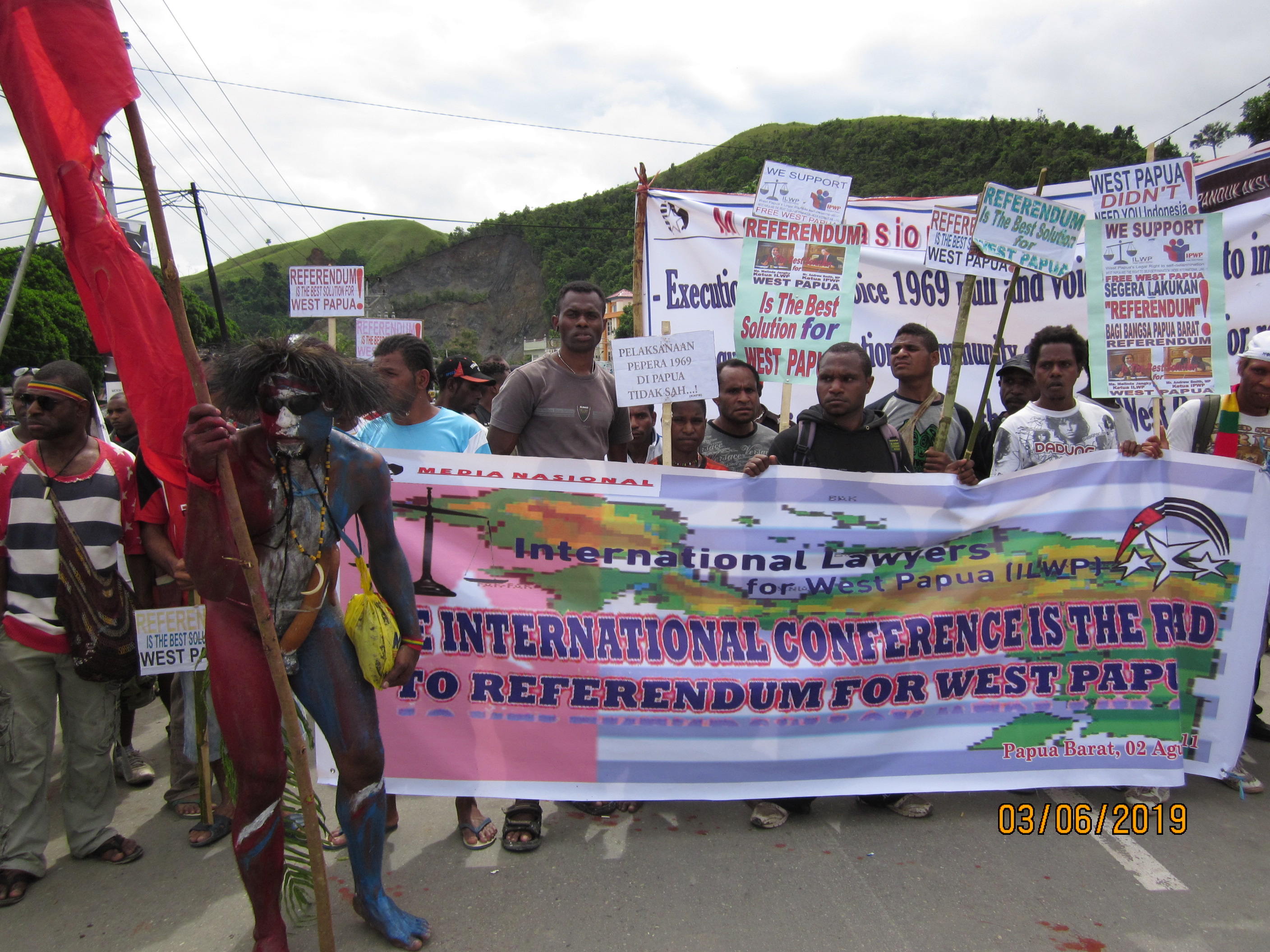
Jayapura, 1340: The streets of several centres across West Papua are being blockaded today by heavily armed Indonesian security forces in an attempt to prevent a planned gathering of tens of thousands of protestors who are demanding a Referendum on the future of the province.

However, thousands of Papuans have reportedly ignored the strong military presence and are marching the streets of Jayapura, paralyzing the provincial capital with their huge numbers.

The protests, called by the West Papua National Committee (KNPB) and actively supported by the entirety of pro-independence movement, are being held to demonstrate both opposition to Indonesian rule and to the Indonesian-run dialogue process, in favour of legitimate internationally-mediated dialogue that takes into account the wishes of West Papuan people. The demonstrations are demanding a Referendum as the only lasting and credible solution to determine the future of Papua for Papuans.
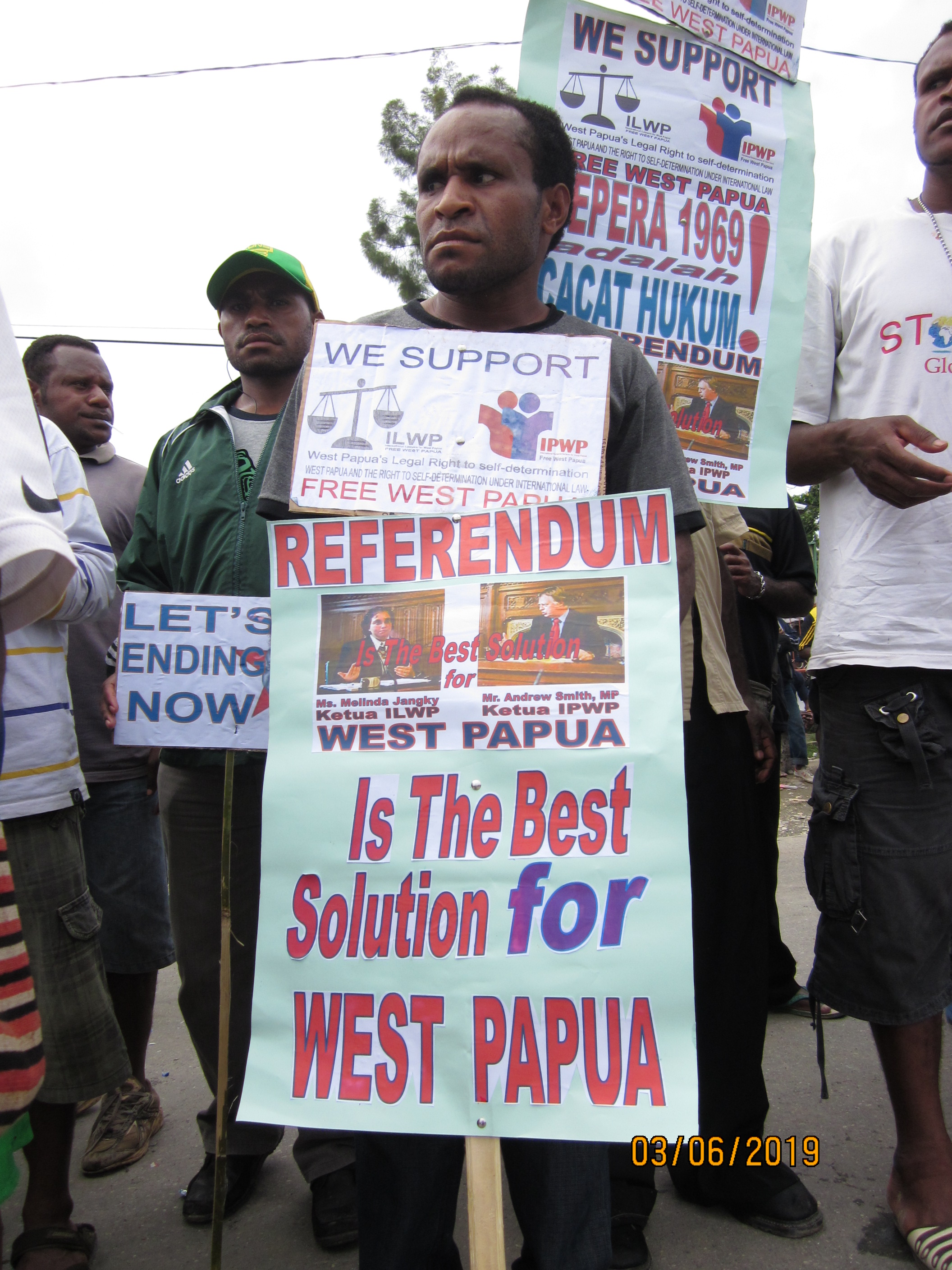
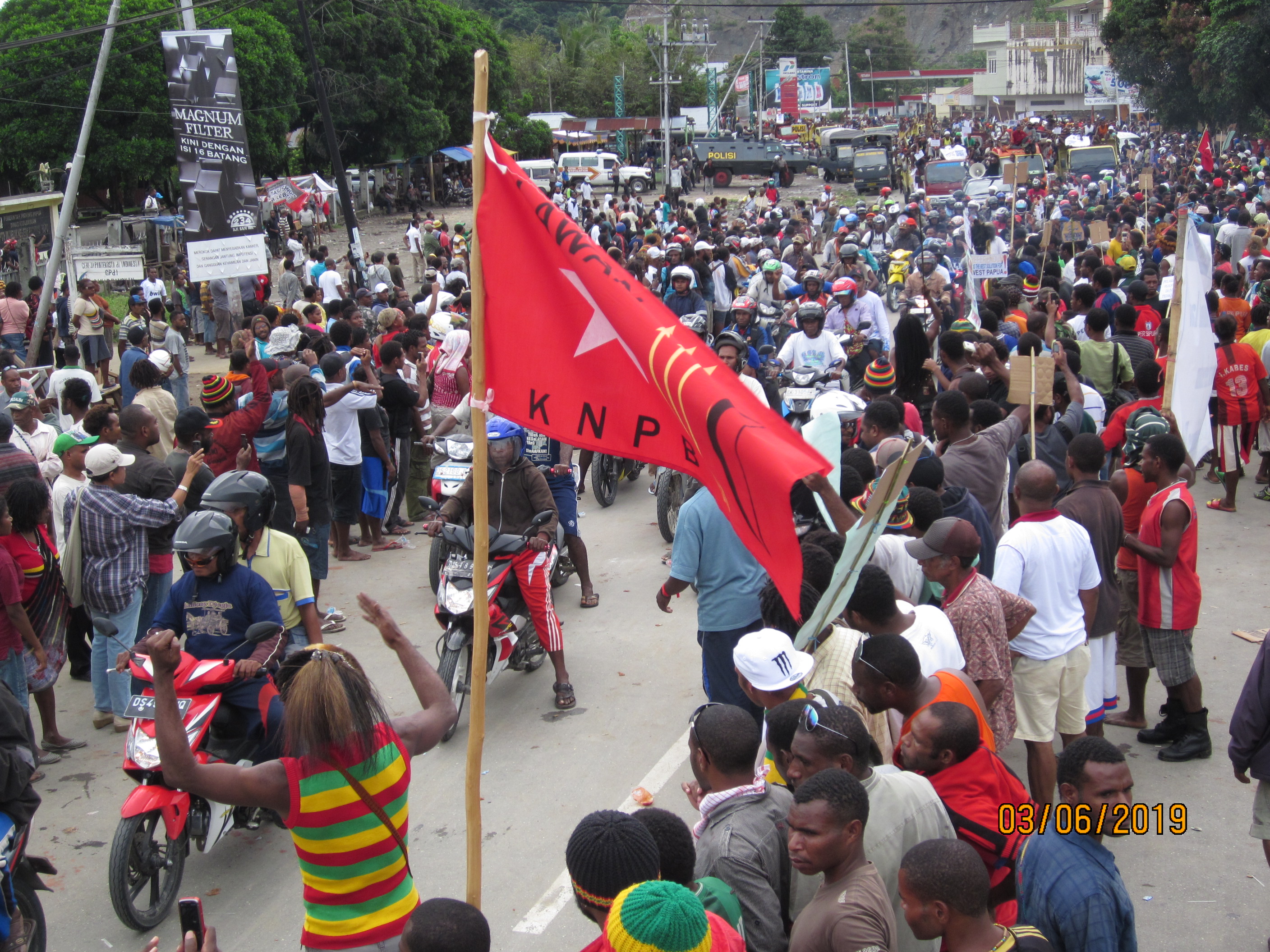
Outside Jayapura, protests are also being held in Wamena, Biak, Nabire, Manokwari, Paniai, and Timika.

West Papua Media stringers on the ground in Abepura are reporting that the demonstrations outside the main Post Office were being blocked by hundreds of heavily armed riot police and soldiers. This is despite official permits being issued by the Jayapura police for the demonstration to proceed without hindrance.

At 10am local time, three truckloads of soldiers and BRIMOB riot police then decamped and headed to Waena to intercept a long march of several thousand people who were attempting to join together with the Abepura march and then head to Jayapura, in information conveyed to West Papua Media by Daniel Wenda, Secretary General of KNPB. It is unknown at time of writing whether the march has pushed through the security force blockade or if any casualties or arrests have been sustained.

Local human rights sources have reported that a recent spate of violent acts may have succeeded in keeping away crowds of over 10,000 people, with one person stabbed and wounded by a militiaman at a pre-rally gathering in Angkasapura. However in news just to hand, organisers of the rally are reporting that security forces have relented and several thousand people have now successfully joined the demonstration, which is continuing to grow.

With tensions extremely high after the violence, the organisers of today’s rallies across Papua have been at pains to ensure that no symbolic traditional weapons be brought to the gatherings, and have worked with the Dewan Adat Papua to deploy hundreds of peacekeepers from the uniformed Community Security Force of Petapa, or The Guardians of the Land of Papua.

This slideshow requires JavaScript.

Telephone communication to Jayapura has been sporadic with many calls being cut off and SMS communication delayed, making confirmation of events difficult. It is unclear if the security forces are currently preventing West Papuan people from actively communicating to the outside world.

Reports are filtering through that other political actions are occuring throughout Papua simultaneously with the mass protests, with the KNPB suggesting that those who could not make it engage in innovative and non-violent economic disruption actions, such as strikes by ojek drivers, street vendors and bus drivers.

Independence activists are also reporting that members of two pro-Indonesian militias — Besar Merah Putih and Aswain (headed by Euricio Guterres) — have been deployed widely across the Jayapura area in conjunction with security forces.

Witnesses reported that late last night, a PELNI ship suspiciously landed 92 unfamiliar men at the main Jayapura dock, who are widely believed by activists to be members of Kopassus special forces in plain clothes. Activist surveillance of military facilities has indicated that special forces officers have not been seen at regular barracks for the past three days at least.

Suspicions have also been cast on unidentified forces responsible for a spate of violent incidents prior to the nonviolent mobilisations, who are believed to be connected to the Indonesian security forces, in what many observers see as an attempt by the security forces to spread fear, panic and division among the demonstrators to prevent the protests going ahead.

In the early hours of Tuesday morning, an arson attack on the Rectorate of the Cenderawasih University, Abepura, was foiled by Papuan students. The fire was detected before it took hold by alert from student security and was quickly extinguished.

After attacks yesterday by unknown assailants on Indonesian transmigrants in Nafri, Abepura, sources are reporting that one person has been killed and an unknown number injured in another attack in Koya, where SMS reports from credible local sources have described several incidents involving shootings and stabbings.

The Indonesian military has long had a policy of using civilian proxies and plain-clothes agents to carry out acts of violence to provoke civil resistance movements into self-defence. This has often been used as a pretext to engage in a security crackdown, which reinforces military dominance over the region.

Elsewhere in Papua, the mass rally also being held simultaneously in Manokwari was prohibited by security force, according to organisers from the KNPB. However negotiations succeeded in Indonesian security forces relenting, and the rally is currently ongoing with several thousand people participating. This rally marched from the office of Dewan Adat Papua, and is currently outside the Department of Information in Sanggeng. The atmosphere is described as relaxed.

West Papua Media is monitoring events closely, and will provided updates on the situation throughout the day.

MEDIA NOTE:  CONTACTS FOR SPOKESPEOPLE AND STRINGER ON THE GROUND ARE AVAILABLE.  PLEASE CONTACT +61450079106 or editor<@>westpapuamedia.info

Related articles

Comprehensive Report of Human Rights Violations in Papua since 1969

Bintang Papua, 23 July 2011[Something to look forward to. TAPOL]

Jayapura: With the help of an NGO in the USA  and the European Union, ELSHAM-Papua has drawn up a comprehensive report of cases of human rights violations that have occurred in West Papua during the period since it became part of the Republic of Indonesia.

ELSHAM co-ordinator in Papua, Ferdinand Marisan S.Sos told Bintang  Papua that they had already completed their collection of data.

‘We have collected data about human rights violations in Papua from the year 1969 up to 2010,’ he said. He said that they had been doing the work since February  this year and had completed it in April.

They are now going through the process of  putting all the data together in a book. ‘We plan to produce the data in a book which we hope to publish in October this year.’

He said that the compilation had been done together with the ICTJ, the International Center of Transitional Justice, a body that has the support of the European Union.

, , , , , , , , , , , , , , , , , ,

Komnas HAM calls for harshest punishment for killing civilian

In a statement issued today, 25 July, the Papuan branch of Komnas HAM, the National Human Rights Commission, has called on the authorities to mete out the harshest possible punishment for the member of the army who murdered the Rev. Ginderman Gire and wounded Gembala Pitinius in Tingginambut on 17 March 2011.Deputy chairman of Komnas HAM, Mathius Murib,  said he appreciated the decision of the Indonesian army to launch legal proceedings against  those who tortured and killed Rev Ginderman and wounded Gembala Pitinius. The latter man survived after being tortured. in Tingginambut, Puncak Jaya district. ‘We very much hope that the perpetrators  will be punished as harshly as possible according to the law so as to act as a deterrent, to ensure that such a crime doesn’t happen again.’

This was in connection with the forthcoming trial of the three army officers  who had committed acts of violence against two civilians

As has been reported, the trial is now under way before a military tribunal of three officers: First Sergeant  Torang Sihombing, NCO Hery Purwanto and NCO  Hasirun. The three are charged with using violence and torture according to articles 351 and 103 of the Military Code for causing the death of Ginderman Gire.

The crime againt Ginderman occuurred on 17 March 2010, At the time, First Lieutenant  Sudarman as commander of Post Illu Puncak Jaya had ordered the three accused to go on patrol in Pos Illu Post, in the Mulia area  in Puncak Jaya. The three men followed a convoy of vehicles which were transporting foodstuffs. After reaching Pintu Angin Alome, one of the drivers of the trucks reported to First Sergeant Saut Torang Sihombing that a local man named Ginderman Gire had asked for fuel. whereupon the sergeant asked why  he was asking for fuel, when another man Pitinius Kogoya also asked for fuel. When they said nothing, Sergeant Sihombing became very angry and struck Ginderman in his chest and hit Pitinus in the face.

After being struck, Ginderman said: ‘I’m not afraid of the army and I have friends up in the mountains who are well armed.’

The sergeant then handed the two men over  to another soldier, Hery Purwanto for questioning. During the questioning, the two men were beaten. Pitinus was able to escape  and jumped into a ravine. One of the soldiers fired shots into the air as a warning while Ginderman tried to grab a weapon from Hery Puwanto.  The officer fired his SS3 V-1 hitting him in the chest. The soldiers looked down and realised that the man they had shot was dead.

The soldiers then reported the incident to their  superior and were ordered to get rid of the body. The body of Ginderman was then loaded onto a truck and driven away. When they reached the Tingginambut bridge,they threw the body into the river.

JG: Low-Ranking Soldiers Indicted Over Torture, Killing in Papua’s Puncak Jaya

[The Papua Customary Council (DAP), however, disagreed with the Army’s
version of events. It said Kinderman was a local priest and had no
ties to the OPM.

“He was waiting for a delivery from Wamena, so when a convoy
approached he immediately went up to check for his package,” DAP
member Markus Haluk said. “There are thousands of innocent civilians
in Papua accused of being OPM to justify military tortures and
killings. This trial is just for show, like the previous one.”]

The Jakarta Globe
July 21, 2011

Low-Ranking Soldiers Indicted Over Torture,
Killing in Papua’s Puncak Jaya

by Banjir Ambarita

Jayapura

A military tribunal in Papua indicted three low-ranking soldiers on
Wednesday for the killing of a civilian in Puncak Jaya district last
year.

The defendants were identified as First Sgt. Saut Sihombing, Second
Pvt. Hery Purwanto and Second Pvt. Hasirun. All three serve in the
Army’s Nabire Infantry Battalion, as did four soldiers sentenced in
November for torturing two civilians in the village of Gurage in the
same district.

That incident resulted in international condemnation after a video of
the torture was posted on the online video-sharing site YouTube in
October.

Military prosecutor Capt. Jem C.H. Manibuy charged the three
defendants in this latest case with torture. They are accused of
beating and shooting to death a civilian, identified as Kinderman
Gire. The killing occurred near a military checkpoint in the village
of Illu on March 17 last year, just two weeks prior to the Gurage
incident.

The indictment says Saut, Hery and Hasirun accompanied a civilian
convoy that was delivering food supplies to Mulia, the capital of
Puncak Jaya district, around 10 hours by road from Wamena, Jayawijaya.

Kinderman, according to the indictment, stopped the convoy near Kalome
village in an attempt to extort gasoline from the driver of one of the
vehicles.

Saut disembarked from his vehicle and approached Kinderman who was
with another civilian, Pitinus Kogoya. The indictment says that
Kinderman then said, “I am not afraid of the military. I have 30
friends in the mountains and they are armed,” suggesting that
Kinderman was a member of the separatist Free Papua Movement (OPM).

Kinderman and Pitinus were then beaten while being interrogated by
Hery and Hasirun, the indictment says. Pitinus was able to escape by
jumping down an embankment.

The military tribunal was told that Kinderman tried to grab a rifle
from Hery, who reacted by firing at Kinderman. The shot hit Kinderman
in the chest, killing him instantly.

Saut said he reported the incident to his superior, Sudarmin, who told
the three not to say anything about the shooting.

The three soldiers took Kinderman’s body to their vehicle before
dumping it in a river from a bridge in Tingginambut subdistrict, the
indictment says.

The Papua Customary Council (DAP), however, disagreed with the Army’s
version of events. It said Kinderman was a local priest and had no
ties to the OPM.

“He was waiting for a delivery from Wamena, so when a convoy
approached he immediately went up to check for his package,” DAP
member Markus Haluk said. “There are thousands of innocent civilians
in Papua accused of being OPM to justify military tortures and
killings. This trial is just for show, like the previous one.”

AHRC: INDONESIA: Torture Report – A heinous act which is not seriously addressed


AHRC-FST-042-2011
July 14, 2011

Report on the practice of torture in Indonesia for the International Day of Support for Victims of Torture from the Commission for the Disappeared and Victims of Violence (KontraS) in Indonesia forwarded by the Asian Human Rights Commission

INDONESIA: Torture: A heinous act which is not seriously addressed

Download the full report at http://www.humanrights.asia/countries/indonesia/reports/ngo/KontraSTortureReport2011.pdf

I. Introduction

One of the serious issue of human rights violations—which is one of the nonderogable rights —that recently arised public attention is torture. First, in early October 2010 shortly before his plane left for the Netherlands, President Susilo Bambang Yudhoyono decided to cancel his state visit in the country. The cancellation was due to the filing of the lawsuit to the local court in the Netherlands by the activists of South Moluccas Republic (RMS/Republik Maluku Selatan) who live there. The lawsuit for one reason was based on charges of torture committed by police officers against those accused of being RMS activists. They were charged with treason when they displayed RMS flag as they performed cakalele dance in front of the president and some foreign guests during his visit to the Moluccas in June 2007. Following the cakalele incident the security forces, including special anti-terrorism unit Detachment 88 immediately arrested and detained hundreds of suspected RMS activists and some of them were allegedly become victims of torture.

Second, only a few weeks later in October 2010 a 10-minute visual documentation—circulating through ‘Youtube’—on torture of two Papuans recorded with mobile phone video tool. In the video, the extremely brutal and inhuman action was obviously conducted by people in military uniforms in order to conduct interrogations. With the rapid spread of that torture video, various Indonesian authorities—including President Susilo Bambang Yudhoyono— promptly responded to it and affirmed the practice of torture by military personnel in Tingginambut, Puncak Jaya, Papua. Many actually considered this video as an explicit example of the allegedly patterned practice of torture in Papua. The appeals of concern about the practice of torture also expressed by both foreign governments and international organizations.

This paper tries to examine the extent to which states implement human rights standards in the relevant international instruments of torture as an obligation of Indonesia post ICCPR and CAT ratification within the past year (July 2010 to June 2011). The implementative obligation is to do prevention efforts (through improvement of legislation, judicial system, and administration of state), ensuring the perpetrators brought to justice and provide redress to victims or their families. The contextual torture issues and problems in Indonesia can be seen from various post-priority agenda of meetings and discussions conducted by Indonesia government with relevant international human rights agencies.

So far Indonesia has made two reports to the Committee Against Torture under the Convention Against Torture, the first (initial report) was in July 2001 and the second (periodic report) in 2005. Unfortunately, Indonesia has not made the first report to the Human Rights Committee, the regulatory body for the ICCPR. In addition to reporting under the treaty body mechanism, there are also the follow-up results on torture based on the report
under the charter body mechanism. Under the mechanism of the UN Human Rights Council there are two follow-up agendas: first, the official country visit follow-up of Special Rapporteur on Torture, Manfred Nowak, conducted on 10-23 November 2007; second, the special meeting to discuss the results of Indonesia Universal Periodic Review/UPR in 9 April 2008 during the Fourth Session of the UN Human Rights Council. As follow-up results from various human rights mechanisms mentioned before, there are several similar recommendation agendas expected to be implemented by Indonesia related to the issue of torture, such as:

  • Torture should be made crime and its definition should be in accordance with Article 1 of the Convention against Torture;
  • The lack of this legal rule would lead to the practice of impunity;
  • There shold be an effort to revise the detention system, whether the duration of detention and the effort to test the validity of such detention;
  • In the context of law enforcement, any evidence or testimony that was made due to a practice of torture;
  • Ensure that victims of torture receive redress (reparation).

In conducting an audit over the issue of torture in Indonesia during the past year (July 2010-June 2011), KontraS took up cases of alleged torture which were directly dealt with. Information on alleged cases of torture would be considered a secondary source that could help clarify the picture of torture practices more broadly. In addition the audit report also discusses several policies, including plans for the creation or legislation revisions, which emerged within the past year.

To read the following sections, please download the full report here:

II. The Lack of Normative Provisions Against Torture
III. The Pattern of Torture Cases
IV. Development of New Legislation Draft Related with Torture Issue
V. Conclusions and Recommendations


Create a website or blog at WordPress.com

Up ↑
