Unconfirmed reports: Riots in Nabire leave 2 shot after truck crash kills schoolboy

West Papua Media

January 6, 2013

Tensions flared into a riot in Nabire on Friday, January 4, after a truck travelling at high speed ploughed into a family group injuring several people and killing a young school boy, drove off from the scene, according to credible but unconfirmed reports from human rights sources in Nabire.

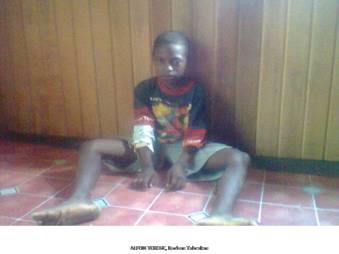
Peter Wakei, a Grade 5 elementary school student, was reportedly buried on Saturday after succumbing from serious head injuries from the collision at 10 am local time on Friday, according to family members spoken to by local human rights activists.  Schoolboy Alfon Tegeke (12, below) was lightly injured from the crash and treated in hospital, with the dead boy’s older brother Anton Wakei (32), the District Head of West Mapia, remains in a critical condition in Nabire hospital.

Indonesian Police were accused by community members of failing to search for the truck driver, according to witnesses, who reported that community members then mounted their own search for the truck driver at the Coral Market on sundown.

A heavily armed unit of Indonesian police confronted the Papuan community members in the market, and opened fire without warning on the group at 1830 local time, hitting two civilians with live bullets.  Apedus Wakei (31), was shot in the buttocks, while John Tekege (26) was shot in the thigh, and were taken to Nabire district hospital in a serious but stable condition, according to reports from Napas (National Papua Solidarity) sources in Nabire.

Police then arrested seven more community members and held them overnight without charge.  The seven detainees were released the following morning after the Nabire Police Chief met with members of the victim’s families together with the new Dogiyai Regent in order to defuse the tense situation in Nabire.  The inflamed situation has since returned to safe conditions after the intensive community negotiations, according to local human rights activists.

Andreas Harsono: Is Repression Against KNPB Legal?

January 4, 2013

by OKTOVIANUS POGAU of SuaraPapua.Com

https://i0.wp.com/suarapapua.com/wp-content/uploads/2013/01/HARSONO-ANDREAS.jpg
ANDREAS HARSONO, Indonesia Consultant for Human Rights Watch. (FOTO: RIDHA/SuaraPapua)

SUARAPAPUA, Jakarta –  Human Rights Watch (HRW) consultant  for Indonesia, Andreas Harsono, questioned the actions of the Indonesian security forces whose shootings led to the death of 22 members of the West Papua National Committee (KNPB) during the year 2012; 55 people were arrested, and hundreds of others were injured.

‘Given that 22 KNPB members died from shootings, dozens were arrested and unknown hundreds were injured, there has been no transparent judicial process, and no internal mechanism to question police procedures in Papua, we have to raise the question of whether this repression of the KNPB is legal?’.

The statement was re-affirmed by Andreas, when interviewed by suarapapua.com on Thursday 3rd Jan 2013).   According to Harsono , the police may justify their actions by incriminating KNPB members in violence, attacks on transmigrant settlers and security forces, but they still need to make their case transparent.

“The problem for police is working with transparency – can the police show this? At the same time, the KNPB needs to carry out an internal investigation in response to police accusations of involvement in violence’, he said.

Harsono also hopes that the organisation led by Victor Yeimo will quickly announce the outcome of the investigation, along with decisions to dismiss KNPB members found to be involved in acts of violence. As previously quoted, the KNPB head Victor Yeimo has stated that 22 KNPB members were killed in 2012 by Indonesian forces, 55 arrested and many among them are currently listed on the police wanted list.

(Translated by West Papua Media translators)


Victor Yeimo: 22 Members of KNPB killed in 2012

Thursday, January 3, 2013

by OKTOVIANUS POGAU at SuaraPapua.com

PAPUA, JayapuraIn 2012 Indonesian security forces murdered twenty-two activists from the West Papuan National Committee (KNPB) and a further fifty-five are behind bars, some of whom are also on a search list from the regional Papuan police.

Victor F Yeimo, Ketua Umum Komite Nasional Papua Barat (Foto: Ist)
Victor F Yeimo, head of West Papua National Committee (KNPB) (Photo: Ist at SuaraPapua.com)

The following information was conveyed by the chairmen of the KNPB, Victor F Yeimo, when he was telephoned by suarapapua.com on the afternoon of Thursday (03/01/2012).

Yeimo predicted that in 2013 the murder and arrest of KNPB activists will continue to be conducted by Papuan police under terrorism laws.

“We will continue to struggle and demand independence for West Papua. We will continue to oppose the modern pattern used by the Indonesian government to colonise us,” Yeimo said.

Yeimo also said he, along with the members of the KNPB, would continue to fight with their hearts, thoughts and actions to free West Papua from the colonial Indonesian government.

Dorus Wakum, a human rights activist in Jakarta, said the brutal actions of the Indonesian military and police that caused the death of dozens of KNPB activists in 2012 needed serious attention from the international community.

“The KNBP fights to uphold the dignity of indigenous Papuans. Why are the security forces accusing them of insurgency and killing them? They have to be responsible for this disgraceful act,” said Dorus to the media.

Dorus also called for KNPB activists and the wider West Papuan community to not withdraw from the fight but to continue to work for the humanity and dignity of Indigenous Papuans.

As was mentioned in the previous media post, Hubert Mabel, a member of KNPB, was shot dead by the military/police at the end of  2012 (see: Aparat TNI/Polri Menembak Mati Aktivis KNPB di Wamena).

Although Papuan police accuse KNPB of being a terrorist organisation and a security threat, these allegations are not true; rather, it is working to free Papua from its Indonesian colonisers.


Violence and intimidation of journalists in Papua in 2012

27 December 2012
The Alliance of Independent Journalists (AJI) has recorded twelve cases of violence and intimidation against journalists Papua  during 2012,which is a significant increase as compared with 2011, when there were seven cases.
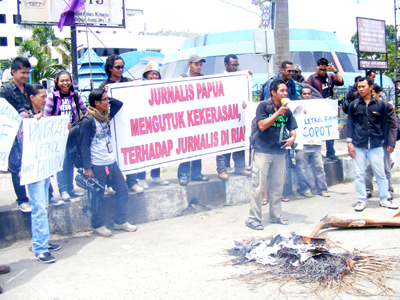
Journalists in Jayapura hold Demo to Reject Violence Against Journalists. (Jubi / Arjuna)

The first case was violence and intimidation against journalists in Papua and West Papua wanting to cover the trial of Forkorus Yaboisembut and his colleagues at the district court in Jayapura on 8 February when they were  physically intimidated, pulled and pushed as they were entering the courtroom. Those responsible were members of the police force in Jayapura. The victims were: Katerina Litha of Radio KBR 68 H  Jakarta. Robert Vanwi of  Suara Pemnaharuan, Jakarta, Josrul Sattuan of TV One, Irfan of Bintang Papua, and Cunding Levi of Tempo.

The second case was against Radang Sorong, a journalist with Cahaja Papua  and Paskalis  of Media Papua, from February until May in West Papua by the police chief of Manokwari, who were preventing journalists from reporting expressions of support for dialogue and a referendum in Papua. Three local journalists said that they had been  under pressure while writing critical reports about political matters, law and human rights violations and political prisoners. One of the journalists from Manokwari was instructed to restrict his reporting about political, legal matters and human rights violations.

The third case was in Abepura on 20 March when Josrul from TV One, Marcel from Media Indonesia, Irfan from Bintang Papua and Andi Irfan of Radio KBR 68 H Jakarta were attacked by members of KNPB, the National Committee of West Papua who were involved in an action outside the Post Office in Abepura. On a separate occasion, outside Polimak, Jayapura, Timbar Gultom of  Papua Pos was ordered to identify himself. When he replied that he  was from Papua Pos,  the people did not believe him and started chasing him. He was able to hide in a house nearby.

The fifth case  was when three journalists in the district of Jayapura, Yance of Radio Kenambai Ombar, Putu of KBR 68 H Jakarta and Suparti of Cenderawasih Pos were verbally intimidated and chased  by some members of the KNPB.on 20 March.

The sixth case was when a journalist from TV One, Josrul Sattuan was beaten by an unidentified person when he was trying to report on the situation in Jayapura following a series of  violent incidents and shooting incidents that occurred in various in places in Jayapura. The physical attack occurred at Abepura Circle on Thursday evening on 7th June.

The seventh case was when a journalist from Metro TV, Abdul Muin who was in Manokwari was attacked by someone from the Fishing Service in who intimidated him with an air gun.The victim told JUBI that the incident started when a member of the Fishing Service sent him a brief message on 8th June asking him and other journalists to cover an incident  of bombing a hoard of fish by a group of  people who were being held in the Manokwari Prison.

The eighth case occurred in Timika on 20 September.The victim was Mohammad Yamin, a contributor to  RCTI, Simson Sambuari of Metro TV, Husyen Opa of Salam Papua and the photographer for Antara News Agency, and David Lalang of Salam Papua.They were prevented from recording some events in the Pamako Harbour.

The ninth case involved Oktavianus  Pogau of suarapua.com and stringer for Jakarta Globe.  This occurred in Manokwari on 22 October. Okto were beaten up by several members of the police force, some in uniforms and others  not wearing their uniforms, who were battling with members of the KNPB in Manokwari.  The victims was thought to be part of a crowd of people involved in a demonstration, even though they had clearly identified themselves.

The tenth case was  when Sayied Syech Boften of Papua Barat Pos was attacked on 1 November by a person who identified himself as a member of the local legislative assembly, Hendrik G. Wairara. The victim was threatened and intimidated among others things by phone. The victim was warned to stop reporting about corruption in a project  involving the extension of the electrification system  and the maintenance of BBM machinery in Raja Ampat District. On the same day, the assistant of the chairman of the the local DPRD flew into a rage while he was at the editorial office of Papua Barat Pos.

The eleventh case occurred on 8 November when Esau Miram of Cenderawasih Pos  was intimidated as he was reporting on a gathering at the office of the Commander of the   XVII Nilitary Command and all the heads of departments in Papua.They were accused of being terrorists even though Esau had shown his  identity card as a journalist.

The twelfth case occurred on 1 December  when Benny Mawel of JUBI was interrogated by members of the police force  near Abepura Circle  for reporting about a large crowd of people who were carrying banners while marching from Abepura to Waena. Benny showed his journalist identity card, but a group of around ten people accused him of not being a journalist. As he was travelling on his motorbike  towards a repair centre, he was followed by some people there who starting asking whether he knew where Benny was.

Victor Mambor added the following: AJI reported two cases, the shooting of a Twin Otter  plane belonging to Trigana Air by an unidantified person in Mulia Airfield, Puncak Jaya on 8th April which killed Leiron Kogoya  who was first said to be a journalist of Papua Pos, Nabire and then the arrest and deportation of a Czech man, Petra Zamencnik who identified himself as a journalist with finecentrum.com. On 9 February, there was inconsistently about the status of the victim, whether he was a journalist or not, or whether he was involved in journalistic activities.

Suroso also confirmed that when the identity of Leiron  was checked, it turns out that  he was not at the time engaged in journalistic activities.but had gone to Mulia for personal reasons. Leiron had not registered himself as a journalist of  Papua Pos Nabire.  As regards Petr Zamencnik. he was unable to prove that he was a journalist. AJI Jayapura  sought confirmation with finecentrum.com about his status  and he was described as being the editor for financial affairs in the Czech Republic.

[Translated by TAPOL]

Ruben Magay : KNPB is not a terrorist group

Tabloid Jubi

December 20, 2012

Jayapura (20/12) – Ruben Magay, Chairman of Committee A of the Papuan Legislative Council (DPRP), strongly insisted that it is not correct for certain parties to link the activities of the West Papua National Committee (KNPB) to terrorism.

“For quite some time now, some parties have referred to the KNPB as a terrorist organization but I wish to reiterate that KNPB is not a terrorist group.  On the contrary they are an organization which promotes democracy in Papua and that is part of the controlling function and the ability to evaluate the performance of the government in the region,” said Ruben Magay on Thursday (20/12).

According to him, if so far, for some reason, weapons, ammunition and explosives have been found in Papua, the task of the intelligence is to uncover and find out the origin and the source of this material.

“We question the efforts put into this matter by the intelligence. Where did they obtain those guns? It is really the task of the police and the intelligence to answer that question.  At the governmental and institutional levels we need to make sure that we clearly define the status of terrorist groups and prove with strong evidence how such groups plan and carry out their actions,” he said.

According to Chairman Ruben, enforcing anti-terrorism laws in Papua, as envisaged by the Indonesian National Police (Polri), is also unnecessary.

“I believe such measures should not be deemed as necessary. If it is said that there are terrorists in Papua, I think we should turn our attention to the level of performance of the security apparatus.  It would be wrong to address one issue with another issue.  There are terrorists that are known to be implicated in explosions. The question is now: to what extent is the police able to ascertain them and subsequently how many further threats can be identified. This is what is important,” he said.

He went on to say that it is not the people who talk about democracy that should be called terrorists; certainly not the people who were shot and whose actions were then put in such a scenario that later on it was stated that they were the terrorists. “No, that should absolutely not be the case.  For example, weapons and ammunition are being discovered in all kinds of places lately.  My question is: where did these guns come from?  It’s not as if we are talking about gold that can be panned by the local communities from underground.  So it would not be appropriate to apply these so-called anti-terrorism laws to Papua.  Let’s tackle this problem together in a responsible way and straighten out the issue of clarifying who the real owners are of these arms, ammunitions and explosives that were found in Papua.  It is obvious that the material was brought in from outside, so a first step would be to take measures to heighten the safety and tighten security checks at ports and airports.  That’s what is important,” said Ruben Magay. (Jubi/Arjuna/LT)


Create a website or blog at WordPress.com

Up ↑