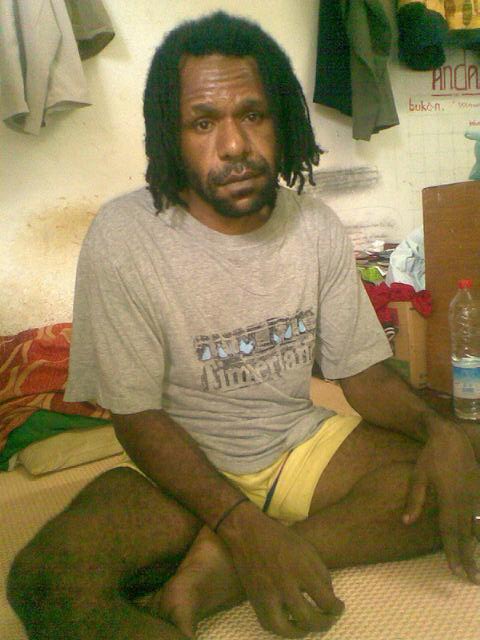
AHRC: Authorities refuse to treat political prisoner with tumour

January 27, 2012

ASIAN HUMAN RIGHTS COMMISSION – URGENT APPEALS PROGRAMME

Urgent Appeal Case: AHRC-UAC-008-2012

ISSUES: Indigenous people; inhuman and degrading treatment; prison conditions

The Asian Human Rights Commission (AHRC) has received information regarding the condition of Kimanus Wenda, a political prisoner at Nabire prison, Papua, who has a tumor in his stomach and must be operated on. Although Indonesian law clearly notes that it is the state’s obligation to provide medical fees, the Papua legal and human rights department is refusing to pay for Mr. Wenda’s surgery due to a lack of funds. Moreover, the goverment is now claiming that Mr. Wenda does not require surgery, although local activists found the opposite to be true.

CASE NARRATIVE:

According to the information received from KontraS, ALDP and SKPHP, on April 4, 2003, at around 1am, there was a burglary at 1702/ Jayawijaya Wamena military district staff headquarters armory.

Eight perpetrators were arrested in connection to this theft: Yafrai Murib, Numbungga Telenggen, Enos Lokobal, Linus Hiluka, Kanius Murib, Kimanus Wenda, Des Wenda and Mikael Haselo. On January 15, 2004, according to the verdict declared by the Wamena district court, all the victims were found guilty for rebellion under articles 106 and 110 of the Criminal Code. Yafrai Murib and Numbungga Telenggen were sentenced to lifetime imprisonment, while the others were sentenced to 20 years imprisonment. Civil society considers this verdict to not be based on legal facts.

Since 2010, Mr. Wenda has had a tumor in his stomach and is constantly vomiting. He informed the health staff at Nabire prison but was not given any adequate response. On February 2, 2011, the Nabire hospital issued a reference letter regarding Mr. Wenda’s sickness and the need for him to be operated at Jayapura hospital. Two days later, Mr. Wenda’s legal counsel sent a medical leave letter to the head of Papua’s regional office of law and human rights and the head of Nabire prison, but received no response. On September 19, SKPHP met the head of Papua legal and human rights department but the department said it has no money and thus cannot pay for Mr. Wenda’s operation. This violates Indonesian law under Indonesian Government Regulation No. 32/1999 on Terms and Procedures on the Implementation of Prisoners’ Rights in Prisons, which states that it is a state obligation to provide medical fees and treatment. While civil society is now gathering funds to pay for the operation in Jayapura hospital, it is not yet enough.

Furthermore, on December 16, at the hearings between KontraS and the ministry of law and human rights, the staff of Nabire prison said that based on their report and the statement of the prison chief, Mr. Wenda was seen playing volley ball in prison and therefore his stomach tumour is not dangerous and does not need to be operated in Jayapura hospital. However, on December 21, when local activists brought Mr. Wenda to be examined at Nabire hospital, John, the surgery doctor who examined Mr. Wenda, stated that the tumour is severe and should be operated as soon as possible. The government denial to treat Mr. Wenda has resulted in much civil society concern about his safety.

ADDITIONAL INFORMATION:
The AHRC has recorded that political prisoners, especially in Papua, face ill-treatment and torture in prison, as in the case of Fendinand Pakage, who was tortured by a Abepura prison officer in 2008, resulting in permanent damage to his right eye, and in the case of Buchtar Tabuni in 2009, also beaten and tortured by a Abepura prison officer. Political prisoners’ rights are bare fulfilled, especially the right to health, as seen by Filep Karma, who was neglected at Dok II Jayapura hospital although his ureter should be operated.

Furthermore, on August 28, 2007, Mikael Haselo, a political prisoner arrested and charged in the same case as Mr. Wenda, died after being treated at Bayangkara hospital, Makasar, South Sulawesi, due to the complication of some diseases, such as cough, enteritis, bronchitis and lung inflammation.

for suggested actions please visit http://www.humanrights.asia/news/urgent-appeals/AHRC-UAC-008-2012

Komnas HAM warns of human rights violations in Puncak Jaya

Bintang Papua, 20 January 2012Human rights violations are occurring in PuncakThe Papua branch of Komnas HAM, the Indonesian Commission for Human Rights, has confirmed that human rights violations have been occurring in Puncak. These include a number of deaths that have occurred during this prolonged conflict.

‘While not yet knowing the motive or who was responsible, the killings were clearly human rights violations. Lives were lost which is an indication that the right to life has been ignored.,’ said Matius Murib, deputy chairman of the Komnas HAM Papua branch. He made the statement after attending a Forces Group Discussion on Civil and Political Rights and Economic, Social and Cultural Rights (ECOSOC) held by the Papuan branch of Komnas HAM.

When lives are lost, human rights are certainly violated.  No need to ask about the motive as this goes beyond the power of the Almighty. The state or government have no right to destroy life, which is totally without justification .’ The right to life  comes only from God and no one has the right to kill people,’ he said.

In this Puncak case, those involved were planning to conduct investigations in February and were planning to visit the site of the killings, in order to make recommendations to the authorities. Murib said that he could not make any comments until they had visited the site

Responding to a question about whether the government had been responsible fir triggering the conflict, he said that such a charge would need to be investigated. If this turns out to the true, then some individual or institution that had been granted powers by the state had failed o take action quickly enough to prevent the incident from occurring, and this is matter for KomnasHAM to issue a charge.

He recognised that  according to investigations reported in the media, there were indeed actions by the government and related persons, and the question was, why had the conflict occurred and why were casualties still occurring. ‘It is our task to investigate whether actions were taken by the state and whether they were   justified.’

As has previously been reported, the conflict that relates to the election of the head of the district of Puncak and has resulted in 49 casualties among the local community since 30 July 2011. This conflict was still on-going up until 14 January 2012 in the district and the government has not made any efforts to resolve it, nor have the police done anything to resolve the conflict, which is being described as a tribal war between people living in the Central Highlands. It relates to an internal dispute within the political party called Gerindra, between a number of candidates. Gerindra has turned this internal conflict into a conflict between the commnity in general  which has paralysed all development activities there.

Human rights violations in Papua are very high, according to a three-year survey

JUBI, 20 January 2012

[A photograph at the beginning of the article shows three little boys squatting in the street and inhaling aibon.]

The Papuan branch of Komnas HAM, the National Commission  on Human Rights, believes that violations of economic, social and cultural rights  in Papua are very serious  and can be described as gross human rights violations.

The commission’s chairman for co-ordination, Adriana S. Walli, has drawn together a great deal of information in her review of the prospects for economic, social and cultural rights in Papua which she presented at a Focus Group Discussion which was held in Jayapura on 20 January.

According to Adriana, repression and ECOSOC violations have been perpetrated on a vast scale during the past three years .’These violations are occurring on a daily basis and can be identified as gross violations. However, she said, they are brushed aside as being nothing more than trivia.

She went on to say that there were two indicators for why these violations continue to occur. The first was the prevailing view that these violations were trivial, and the second was the lack of commitment of the government and various related agencies.

While presenting her data, Adriana  said that when she was carrying out her investigations during the past three years, she had come across  a great number of ECOSOC violations, especially in health, economic rights and children’s rights.

She drew attention to the fact that in the various hospitals, little had been done to improve the facilities. Many of the personnel were harking back to Dutch times. The supply of clean water is inadequate while there has been a big increase in the number of street children. Many of these youngsters consume alcohol and sniff dangerous substances such as aibon; they also participate in free sex practices, take drugs and so on.

Small indigenous Papuan traders have great difficulty obtaining credit to grow their businesses while they still use traditional methods to handle their finances.

The chairman of the Papuan branch of Komnas HAM, the National Commission on Human Rights, Julius Ongge, told the gathering that the  government of the province of Papua  must be held responsible for the implementation of ECOSOC rights. When local people call for  their basic rights such as customary rights and their rights to education and health, it is obligatory for the government to respond but what in fact happens is that they come face to face with the security forces.

‘Whenever people make demands for their rights, they confront many alarming accusations  and often have to face lengthy legal processes even they have done nothing wrong,’ he said.

3 Papuan prisoners in need of medical treatment for stroke

Papuan prisoners in Biak Jail
Papuan prisoners in their cell in Biak prison: Numbungga Telengen (black clothes), Jefrai Murib (sleeping) and Apot Lokobal (wearing glasses). Jafrai Murib is thought to have suffered a stroke on 19 December 2011 which has caused paralysis. He can no longer stand.


I am often in and out of prisons to deal with political prisoners, so I know many detainees and their families and lawyers. Last week, I received a message from somebody representing three Papuan prisoners in Biak prison. He said that prisoner Jefrai Murib is thought to have suffered a stroke on the morning of 19 December 2011. He’s paralysed. He can’t walk. When he walks he does so with the aid of his friends. The left side of his body, his left leg and his left arm have lost all sensation.

Jefrai Murib

Murib has had a check-up in Biak General Hospital, where the doctor referred him to Jayapura hospital.  Biak hospital is not as well equipped as Jayapura hospital. Murib is in a cell together with Numbungga Telengen and  Apotnagolik Enos Lokobal.  They were arrested in April 2003 following a raid on a Wamena weapons store. Murib and Telenggen got a life sentence, Lokobal was sentenced to 20 years in jail.

Lokobal also suffers from the same symptoms; the right side of his body has lost all sensation. He has also been seen twice at Biak hospital, on 12 November and 23 November. Lokobal is also suspected of having suffered a stroke. Unlike Jafrai Murib, by last week Apot Lokobal was able to walk again, although his steps are weak and faltering, and he has to be carried when taken to hospital. Lokobal needs more specialised medication. The Indonesian state is responsible for providing healthcare to prisoners. I hope that the health condition of these two prisoners will be taken seriously by the Penitentiary Director General.

In accordance with the doctor’s recommendations, Jefrai Murib should be moved to Abepura jail in Jayapura, and needs to receive medical attention at the Dok Dua Hospital in Jayapura.

It’s time for Jakarta-Papua dialogue, says MRP deputy chair

Bintang Papua, 3 January, 2012
[Abridged in translation by TAPOL]
Jayapura: ‘The new year, 2012  must be a year in which dialogue between Papua and Jakarta takes place,’ said  Hofni Simbiak, deputy chair of the MRP, during a discussion about development, the human rights situation and civil society in Papua.’As a response to the current political and ECOSOCsituation  in Papua, all sections of the people in Papua agree that 2012 should be the year in which dialogue between Jakarta and Papua should take place. This is an emergency and there should be a response from the central and regional governments,’ said Septer Manufandu. He said that if  the government fails to respond to people’s calls for dialogue, this will damage the reputation of the government in the eyes of the people.

He went on to  say that 2012s a year in which many problems must be solved through dialogue and it is up to the government quickly take the initiative, as a way of improving Indonesia’s reputation worldwide. ‘Dialogue is the only way to solve the problems in Papua and to put an end to violence.’ He also said that  the government should make an evaluation of the implementation of the development programme since the adoption of the special autonomy law (in 2001). This should include evaluating developments in education and health and to see whether this has benefited the people or Papua or not. These are matters requiring the serious attention of the government, he went on to say.

According to Hofni Simbiak, all the activities in 2011  were orientated towards projects for which  there was no financial backing because of the misuse of the funds and corruption which is widespread in the education and health sectors.

Although the government had taken action regarding the implementation of UP4B (Unit to Accelerate Development in Papua and West Papua), the MRP des not agree with this programme. As far as they can see, a lot of money has been spent but this has not had any significant impact which has resulted in the people losing confidence in the government. As long as the Papuan people are not themselves the object  of all the development, this will continue to be a problem from year to year and could be a time bomb. This also applies to the UP4B, which could create big problems in 2012.

According to Septer Manufandu, the failures in human rights problems as well as political problems and ECOSOC had intensified in 2011 so much so that the government could be charged with failure on these issues as well as its failure to deal with the issues of education and health.

Create a website or blog at WordPress.com

Up ↑