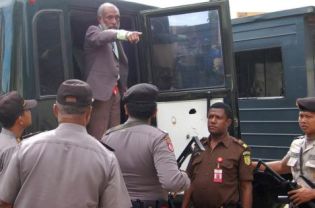
Witness testimonies at Papuan treason trial

The sixth hearing of the trial of Forkorus Yaboisembet and his four colleagues took place on 21 February at which seven witnesses for the prosecution were called to give evidence. According to the executive-director of the LB3PH, Yan Christian Warinussy, six of the seven of the witnesses were members of the police force who  had been involved in the attack against the Third Papuan Peace Conference (KRP-III) on the third day of the event, 19 October 2011.Six of these witnesses were unable to answer questions from the chief prosecutor regarding the declaration that was allegedly read out at the end of the  conference nor could they say whether the five defendants had been involved in a criminal conspiracy to set up the Federal Republic of West Papua.One of the witnesses who had been summoned was Drs Alfons Rumbekwan, a member of the Majelis Rakyat Papua. Speaking for the defence team, Olga Helena  Hamadi said that this person should not testify at the trial because the majelis of which he is a member is the cultural body of the indigenous Papuan people. Since the trial was related to the political aspirations of the Papuan people, his appearance might cause a conflict between the MRP and the Papuan people. It was agreed that Drs Rumbekwan  would not be called to give testimony.

According to a lengthy report of the hearing in Bintang Papua, the police witnesses appeared not to know the defendants and were unaware of the declaration by Forkorus calling for the re-establishment of the Federal Republic of West Papua.

According to Bintang Papua, for example, the first witness, Lambertus Limbong Sattu, a member of the Jayapura City police force who reportedly told the hearing that he did not know the identity of one of the accused, Agustinus Sananay Kraar, when he pulled him into the police vehicle but only knew his name after they reached police headquarters. He told the court that he had not seen the document proclaiming the establishment of the Federal Republic of West Papua but confirmed that there was a banner  on which were inscribed with the words: ‘Let Us Affirm the Basic Rights of the Papuan Indigenous People, Today and in the Future’.

The second witness, Aamet Mahu told the court that he was in the vicinity of the venue of the KRP-III  on 19 October 2011 and was there on orders to handle security of the conference.

The defence team of the five defendants said that all the testimony given on that day in court was in way related to the charges in the indictment.

Rallies reject Indonesian status quo in Papua, and demand referendum

This slideshow requires JavaScript.

February 22, 2012

By Nick Chesterfield at WestPapuaMedia.info with local sources

Thousands of people took part in peacful rallies across West Papua on Monday, February 20,  rejecting attempts by Indonesia to impose new development policies on Papua, and demanding an internationally supervised referendum as the key step towards solving the Papua problem.

The rallies, organised by the West Papua National Committee (KNPB), took place in Jayapura, Biak,  Manokwari, Timika, Nabire, Wamena, Yakuhimo and Merauke.  According to initial reports, all rallies remained peaceful despite standard Indonesian security force threats to forcibly break up proceedings.

This slideshow requires JavaScript.

In Jayapura, a long march was held from Abepura to the offices of the Papuan People’s Assembly (Majelis Rakyat Papua or MRP) with the crowd of close to a thousand people shouting “we want referendum”; “Special autonomy has failed, why start it again”; and “We reject the dialogue between Jakarta and Papua and demand a Referendum”.

Mako Tabuni, on behalf of the KNPB, told the gathering that the the plans by Indonesian President Susilo Bambang Yudhoyono to impose a new body U4PB (or Program to Accelerate Development of Papua and West Papua) to implement the failed Special Autonomy package is not a solution to the problems in Papua and was thoroughly rejected by West Papuan people.  Only a Referendum would address those grievances, and it must be. held soon.  U4PB, with authority over all of Papua, is to be headed by former army intelligence chief Bambang Darmono, himself subject to numerous allegations of human rights abuses whilst stationed in Aceh.

Tabuni expanded: “when in Papua, there are two paths of narrow and wide roads. Papuan Special Autonomy the road is paved with a lot of money, including UP4B, but the road is narrow.  The road to independence is a wide open road, like the road to referendum being fought KNPB”.

Former Political Prisoners Yusak Pakage and Saul Bomay echoed the KNPB concerns and demanded that Indonesia just try to listen to the will of the people and stop trying to implement policies proven to have been a failure, like Special Autonomy.

The demonstrators dispersed peacefully with a promise of escalation of mass actions.

westpapuamedia

Indonesian police conduct armed sweep of treason defendants in their cells

from WestPapuaMedia sources in Jayapura

Monday February 20, 2012

Extraordinary scenes occurred at Abepura prison in West Papua on Saturday night when heavily armed police stormed the cells of non-violent Papuan leaders currently on trial for treason.

The unusual and heavy handed security sweep was carried out between 9-10 pm on Sunday night and involved 3 truckloads of armed Dalmas anti-riot paramilitary police; 2 truckloads of Brimob police, and a detachment of the fully armed prison anti-riot officers.

Forokorus Yaboisembut (Jakarta Globe)

The cells of a number of West Papuan political prisoners were turned over in the sweep, and all prisoners possessions were removed, including pens, paper, files, books, letters, plates, drinking glasses, cutlery knives, guitars, and music tapes, including lawyer-client privileged communications and defence notes.  Mobile phones were not found however, according to sources at the prison.

It is believed the targets were  five leaders of the Third Papuan People’s Congress that peacefully declared independence from Indonesia on October 19, 2010, sparking a brutal and bloody crackdown by Indonesian occupation forces.

Forkorus Yobeisembut, and Edison Waromi, the President and Prime Minister respectively of the Federated Republic of West Papua, together with Selpius Bobbi, Dominikus Sorabut, and Agus Kraar are all on trial for treason charges.  The hearing on Friday had to be suspended after the prisoners refused to return into the courtroom due to concerns of the conduct of witness cross-examinations.  The trial was adjourned to February 21.

Reliable sources close to the accused Congress leaders have told West Papua Media that the raids relate to rumours circulating that the five defendants will be broken apart and moved to separate prisons away from Papua. These rumours have been propagated by unknown parties, however regular prison transfers are a common tactic by the Indonesian state on Papuan political prisoners.  The Indonesian Attorney-General and the Prosecutors office have repeatedly stated publicly that the trial and prisoners would be moved from Papua if any unrest occurs, but there is significant local Papuan resistance to such a move.

Local observers also have suggested that the bizarre raids had occurred after police objected to the defendants conduct in court and sought to reassert the “authority of state” by behaving unpredictably.

According to a series of urgent text messages sent to various advocates, the head of the prison at Abepura opened up the political prisoners section to normal criminals allowing them to mix freely.  This is often a tactic utilised by prison authorities to effect violence on prisoners without prison guards having to commit the abuse personally.  The political prisoners source told West Papua Media that in a disturbingly strange move, the prison chief then invited the political prisoners to sit without resistance with in a room together with hardened murderers, robbers and rapists, many of whom are from other parts of Indonesia.

Prison authorities did not reply to any requests for clarification from West Papua Media about the events at Abepura.

Forkorus: international community must acknowledge the political rights of the people of West Papua

JUBI, 14 February 2011’The President of West Papua, Forkorus Yaboisembue has called on the international community which has raised the issue of basic human rights  to give evidence of its recognition of the political rights of the West Papuan people. If they fail to do this, he said, it means that the Papuan people are merely the colonial possession of a foreign power, while the world is only concerned with human rights, which, he said, is nonsense.

‘We call  upon the international community to discuss the issue of the right to self-determination, whereas this right of the Papuan people is being trampled underfoot. He was speaking after the court in Jayapura rejected the demurrer of the defendants submitted by the legal team of the Papuan defendants, Forkorus Yaboisembut, Edicon Waromi, Dominikus Surabut, Selpius Bobii and Agust Kraar.

Forkorus said that the international community has remained silent about the basic right of the Papuan people to self-determination, while it concerns itself only with the issue of human rights. The concept of human rights without any further evidence means that the international community is only toying with the problem, while there is plenty of evidence. Talking about human rights  while claiming that if these rights are recognised for all nations, this will be the way to safeguard peace in the world.’ This, he said, is utter nonsense.’

The international community, the USA, the European Union and the United Nations,never talk about the basic right of the Papuan people, who are campaigning all over the world and to other colonised people; this is is nothing more than empty talk.

Forkorus said that the world must give real proof of the concept of human rights by taking into account the importance of the political rights of the people of West Papua. The international community must prove its commitment to human rights because the Papuan people are bound by their right to speak out. This is an issue that lies deep in the hearts of all people including the people of West Papua. [The word used here is kesulungan the precise meaning of which escapes me, C Budiardjo]

‘When I say that I am a West Papuan, what then do you say? No one can force me to do anything. I have the absolute right to be a West Papuan.’

Edison Waromi who was standing beside Forkorus when he made this statement, said that the right of kesulungan [unchallengability ?] is recognised in the Bible to which the Papuan people are devoted. Quoting Verse 32, (8) of Deuteronomy in the Bible he said:  ‘It is God who determines the territory of all people’ which means that something determined by God cannot be challenged.’ The territory of West Papua  belongs to the people of West Papua.

When this was said, the crowd outside the courthouse cheered and applauded.

Statement from 5 Makar accused at KP3 treason trial

STATEMENT BY FIVE PAPUANS WHO WENT ON TRIAL IN JAYAPURA ON 30 JANUARY 2011[This hand-written statement is signed by the five Papuans who went on trial in Jayapura on 30 January 2012, and is translated in full by
Carmel Budiardjo, TAPOL]

Fully understanding and conscious of our basic human rights as Papuans of the negroid race, part of the Melanesian race who live in the land of the country of West Papua, inheritors from our ancestors, we herewith firmly declare  that WE FIRMLY REJECT THE TREASON TRIAL AND OTHER SUCH TRIALS that has been mounted against the five of us, and we speak on behalf our colleagues and the entire nation of the Papuan people of the Nation of West Papua.

We call for an understanding of this declaration, a declaration of independence, in accordance with the principles of PUBLIC INTERNATIONAL LAW, a law which should be lawfully accepted. And in this case, this declaration will bring us substantial  happiness if it gains the recognition of the international community.

In order to gain substantial and dignified recognition from the international community, we have requested our international team of lawyers to  notify and register  our legal status along with the question of the annexation of the TERRITORY OF THE STATE OF WEST PAPUA at the International Court, with the Secretary-General  of the United Nations, Amnesty International and all member states of the United Nations, as well as other competent authorities.

We herewith categorically state that we are not prepared to make any statements or answer any questions that are based on the laws and accusations of treason by  the Unitary State of the Republic of Indonesia, during the current trial for treason. It is very clear indeed that this is a matter between two nations and two states, that is to say, between the Papuan nation and the Indonesian nation, between the Federal State of West Papua  and the Unitary State of the Republic of Indonesia.

The following are the reasons for our rejection of the trial for treason or any such trial:

[NB: The copy of the statement which we have received jumps at this point from page 2 to page 4 which suggests that the copy we have is incomplete.]

1.    Our struggle and the struggle of those who have gone before us and the nation of West Papua  and all members of the Papuan people up to the present day is a struggle for the restoration of independence and sovereignty of the Papuan Nation as one of our most basic political rights.

2.    Bearing in mind that the Unitary State of the Republic of Indonesia annexed and continues to annex, the people and nation of the Papuan people since the TRIKORA command which was proclaimed by the former president of Indonesia, President Sukarno on 19 December 1961 in the city of Jogyakarta and which was followed up by  the Indonesian military, from 1962 to the present day, by a variety of measures aimed at preserving the annexation.

3.    Our struggle is not aimed as damaging or destroying any country in the world.

4.    We do not intend to damage or destroy the Unitary State of the Republic of Indonesia.

5.    We feel that our dignity has been defiled, that our basic political  rights have been violated in our country, West Papua, which we inherited from our ancestors.

6.    No one, for whatever reason, has the right to make accusations against us or to convict us in a treason trial or any such trial. This is because we have become the subjects of our own laws  as citizens of the nation and state of the Federal Republic of West Papua.

7.    Based on the values of basic human rights, of democracy and the following universal laws:

a. The  first article in the Preamble to the1945 Constitution  of the Republic of Indonesia.
b. Article15 of the Universal Declaration of Human Rights of the United Nations adopted on 10 December, 1948.
c. Article 1, para 1 of the Covenant on Civil and Political Rights adopted as UN Resolution 2200 (xxi) which has been in force since 23 March 1976,.
d. The Declaration on Granting of Independence to Colonial Countries and Peoples in UN Resolution 1514 (xv) on 14 December 1960.
e. The basic principles of decolonisation , namely possidetis juris and the legal succession of the state to the colonial territories  of the  Dutch East Indies (Dutch Papua) since 19 October 1961.
f. ILO Convention No. 169, 1989 on the Rights of Indigenous and Tribal People.
g. The UN Declaration on the basic rights of indigenous peoples of 13 September 2007.
h. The Papuan Independence Manifesto of 19 October 1961 adopted by the Papuan National Committee.
i.  Stipulations adopted by the Grand Congress (MUBES) of the Papuan people in 2000.
j. The Eleven Recommendations of the Second  Papuan Peoples’ Congress and Indigenous Papuan People  in 2010.
k. The decisions of the Second Papuan Peoples Congress in 2000.
l.  The decisions of the Third Papuan Peoples Congress of 2011.

8.    The Statement by the Indigenous Papuan People and the Papuan people is a truth based on analytical and practical categories. The analytical category means that the indigenous P apuan people are the Papuan nation, a negroid race of the Melanesian race, located in the South Pacific. Whereas the practical category is a political statement which was enunciated in the Manifesto of Papuan Independence of the Papuan National Committee on 19 October 1961 in Hollandia, the State of West Papua.

9.     We democratically restored the independence and sovereignty of the Papuan people on 19 October 2011, at the Third Papuan Peoples  Congress with the establishment of the Federal Republic of West Papua  which was announced by the DECLARATION OF THE PAPUAN NATION IN THE STATE OF WEST PAPUA.

10.    The government of the Republic of Indonesia and the governments of all other members of the United Nations, should without discrimination recognise and respect the democratic processes of the Papuan people at the Third Papuan Peoples Congress on 19 October 2011 in the form of the Declaration of the West Papuan Nation and State.

11.     The application of the treason law against the Papuan people must be categorised as a violation of the basic and legal political rights of the Papuan nation.

We hereby call on to the Honourable Judges in this forum to annul the trial held in order to accuse us of TREASON and make similar charges against us. The solution to the independence of the Papuan nation which is our most basic political right must be sought by means of international mechanisms between the Federal Republic of West Papua and the Unitary State of the Republic of Indonesia, mediated by the United Nations.

In order to regulate the transfer  of sovereign powers from the Unitary State of the Republic of Indonesia to the Federal Republic of West Papua, we intend to initiate a new phase of cooperation  based on the principles of democracy,  justice, peace, mutual respect and dignity. As is customary between independent and sovereign nations and states on Planet Earth.

Herewith our statement of REJECTION OF THE TRIAL BEING HELD TO ACCUSE  US OF TREASON AND SIMILAR CHARGES.

Jayapura, 30 January 2012

Signed:

1. Forkorus Yaboisembut, President of the Federal State of West Papua.
2. Edison G. Waromi, SH, Prime Minister of the Federal State of West Papua.
3. Agust M. Sananai Kraar, SIP,human rights activist/staff
4. Selpius Bobii, activist/staff
5. Dominikus Subarat, activist/staff

Create a website or blog at WordPress.com

Up ↑