JUBI, 23 March 2012The commander of the district military command in Jayapura denied that any military operations are taking place in Papua. Lieut-Colonel Rano Tilaar was speaking to journalists after taking part in a Joint Forum of the SKPD (?) and the start of a Consultation on Development in Jayapura.
‘There are no military operations under way in Papua, but only Security Operations Along the Border. We have to realise that although the situation in general is calm and orderly, there are conflicts going on, vertical conflicts as well as a horizontal conflicts,’ he said.
The vertical conflict is related to various problems between the government and those wanting independence – or separatism – while horizontal conflicts are those that occur between groups within the community where there are differences between the native population and the newcomers.
‘We need to be conscious of what is meant by nation and state. What is the meaning of the legacy inherited from our ancestors and the natural resources which offer great potential if they are not exploited jointly in the interests of the nation and the state.’
According to Rano, in the present political situation in Papua, the TNI – Indonesian Army – regards the group which pursues the ideology of M – merdeka – as our brothers. The difference between us, he said, is they have not yet accepted the ideology of NKRI – the Unitary State of the Republic of Indonesia.
When asked his opinion about the the Third Papuan Peace Congress [held last October], he said that this meeting was not representative of the Papuan people because according to information he has received from local customary leaders and religious leaders, there was no legitimacy for the creation of a state and the appointment of the president and the prime minister of that state, because others felt that they had not been consulted and they were not willing to legitimise the congress as being representative of the Papuan people.
‘It only represented a group of people and it was correct to apply the charge of makar – treason – from the point of view of the law because that was a treasonous act.’
(This article unfortunately does not report the contradictions in this story, and fails to mention the fact that significant sweeps against civilians are ongoing throughout the Highlands in Tingginambut and Mulia – against Free Papua guerillas led by Goliat Tabuni – as well as major operations across the entire border region, including allegations of village clearances. West Papua Media)
Bintang Papua, 23 March 2012Journalists are very important for Papua
Ruben Magay
Jayapura: Without journalists, nothing would be known by the general public about the aspirations of the Papuan people, said Ruben Magay chairman of Commission A of the DPRP, the Papua Provincial Legislative Assembly.
Referring to recent demonstrations organised by the KNPB – National Committee for West Papua – he warned that demos should avoid becoming ‘anarchistic’ and start throwing things at journalists.
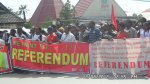
‘Demonstrations to press for our aspirations are in accord with the laws in force in Indonesia but people should understand that they must refrain from abusing or attacking journalists, as this is in violation of the ethical code of the press. A recent demonstration was held to call for a referendum, but if people resort to anarchistic behaviour, this would result in the aspirations not being made known to in public. He urged the KNPB to remember that the demos they organise should always be orderly and peaceful.. ‘They should avoid trying to force their wishes on other people,’ said Magay, who in earlier days often took part in demonstrations himself.
He referred to Law 29/1998 on demonstrations in which it is stated that people wishing to proclaim their aspirations and their opinions to the general public were fully entitled to do so and should always conform with the regulations in force.
A leading Papuan human rights activist has said that the Indonesian government will never be able to silence the Papuan struggle by putting Papuans behind bars. On the contrary, he said, it has the reverse effect by making people more determined than ever.
Sebby Sambom made these comments in an interview with JUBI in connection with the three-year sentence given to Forkorus Yaboisembut and his four colleagues last week.
‘Indonesia has neither the power nor the legal means to punish Papuans by silencing them with regard to their aspirations for an Independent Papua,’ he said.
He said that whenever Papuans take action, they are brought before the court and given a prison sentence. This is the way the government behaves which is simply unacceptable. Even though Papuans have done nothing wrong, they are thrown into prison.’
He said that any Papuan who takes action faces the prospect of being jailed. People keep on being arrested, put on trial and thrown into prison but this will never silence the Papuan people.
He went on to say that as the number of Papuans being held behind bars goes on increasing , this will help to alert the international community to get involved in solving the Papuan issue.
‘With all these political prisoners,’ he said, ‘international support will become more positive.’
Sebby said that Forkorus is a loyal Papuan leader who is very serious about the Papuan struggle. ‘He is doing everything he possibly can to bring an end to our sufferings,’ His attitude was very clear from the remarks he made after the verdict was announced. ‘We were pleased with the verdict and our struggle will continue,’ said Sambom.
ICTJ, the Women Commission, and the Women Working Group of Papuan People Assembly
“We women of Papua have been bruised, cornered, besieged from all directions. We are not safe at home, and even less so outside the home. The burden we bear to feed our children is too heavy. The history of the Papuan people is covered in blood, and women are no exception as victims of the violence of blind military actions. We have experienced rape and sexual abuse in detention, in the grasslands, while seeking refuge, no matter where we were when the army and police conducted operations in the name of security.”
In 2009–2010, ICTJ, the Women Commission, and the Women Working Group of Papuan People Assembly provided support to Papuan women in a project to document gender-based violence and human rights violations that occurred between 1963 and 2009. This documentation effort aims to understand different patterns of violence, including abuses committed by security forces and resulting from efforts to seize natural resources in Papua, as well as violence women have experienced in their own households since the army took control of the region in 1963. Of the regions in Indonesia, Papua—on the verge of becoming independent when Soehato gained power—experienced some of the highest rates of atrocities committed under the regime. And recent crackdowns in Papua indicate the government is still adopting a heavy-handed security approach.
The women in Papua worked on this collection of stories of violence and abuse over three months, interviewing 261 people (243 women and 18 men). The report finds that a range of factors within Papua—violence employed by security forces, a culture of discrimination against women, and lack of political will to change policies among others—have meant the victims are still neglected and none of the effects of violence have been addressed. “Change cannot be postponed any longer,” the women conclude.
Ban Ki-moon with Indonesia President Susilo Bambang Yudhoyono (Photo credit: Wikipedia)
PHOTO AND VIDEO REPORT
from the West Papua Media Editorial team, and local sources across Papua
March 21, 2012
Rallies held across West Papua, Indonesia, and Australia have drawn tens of thousands of people on to the streets calling on UN Secretary-General Ban Ki-Moon to do more to protect West Papuans to Indonesian state violence, and to allow them exercise their universal human rights to self-determination.
Despite significant threats of violence prior to the rallies by Indonesian security forces against peaceful unarmed protestors, the mass mobilisations across West Papua significantly outnumbered security forces and were peaceful. In some centres, the police only sent a handful of undercover intelligence agents to monitor the situation.
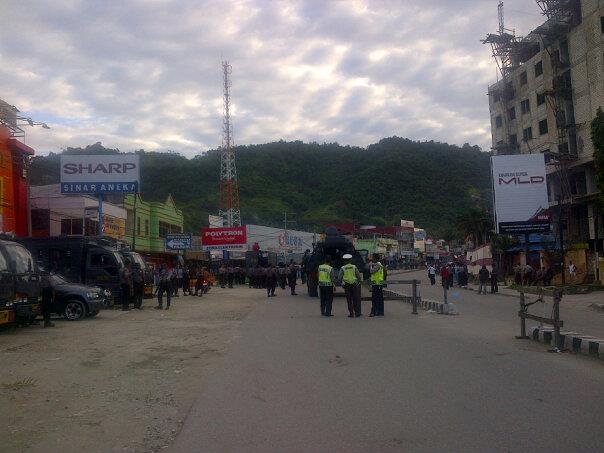
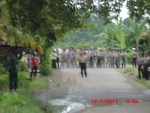
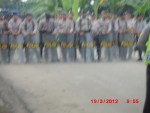
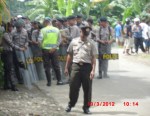
Security forces blocking access to Jayapura (photo Matias Murib)
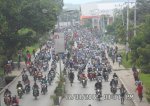
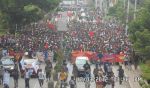
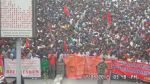
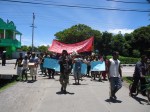
In Jayapura, over 5000 demonstrators marched from Taman Imbi and joined with a long march of several thousand people. Security forces blocked access to the centre of Jayapura with heavy weaponry, but the rallies avoided provocation. Jayapura was reported to be a ghost town as the rallies paralysed normal business and movement.
Speakers in Jayapura demanded that the UN Secretary-General listen to the people of West Papua and tabled seven key demand on the UN. Buchtar Tabuni, from the West Papua National Committee (KNPB) told the crowd that the UN must take responsibility for its role in the sham 1969 Act of Free Choice handover of West Papua to Indonesia, actions that violated international law.
“Ban Ki-Moon and SBY have to know the wishes of the sovereign independence of Papua on the land itself. KNPB will mediate the West Papuan people so they can determine their political choices through a mechanism that is democratic, peaceful, dignified and final in accordance with the principles and standards of international law”, said Tabuni.
Jayapura
Herman Wainggai, a West Papuan the West Papuan independence advocate based in the United States explained at the solidarity rally in Melbourne, Australia, “Our troubles began in New York in 1962, and I hope they will end there soon. We ask the United Nations to host talks between the Indonesian Republic and the Federated Republic of West Papua, just as the UN did between the Indonesians and the Dutch”
Ban Ki-Moon was visiting Indonesia to participate in The Jakarta International Defence Dialogue, hosted by the Indonesian Ministry of Defence on 21 March 2012, a move widely seen by human rights observers as giving legitimacy to Indonesian militarist objectives over West Papua and beyond.
West Papuan activists called on Mr Ban to use the opportunity to press Indonesia on human rights in Papua and its consistent denial of basic freedoms and rights to West Papuan people, including rights to life and of freedom of expression, and freedom from arbitrary detention.
“We would like Mr Ban Ki-moon to attend to our defence while he’s in Jakarta” said Herman Wainggai,
“The Universal Declaration of Human Rights establishes the right of all individuals to freedom of opinion and expression and the right to peaceful assembly and association. Also, Indonesia is a signatory to International Covenant on Civil and Political Rights (ICCPR), which guarantees the rights to freedom of expression and peaceful assembly and Indonesia’s constitution also protects these rights,” Wainggai told West Papua Media.
“So, it would be appropriate for the Secretary-General to negotiate the release of all political prisoners in Indonesia while he is visiting the new ‘Peacekeeping’ Centre in West Java,” said Wainggai.
Widespread Mass Actions
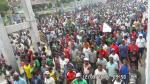
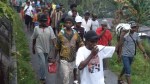
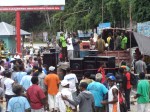
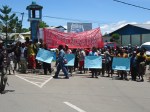
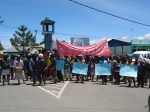
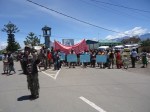
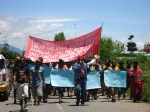
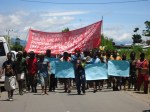
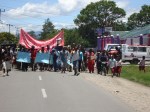
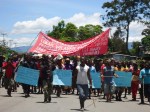
The rallies across Papua drew tens of thousands of people in total in Wamena, Biak, Serui, Yapen, Sorong, Nabire, Jayapura and Fak-Fak. Security forces engaged in their standard procedures of intimidation and disruption at all rallies, but protesters maintained non-violence discipline at each area.
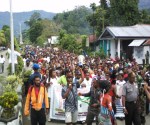
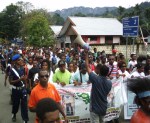
On Yapen island, close to 6000 people in total held two long marches to support the demands of the day, all under threat of arrest. Local police had refused to issue a permit for the rallies to go ahead, claiming the rallies would upset the security and integrity of Indonesia. After a week of pamphleteering and socialising the rallies, police had no choice but to allow the rally to go ahead. The rally began in the village of Mantembu, where former political prisoner Yawen Wayeni was brutally disembowelled and filmed by Brimob police in a video leaked on Youtube in 2010.
Mantembu, Yapen Island
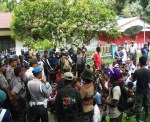
The same Brimob unit on Monday attempted to block the long march from leaving Mantembu, using over 50 police to block the narrow road, and attempted to seize all Morning Star flags. Negotiations ensued, led by Reverend Jhon Pairire and FRWP Doberay Governor David Abon, who got agreement from police for the rally to continue to Serui city. Police continued to intimidate Papuans all day, but Morning Star flags still appeared throughout the day despite Police.
Serui, Yapen Island
Manokwari saw more than 7000 people from across Papuan society and resistance raise the Morning Star flag and conduct long marches all over town after prayer, eventually settling down to listen to orations from a wide range of speakers. Speakers called for the freeing of all political prisoners in Papua in Indonesian prisons, including the President and the Prime Minister of the Federal Republic of West Papua. Brimob officers tried to seize the Morning Star flags early unsuccessfully, but soon stood aback training their weapons on the crowd, who studiously ignored the provocative intimidation according to stringers for West Papua Media.
Manokwari
In Sorong, our stringers reported that almost 1000 people took to the streets in a festive atmosphere. Organisers claimed that few security forces turned up other than about ten plain clothes intelligence agents. “It is clear that this drastically changed the atmosphere, it must be because of international pressure,” said our stringer by SMS.
On the West Coast in Fak-Fak, almost 1000 people took part in prayers and listened to speeches in the main market square, with little interference by security forces present.
Fak-Fak
In Jayapura, stringers for West Papua Media reported a wide range of colourful, festive and dramatic demonstrations for Papuan aspirations, including the release of almost 300 balloons painted with banned Morning Star flags and the UN flag, which drifted across town and out to sea. This tactic has been used repeatedly as a tactic for distributed symbolic resistance in both Papua and Maluku for years. Isolated gunfire was heard when the balloons passed over military barracks, according to local sources, believed to be Indonesian soldiers attempting to shoot down the balloons.
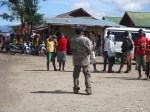
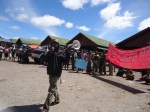
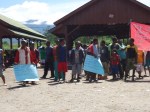
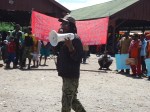
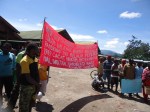
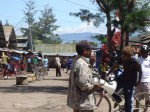
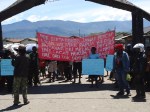
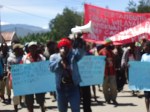
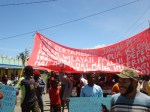
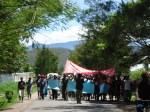
And in Wamena, in the Baliem Valley, a thousand people joined in a rally and march to support the call for the UN to take action by sending peacekeeping force to protect Papuan people against Indonesian security forces. Stringers for West Papua Media report that few security forces were in overt attendance, but there was an understanding that troops were close by at all times. The Baliem Valley and West Papuan highland people have borne the brunt of Indonesian violence since the occupation began, with sweeps against civilians by the Australian funded Detachment 88 counter terrorism group and Indonesian army still ongoing in Tingginambut, Mulia and the outer areas of the Baliem Valley.


































 West Papua Media Alerts