FORKORUS’ AND FOUR OTHERS’ SENTENCE VIOLATES HUMAN RIGHTS LAW
16 March 2012 – The Jayapura state court today found five Papuan leaders guilty of treason, sentencing them each to three years imprisonment. TAPOL, the Asian Human Rights Commission, the Faith-Based Network on West Papua, Franciscans International, and the West Papua Netzwerk seriously regret the verdict and question the fairness of the trial proceedings. The verdict is another example of the severe restrictions by the Indonesian authorities on the right to freedom of expression of the Papuans. We call upon Indonesian President Susilo Bambang Yudhoyono to order that all convictions which do not reflect international legal standards be overturned and the prisoners be immediately released.
Today’s verdict represents a setback in the relationship between Jakarta and Papua, suggesting that Indonesian authorities still see arrest and detention as the best ways to respond to expressions of Papuan aspirations. As a country widely applauded for its burgeoning democracy, Indonesia should be promoting peaceful political activity, not punishing it.
Forkorus Yaboisembut, Edison Waromi, Selpius Bobii, Dominikus Surabut and August Kraar were arrested in October 2011 for their roles in the Third Papuan People’s Congress, a peaceful gathering at which the leaders declared that Papua has been independent since 1961. As the gathering began to disperse, security forces fired shots into the crowd and carried out mass arrests and beatings. Three people were shot dead.
While the leaders of the Congress now face three years in jail for their peaceful actions, those responsible for the violent response to the Congress received a slap on the wrist, and investigations to determine who was responsible for the killings have led to neither justice nor accountability.
The five men were convicted of treason under Article 106 of the Indonesian Criminal Code. While the treason laws are intended to prosecute serious crimes against the state, alleged members of the armed resistance are rarely if ever brought to trial in Papuan courts; they are beaten, tortured or shot. Article 106 is instead used to charge those engaged in peaceful actions such as raising the Papuan national ‘Morning Star’ flag or organising and attending public events at which Papua rights and aspirations are asserted.
The denial made by the Coordinating Minister for Law and Human Rights of any political prisoners this month shows a lack of commitment to uphold human rights norms that are applicable to Indonesia according to international law, including that the peaceful expression of political opinions cannot be persecuted.
There are serious doubts about the fairness of the trial proceedings. Armed members of the security forces maintained a heavy presence during the trial sessions, and one of the senior lawyers for the defence, Gustav Kawer, is being threatened with prosecution, in violation of his right under Indonesian law and international standards to carry out his professional duties in defending clients in court. There have also been questions about the independence of the judges, who were reportedly visited by senior military, police and government officials just one hour before the trial began.
According to TAPOL’s data, the five men will join at least 27 other Papuan political prisoners currently in jail for treason under article 106. All those detained for peaceful political activities should be immediately and unconditionally released.
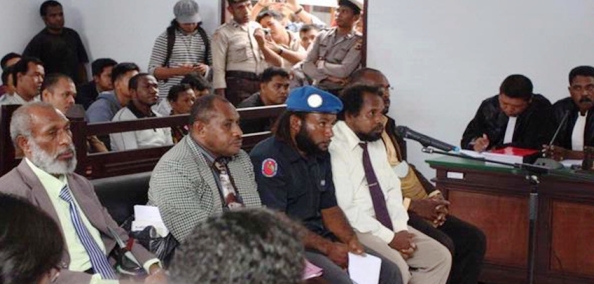
Papuan leaders accused of treason on trial in Jayapura, January 30, 2012
(Jayapura): Hundreds of security forces are on the streets around Jaypura, West Papua, in a show of force as an Indonesian court found five Congress leaders guilty of Makar (treason), and sentenced the defendants each to three years in prison.
The five defendants, Forkorus Yaboisembut, Edison Waromi, Selfius Bobii, Dominikus Sorabut, and Agus Kraar, were leaders and organisers of the Third Papuan People’s Congress held on October 19 2011, which was brutally broken up by Indonesian security forces after Forkorus – the Chairman of the Papuan Tribal Council elected as President of the Federated Republic of West Papua – unilaterally reaffirmed West Papua’s independence from Indonesia.
Today’s hearing at the Jayapura Class 1A District Court, the 15th hearing in a trial described by international observers of “descending into farce”, closed after the panel of judges led by Jack Johan Oktavianus declared that the defendants had committed treason under Article 106 of the Indonesian Criminal Code.
During the trial, several Indonesian Brimob paramilitary police officers who opened fire on the Congress gathering, admitted they had no proof that the accused had committed treason before they opened fire on unarmed civilians.
No member of the Indonesian security forces, who during the breakup of Congress were filmed committing acts of brutality and violence on unarmed civilians, were criminally charged and so far have not receive any sanction for the unprovoked attack.
On March 14, another defendant from the Third Papuan Peoples’, Gat Wenda, was also found guilty of makar charges, but was sentence to five months gaol, less time he has already served since his arrest.
Lawyers for the defendants, themselves under threat of prosecution and harassment by Indonesian security forces for their advocacy for the accused, have planned to appeal the decisions, saying “we think this decision is a disaster.”
In SMS messages sent from the legal team to West Papua Media, senior lawyer Olga Hamadi said “we think the judgement from the full bench is out of tune with what actually happened. We will appeal this to the High Court”.
Gustaf Kawer, another senior member of the legal team, also told West Papua Media via SMS that “the judges considered ambiguous and inconsistent testimony. (Yet) there is evidence of free expression and democracy that was ruled,” Kawar said, referring to the democratic rights and obligations adhered to by the Congress leaders.
A massive show of military hardware has caused major fear on the streets of Jayapura, with most poeple staying away from demonstrations for fear of an imminent military crackdown. 600 Heavily armed Brimob riot police and 300 Indonesian army soldiers are surrounding the streets around the court, backed up by several water cannon, 13 Barracuda armoured vehicles, and seven Army Panzers (assault vehicles).
Security forces today have, according to local civil resistance sources, used this show of force to actively prevent supporters of the accused to attend court.
The atmosphere has been described as highly tense with Papuan supporters of the convicted men outraged, but terrified, according to SMS messages from sources on the ground.
westpapuamedia
This is a developing situation – please stay tuned.
Indonesia: Five Papuans Convicted for Peaceful Protest Amend Treason Law to Uphold Free Speech
(New York, March 16, 2012) – The Indonesian government should drop the politically motivated treason charges against five Papuan activists who were convicted on March 16, 2012, and order their release, Human Rights Watch said today.
The district court in Jayapura, the Papuan provincial capital, convicted the five men and sentenced them to three years in prison for statements made at a Papuan People’s Congress in October 2011. The demonstration was brutally suppressed by the authorities, leaving at least three people dead. The five men convicted on March 16 are Selpius Bobii, a social media activist, August Sananay Kraar, a civil servant, Dominikus Sorabut, a filmmaker, Edison Waromi, a former political prisoner, and Forkorus Yaboisembut, a Papuan tribal leader.
“If the Indonesian government wants to make an example out of these people, then it should free them as a symbol of its commitment to free expression,” said Elaine Pearson, deputy Asia director at Human Rights Watch. “Instead, the legacy of the Papuan Congress crackdown will be five unjust convictions, while those responsible for the violence go unpunished.”
On October 19, 2011, in Jayapura, Indonesian security forces used excessive force to break up a three-day People’s Congress demonstration supporting independence for Papua, Human Rights Watch said. After Yaboisembut, one of the leaders, read aloud the 1961 Papua Declaration of Independence, police and the army fired warning shots to disperse the approximately 1,000 Papuans gathered. The security forces then used batons and in some instances firearms against the demonstrators, killing at least three and injuring more than 90 others. Witnesses said that demonstrators had been struck on the head and several suffered gunshot wounds.
Following the incident, 17 police officers, including the Jayapura police chief, Imam Setiawan and seven of his subordinates, were given written warnings for committing a disciplinary infraction by not giving priority to the protection of civilians. However, no other action was taken against police or military personnel for possible misuse of force.
The trial of the five activists raised serious due process concerns, Human Rights Watch said. During the trial, the defense told the court that police questioned their clients in the first 24 hours of arrest without the presence of lawyers. The defense also alleged that the men were beaten by police while in custody. Police allegedly kicked Yaboisembut in the chest and beat his head with a rifle butt. Sorabut testified that the police beat him on his head with a pistol and struck his body repeatedly with an M-16 assault rifle. Kraar said he was hit by police twice on the head with a pistol.
Human Rights Watch renewed its call for the Indonesian government to release all political prisoners and allow human rights organizations and foreign journalists unimpeded access to Papua.
The Indonesian Criminal Code should be amended to ensure that no one is prosecuted for treason for exercising their rights to peaceful protest protected under the Indonesian constitution and international law, Human Rights Watch said. The constitution, in article 28(e), states, “Every person shall have the right to the freedom of association and expression of opinion.” Article 28(f) provides, “Every person shall have the right to communicate and obtain information for the development of his/her personal life and his/her social environment, and shall have the right to seek, acquire, possess, keep, process, and convey information by using all available channels.” The International Covenant on Civil and Political Rights, which Indonesia ratified in 2006, similarly protects the rights to free expression and peaceful assembly.
Human Rights Watch takes no position on claims to self-determination in Papua. Consistent with international law, however, Human Rights Watch supports the right of everyone, including independence supporters, to express their political views peacefully without fear of arrest or other forms of reprisal.
“Throwing activists in prison on charges of treason will just reinforce Papuans’ beliefs that the Indonesian government uses the law for political purposes,” Pearson said. “And while the government is busy prosecuting peaceful protesters, it seems to have had no time to investigate adequately the violence against them.”
The Australian Government’s silence on human rights abuses in the region has once again been put in the spotlight, with the Human Rights Law Centre (HRLC) and International Lawyers for West Papua (ILWP) urging the Foreign Minister to speak up in defence of basic rights such as freedom of expression and assembly.
Criminal trials have commenced this week in Jayapura, against five Papuan political activists charged with criminal offenses following their involvement in last year’s peaceful assembly at the Third Papuan People’s Congress. The activists were among the hundreds of people arrested after Indonesian police and military forcibly shut down the gathering, killing at least three people and injuring approximately 90 others.
HRLC spokesperson, Tom Clarke, said the fundamental rights of all persons to freedom of expression, peaceful assembly and association are protected by International Covenant on Civil and Political Rights – which Indonesia ratified in 2006.
“These fundamental human rights must be recognised and respected by Indonesia. The exercise of such democratic rights and freedoms must be protected by law, not criminalised.
“Australia’s UN Security Council bid pitches us as a ‘principled advocate of human rights for all’. This is a prime opportunity for the Foreign Minister to take a principled stand against human rights abuses on our doorstep,” Mr Clarke said.
The Papuan activists, Forkorus Yaboisembut, Edison Waromi, August Makbrowen Senay, Dominikus Sorabut and Selpius Bobii, are facing charges of treason in a region where people may be imprisoned for simply raising the West Papuan ‘Morning Star’ flag.
ILWP’s Jennifer Robinson called on the Australian Government to use its unique relationship with Indonesia to encourage the authorities to demonstrate their respect for human rights by dropping charges against the five activists.
“These trials should stop immediately, and Australia should do everything it can to help that happen. The prosecution of activists for peacefully expressing their political views has no place in a modern democracy. The Australian Foreign Minister, his department and embassy staff in Indonesia should make it very clear that the Australian Government firmly supports human rights and freedom of expression in the region,” Ms Robinson said.
Ms Robinson also called on the Australian Government to deploy embassy staff to observe the legal proceedings for the purpose of ensuring that the protesters receive a fair trial.
The trial is scheduled to resume on Wednesday 8 February.
For further comments:
please contact West Papua Media +61450079106 for contacts
Papuan Leaders take a sit in floor of Papuan Police Prison. From left to right each of them; Edsison Waromi SH (Prime Minister), Forkorus Yaboisembut S.Pd ( President Republic Federal State of West Papua), Dominikus Surabut ( Aktivist)), Gad Wenda (Aktivist ), Agus Senandy Kraar (Aktivist ) and Selpius Bobii (Chair of Orginizing Commettee of Third National Papua Congress). (Photo: West Papua Media)
30 November 2011
Exclusive interview by Alex Rayfield (New Matilda) with West Papua Media
The President of the Federal Republic of West Papua may be behind bars, he may have been savagely beaten by the Indonesian police, but he has not been silenced. From his 5×4 meter cell in the bowels of the Jayapura Police Station – quarters he shares with five other Papuans also charged with rebellion against the Indonesian state – Forkorus Yaboisembut recently issued a rousing call to action smuggled out of prison.
“To all the Papuan people” Yaboisembut writes, “don’t be afraid to celebrate December 1st, whether you do so simply, or as part of large gatherings. Do not be afraid because we, the Papuan people, do not intend to destroy any country; we only wish to defend our political rights.”
Our interview, the first – clandestine – interview with Western media, may be constrained by time and space, but I can picture the tribal elder from previous meetings. He is a quietly spoken man, late in years but strong and alert. He walks tall, sits up straight and dresses neatly in long dark pants; polished slip-on shoes and patterned but subdued crisply ironed business shirts. His short hair and longish grey beard gives him the look of an Old Testament prophet, grandfatherly if you like.
It is painful to think that he when he was arrested on October 19 he was tortured so badly that he could barely sit down – or stand. Dominikus Surabut, from the West Papua Council of Customary Tribal Chiefs, who was detained with the man who is now the President of the Federal Republic of West Papua and who was also badly tortured, tells me that when Mr Yaboisembut was arrested the Police beat him mercilessly with a rifle butt, raining blows down on his head and crashing their weapons into his solar plexus. In a widely published Indonesian language account of the arrest, a religious leader said that an Indonesian soldier was ready to shot him dead but was urged not to by a policeman.
West Papuan’s political rights, Mr Yaboisembut says, are inalienable. “Whether you take the United Nations founding document, the International Covenant on Civil and Political Rights, the International Covenant on Economic, Social and Political Rights or even the Indonesian Constitution as your starting point, Papuans have the right to self-determination.”
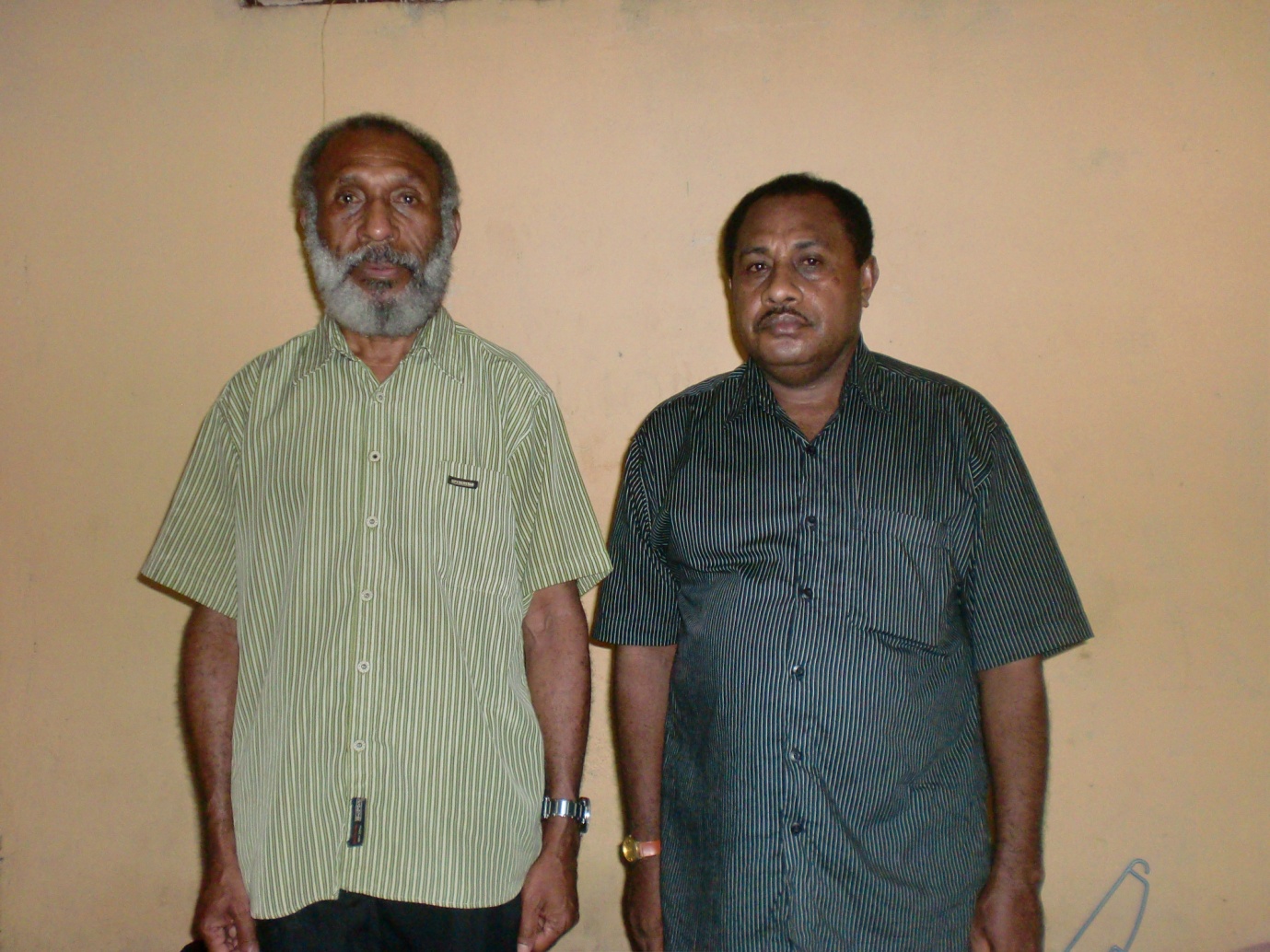
Forkorus Yaboisembut S.Pd and , Edison Waromi,SH
“The preamble to the 1945 Indonesian Constitution mentions expressly, that independence is the right of all Nations, and because of this colonialism must be swept away, it is consistent with the principles of justice and humanity. Consequently, the people of Papua cannot be blamed in accordance with any law for wanting to celebrate their national day.”
These ideas, the same ideas that inspired Indonesians to liberate themselves from Dutch rule, are igniting the imagination of entire generation who yearn to be free. What makes Mr Yaboisembut’s ideas even more extraordinary is that he is urging an insurrection that grounded in what he calls “human dignity”.
“December the first 2011, is the fiftieth anniversary of when Papuans first raised the Morning Star flag. It is our golden anniversary, the year of God’s liberation” he says evoking the images of the ancient Jewish custom of Jubilee – of freeing captives and erasing debts. “It must be celebrated in an atmosphere of peace, safety and calm”.
“To Papuans, I therefore say, do not carry out acts of terror, intimidation or commit violence of any kind towards anyone, for whatever reason, whether they are Papuan or migrants.
“Do not be afraid,” Mr Yaboisembut repeats, “God is with us.”
Papuan leaders are standing infront; Forkorus Yaboisembut S.Pd, Edsison Waromi SH .behind Dominikus Surabut, Gad Wenda, Agus Senandy Kraar and Selpius Bobii (Photos: West Papua Media)
“The roots of our oppression is political” says Mr Selphius Bobii, Chair of the Committee of the Third Papuan Congress, who also shares a cell with Mr Yaboisembut and Surabut. “The annexation of our country by Indonesia and the acquiescence of the international community has resulted in state sanctioned human rights violations and creeping genocide.”
Those arrested on October 19 in the wake of the Third Papuan Congress are not backing down from the declaration of independence. “We are committed to using people power, diplomacy and the law to achieve our rights” Bobii tells me.
Dominikus Surabut says that he and the other prisoners are refusing to sign police statements charging them with “rebellion” (makar) under sections 106 and 110 of the Indonesian Criminal Code.
“We have done nothing wrong” Surabut says. “We have a political right to declare independence. We do not seek to destroy Indonesia or any other country. On the contrary, it is the Indonesia state that has attacked us.”
How can it be, they rhetorically ask, that the Indonesian police get written warnings for killing Papuans when Papuan activists nonviolently exercising their rights to freedom of expression are beaten and jailed?
Is this the same country that Obama and Gillard lauded for being a beacon of democracy?
In a widely published letter in support of Papuan political prisoners Human Rights Watch says that the articles under which the six Papuan political prisoners arrested after the Third Papuan Congress have been charged “are a legacy from the Dutch colonial era”. Charging nonviolent activists with rebellion is “in violation of the Indonesian Constitution, Articles 28(e) and 28(f) which respectively afford “the right to the freedom of association and expression of opinion,” and “the right to communicate and obtain information for the development of his/her personal life and his/her social environment, and shall have the right to seek, acquire, possess, keep, process and convey information by using all available channels.”
The charge of rebellion is also inconsistent with Indonesia’s international obligations under the International Covenant on Civil and Political Rights (ICCPR) which Indonesia ratified in 2006, a point which the jailed Papuan leaders make repeatedly to me. Besides, the Papuan leaders sigh, we have been left with no other option. “Special Autonomy has totally failed and even the MRP, a state institution convened a meeting which came up with eleven recommendations, one of which was to hold the Third Papuan Congress.”
Outside their police cell, in the streets of the cities and towns of West Papua, in the cloud covered mountains and on the coconut palm fringed coasts a new political consensus is emerging. This consensus has been forged not through endless meetings of the Diaspora, nor in stillborn discussions with political elites in Jakarta, nor in the conference halls of NGO deliberations, but in the furnace of political action. It is simply this: that West Papua must be free.
After the Congress three overlapping political groupings have emerged: the Papuan Peace Network who is calling for political dialogue, the West Papua National Committee who demands a referendum, and the Papua Congress leaders (supported by a loose alliance made up of the West Papua National Authority, the Council of Customary Papuan Chiefs, the Presidium Dewan Papua, and the West Papua National Coalition for Liberation).
The killings of nonviolent Papuans by the Indonesian police and military on October 19 have divided ordinary Indonesians, flushing out ultra-nationalists and their racist discourse, and outraging political moderates longing for a different kind of future than the one left to them by former dictator Suharto.
Inside Papua the massacre appears to be having a unifying effect, although Papuan politics remains complex affair. The West Papua National Committee who opposed the Congress later marched in support of the six political prisoners. Father Neles Tebay, respected intellectual and leader of the Papua Peace Network has intensified the demand for political dialogue. It is a call that has been supported by Yaboisembut and others. “All Papuans, wherever they are must respect the dialogue process democratically initiated through the Papuan Peace Conference and the Papuan Peace Network” wrote Mr Yaboisembut in a message smuggled out of prison.
Whether the Indonesian police and military act in a similarly dignified manner, or not, remains to be seen.
As I write this a long-term Papuan human rights activist sends me this message: “there’s an increase of military patrol of soldiers around Jayapura Township.” Some put the numbers as high as forty thousand. Reports are filtering in of troop surges in Sorong, Paniai (where gunshots have been heard), the border region and Jayapura.
“The atmosphere here is quiet but eerie” my friend writes. We are all waiting to see what December 1 will bring.






 West Papua Media Alerts