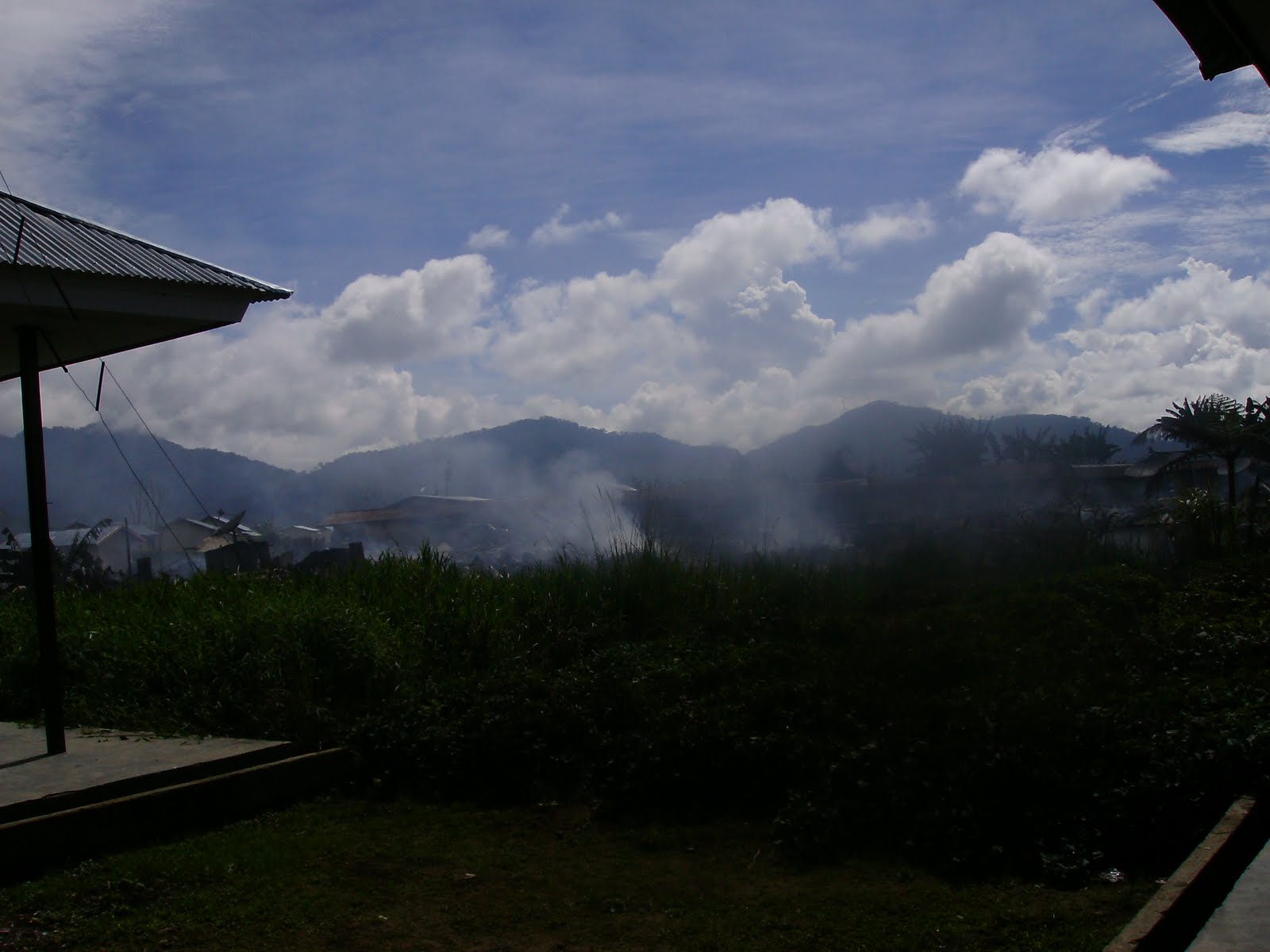
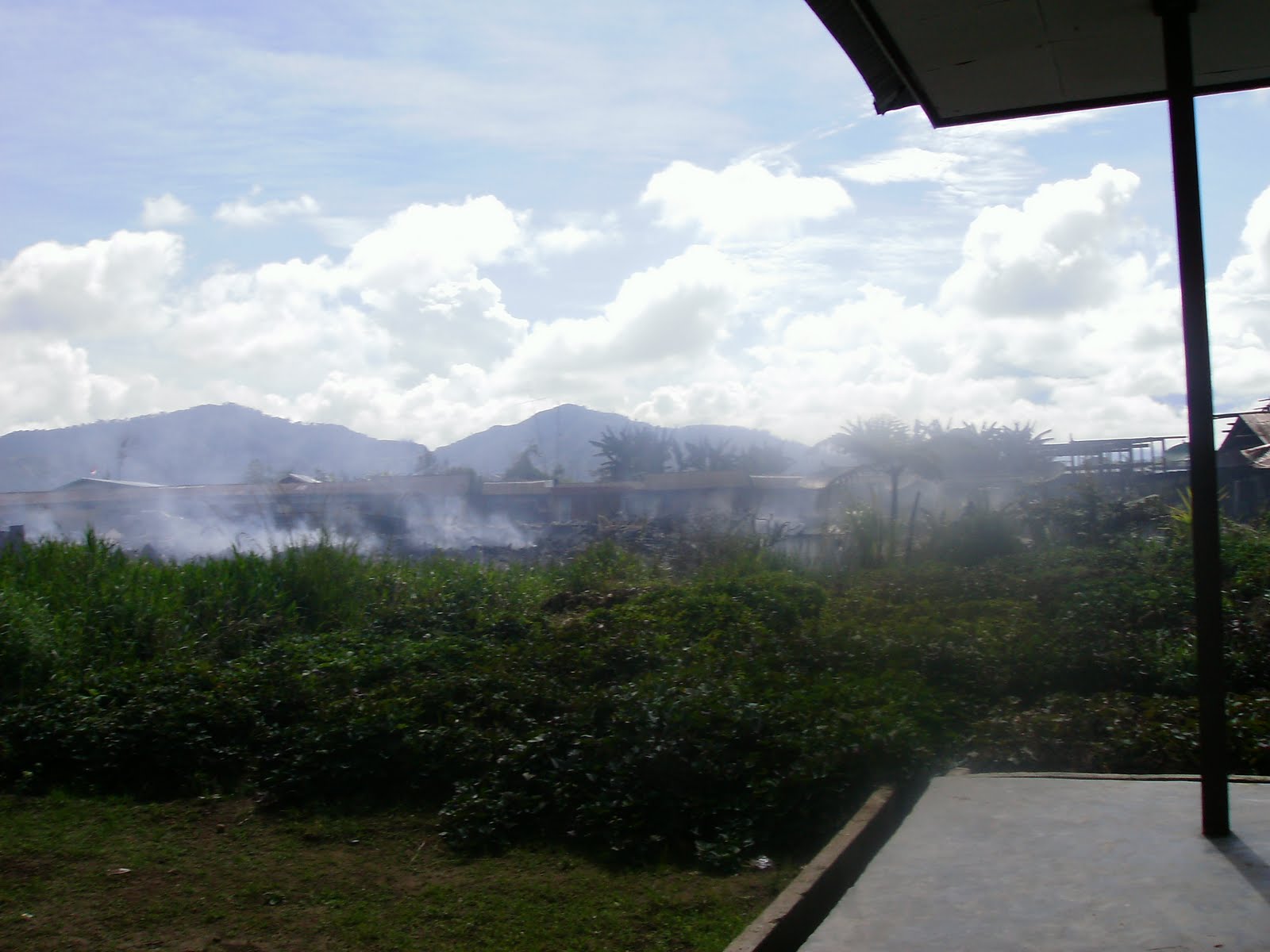
4 Residents Shot Dead By Indonesian Police in Dogiay, West Papua

by Victor Yeimo, KNPB

[Dogiay, West Papua] – 4 residents, namely Dominikus Auwe, Pinsen Tigi, Alwisius Waine, and Matias Iyai from Dogiay (near Paniai, West Papua ) have been shot dead by Indonesian Police on 13 April 2011 at 3.00 AM.  During this operation, some others residents were injured.

According to local witnesses, this incident began when police wanted to disperse some people who were playing a gambling game.   These people were immediately attacked by the police, without giving any warning to the victims.

Until now, several houses (in DOgiyagi) have been burned down by police. About 2,000 residents fled to the forests because of last night, there are 7 companies of police were brought in from Nabire last nigh at 3.00 AM.

(WPMA NOTE: these are preliminary figures based on witness reports.  WPMA has no way of independently verifying these numbers at present, but given the severity of the operation the numbers would be accurate.  1 Company of Police would be approximately 100-150 men, depending on the unit)

Local people claim that AKP (Inspector) Marji Marpaun is immediately responsible for this incident.

MORE INFORMATION AS IT COMES TO HAND.

Photos by ALIANSI-MAHASISWA-PAPUA(AMP) 

http://myspecialdocumentaries.blogspot.com/  (tested, legitimate link)
=============

Victor F. Yeimo,
International Spokesperson for the West Papua National Committee [KNPB]
“Tidak ada kemenangan revolusioner tanpa teori revolusioner”


Komnas HAM member warns of potential conflicts in Papua

Bintang Papua 13 April, 2011 

The deputy chairman of the Papua branch of the National Human Rights Commission is afraid that serious conflicts could occur in Papua around such issues as the election of the governor, conflicting views regarding special autonomy/OTSUS and the new Papuan Asembly, the MRP, conflicts between religious groups or between the churches, and the Puncak Jaya case. Other issues that were potentially controversial were the recent shooting dead of two people in the Freeport area, the serous flooding in Paniai and a number of mysterious deaths that have not been investigated.

Mathius Murib conveyed these thoughts to Bintang Papua in an SMS message.

He urged all sides in Papua to remain vigilant, to do everything possible to preserve peace in Papua and not to be provoked into making emotional responses. What is needed, he said, is well-thought out criticism in an era of democratisation and recognition of basic human rights in Indonesia. People should be careful to abide by the laws and regulations.

He expressed the hope that the newly appointed MRP would struggle for the basic rights of the Papuan people and hoped that the members of the new body would acknowledge the struggles waged by the late Agus Alue Alua and his colleagues in the previous MRP.

NGOs Say US Got it Wrong on Indonesian Human Rights

FYI

Dessy Sagita | April 11, 2011

Indonesian activists on Sunday criticized the US government for praising Indonesia’s progress on human rights, saying that the barometer used for the report could be misleading.

“I’m a bit concerned with the diplomatic statements made by some countries regarding Indonesia’s progress on human rights, because it could give people the wrong perception about what’s really happening,” Haris Azhar, coordinator of the Commission for Missing Persons and Victims of Violence (Kontras), told the Jakarta Globe.

As in previous editions, the US State Department’s annual survey on human rights pointed to concerns in Indonesia, this year including accounts of unlawful killings in violence-torn Papua along with violations of freedom of religion.

But US Secretary of State Hillary Clinton, while presenting on Friday the mammoth, 7,000-page global report, pointed to Indonesia as a success story.

“Indonesia boasts a vibrant free media and a flourishing civil society at the same time as it faces up to challenges in preventing abuses by its security forces and acting against religious intolerance,” she was quoted by foreign wire agencies as saying.

The survey covers the period before Islamic fanatics brutally killed three members of the Ahmadiyah sect in early February, raising questions over Indonesia’s commitment to safeguard minority rights.

The concern over Papua is primarily a reference to the torture of two civilians there last year by soldiers. They were subsequently court-martialed in January but given sentences of less than a year, a punishment slammed by the influential group Human Rights Watch as far too lenient to send a message that abuse was unacceptable.

Kontras’s Haris said both indicators presented by the US government — that Indonesia has been progressing in terms of media independence and better access for civil societies to voice their concern — were also incorrect.

“Freedom of journalism? I don’t think so. It’s still fresh in our minds that several journalists have been brutally attacked because of their reporting, some were even murdered,” he said.

“And in terms of flourishing civil societies, it’s true, non-government organizations are mushrooming, but what’s the point if human rights defenders and anticorruption activists are assaulted?” he added.

According to Kontras, in 2010 alone more than 100 human rights activists here were victimized and many of the perpetrators remain free.

And according to Reporters Without Borders, when it comes to press freedom, Indonesia ranks very low, much worse than it did several years ago when Abdurrahman “Gus Dur” Wahid was the president.

The US report in some ways echoes progress noted by New York-based Human Rights Watch in its own annual review of human rights practices around the globe, released in January. Then it noted that while serious human rights concerns remained, Indonesia had over the past 12 years made great strides in becoming a stable, democratic country with a strong civil society and independent media.

But Andreas Harsono, from Human Rights Watch, said it was perplexing that the US government would compliment Indonesia’s progress on rights.

“It’s a big joke,” he said. “Attacks against Ahmadiyah have been happening since 2008, after the joint ministerial decree was issued, and attacks against churches during SBY’s six-year tenure are even more prevalent than during the five decades in which Sukarno and Suharto ruled,” he said.

Additional reporting by AP, AFP 

USGOV: 2010 Human Rights Report: Indonesia

BUREAU OF DEMOCRACY, HUMAN RIGHTS, AND LABOR

2010 Country Reports on Human Rights Practices

April 8, 2011

Indonesia is a multiparty democracy with a population of approximately 237 million. In July 2009 Susilo Bambang Yudhoyono was reelected president in free and fair elections. Domestic and international observers judged the April 2009 legislative elections generally free and fair as well. Security forces reported to civilian authorities, although the fact the Indonesian Armed Forces (TNI) continued to be partly self-financed had the potential to weaken this control.

Human rights problems during the year included: occasional incidents, primarily in Papua and West Papua Provinces, of arbitrary and unlawful killings by security forces; vigilantism; sometimes harsh prison conditions; impunity for some officials; official corruption, including in the judicial system; some narrow and specific limitations on freedom of expression; societal abuse against religious groups and interference with freedom of religion sometimes with the complicity of local officials; trafficking in persons; child labor; and failure to enforce labor standards and worker rights.

DOWNLOAD FULL REPORT HERE:

http://www.state.gov/g/drl/rls/hrrpt/2010/eap/154385.htm

Komnas HAM on Lack of commitment to solve human rights issues in Papua

JUBI, 8 April 2011 

The deputy chairman of the Papuan branch of Komnas HAM, the National Human Rights Commission, Mathius Murib, has accused the regional authorities of lack of commitment to solve human rights violations in West Papua.

He said that the local government had failed to enact a regional regulation known as Perda regarding human rights .

Komnas HAM has already prepared the draft of a Perda but the provincial governor  and the provincial legislative assembly  have as yet failed to enact it as a regulation.

He cited as examples of the government’s lack of commitment  the fact that the Wasior case in 2001 and the Wamena case in 2003 were still unresolved although Komnas HAM had carried out pro justicia investigations of these cases and had reached the conclusion that both were cases of gross human rights violations. However, the attorney-general’s office had a different opinion about the cases.

Murib made three recommendations that the victims might consider in order to bring such cases to a resolution. They could find ways to use legal mechanisms  within the Indonesian judiciary, adding that it might be possible to bring these cases before an international mechanism.

A second possibility was for the provincial government to enact the Perda regulation as drafted by Komnas HAM.

The third possibility was for Komnas HAM to become a regional human rights commission under the framework of the special autonomy law within the powers of authority of the governor of the province of Papua.

Create a website or blog at WordPress.com

Up ↑