Extraordinary scenes occurred at Abepura prison in West Papua on Saturday night when heavily armed police stormed the cells of non-violent Papuan leaders currently on trial for treason.
The unusual and heavy handed security sweep was carried out between 9-10 pm on Sunday night and involved 3 truckloads of armed Dalmas anti-riot paramilitary police; 2 truckloads of Brimob police, and a detachment of the fully armed prison anti-riot officers.
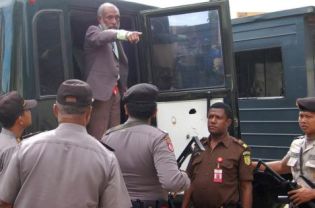
Forokorus Yaboisembut (Jakarta Globe)
The cells of a number of West Papuan political prisoners were turned over in the sweep, and all prisoners possessions were removed, including pens, paper, files, books, letters, plates, drinking glasses, cutlery knives, guitars, and music tapes, including lawyer-client privileged communications and defence notes. Mobile phones were not found however, according to sources at the prison.
It is believed the targets were five leaders of the Third Papuan People’s Congress that peacefully declared independence from Indonesia on October 19, 2010, sparking a brutal and bloody crackdown by Indonesian occupation forces.
Forkorus Yobeisembut, and Edison Waromi, the President and Prime Minister respectively of the Federated Republic of West Papua, together with Selpius Bobbi, Dominikus Sorabut, and Agus Kraar are all on trial for treason charges. The hearing on Friday had to be suspended after the prisoners refused to return into the courtroom due to concerns of the conduct of witness cross-examinations. The trial was adjourned to February 21.
Reliable sources close to the accused Congress leaders have told West Papua Media that the raids relate to rumours circulating that the five defendants will be broken apart and moved to separate prisons away from Papua. These rumours have been propagated by unknown parties, however regular prison transfers are a common tactic by the Indonesian state on Papuan political prisoners. The Indonesian Attorney-General and the Prosecutors office have repeatedly stated publicly that the trial and prisoners would be moved from Papua if any unrest occurs, but there is significant local Papuan resistance to such a move.
Local observers also have suggested that the bizarre raids had occurred after police objected to the defendants conduct in court and sought to reassert the “authority of state” by behaving unpredictably.
According to a series of urgent text messages sent to various advocates, the head of the prison at Abepura opened up the political prisoners section to normal criminals allowing them to mix freely. This is often a tactic utilised by prison authorities to effect violence on prisoners without prison guards having to commit the abuse personally. The political prisoners source told West Papua Media that in a disturbingly strange move, the prison chief then invited the political prisoners to sit without resistance with in a room together with hardened murderers, robbers and rapists, many of whom are from other parts of Indonesia.
Prison authorities did not reply to any requests for clarification from West Papua Media about the events at Abepura.
Statement by Yan Christian Warinussy, Executive-Director of LP3BH, Papua[Translated by TAPOL]
The appointment and deployment of Major-General Mohammad Erwin Syafitri (former deputy chief of BAIS, Indonesia’s joint strategic intelligence agency) as commander of KODAM XVII Cenderawasih Papua is clear proof that the Land of Papua is still an area of operations of Indonesian military intelligence.
As a result, the top leadership of the military territorial command in this region has been placed under the command of a leader who has a background in intelligence or at the very least a history of involvement in Indonesia’s intelligence agency.
This is important in order to protect the collaboration between military activities or security and intelligence which acts as the front line for gathering information and deploying security forces in the area.
It is important to point out that in the opinion of human rights activists in Papua, the Land of Papua is still isolated from the international community, bearing in mind that access to the area has been made difficult for several humanitarian and human rights institutions such as the International Committee of the Red Cross and Peace Brigades International, as a result of which they have closed their offices in Papua and left Indonesia in November last year.
The same goes too with regard to the presence of international observers as well as foreign journalists. And for the past five years, it has been difficult for foreign diplomats based in Jakarta to gain access to Papua. This situation has come about because of the powerful influence of the Indonesian army – TNI – and the Indonesian police, so as to make it more difficult for international observation of developments with regard to the rule of law and basic human rights in the Land of Papua.
As a human rights defender in the Land of Papua, I see a close connection with the upsurge in demands being made by the Papuan people to the Indonesian government to find a solution to a number of problems by means of a Papua-Indonesia dialogue, as an important theme which is continually being confronted by certain elements, such as the TNI and the Indonesian police, both of whom have their own vested interests in the Land of Papua.
Bearing in mind that President Susilo Bambang Yudhoyono stated on 9 November 2011 that he is ready to enter into dialogue with all forces in the Land of Papua, I have not yet seen any response to this from TNI or from the Indonesian police, to indicate whether they agree with this or indeed whether they support the wishes of the President.
Although in this connection, the military commander and the chief of police of Papua said in their presentations to the Papuan Peace Conference on 5-7 July 2011 that they too support dialogue as the way to solve the conflict in the Land of Papua.
I believe that the Indonesian army and police must clearly reveal their attitude towards the question of dialogue.which is what the vast majority of Papuans support, along with their non-Papuan brothers here in Papua. Even the central government in Jakarta is supporting this, which is clear from the fact that President SBY has appointed Deputy President Boediono to take the lead in efforts to prepare the way for this Papua-Indonesia dialogue.
The idea of dialogue has moreover won positive support from a number of countries around the world, including the USA, Australia, Germany, the UK and the European Union, all of whom are close allies of Indonesia and support the territorial integrity of the Republic of Indonesia.
By Nick Chesterfield and local sources at Westpapuamedia.info
Special report and update
January 14 2012
Local human rights monitors report from the remote Paniai district of West Papua that Indonesian security forces continue to maintain a “disproportionate” military offensive since early January, intensifying the displacement of tens of thousands of villagers who fled from several weeks of village burnings in December.
Indonesia’s Australian trained Detachment 88 counterterrorism troops and Brimob paramilitary police together with Indonesian army battalions, are continuing to conduct search, capture and cordon missions on the villages in the hunt for the forces of a National Liberation Army (Tentara Pembebsan Nasional or TPN) commander Jhon Yogi.
This is despite Indonesian President Susilo Bambang Yudhoyhono ordering the immediate suspension of the offensive and withdrawal of all non-organic security forces from Paniai, when meeting with West Papuan church leaders on December 12 at his residence in Bogor, West Java. No firm date for withdrawal was given.
Papua Police spokesman Wachyono, told the Jakarta Globe that 481 Brimob and Densus 88 members deployed in Papua from Jakarta, East Kalimantan and North Sulawesi would leave Papua by January 23. However West Papua Media understands from sources on the ground that these troops will significantly escalate the pace of attacks on civilians in the lead up to the departure. Local human rights sources have further questioned the ability of independent monitoring of this withdrawal when the Indonesian government is continuing to enforce an access ban on media to the area.
Yogi’s forces have consistently avoided capture since the offensive began, despite sustaining significant casualties. This continued escape and evasion has raised pertinent questions from observers on the real aims of the Indonesian security force offensive, in an area that has extensive gold deposits and a brutal history of land use conflict triggered by a lucrative “legal” and illegal gold trade. Several foreign gold mining companies continue to operate in the area during the offensive, and Brimob police and assets, that have been contracted to provide mine security to these companies, are continuing to be utilised in the ongoing offensive.
The systemic excessive force by Brimob and Indonesian security forces working for foreign mining interests are again under the spotlight across Indonesia after Brimob troops were recently caught on video uploaded to Youtube opening fire on a protest on behalf of another Australian gold mining company Arc Exploration in Bima, Sumbawa. At least 3 protestors were killed and 11 seriously wounded as local residents held a non-violent protest against the destruction of their village lands by the gold mine.
Credible information during the Paniai offensive has been incredibly difficult to verify due to the continuing Indonesian government ban on all journalists and foreign observers from coming to the area. Indonesian journalists covering have not been able to access the district either, despite article claiming that they have been present. However, stringers for West Papua Media, human rights monitors from Elsham, church officials, and witnesses have been able to get close to the area to report on the situation, which by all accounts in worsening for civilians. Indonesian security forces however are continuing to block any independent access to the immediate conflict area around the former TPN headquarters of Markas Eduda to verify or rule out human rights abuses, and most reports are still coming from interviews with refugees who have fled from the fighting.
West Papua Media has repeatedly attempted to contact spokespeople for the Indonesian police operating in Paniai, however no replies have been forthcoming.
Church* and Human rights sources have claimed that security forces are continuing to indiscriminately target civilians in the campaign, and have embarked on a policy of village and church burnings. According to detailed reports provided to West Papua Media by investigators, Brimob and D88 troops have burnt down 29 churches, 13 primary schools and 2 junior schools, and 13 villages have been destroyed over the New Year period. The razed villages are spread out across the south and west of Wegamo, and in Ekadide areas.
Local witnesses interviewed by human rights observers have reported that civilian helicopters have again been used in the intensified security offensive, with allegations that two helicopters belonging to mining companies operating in the area have been again used by troops to continue to strafe villages, drop live and gas grenades and ferry troops into the fighting areas. Multiple witnesses confirmed that one of the helicopters was a civilian Squirrel AS355 previously implicated in attacks, and identified formally with a helicopter identification sheet provided to West Papua Media stringers and human rights workers.
According to the report received, around dawn (0600) on the morning of January 1, 2012, A civilian Squirrel (pictured)
The AS355 Squirrel helicopter used by Brimob on December 13, and allegedly used over the New Year Paniai offensive (File: West Papua Media)
helicopter conducted what the report describes as “surgery” (surgical military strikes) on Wege mountain, and was used to ferry troops between White Sands and the now-occupied former TPN headquarters of Markas Eduda. Villagers in the White Sands area have been forcibly evacuated by Brimob troops and are still unable to return.
Hana Degei (37), Jemi Gobai (26), Oktolince Degei (20), Menase Kayame (41), Mabipai Gobai (18), Silpa Kayame (32) all from Dagouto, and Peter Kudiai, a 14 year old school student from Badauwo were all confirmed killed by Brimob and D88 troops in the New Year offensive, adding to the toll of those killed during December’s operations.
In the report, church sources stress that full extent of deaths from the Paniai offensive is still being shrouded by deliberate obfuscation and cover-up from Indonesian security forces. “The full death toll from the armed clashes between Brimob and the TPN we do not know, because our religious and community leaders have been refused access to the Eduda conflict area,” the report states. “Thus, we also have not been able to collect (exhaustive casualty) data which is accompanied by clear facts. Perhaps Brimob forces and TPN knows how many are wounded and dead due to gunshot wounds, (but) all the information is still closed to the public,” the report claimed.
Local sources have also expressed concern for the longer term humanitarian situation across Paniai when and if the offensive finishes, due to the deliberate village burnings. According to both church sources, Brimob and D88 deliberately destroyed and burnt food gardens across the offensive area, and burned down fences designed to keep livestock out. Surviving cattle have been moving freely and have eaten whatever food plants have survived the destruction, stoking fears of starvation for already stressed and displaced local villagers
Together with villages forcibly evacuated as reported in December, over 150 villages are now vacant, displacing at least 9000 civilians.
Indonesian officials have blatantly misrepresented the scale of displacement, claiming that only 1715 were displaced and all those “temporarily evacuated” were being supported at a military controlled “care centre”. This number is failing to take into account those who are in grave fear of the security forces running the “care centre”, and those who are staying with extended families and/or tribal networks. So far the 1715 have not been able to return to their villages, and their conditions at the “care centres” are deteriorating from already grave conditions, according to local observers.
An Indonesian health worker who has been in Enaratoli during the offensive, and who declined to be identified publicly after contacting West Papua Media privately via SMS, described the situation as extremely tense and a human disaster. He also expressed concern, from his observations and conversations with displaced locals, that there seems to be a wider plan from Indonesian security forces for the long-term.
“Everyone here knows that Brimob are in the gold trade across Paniai, doing business for and with both orang bule {white man} and Javanese, and now they are clearing people whose villages are on top of the gold diggings” the health worker told West Papua Media – in English – in an SMS exchange. “This human disaster is happening, and we are part of it, but who has ordered it? Is it just the police looking for golden scrapings, or is someone richer telling them to do it?”
West Papua Media has not been able to fully verify the authenticity of this source’s claimed identity, given the security risks of identifying them publicly speaking out.
The Paniai region has had a long and brutal history of land use conflicts between the Indonesian colonists and local people, mainly stemming from the illegal gold trade.
The church human rights investigations have also reported that all normal community activities in the conflict are have ceased, with those churches and schools not yet burnt by Indonesian security forces closed indefinitely, and local employment has also ceased – further exacerbating the humanitarian disaster in Paniai.
*Due to the danger faced by local church officials from Indonesian security forces in reporting these facts, West Papua Media has made a difficult decision to not identify either the church sources, nor their denomination.
General John Magai Yogi, the leader of the TPN/OPM Makodam Pemka IV Division in Paniai, declared in a letter that they will not withdraw a single step in their operations against the Indonesian army and police which have been under way since August, 2011. He said that their struggle was a continuation of the struggle of their predecessors to achieve the aspirations of the people of West Papua.
‘We, the TPN/OPM throughout the Land of Papua, will never surrender and will continue to resist the forces of Indonesia to the very last drop of blood,’ he wrote in the letter dated 5 January.’The only weapons we hold in our hands are Ukaa Mapega, bows and arrows, but we have pledged to God Almighty that we are ready to confront the Brimob troops of the Indonesian police and Densus 88, the elite forces of Indonesia, who are equipped with modern weapons and are at present in control of the district of Paniai’
He made two other points in his letter. The first is: The United Nations, the USA and the Netherlands will soon be called to account for the mistakes they made in the past which sacrificed the Papuan people. And the second is: The UN and the USA must speedily resolve the Papuan problem because this problem will never be resolved by means of bargains and Indonesian development activities in Papua.
‘We will never surrender. People living in the kampungs and near the forests are always deemed to be part of the TNP/OPM, even though they are just ordinary people. They [the military] are now chasing the TPN/OPM and we are not free from military pressure in the forests of Paniai because the chief of police has ordered a large number of Brimob troops from Kalimantan and Densus 88 to come here and encircle our headquarters. They are threatening our lives. The troops that have been sent here are disrupting our tranquillity and are trying to destroy us, the TPN/OPM,’ he said in the letter.
He went on to write that since the encirclement and attack against their Eduda headquarters on 13 December 2011, members of the TPN/OPM division have held on to their position in the forests of Paniai. ‘This does not mean that we have surrendered.’
The letter concludes with the following words: ‘All people and groups have basic rights which must be respected by everyone, including the right to self-determination. This is the right which we Papuan people demand from the UN who never listened when our rights were trampled upon by the forces of Indonesia and the USA.’
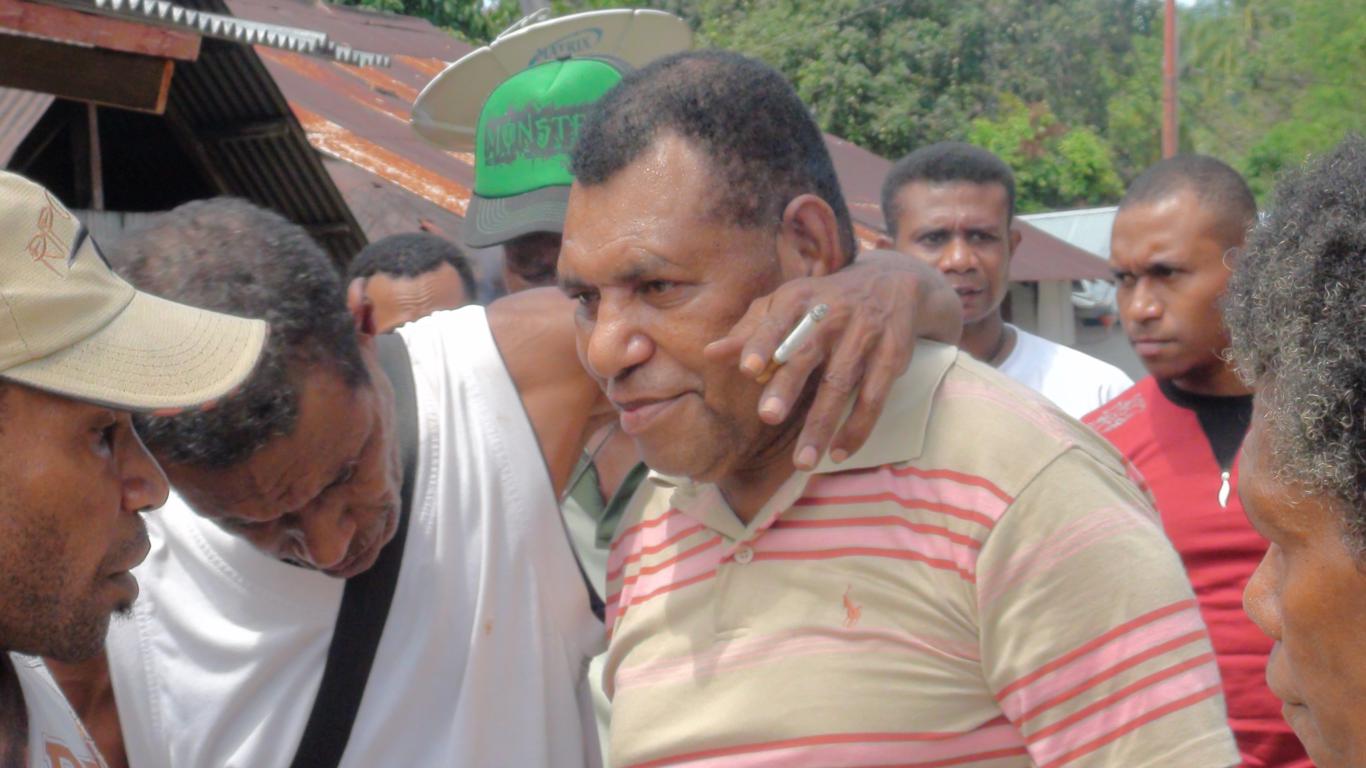
Simon Tuturop has finished his prison sentence in Fakfak. From outside the jail Tuturop said “Having been in prison for years doesn't mean that I will be quiet, instead prison was a place for study and self-reflection about how to build a struggle together with other brothers and sisters. Unity is the key” (Photo @Elsham Advocacy Team & Foker Fakfak)
Five political prisoners, imprisoned for raising the Morning Star flag on 19 July 2008 in front of the Fakfak Act of Free Choice building, were freed today. They were condemned to four years in prison by the Fakfak court and have now been released having served three years, five months and three days of their sentence.
Simon Tuturop, Tadeus Weripang, Benediktus Tuturop, Tomas Nimbitkendik and Teles Piahar were collected from the prison by Freddy Warpopor, the Fakfak Area Coordinator of Foker NGO Papua, and other friends by two minibuses and several motorbikes, according to a Foker NGO press release.
The group left the prison at 09:30. They went to the house of Eligius Warpopor, a community leader in Gewerpe Village, where they were greeted by the people of Gerwerpe. Simon Tuturop made a speech thanking the people of Gewerpe Village, as well as the Papuan Customary Institute (Lembaga Adat Papua), Elsham Papua, Foker NGO, LP3BH Manokwari, Amnesty International and the ICRC. He said that they had helped to greatly reduce their suffering in prison.
Simon Tuturop being welcomed by the people of Gerwerbe Village. Photo @Elsham Advocacy Team & Foker Fakfak
Simon Tuturop, originally from Fakfak, is a leading figure of the non-violent movement for Papua liberation. In 1982 he joined in a proclamation of West Papuan independence in Jayapura. He was sentenced to twelve years in Kalisosok prison, Surabaya. In 1998, as President Suharto fell, Tuturop and other political prisoners across the whole of Indonesia were set free. He then went to work in Aceh, to help with social projects for Achenese people who had become refugees of Indonesia’s war with the Free Aceh Movement (GAM)
On 19 July 2008, Tuturop led a flag-raising of the Morning Star flag where 44 people were arrested by Indonesian police. Five were found guilty by the Indonesian court in Fakfak and convicted of treason under articles 106 and 110 of the Indonesian criminal code. Elsham Papua, LP3BH Manokwari and Foker NGO Papua regard them as innocent prisoners of conscience who did not committed any violent acts. To express a desire for independence is part of the freedom to express political aspirations. It is not a criminal act. These three organisations continued to advocate for them and defend them.
Tadeus Waripang returns to his home in Kampung Wayati. Photo @ Elsham Advocacy Team & Foker Fakfak
The group then continued their journey to Wayati Village to bring Tadeus Weripang back home. The people of Wayati Village and the village chief were already waiting for Tadeus Weripang’s arrival.
Warpopor said, “It was a great welcome, despite the tumultous atmosphere. Some people shed tears.” Village chief Plerius Kondawe gave his thanks to the three organisations.
The villagers asked Freddy Warpopor to explain about President Susilo Bambang Yudhoyono‘s meeting with Papuan church leaders. Warpopor encouraged the villagers to pay attention to any developments which may arise. He said that President Yudhoyono “was already open to dialogue with the Papuan people.”
“Let’s all support this process, so that we can determine the right format that Papuans will later use in the dialogue, and another important thing is that this struggle is a non-violent struggle. Let’s unite to save the country and this land of Papua,”said Warporpor.






 West Papua Media Alerts