Empty promises whitewash Freeport’s rights, responsibility record

 http://etanaction.blogspot.com/2011/08/empty-promises-whitewash-freeports.html

Special for ETAN‘s  Blog

by David Webster

What does a mining company need to do to get a top score for “corporate social responsibility”?

Freeport's contribution to Papua's welfare - Riverine tailings pollution

To judge by the recent “100 Best Corporate Citizens List”, all it takes to finesse a long and controversial record of human rights abuses is to come up with a piece of high-minded rhetoric, then carry on as usual.

Human rights advocates and those who have studied the record of Freeport McMoran in West Papua were startled to learn that Corporate Responsibility Magazine had named Freeport as the 24th-best corporate citizen in America (click for the full list). More startling still, the company scored well based mainly on a sixth-place ranking in the human rights category.

How is this possible? Well, the survey’s methodology seems to pay no heed to human rights performance. Only human rights rhetoric matters. And in that, Freeport excels. A strong written policy on human rights declares: “Freeport-McMoRan does not tolerate human rights transgressions.” It points to rights risks in West Papua, Peru, and the Democratic Republic of Congo, and adds that PT Freeport Indonesia policy is to “notify the direct commanders of the perpetrators” in cases where human rights allegations are made against Indonesian security forces. Since reputable human rights groups suggest that the top ranks of the security forces are implicated in widespread human rights violations in West Papua, this is hardly striking at the root of the problem.

As local people have pointed out, and researchers have confirmed, Freeport’s performance is a far cry from the written policies. The main trouble is intimate ties to Indonesian security forces.

Security forces may be implicated in the murder of American citizens near the Freeportmine, as Eben Kirksey and Andreas Harsono have reported.

Violence around the mine is used by security forces to target and scapegoat local people. In 2005, the New York Times revealed thatFreeport paid the security forces more than $10 million in 2001 and 2002. Payments are now made “in-kind” rather than in cash. The local Amugme people have long protestedFreeport seizure of their lands. Pictures of Freeport’s Grasberg mine from space (left) show the scale and environmental impact in the mountains that are home to the Amungme.

And lest all of this be hailed as “old news,” the Amungme filed a lawsuit last year sayingFreeport had taken their lands illegally. Meanwhile, the Indonesian army’s presence around Freeport, and the company’s close ties to Indonesian security forces, were reinforced this year. The continuing alliance between Freeport Indonesia and the Indonesian security forces is likely to exacerbate, rather than improve, the human rights situation.

None of these reports are taken in to account in the “100 Best Corporate Citizens List.” All the human rights indicators measure “human rights disclosure” and the sole source, according to the methodology details, comes from “Company public disclosures” – a corporation’s own information about itself.

The methodology, in other words, measures promises, not performance. There are parallels to the debate over whether companies accused of operating sweatshops overseas can be trusted to police themselves, or should accept independent monitoring. Thus the list cites the voluntary “Sullivan principles” first created under the Reagan administration and welcomed by companies resisting demands to divest from apartheid South Africa. AndFreeport boasts of adherence to the Voluntary Principles on Security and Human Rights, launched by the British and American governments in 2000.

The key word here is “voluntary.” As with the mining industry globally and with businesses jumping on the corporate social responsibility (CSR) bandwagon more generally, companies are happy to promise good performance, as long as no one will be looking over their shoulders.

So perhaps it’s no surprise to learn that Corporate Responsibility Magazine is in fact published on behalf of the Corporate Responsibility Officers Association, a body made up of many of the companies being judged, and steered by such firms as Domtar and KPMG.Freeport is listed as a “recent member” of the CROA. It’s advanced in the listings – it was ranked 83rd in 2010.

The problem here isn’t just the “corporate social responsibility” methodology, but the entire concept of “CSR”. It can all too often be used by companies to buy their way out of “corporate social irresponsibility.”

Freeport is no champion of the best values of corporate citizenship: For human rights activists, it’s long been a poster child for corporate irresponsibility. A list of good corporate citizens with Freeport winning laurels demonstrates more than flaws in the study. As George Monbiot has written of climate change credits, the lists offer corporations a new form of medieval European Catholic “indulgences,” forgiveness for any form of offence. Jeff Ballinger recently pointed out on this blog that companies like Nike are wrapping themselves in the CSR garment to burnish their corporate images, despite continuing disregard for many labor rights. Freeport, too, is now having itself measured for a fine CSR wardrobe.

—-

David Webster is an assistant professor of International Studies at the University of Regina inSaskatchewan, Canada. He is a former coordinator with the East Timor Alert Network/Canada.

see also

West Papua Report (monthly)

ETAN/WPAT: Statement on the operations of the Freeport McMoran Mine in West Papua, to the U.S. Senate hearing on Extracting Natural Resources: Corporate Responsibility and the Rule of Law

Indonesia food security project threatens Papuan way of life – activists

http://www.trust.org/alertnet/news/indonesia-food-security-project-threatens-papuan-way-of-life-activists

Source: Alertnet // Thin Lei Win

05 Aug 2011 14:07

NOTE: West Papua Media proudly provided fixing services for Reuters AlertNet for this article and further investigations.  

A member of the Koroway tribe walks up a ladder to his house at a forest nearMerauke city in Indonesia’s Papua province in this May 18, 2010 handout photo. REUTERS/Suntono-Indonesia statistic agency/Handout

By Thin Lei Win

BANGKOK (AlertNet) – Indigenous Papuans are at risk of further marginalisation and the forests and ecosystems on which they rely face destruction due to an ambitious food security project by the Indonesian government, activists say.

Under MIFEE (Merauke Integrated Food and Energy Estate) plans, 1.63 million hectares of forest which forms the basis of life for some 200,000 indigenous people in the Merauke area would be used to grow rice, palm oil, soya bean and corn among other crops.

Indonesia is seen as a key player in the fight against climate change and is under intense international pressure to curb its rapid deforestation rate and destruction of carbon-rich peatlands.

Activists accuse the authorities of not sufficiently consulting the Malind Anim people about the project, which they say pose a double threat to local Papuans. Not only would they lose their customary lands, but they would also face an influx of migrants from the rest of Indonesia — further marginalising communities that feel disenfranchised by what they say is the government’s exploitation of natural resources at their expense.

“If this project goes ahead, it means we will lose everything – we will lose our land, our culture, our livelihood, our food,” Rosa Moiwend, a Papuan activist whose family still lives in Merauke, told AlertNet.

The transition from forest to farm and plantation land would have a “tremendous” impact on natural ecosystems, Carlo Nainggolan from Indonesian rights group Sawit Watch, said.

“Indigenous people who have made use of natural forests to meet necessities of life will experience a dramatically decreased quality of life and well-being,” he said.

Department of Agriculture officials did not respond to a request for comment.

STRAINED TIES

Papua, two provinces on the west half of New Guinea island, has long suffered strained ties with Indonesia which took over the area from Dutch colonial rule in 1963. And this week, thousands of indigenous Papuans them marched on the parliament in the capital of Papua, demanding a referendum on independence from the archipelago.

Despite being home to a mine with the world’s largest gold and recoverable copper reserves, Papua is one of the least developed regions in Indonesia. According to the United Nations, 40 percent of Papuans live below the poverty line of $1.25 a day, compared to the national average of 18 percent.

Both the central and regional governments have hailed MIFEE as the answer not only to Indonesia’s growing concerns about food shortages but as a source of exports.

The project is expected to produce close to 2 million tonnes of rice, almost 1 million tonnes of corn, 2.5 million tonnes of sugar and close to 1 million tonnes of crude palm oil, according to local media reports.

However, activists point out that the staple food for Papuans is sago, a starch derived from sago palm, not rice. And they say there has been discontent in some areas where compensation from companies clearing and managing the land was deemed insufficient.

Despite a recent government pledge to resolve land tenure conflicts and protect the rights of people in forest-based communities, activists say most locals remain in the dark about the project.

“People from the village, when asked about MIFEE project replied, ‘MIFEE is a car that frequently crosses the road that reads MIFEE (on the body of the car)’,” Sawit Watch’s Nainggolan said.

LOSING A WAY OF LIVING

The massive scale of the project and nature of the indigenous people’s skills – many make a living hunting and gathering rather than farming – means a huge workforce is likely to be imported from outside Papua, activists say.

Sawit Watch estimate that some 5 million workers were needed to work the land, or four labourers per hectare. Yet, based on the 2009 census, the number of people native to Merauke was 195,577, Nainggolan said.

The low levels of education, knowledge and Indonesian language skills also mean indigenous Papuans are likely to be only involved in MIFEE as low-skilled labourers despite the loss of their land and livelihoods, he said.

Moiwend summed up the anger felt by activists.

“If the Indonesian government says that we are a part of them, that we are their brothers and sisters like they say, why do they do this project?,” she said. “They don’t want us to live in our own land. They want to kill us with this project.”

AP: Military Vows Crackdown in Papua Province [+Reject Calls for Referendum: Lawmaker]

From Joyo

also: JP: Reject Calls for Papua Referendum: Lawmaker

The Associated Press
August 4, 2011

Military Vows Crackdown in Papua Province

Indonesia’s army chief vowed Thursday to hunt down separatist rebels
after a swell in violence in the restive province of Papua killed two
soldiers and three civilians in less than a week.

They will be “chased down” and “cleaned up” by local military units,
said Gen. Pramono Edhie Wibowo, a day after gunmen shot a military
helicopter in the hilly district of Puncak Jaya, a rebel stronghold
and longtime hotbed of separatist violence.

The chopper had flown into the remote region to evacuate Fana Hadi, an
army private who was wounded during an attack on his post Tuesday
morning.

Gunmen opened fire as it passed a hill, killing Hadi with a shot to
his left rib, local military officials said.

That shooting followed the killings of one soldier and three civilians
Monday, shot and hacked to death during an ambush on their minibus and
taxi near the provincial capital of Jayapura.

Five other people were injured.

It was not immediately clear what sparked the uptick in violence.

Papua is a former Dutch colony on the western part of New Guinea. It
was incorporated into Indonesia in 1969 after a U.N.-sponsored ballot.

A small, poorly armed separatist group known as the Free Papua Movement has battled for independence ever since.

Nineteen people were killed in clashes between supporters of rival
political candidates in a seemingly unrelated violence Sunday. Because
of the violence, elections for district chief scheduled for Nov. 9
will be delayed, local media reported Thursday.

———————————-

The Jakarta Post [web site]
August 4, 2011

Reject Calls for Papua Referendum: Lawmaker

by Mariel Grazella

The chairman of the Papua and Aceh special autonomy supervisory team,
Priyo Budi Santoso, urged the government to send the military to Papua
if the referendum movement escalated to a mass rebellion.

Thousands of Papuans across the province have demonstrated to call for
a referendum on independence.

The demonstrations coincided with a series of attacks on police and
military posts in Puncak Jaya that have been blamed on the Free Papua
Movement (OPM).

“I urge law enforcers not to hesitate in taking firm action,” he said.

He added that if the situation escalated to rebellion, the “military
should be sent in if necessary”.

“We should remain persuasive but if the situation leads to [demands
for] a referendum; [we] should not hesitate in sending in the
military,” he said, adding that special autonomy was the “best formula
in addressing the problems of Papua”.”Therefore, I urge the government to firmly reject [the calls for a
referendum] because Papua is part of Indonesia and that is final,” he
added.

West Papua: the road to freedom?

Benny Wenda at the IPWP launch
Image via Wikipedia
Published on August 4, 2011 by Nick Harvey  in
New Internationalist
http://www.newint.org/features/web-exclusive/2011/08/04/west-papua-protests-independence/

West Papua: the road to freedom

Web exclusive

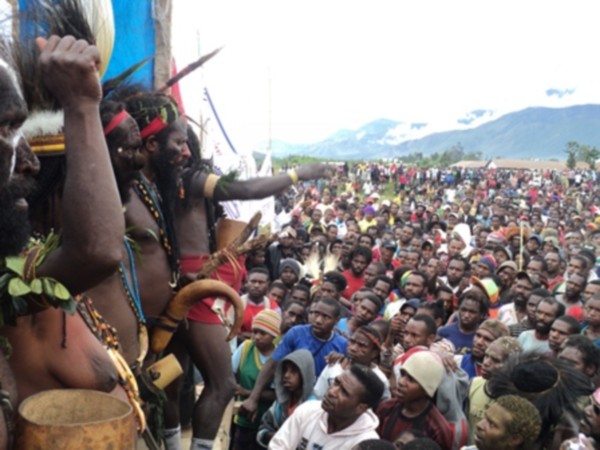
This week marks the 48th anniversary of the West Papuan struggle for independence from Indonesia. Thousands have taken to the streets and international lawyers are making a strong case for West Papuan self-rule.

Thousands have demonstrated on the streets of West Papua in recent weeks demanding independence. Free West Papua Campaign

It is a grief-stricken path that has been followed for generations. It stretches from when the Dutch colonized the region in the 19th century and cruelly continued when control was handed to Indonesia by a United Nations Temporary Executive Authority in 1963. And this week the journey towards independence has led thousands of West Papuans onto the streets to demand the international community acknowledge their right to be free.

‘West Papuans will never recognize their homeland as being part of Indonesia and we have a fundamental right to self-determination under international law,’ says Benny Wenda, a West Papua independence leader living in exile in Britain. ‘West Papuans have marched peacefully this week and have shown again that they can meet violence with peace to achieve this [aim], no matter how much [Indonesia] tries to intimidate us.’

‘A blind eye has been most cynically turned by the international community towards the situation of the people in West Papua’

Protesters and human rights campaigners are regularly harassed and arrested in West Papua and, according to Amnesty International, reports of torture whilst in detention and other human rights violations are commonplace. But with momentum building for the cause, the police have been reluctant to intervene in the recent protests.

‘The demonstrations were so big this time they know if they act violently towards the protesters it would be noticed internationally,’ says Wenda. ‘We have been trying for 48 years now and, just like the Middle East, we need people power to change the world – but we also need people from around the world to notice.’

One of the biggest obstacles that the Free West Papua campaign faces is a lack of interest, let alone support, from the outside world.

Forgotten conflict

‘West Papua is a forgotten conflict,’ says Charles Foster, spokesperson for International Lawyers for West Papua. ‘A blind eye has been most cynically turned by the international community towards the situation of the people there.’

As part of efforts to raise the profile of the region, a conference was held in Oxford this week by the Free West Papua campaign. International lawyers and activists spoke at the event to highlight the case for an independent West Papua under international law.

Nick
Harvey
Benny Wenda and fellow West Papuans sing their national anthem at a conference in Oxford. Nick Harvey

‘In legal terms, the region has a clear right to self-determination,’ says Foster. ‘If you look at the New York Agreement [a treaty signed in 1962 by the Netherlands and Indonesia regarding the political status of West Papua, then known as West New Guinea] the United Nations was given trustee status over the region which was supposed to lead to self-determination in 1969. Indonesia has never disputed the fact it put its name to this agreement; therefore it implicitly acknowledges that it was bound by it.’

But the New York Agreement was followed in 1969 by the ironically titled Act of Free Choice, a vote by a tiny section of the population of West Papua, hand-picked by the Indonesian military, on whether the region should become independent or remain part of Indonesia. Although it has since been widely recognized that the process was a sham, calls for a revote have consistently been ignored.

‘There is no serious legal scholar anywhere in the world who thinks the Act of Free Choice was a genuine expression of the free will of the West Papuan people,’ says Foster. ‘When Indonesians talk about this they try to steer clear of what actually happened on the ground in 1969. They’re not stupid, they realize how embarrassing it is.’

As long as the international inertia continues, the situation for West Papuans continues to worsen

Yet even if the New York Agreement is somehow forgotten and the circumstances surrounding the Act of Free Choice somehow ignored, international law still falls heavily on the side of the West Papuans. In 1960 the UN General assembly passed a crucial agreement, the Declaration of Granting Independence to Colonial Countries and Peoples, which states: ‘All peoples have the right to self-determination; by virtue of that right they freely determine their political status and freely pursue their economic, social and cultural development.’

This firm legal ground has yet to translate into any meaningful concessions to the West Papuan people. And as long as the international inertia continues, the situation for West Papuans continues to worsen.

Clemens Runawery is an exiled independence activist who has been unable to return to his country for more than 40 years.

‘The longer we stay part of Indonesia the more our status will suffer, both physically and demographically,’ he says. ‘Back in 1961 the vast majority of the people in West Papua were West Papuan, with only a minority from other places. Today this situation has been completely reversed. How much time do we really have left?’

Amnesty: URGENT ACTION FEARS FOR SAFETY of Human rights defender Yones Douw

AI has released an Urgent Action Update for Yones Douw. (5 August 2011)
The original Urgent Action concerning Yones was Issued on the 17 June 2011and is below the present one.


————————————

http://www.amnesty.org/en/library/asset/ASA21/023/2011/en/95040490-098a-445d-81e2-20f94150781e/asa210232011en.html

DOCUMENT – INDONESIA: FURTHER INFORMATION: FEARS FOR SAFETY OF INDONESIAN RIGHTS ACTIVIST

FU UA: 188/11 Index: ASA 21/023/2011 Indonesia Date: 5 August 2011

URGENT ACTION

fears for safety of indonesian rights activist

Human rights defender Yones Douw has received medical treatment after he was beaten by military officers on 15 June. However, he continues to fear for his safety and the safety of his family after he received information that he is under surveillance by members of the Indonesian security forces.

On 1 July Yones Douw travelled to Jayapura, Papua province in Indonesia, to seek medical assistance for the injuries he sustained while monitoring a demonstration on 15 June. X-rays revealed a blood clot in his head and a fracture to his hand. He is still receiving medical treatment for these injuries and continues to feel pain at the back of his head and in his hand. He also suffers from frequent headaches.
While he was travelling to Jayapura for treatment, Yones Douw received information that a senior police officer in Nabire had contacted police intelligence officers in the district by SMS asking “Has Yones left Nabire, please check and keep a close eye on him”. On 15 July he was informed by a credible source that the Nabire District Police Station had ordered officers to monitor Yones Douw’s movements in Nabire. Since then Yones Douw has seen strangers waiting in the vicinity of his house and heard motorcyclists revving their engines as they pass by. Human rights groups have raised concerns in the past about individuals and groups being hired to intimidate human rights defenders, minority groups and others. Yones Douw fears for his safety, and the safety of his family.

Yones Douw was beaten while monitoring a demonstration calling for accountability for the stabbing and killing of Papuan Derek Adii on 14 May, reportedly by military officers. To Amnesty International’s knowledge there has been no investigation into the death of Derek Adii.
Please continue to write in English, Indonesian or your own language:
Urge the authorities to take immediate action to ensure the safety of Yones Douw, in accordance with his wishes;
Call for an immediate, effective and impartial investigation into the unnecessary and excessive use of force used against Yones Douw, with the results made public and those responsible brought to justice in fair trials;
Call on the authorities to initiate an independent investigation into the possible unlawful killing of Derek Adii, and ensure that, should the allegations be verified, those responsible be brought to justice in fair trials and the victims receive reparations;
Call on the authorities to ensure that all members of the police and military are made aware of the legitimate role of human rights defenders and their responsibility to protect them, as set out in the UN Declaration on Human Rights Defenders.
P LEASE SEND APPEALS BEFORE 16 SEPTEMBER 2011 TO :
Minister of Justice and Human Rights
Patrialis Akbar
Ministry of Justice and Human Rights
Jl. H.R. Rasuna Said Kav No. 4-5
Kuningan, Jakarta Selatan 12950
Indonesia
Fax: +62 21 525 3095
Salutation: Dear Minister
Papua Police Chief
Inspector General Bekto Suprapto
Papua Regional Head of Police (Kapolda)
Jl. Samratulangi No. 8 Jayapura,
Papua, Indonesia
Fax: +62 967 533763
Salutation: Dear Kapolda
And copies to:
Chairperson National Human Rights Commission (Komnas HAM)
Ifdhal Kasim
Jl Latuharhary
No.4 Menteng Jakarta Pusat
10310, Indonesia
Fax: +62 21 39 25 227
Also send copies to diplomatic representatives accredited to your country.
Please check with your section office if sending appeals after the above date. This is the first update of UA 188/11. Further information: www.amnesty.org/en/library/info/ASA21/014/2011/en
———————————————————————————————————————————-

DOCUMENT – INDONESIA: PAPUAN ACTIVIST AT RISK FOLLOWING BEATING

UA: 188/11 Index: ASA 21/014/2011 Indonesia Date: 17 June 2011 Date: 17 June 2011
URGENT ACTION

PAPUAN ACTIVIST AT RISK FOLLOWING BEATING
Yones Douw , a human rights activist in the Indonesian province of Papua , was beaten by military officers on 15 June and has been denied medical treatment . He fears for his health and safety , as he has previously been detained and assaulted as a result of his human rights activities.
A protest took place at the 1705 District Military Command (Kodim) base in Nabire, Papua province, on the morning of 15 June, to call for accountability for the stabbing and killing of Papuan Derek Adii on 14 May 2011, reportedly by military officers from the 1705 District Military Command. At about 9am on 15 June, Yones Douw, a 42-year-old human rights activist, heard that a protest, which included family members of Derek Adii, was about to take place, and he went to the base to monitor it. Thirty minutes after he arrived, a group of protesters turned up in three trucks, broke into the front entrance of the base and started to shatter the windows and throw objects. Yones Douw immediately rushed into the base to calm the protesters.

In response, the military fired shots into the air and started hitting the protesters. Yones Douw was struck on the head with pieces of wood many times. He also sustained injuries on his shoulder and wrists from the beatings. As he was beaten he heard the military threaten to shoot the protesters saying “these animals should be taught a lesson”. A military officer also hit the father of Derek Adii, Damas Adii, with a piece of wood. After the beatings, Yones Douw travelled to the Siriwini hospital for treatment and to obtain a medical report, but was told by medical staff that he required a letter from the police before they could treat him. He then decided to go home and is still suffering from the injuries. He fears for his health and safety.
Yones Douw is a respected human rights activist in Papua and has been documenting human rights violations by the police and military over the last decade.


PLEASE WRITE IMMEDIATELY in Indonesia n , English or your own language:
Urging the authorities to take immediate action to ensure the safety of Yones Douw, in accordance with his wishes, and ensure his immediate access to medical care;
Calling for an immediate, effective and impartial investigation into the beatings and the threats against Yones Douw, with the results made public and those responsible brought to justice in fair trials;
Calling on the authorities to initiate an independent investigation into the possible unlawful killing of Derek Adii, and ensure that, should the allegations be verified, those responsible be brought to justice in fair trials and the victims receive reparations; and
Calling on the authorities to ensure that all members of the police and military are made aware of the legitimate role of human rights defenders and their responsibility to protect them, as set out in the UN Declaration on Human Rights Defenders.
PLEASE SEND APPEALS BEFORE 29 JULY 2011 TO :
Minister of Justice and Human Rights
Patrialis Akbar
Ministry of Justice and Human Rights
Jl. H.R. Rasuna Said Kav No. 4-5
Kuningan, Jakarta Selatan 12950
Indonesia
Fax: +62 21 525 3095
Salutation: Dear Minister
Chairperson National Human Rights Commission (Komnas HAM)
Ifdhal Kasim
Jl Latuharhary
No.4 Menteng Jakarta Pusat
10310, Indonesia
Fax: +62 21 39 25 227
Salutation: Dear Ifdhal Kasim
Papua Police Chief
Inspektur Jenderal Bekto Suprapto
Papua Regional Head of Police (Kapolda)
Jl. Samratulangi No. 8 Jayapura,
Papua, Indonesia
Fax: +62 967 533763
Salutation: Dear Kapolda
Also send copies to diplomatic representatives accredited to your country. Please check with your section office if sending appeals after the above date.
URGENT ACTION
PAPUAN ACTIVIST AT RISK FOLLOWING BEATING

ADDITIONAL INFORMATION

In January 2009, police officers kicked and punched Yones Douw during his arrest, after he attempted to intervene to stop clashes between police and demonstrators in Nabire. He and seven other demonstrators were denied access to the outside world and he was deprived of food and drinking water during his one day detention.
In recent years, there have been a number of cases of intimidation and attacks against human rights defenders and journalists in Indonesia, and human rights defenders are regularly intimidated and harassed in Papua. International human rights observers, non-governmental organizations and journalists are severely restricted in their work there.
Amnesty International continues to receive credible reports of human rights violations by the security forces in Indonesia, including torture and other ill-treatment and the unnecessary and excessive use of force. There are often no independent investigations into allegations of human rights violations, and those responsible are rarely brought to account before an independent court. In January 2011 three soldiers who had been filmed kicking and abusing Papuans were sentenced by a Military Court to between eight and 10 months’ imprisonment for disobeying orders. The fact that the victims were not able to testify because of the lack of adequate safety guarantees raised serious concerns about the trial process. Amnesty International believes that the civilian courts are much more likely to ensure both prosecutions for crimes involving human rights violations and protection for witnesses than the military system, which is unlikely to be impartial and independent.
While Amnesty International acknowledges the difficulties faced by security forces in Indonesia, especially when confronted with violence, the power to use force given to security forces is restricted by relevant international human rights law and standards, the basis of which is the right to life. The Indonesian authorities must ensure prompt, independent and impartial investigations into all credible allegations of human rights violations by the security forces. Those found responsible, including persons with command responsibility, should be prosecuted in proceedings which meet international standards of fairness, and victims provided with reparations.
UA: 188/11 Index: ASA 21/014/2011 Issue Date: 17 June 2011

Create a website or blog at WordPress.com

Up ↑