Wikileaks – US Government blames Jakarta for unrest in West Papua

Article by Philip Dorling and Nick McKenzie
Link to article in The Age

THE United States fears that Indonesian government neglect, rampant corruption and human rights abuses are stoking unrest in its troubled province of West Papua.

Leaked embassy cables reveal that US diplomats privately blame Jakarta for instability and “chronic underdevelopment” in West Papua, where military commanders have been accused of drug smuggling and illegal logging rackets across the border with Papua New Guinea.

A September 2009 cable from the US embassy in Jakarta says “the region is politically marginalized and many Papuans harbor separatist aspirations”. An earlier cable, from October 2007, details claims by an Indonesian foreign affairs official about military influence in West Papua.

“The Indonesian official] claims that the Indonesian Military (TNI) has far more troops in Papua than it is willing to admit to, chiefly to protect and facilitate TNI’s interests in illegal logging operations,” says the cable, obtained by WikiLeaks and made available exclusively to The Age.

“The governor … had to move cautiously so as not to upset the TNI, which he said operates as a virtually autonomous governmental entity within the province,” the cable says.

It notes that because the allegations are coming from an Indonesian official rather than a non-government organisation, they “take on an even more serious cast”.

A 2006 cable details a briefing from a Papua New Guinea government official who said that the armed forces were ”involved in both illegal logging and drug smuggling in PNG”.

In another cable from 2006, the US embassy records the reaction of Indonesian authorities to a riot in West Papua that left four officials dead. “While the gruesome murder of three unarmed policemen and an air force officer at the hands of angry mob is unconscionable, the authorities’ handling of the aftermath has merely added a new chapter to the history of miscarriages of justice in Papua,” it says.

“It is clear that the police rounded up a miscellany of perceived trouble-makers and random individuals and that the prosecutors and judges then railroaded them in a farcical show trial.”

Cables from throughout 2009 blame the Indonesian government’s neglect of West Papua – including the failure to ensure revenue generated by mining is distributed fairly – for continuing unrest. “Most money transferred to the province remains unspent although some has gone into ill-conceived projects or disappeared into the pockets of corrupt officials,” a September 2009 cable says.

”Many central government ministries have been reluctant to cede power to the province. As a result, implementation of the [Special Autonomy] law has lagged and Papuans increasingly view the law as a failure.”

The Special Autonomy Law was introduced by Jakarta in 2001 in a bid to dampen the push in Papua for independence, to address past abuses in the region, including by the Indonesian military, and to empower local government entities.

While the US embassy cables detail some improvements in the conduct of the Indonesian military and police in the region in recent years, several cables also detail serious misconduct.

The US cables also record allegations of corruption involving local officials.

After NGO Human Rights Watch released a report last year alleging that military officers had abused Papuans in the town of Merauke, the US embassy in Jakarta wrote that the incident was isolated and may have involved soldiers following orders from local official Johanes Gluba Gebze.

“An ethnic Papuan, Gebze presides over a regional government where allegations of corruption and brutality are rife,” the 2009 cable says. It quotes advisers to Papua Governor Barnabas Suebu saying Gebze is ”out of control” and has made numerous illegal forestry deals with Chinese and Korean companies.

In early 2006, a senior manager of the Papuan mining operation run by US minerals giant Freeport-McMoRan privately told the embassy that “rampant corruption among provincial and regency officials has stoked Papuans’ disenchantment”.

Freeport is the biggest taxpayer in Indonesia and its mine is frequently and, according to the US embassy, unfairly accused of acting unethically. According to a March 2006 cable, a senior mine official said that “average Papuans see few benefits from the royalty and tax payments by Freeport and other extractive industries that should go to the province under the Special Autonomy law … This corruption hurts Freeport’s image with Papuans as well.”

The documents also reveal candid disclosures by senior Freeport executives about how the company pays members of the Indonesian military and police officers who help secure its operations. The payments caused controversy after they were detailed in a 2006 article in The New York Times.

A January 2006 cable states that Dan Bowman, Freeport Indonesia’s senior vice-president, said the “main allegations about direct payments by the company to military and police officials are true but misleading … the military and police did not have institutional bank accounts into which Freeport could deposit funds, so they were forced to make payments directly to the commanding officers responsible for security at the mine.”

An April 2007 cable says that Freeport continues to pay “voluntary support allowances” to police who help protect the mine, although does so using safeguards to prevent the money being corruptly diverted.

In October 2007, Freeport officials told the embassy that police who guarded the company’s mine were being bribed by illegal miners, who the company says are responsible for environmental damage.

“Freeport officials allege that the illegal miners have bribed Mobile Brigade officers to allow their activities. They also charge that Mobile Brigade personnel sell food and other supplies to the miners.”

British Deputy Prime Minister raised ‘grave concerns’ over human rights and restricted press access to West Papua during meeting with Indonesian Government officials

It has emerged that the British Deputy Prime Minister Nick Clegg has raised concerns to the highest levels of the Indonesian Government about the ongoing human rights abuses being committed in West Papua, and the restricted access granted to foreign journalists to the region.

The Deputy Prime Minister made representations to Indonesian ministers during the Asia-EU summit in October.

During an exchange in the House of Lords in the British Parliament on 16th December, a prolonged exchange took place between several Lords regarding reported human rights abuses by the Indonesian military in West Papua and the denial of access to the region for foreign journalists. Many of them urging the British Government to take a stronger line against Indonesia. (view exchange here)

The situation in West Papua and human rights abuses in the region have steadily risen in the public consciousness in the UK in the past few years, part due to the campaigning efforts of exiled independence leader Benny Wenda. Earlier this year the British Prime Minister David Cameron described the Papuan peoples plight under Indonesian colonial rule as a ‘terrible situation’ leading to celebrations throughout West Papua that a Western leader had recognised their situation publicly. More recently, footage was broadcast on national news broadcaster Channel 4, showing Indonesian troops torturing Papuans, leading to pubic outrage in the UK and further representations from the UK Government.

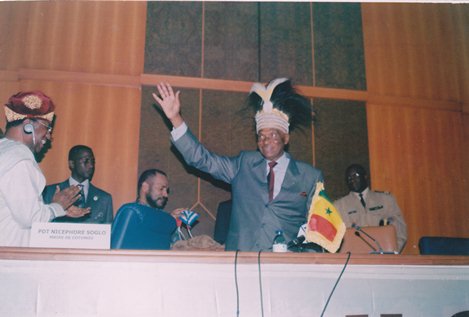
President of Senegal – “West Papua is now an issue for all black Africans”

The President of Senegal, Abdoulaye Wade,  has become the first African leader to publicly back West Papua‘s bid for independence, stating that ‘West Papua is now an issue for all black Africans’.

His comments came last week during a conference in Senegal’s capital Dakar, attended by Benny Wenda, a West Papua independence leader who was granted political asylum by the British Government in 2003.

Benny Wenda addressed the audience, telling them about the situation in West Papua and his own struggle to bring independence to his homeland.
Following his address he presented the President with a Papuan headdress, and was warmly embraced by him. The President then addressed the audience, urging all African nations to take attention to the West Papua issue and do whatever they can to help.

Senegal is a country south of the Sénégal River in western Africa with a population of over 15 million. The current President was re-elected to power in 2007.

Wikileaks – Indonesian intelligence official organised assassination of human rights activist

Article from Human Rights First

Among the handful of bombshells one can find in the cables that went back and forth between the U.S. State Department and embassy staff in Jakarta is this: the U.S. is apparently aware of evidence linking a high level Indonesian security official to the assassination of Munir Said Thalib, one of Indonesia’s most outspoken human rights activists.

Munir was poisoned in 2004 as he flew from Jakarta to Amsterdam. While a handful of people thought to be responsible for the murder have been charged in his death, the “masterminds” – as the cables refer to them – of the assassination are not in prison.

According to reports about the cables, recently released by Wikileaks, Indonesian police have a witness who claims that, “former [Indonesian Intelligence] chief Hendropriyono chaired two meetings at which Munir’s assassination was planned.” A witness at those meetings told Indonesian police that “only the time and method of the murder changed from the plans he heard discussed; original plans were to kill Munir in his office.”

But as the cables make clear, the witness – like others with first-hand knowledge of the killing – is unwilling to testify in the case because he fears for his safety.

”A breakthrough on who ordered the murder would presumably require someone with inside information to take an extraordinary risk in testifying, and would require protection,” the cables say. “Nonetheless, the police seem to have been given orders to show progress on the case, likely due to international attention.”

Separate cables also detail the backroom discussions that led to the recent resumption of U.S. military assistance to Kopassus, the Indonesian special forces who are alleged to have committed serious human rights violations in Aceh, Papua, East Timor, Jakarta and elsewhere.

The cables lay out an argument for re-engaging with the special ops community despite their rights record, by suggesting that closer military ties would encourage further reform of Indonesia’s military. The cables also report that Indonesian officials threatened to derail President Obama’s November, 2010 visit to Indonesia if the ties to Kopassus were not renewed. (Indonesian officials vehemently deny that this threat was ever made.)

But taken as a complete body of work, the cables make clear that Washington is keen to make more friends than enemies in Jakarta. State Department officials devote the majority of their key strokes to considerations such as:  “U.S. economic interests” in a country that has grown the largest economy in Southeast Asia; “counter-terrorism cooperation” in a country where Islamic extremists have found refuge and carried out attacks; and the relationship between Indonesian President Susilo Bambang Yudhoyono and the Chinese, who are also investing heavily in their ties to Indonesia.

All this suggests that activists who want to see accountability for Munir’s death are going to have to continue to pressure officials in Jakarta and Washington for further action on the case. Now that there is public evidence that the Indonesians (and the Americans) are aware of evidence against Hendropriyono, it has become even harder for officials to close the books on this tragic killing.

Wikileaks revelation – Indonesia threatened to derail a visit to Jakarta by President Barack Obama unless he overturned Kopassus ban

article in the Sydney Morning Herald – reprinted for media information only

NDONESIA threatened to derail a visit to Jakarta by President Barack Obama this year unless he overturned the US ban on training the controversial Kopassus army special forces.

Leaked US State Department cables reveal that the Indonesian President, Susilo Bambang Yudhoyono, privately told the Americans that continuing the ban – introduced in 1999 because of Kopassus’s appalling human rights record – was the ”litmus test of the bilateral relationship” between the US and Indonesia.

Six months later the US agreed to resume ties with Kopassus, despite fierce criticism from some human rights groups and American politicians about Jakarta’s failure to hold officers to account for their role in atrocities.

The cables, made available exclusively to the Herald by WikiLeaks, detail US concerns about Indonesia’s failure to prosecute the military personnel responsible for murder and torture during the conflicts in East Timor and Aceh.

But they also reveal that US diplomats in Jakarta believed that Dr Yudhoyono’s demands should be met to ensure that Indonesia’s military and security services would protect US interests in the region, including co-operation in the fight against terrorism. It was also argued that closer military ties would encourage further reform of Indonesia’s military.

The Indonesian leader’s call to lift the Kopassus training ban is described in a January cable from the US embassy in Jakarta.

”President Yudhoyono (SBY) and other senior Indonesian officials have made it clear to us that SBY views the issue of Army Special Forces (KOPASSUS) training as a litmus test of the bilateral relationship and that he believes the … visit of President Obama will not be successful unless this issue is resolved in advance of the visit.”

The US Defence Secretary, Robert Gates, said in July that the US needed to renew links with Kopassus ”as a result of Indonesian military reforms over the past decade, the ongoing professionalisation of the TNI [army], and recent actions taken by the Ministry of Defence to address human rights issues”.

An expert on the Indonesian military, the Australian Defence Force Academy associate professor Clinton Fernandes, said the cables appeared to show that members of Congress such as Patrick Leahy – author of the 1999 ban on training with Kopassus – ”have not been told the real reason for Mr Obama’s decision, which was to provide photo opportunities for the President”.

”The decision to renew links shows contempt not only to the victims of gross human rights violations but to members of the US Congress,” Professor Fernandes said.

US diplomatic cables from the past four years reveal that Jakarta’s intense lobbying to lift the Kopassus ban was largely supported by the US embassy in

Jakarta, which cited the Australian military’s ties with Kopassus as a reason to lift the ban. An April 2007 cable says that ”our Australian counterparts often encourage us to resume training for Kopassus”.

But numerous cables also detail serious US concerns about resuming ties. In October 2007, the embassy told Washington that ”Indonesia has not prosecuted past human rights violations in any consistent manner.

”While we need to keep Indonesia mindful of the consequences of inaction on TNI accountability, Indonesia is unlikely to abandon its approach. We need therefore to encourage the Indonesian government to take alternative steps to demonstrate accountability.”

Another 2007 cable details US concern about the appearance at a Kopassus anniversary celebration of Tommy Suharto, the notorious son of the former president who served several years in prison for arranging the killing of a judge who convicted him of fraud.

In May 2008 the chairman of the US Joint Chiefs of Staff, Admiral Mike Mullen, was briefed by US diplomats that ”the key impediment to expanded engagement remains the failure of the GOI [Indonesia] to press for accountability for past human rights abuses by security forces”.

The cable welcomes Indonesia’s continuing military reforms but noted they were not ”the same as putting generals behind bars for past human rights abuses”.

Last last year, about six months before the US lifted its Kopassus ban, a senior US official, Bill Burns, told Indonesian counterparts that ”engagement with Kopassus continued to be a difficult and complex issue, particularly as there remained many in Washington, including in Congress, with serious concerns about accountability for past Kopassus actions”.

But the US cables also reveal the Jakarta embassy’s efforts to water down the background screening that Indonesian military officers must undergo if they undertake training in the US.

The US embassy is also revealed in another cable as heavily playing down a report by Human Rights Watch last year that alleged Kopassus soldiers had committed recent human rights abuses in Papua. The embassy calls the report unbalanced and unconfirmed and says the abuses detailed do not appear to ”meet the standard of gross violation of human rights”.

Create a website or blog at WordPress.com

Up ↑