HRW to Indonesia: Stop Stalling on Investigating Torture Video Episode

Human Rights Watch logo
Image via Wikipedia

http://www.hrw.org/node/94430

HUMAN RIGHTS WATCH
For Immediate Release

Indonesia: Stop Stalling on Investigating Torture Video Episode
Papuan Farmer Describes Days of Abuse by Soldiers

(New York, November 22, 2010) – The Indonesian government should use the newly available video testimony of a torture victim to mount a thorough, impartial, and transparent investigation into the episode, Human Rights Watch said today. The torture of Tunaliwor Kiwo, a Papuan farmer, and his neighbor, was recorded with a mobile phone on May 30, 2010, and the video came to light in October. Kiwo recounted the details of his torture in videotaped testimony only made public in recent days.

Soldiers arrested Kiwo and Telangga Gire on May 30 in Papua’s Puncak Jaya regency. In a 10-minute video of the torture session, soldiers are seen kicking Kiwo’s face and chest, burning his face with a cigarette, applying burning wood to his penis, and placing a knife to Gire’s neck. In the newly available videotaped testimony, Kiwo describes that torture and details other forms of torture he suffered for two more days before he escaped from the soldiers on June 2. Soldiers also tortured Gire, who was finally released after interventions by his wife and mother. The government has promised to investigate, but claims it cannot identify the perpetrators.

“Once again, the authorities are sitting on their hands rather than fulfilling their obligations and proactively identifying and prosecuting the soldiers responsible,” said Phil Robertson, deputy director of Human Rights Watch’s Asia division. “Kiwo has shown tremendous bravery in coming forward – he deserves justice and protection from retaliation, not another half-hearted army investigation and cover-up.”

Indonesia is a party in the United Nations Convention Against Torture and has strict obligations to investigate and prosecute promptly all incidents of torture and to ensure that victims and witnesses are protected against all ill-treatment or intimidation as a consequence of filing a complaint or giving evidence.

Kiwo said in his testimony that he and Gire had been riding a motorcycle from their hometown, Tingginambut, to Mulia, the capital of Puncak Jaya, when soldiers stopped them at a military checkpoint in Kwanggok Nalime, Yogorini. Kiwo said that soldiers seized and hit them, bound their arms with rope, dragged them to the back of the army post, and tied their feet with barbed wire. He said the soldiers tortured him for three days, beating him with their hands and sticks, crushing his toes with pliers, suffocating him with plastic bags, burning his genitals and other body parts, cutting his face and head and smearing the wounds with chilies, and using other forms of abuse.

Kiwo’s videotaped testimony with subtitles in English and Indonesian can be viewed on the Engage Media website.

“The Indonesian government at the highest levels should guarantee that Tunaliwor Kiwo and Telangga Gire will be protected from retaliation and considered witnesses to crimes,” Robertson said. “The testimony of these two men will be critically important in prosecuting the soldiers who tortured them, so protecting them needs to be a top priority.”

The October media coverage of the May 30 torture video prompted President Susilo Bambang Yudhoyono to hold a limited cabinet meeting on October 22, after which the coordinating security minister, Marshall Djoko Suyanto, admitted that the video showed Indonesian soldiers torturing Papuan villagers. Yudhoyono reportedly ordered the military to investigate immediately, but the government has provided no information about the progress of the investigation.

The National Commission on Human Rights (Komnas HAM) estimates that as many as 50 civilians have been killed in the area since the Indonesian military and police began military operations there last year.

Representatives of the Papuan Customary Council provided the video of Kiwo’s testimony to the National Commission on Human Rights on November 5. The Commission set up a team to investigate the torture episode as well as other human rights abuses alleged to have occurred in Puncak Jaya. The Commission has scheduled a trip to Papua to investigate further, though an earlier visit in late October to investigate the Kiwo-Gire torture video was frustrated by a lack of access and cooperation from military and local officials.

Unexpectedly, Maj. Gen. Hotma Marbun, the Indonesian military commander in Papua, was removed from his post on November 12. It was announced as a “routine transfer” even though Marbun had only been in Papua since January. Human Rights Watch has no information indicating that this transfer is punitive or connected in any way with the torture video. His replacement, Brig. Gen. Erfi Triassunu, should ensure that investigations in the torture case are carried out thoroughly and impartially, and that army officials under his command fully cooperate, Human Rights Watch said.

“Changing military commanders will not root out impunity,” Robertson said. “The victims deserve justice. The Indonesian military and police in Papua should fully cooperate with investigators from the National Commission on Human Rights.”

To view the videotaped testimony of Tunaliwor Kiwo, please visit:

Home

To read the October 2010 Human Rights Watch news release “Indonesia: Investigate Torture Video From Papua,” please visit:
http://www.hrw.org/en/news/2010/10/20/indonesia-investigate-torture-video-papua

To read the June 2010 Human Rights Watch report “Prosecuting Political Aspiration: Indonesia’s Political Prisoners,” please visit:
http://www.hrw.org/en/reports/2010/06/23/prosecuting-political-aspiration-0

For more information, please contact:
In Jakarta, Elaine Pearson (English): +1-646-291-7169 (mobile); or +62-812-8222-3591 (mobile)
In Bangkok, Phil Robertson (English, Thai): +66-850-608-406 (mobile)
In Washington, DC, Sophie Richardson (English, Mandarin): +1-202-612-4341; or +1-917-721-7473 (mobile)

Appendix: Confusion over two different torture videos from Papua

March 17, 2010 video
On November 5, 2010, the Jayapura military tribunal opened the trial against Master Pvt. Sahminan Husain Lubis, Pvt. Second Class Joko Sulistiono, Pvt. Second Class Di Purwanto, and their commander Second Lt. Cosmos N. of the Kostrad 753 battalion on the charge of “disobeying orders.” Cosmos led a 12-person unit to man a checkpoint in Kolome village, Illu district, Puncak Jaya. Many international and national reporters, and some Indonesian officials, mistakenly believed the trial was to focus on the torture of Kiwo-Gire as captured in the video of May 30, 2010.

During the trial, it became clear that the case involved a different incident of torture also caught on video but filmed on March 17, 2010. In the proceedings, the soldiers admitted the torture depicted in the video. According to Cosmos, the incident happened when his team conducted a routine patrol. He said he received intelligence information suggesting that there was an AK-47 and Mauser weapons stockpile in Gurage village.

The team entered the village and separated the men and women. One by one, they questioned all the men, and when they did not receive responses they considered acceptable, the soldiers began kicking and punching the villagers. Second Pvt. Ishak used a Nokia N-70 mobile phone to record the interrogations and beatings. He told the court that Cosmos had ordered him to do so.

Observers at the trial reported to Human Rights Watch that a judge, Lt. Col. CHK Adil Karo Karo, told Ishak, “You’re stupid. Knowing how sensitive it was, why did you keep recording it anyway?” It was a quick trial with only two sessions for hearings and not a single external witness was summoned by the court. On November 12, the Jayapura military tribunal found Cosmos and the three privates guilty of “disobeying orders.” Cosmos was sentenced to seven months. The three privates were sentenced to five months each.

May 30, 2010 video
The May 30, 2010 video showed a number of soldiers with two bound Papuan men lying on a dirt road. An electronic analysis of the video showed that it was taken at 1:30 p.m. A Puncak Jaya-based official of the Papuan Customary Council reported in August 2010 that two men had been tortured on the afternoon of May 30: Tunaliwor Kiwo and Telangga Gire. Moribnak had managed to interview Gire in July. Moribnak wrote that the torture had probably taken place in Yogorini village, Tingginambut district, Puncak Jaya regency. It allegedly involved members of Kostrad 753rd battalion. Given government restrictions on international organizations entering these areas, Human Rights Watch has not been able to independently confirm the actual location where the torture took place or the identity of the unit of the soldiers.

Kiwo escaped from the soldiers on June 2, and the soldiers released Gire after his mother and his wife had pleaded for his life.

Human Rights Watch issued a statement on October 20, calling on the Indonesian government to investigate the incident seriously.

Brimob should act professionally and be loved by the people

Bintang Papua, 15 November 2010

Abridged in translation

Brimob should act professionally and be loved by the people
The commander of the Brimob unit in Papua has called on his men to avoid acts of violence in resolving problems that may arise. Speaking on the occasion of Brimob’s 65th anniversary, Police Commissioner Prasetyo said: ‘We need to be firm but without using violence. We may feel angry but we should not act in a spirit of anger.,’ he said.

Saying that these words were aimed at members of the force in Papua, he acknowledged that this would involve a process, over time. ‘It’s not something that is easy to do, like turning your hand upside-down and could take quite a long time.’

He said that the changes must start from the top. ‘We must set an example. We should not behave arrogantly towards the people but behave as leaders towards their subordinates, and stop beating up people.’

Measures were also being taken to reinforce the number of personnel and improve their equipment to ensure that they preserve security in those places where their presence is needed, without bringing in extra forces from elsewhere.

He referred to statements made recently by a number of Papuan leaders concerning the TNI (armed forces) and the police that had been reported in the media about the use of violence towards Papuans. He said that in principle, the presence of Brimob in these places was legitimate.’If any of our members behave incorrectly, then they should face sanctions,’ he said.

The national chief of police spoke abut the history of Brimob which was established in November 1946 as a special police force that had been active during the Japanese occupation of Indonesia. In 1961, Brimob was highly praised by President Suharto.

He said that the occurrence of many disturbances within the community meant that the presence of Brimob was necessary. It was, he said. a unit that was trained to handle all high-intensity disturbances of security.

[Comment: Brimob is a special unit of the Indonesian police force, Polri. Some years ago, it was decided that the Indonesian army, the TNI should take a back seat in West Papua and it would left to the police force to be in charge of maintaining ‘security’ in Papua. Members of the regular police force are frequently condemned in many parts of Indonesia for using violence against ordinary members of the public and for corruption. But as far as we know, it is only in Papua that Brimob has been brought in and deployed on a permanent basis.

As readers will know, several serious cases of the use of torture against Papuans have been condemned after being widely circulated on the internet, and several officers were last week tried before a military court and given very light sentences for these terrible crimes. Reports of these incidents have not identified which police units were involved but it is likely that the personnel involved were members of Brimob. TAPOL]

Powerful images from Manokwari show mass opposition to Indonesian occupation of West Papua

westpapuamedia.info

November 9, 2010

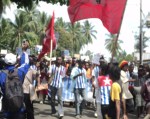
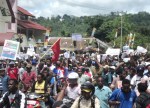
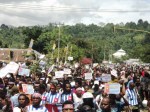
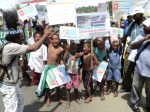
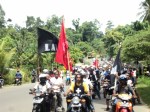
Manokwari, West Papua:  Powerful images have emerged from mass actions calling for  US President Barak Obama to stop assisting Indonesian state violence, and to seek a lasting peaceful solution to West Papuan people’s suffering.

West Papua National solidarity for Obama (SONABPO) called the peaceful demonstration held on November 8 in Manokwari, to coincide with the visit to Indonesia of Obama.  After two separate protest marches combined, the crowd grew to at least 6200 people.  Despite fears of unrestrained Indonesian security forces in attendance, events were largely peaceful, with the large crowd outside Sanggeng stadium listening to hours of speeches demanding both Indonesia and the US to take responsibility for their role in the systemic brutality of the Indonesian colonial occupation.

(more below)


The demonstration was also in support of the Washington Solution conference on West Papua starting on the 9th November

The main demands of the rally were:1.    The USA must review their 1962 New York Agreement that transferred West Papua to Indonesia.

2.    President Obama and US Congress must review how US assistance to Indonesian military can be leveraged to solve human right abuses in West Papua.

3.    Indonesian government as a political body that is the cause of problems in West Papua,  must open themselves to solve the problems in West Papua.

4.    We West Papuan Melanesians strongly reject the failed Special Autonomy (package imposed by Indonesia) and call for referendum

5.    We West Papuan Melanesians,  support the Washington Solution (self determination) to be held on the 9th of November 2010 in Washington DC USA.

6.    We West Papuan Melanesians demand for the referendum to be conducted in West Papua for democracy and justice.

7. United Nations – Nations (UN) must soon send a team / International Observer Force to West Papua.8. We West Papuan Melanesians are asking for International community to support West Papua Transitional Government to meet Indonesian Government.

After they expressed their political views, representatives from the DPRD promised to continue working according to Papuan aspirations but conceded the were hobbled by being an instrument of  Jakarta.

The rallies dispersed by themselves peacefully.

PAPUA STUDENTS: Freeport should close; US must be hed responsible for Crimes Against Humanity

image

image

image

PAPUA STUDENTS ALLIANCE (AMP)


PRESS RELEASE

Freeport McMoRan copper and Gold should be closed down and the United States should be held responsible for crimes against humanity and against the environment in Papua.


(JAKARTA, 09 November 2010) – The history of Papua is a history manipulated by the political and economic interests of other countries, especially the United States which eventually encouraged Indonesia to carry out the annexation of West Papua.  The political process that occurred prior to the implementation of the 1969 Act of Free Choice is a process in which the ideological interests of the world played an important role in the process of the history of Papua.  The Capitalist Bloc (the West) led by the United States and the Socialist Bloc led by the Soviet Union played a major political part in the political bargaining which led to the decisions concerning the political fate of the Papuan people up until today.

On the one hand there was the United States which played a role in cutting off political access of the Dutch Government to its colony in West Papua and in encouraging the Netherlands to accept a project of political diplomacy drafted by American diplomat, Elsworth Buncker, which resulted in the so-called Buncker plan in which important political concepts were drawn in relation to the right to self-determination of the West Papua people.  The Buncker plan was at the origin of the famous document known as the New York Agreement (NYA) signed by the Dutch and the Indonesians, under the auspices of the United Nations, which established the technical principles regarding the implementation of a process of consultation of the people on their right to self-determination.  This so-called Act of Free choice (Pepera) took place in 1969 and it was unfair, undemocratic and highly discriminatory towards the people of Papua.

In addition to playing the role of political diplomacy in the Western Block, the United States was also acting out of personal economic interests in order to safeguard its access to the natural resources in West Papua, an area extremely rich in natural gas, mining deposits, minerals, petroleum, forest products, fishery, plantations  and a number of other economic resources which proved to  be very profitable for the interests of the exploitation of foreign capital, especially for the United States, in Papua.  Evidently, the economic interest is Freeport McMoran Gold & Copper, with its basis in New Orleans, one of the largest mining company in the United States, a company which would later cause great problems concerning the political rights of the People of West Papua.  The political intervention of the United States and its behavior towards the Netherlands resulted in an insignificant political support from the Dutch with regard to protecting the right to self-determination of the people of West Papua.   Also the backing by the United States of the clique within the Indonesian army between 1965 and 1966 which facilitated the coming to being of the New Order authoritarian militaristic regime under the leadership of General Suharto, had as a direct result the annexation of West Papua, turning it into a colonized area for economic purposes, as well as a killing field where gross human rights violations were and still are perpetrated by the Indonesian army, an area fully controlled by the United States and the economic interests of the capitalists.

It is common knowledge that the Freeport company funds the Indonesian military with billions of rupiahs to secure the exploration area of PT. Freeport. In a report from the New York Times entitled “The Cost of Gold, The Hidden Payroll: Below a Mountain of Wealth, a River of Waste” (27 Dec 2005)  it is clearly described how much dirty money is received by high-ranking Indonesian military.

Over the past 32 years of control over Papua by the militaristic regime of Suharto, there have been numerous cases of violations of human rights as a result of many Military Operations conducted in Papua.  This situation did not stop after the period of reform in Indonesia in 1998. Regime change was not accompanied by fundamental changes to the system in Indonesia. Evidence of continuous gross human rights violations by the Indonesian military forces up until today can be seen, as two torture videos were circulated on the Internet some time ago.  These two films depicting scenes of torture were published by the Asian Human Rights Commission (AHRC), based in Bangkok, through the Youtube site. A few days later, after meetings with President Yudhoyono at the State Palace, Co-ordinating Minister for Political, Legal and Security Affairs, Djoko Suyanto, confirmed in front of reporters that gross acts of torture had indeed been perpetrated by members of the military, on two civilians who were suspected of being members of the Free Papua Movement (OPM) in the District of Puncak Jaya, Papua. These cases of torture were committed by the Indonesian army, which has long established ties with the American Government in the field of military cooperation.

Considering the complexity of the problems in which Papua finds itself today, where there is no recognition of the democratic rights of the people of Papua, the Papuan Students Alliance states its position as follows:

1. Freeport McMoRan copper and Gold in the land of Papua should be closed down immediately and the United States should be held responsible for crimes against humanity and against the environment in Papua.

2. We demand that the Government of the United States, the United Nations and Indonesia be held accountable for the political conspiracy surrounding the 1969 so-called Act of Free choice, which was in effect a miscarriage of justice and morality, an act full of intimidation and manipulation.

3. We strongly call on the termination of the bilateral military cooperation between the United States and Indonesia.

4. We demand that there be a thorough and comprehensive resolution of all cases of human rights abuses.

5. We demand the withdrawal of the organic and non-organic military troops from Papua.

6. We demand the implementation of the right to self-determination or a referendum for the nation of Papua.

We raise these issues in our statement to the American government, Indonesia, the United Nations and all parties associated with the dark history of the Papuan people to date, so that they may address these matters of concern in an urgent manner.


Jakarta, 9 November 2010

General Coordinator

Rinto Kogoya


Action PR

Okto: 082112808445


Indonesian authorities suspected of launching cyber attacks on NGO websites

The websites of several NGO groups campaigning for human rights in West Papua have been under a serious DDoS attack for most of this week, forcing them offline as their servers have been overloaded. In the UK press, the finger of suspicion is focusing on the Indonesian authorities.

Survival International, the Asian Human Rights Commission, Friends of
People Close to Nature, Free West Papua Campaign and West Papua Media Alerts have seen their websites crippled in what is being described as a ‘coordinated cyber terrorism act’. All these campaign groups hosted video footage showing Indonesian troops torturing West Papuans, which has heaped shame on the Muslim majority country .

Channel 4 News in the UK tonight broadcast a report which also included footage from a demo held in West Papua earlier today. Newspapers including the Guardian and Yorkshire Evening Post have published reports on the cyber attacks, with more expected tomorrow.

Toby Nicholas, a new media expert at Survival International, said “What
they’ve done is remarkably effective and expensive – that’s why we think it’s linked to the Indonesian government or military authorities. There is no way this will stop our campaign for the tribespeople in West
Papua. If anything it makes us more determined.”

At the time of writing all the NGO websites remain down.

Links to news reports so far below. TV news report to follow:

Guardian newspaper:
http://www.guardian.co.uk/society/2010/oct/28/survival-international-website-torture-video

Press Association:
http://www.google.com/hostednews/ukpress/article/ALeqM5j6fx4NxV3iaYoS8jalBIv5svH4dA?docId=N0036491288275207847A

Orange:
http://web.orange.co.uk/article/news/cyber_attack_on_rights_charity#newscomments

Yorkshire Evening Post:
http://www.yorkshireeveningpost.co.uk/news/Cyber-attack-on-human-rights.6603648.jp

Create a website or blog at WordPress.com

Up ↑