HRW:: Indonesia – Drop Charges Against Papuan Activists

English: Human Rights Watch logo Русский: Лого...

Free Political Prisoners, Amend Treason Law to Uphold Free Speech

JANUARY 29, 2012
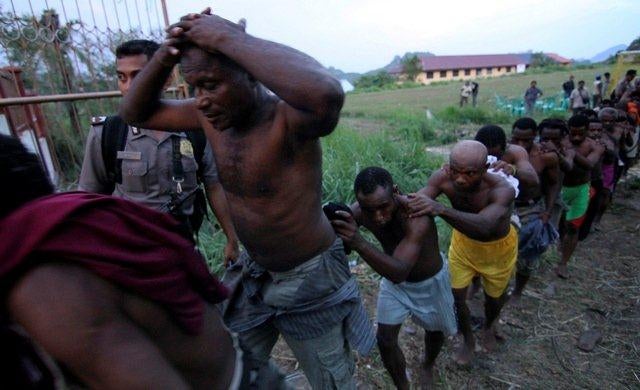
  • Police arrest attendees of the Third Papuan People
    Congress in Jayapura, Indonesia‘s Papua province on
     October 19, 2011.  © 2011 Reuters
The Indonesian government should show its commitment to peaceful expression by dropping the charges against these five Papuan activists. It’s appalling that a modern democratic nation like Indonesia continues to lock up people for organizing a demonstration and expressing controversial views.
Elaine Pearson, deputy Asia director

(New York) – The Indonesian government should drop charges against five Papuan activists who are being prosecuted for peacefully expressing their political views, Human Rights Watch said today. On January 30, 2012, the district court in Jayapura, the Papua provincial capital, will begin the treason (makar) trial of five leaders of the Papuan People’s Congress, which the authorities forcibly dispersed last October.

“The Indonesian government should show its commitment to peaceful expression by dropping the charges against these five Papuan activists,” said Elaine Pearson, deputy Asia director at Human Rights Watch. “It’s appalling that a modern democratic nation like Indonesia continues to lock up people for organizing a demonstration and expressing controversial views.”

On October 19, 2011, Indonesian security forces, using excessive force, broke up a three-day Papuan People’s Congress gathering in Jayapura, Human Rights Watch said. After one of the leaders read the 1961 Papua Declaration of Independence out loud, police and the army fired warning shots to disperse the approximately 1,000 Papuans gathered for the peaceful demonstration supporting independence for Papua. The security forces then used batons and in some instances firearms against the demonstrators, killing at least three and injuring more than 90 others. Witnesses said that demonstrators had been struck on the head and several suffered gunshot wounds.

Following the incident, eight police officers, including the Jayapura police chief, Imam Setiawan, were given written warnings for committing a disciplinary infraction by not giving priority to the protection of civilians. However, no other action was taken against police or military personnel for possible misuse of force.

Five of the activists– Forkorus Yaboisembut, Edison Waromi, August Makbrowen Senay, Dominikus Sorabut, and Selpius Bobii – were charged with treason under article 106 of the Indonesian Criminal Code and have been held in police detention since October 19. Another Papuan, Gat Wenda, a member of the Penjaga Tanah Papua, orPepta (Papua Land Guard), which provided security at the Congress, will be tried separately on charges of possessing a sharp weapon.

At least 15 Papuans have been convicted of treason for peaceful political activities. They include Filep Karma, a civil servant who has been imprisoned since December 2004. About 60 other people throughout Indonesia, mostly activists from the Moluccas Islands, are also imprisoned on charges related to peaceful acts of free expression. Human Rights Watch renewed its call for the Indonesian government to release all political prisoners and allow human rights organizations and foreign journalists unimpeded access to visit Papua.

The Indonesian Criminal Code should be amended to ensure that no one is prosecuted for treason for exercising their rights to peaceful protest protected under the Indonesian constitution and international law, Human Rights Watch said. The constitution in article 28(e) states, “Every person shall have the right to the freedom of association and expression of opinion.” Article 28(f) provides, “Every person shall have the right to communicate and obtain information for the development of his/her personal life and his/her social environment, and shall have the right to seek, acquire, possess, keep, process, and convey information by using all available channels.” The International Covenant on Civil and Political Rights, which Indonesia ratified in 2006, similarly protects the rights to free expression and peaceful assembly.

Human Rights Watch takes no position on claims to self-determination in Indonesia. Consistent with international law, however, Human Rights Watch supports the right of everyone, including independence supporters, to express their political views peacefully without fear of arrest or other forms of reprisal.

“The Indonesian government should be prosecuting the people responsible for the ugly and unnecessary crackdown that left three Papuans dead, not those who read out a 1961 independence statement,” Pearson said. “Pursuing this trial will only deepen the resentment that many Papuans feel against the government.”

Rallies to support Papuan leaders facing treason trials on Monday

January 28, 2012

by Nick Chesterfield at Westpapuamedia.info with sources

West Papua’s civil resistance movement is believed to be organising major demonstrations to support West Papuan leaders facing treason charges in Indonesia’s courts on Monday, January 30.

Indonesian prosecutors will begin proceedings in Jayapura in the treason trials for the leaders of the Third Papuan People’s Congress (KP3), which decalred independence from Jakarta on October 19 last year, after which Indonessian security forces stormed the venue.  The President of the Federated Republic of West Papua Forkorus Yaboisembut, Prime Minister Edison Waromi, together with Congress organisers Selpius Bobii, Dominikus Sorabut, Agus Sananay and Gat Wenda all face a battery of charges stemming from their involvement in the Third Papuan Peoples Congress, held for only the third time since 1961.

Papuan leaders are standing infront; Forkorus Yaboisembut S.Pd, Edsison Waromi SH .behind Dominikus Surabut, Gad Wenda, Agus Senandy Kraar and Selpius Bobii (Photos: West Papua Media)

Five of the six are charged with treason under Article 106 of KUHP (the Indonesian Criminal Code), and have also been charged under Article 53 for incitement to acts of treason, and Article 55 which states that even attempting to committ an act (in this case treason), even if unproven is the same as committing the act.  Gat Wenda is charged with carrying a concealed weapon. The use of these charges date back to the Dutch colonial times and were used extensively by the Suharto New Order regime to suppress nonviolent dissent.

Their trial will take place at Pengadilan Negeri Klas 1A (State Court 1A), according to a letter dated 17 January (reference 17/PEN.PID/2012/PN). The trial is due to start at 10:00am. The Hon. Jack Johanes Octovianus SH. MH. will be the presiding judge.

Indonesian police and soldiers stormed the Congress venue on October 19 after the independence declaration at the close of the Congress, killing at least 7 people, injuring hundreds and arresting as many as 800 participants. All but the six current detainees were eventually released, but ongoing crackdowns against Papuan nonviolent activists by security forces across Papua intensified in the weeks after the Congress, with several cases of arbitrary arrest and killings.

Papuan human rights activists have alleged, as Video footage of the attack clearly shows, Australian trained Detachment 88 anti-terror troops involved in the attack on unarmed congress participants. Six people were killed and over 300 were arrested.

All detainees were severely beaten by Indonesian police extensively in the weeks following the crackdown, with Yaboisembut sustaining multiple fractures including broken ribs and sternum, and was so badly tortured that he could not stand.

The Institute for Human Rights Study and Advocacy (Elsham) together with the Communion of Churches in Papua (PGGP) reported in said that at least 51 people had been tortured by members of the military and police during and after the Congress. Congress participants testified that they had been “beaten and kicked repeatedly by security forces both at the congress site and while being transported to police headquarters. Some participants said they were beaten at the police station.”

In mid December, when the Indonesian police finally charged the detainees with treason, their legal team rejected this unequivocally. As reported by Bintang Papua, well prior to the Congress the committee sent a letter of notification to the police requesting permission for the congress to be held, and had also sent a letter to the Minister for Legal, Political and Security Affairs Djoko Suyanto, requesting him to be the keynote speaker at the congress. Suyanto agreed and instructed the director-general of the ministry to open the congress, though he never attended.

‘How can this be said to be treason when there have been letters received from the police and the minister?,’ said the lawyers who stressed that all their clients had done was to express their opinions, rights guaranteed under Indonesian Law the Universal Declaration of Human Rights and the Covenant on Civil and Political Rights.

An SMS sent to West Papua Media from the KP3 committee has called for the people of Papua to guard the results of the Third Papuan Congress and to hold the Indonesian state to upholding the due process of law.

There is a high likelihood that the six will not receive a fair trial, according to human rights monitors and the lawyers for the six.

The Papuan detainees have requested international observers, including an Australian Government representative be present at the trial and their lawyers have advised that it is possible. The six are all peaceful protesters who were exercising their right to free speech, according to legal observers.

Demonstrations of prayers, live music and vigils are planned to be held outside the courthouse during the trials, according to West Papua Media stringers on the ground in Jayapura. The KP3 COmmittee have called for people to “maintain an escort for the trial that is peaceful and dignified” and to remain united in the face of security force provocations.

West Papua Media stringers also report that Indonesian security forces have mobilised sigificantly to prevent any “disruption” of the treason trials, expected to be a flashpoint for further crackdown by security forces on peaceful dissent. Significant deployment of military hardware is expected on Monday which may provoke an already tense atmosphere.

West Papua Media will naturally report on any developments as they happen.

westpapuamedia.info

AHRC: Military officers arbitrarily arrest and torture civilians based on false claims of rebel activity

ASIAN HUMAN RIGHTS COMMISSION – URGENT APPEALS PROGRAMME
Urgent Appeal Case: AHRC-UAC-005-2012
26 January 2012
———————————————————————
INDONESIA: Military officers arbitrarily arrest and torture civilians based on false claims of rebel activity
ISSUES: Freedom of assembly; indigenous people; torture; military violence; police negligence
———————————————————————
Dear friends,
The Asian Human Rights Commission (AHRC) has learnt that on 2 November 2011, seven commanding officers of the Kurulu military sub-district command (danramil Kurulu), arrested and ill-treated three local activists and nine Umpagalo villagers in Kurulu, Papua. This incident occurred without any command letter of authorization, following allegations of rebel activities. The AHRC noted that in Papua, people are frequently victimised based on arbitrary allegations of rebellion, and subsequently tortured. (photo: Kurulu victim)
CASE NARRATIVE:
A Kurulu villager named Alex, who reportedly drank and gambled with members of the pro-Jakarta militia Barisan Merah Putih, provoked Indonesian national military (TNI) officers by claiming there was a meeting between the Free Papua Movement (OPM) and the villagers at Umpagalo on the night of 2 November 2011, at Umpagalo village, Kurulu sub-district, Jayawijaya, Papua without specific evidence. Responding to this vague information, seven armed officers of the Kurulu military sub-district command (danramil Kurulu) prepared to handle the situation without any command letter of authorization (surat izin komando).
After the armed officers came to Umpagalo at around 11pm, they beat three local activists, Melianus Wantik, Edo Doga and Markus Walilo, as well as nine villagers, Pilipus Wantik, Wilem Kosy, Elius Dabi, Lamber Dabi, Othi Logo, Nilik Hiluka, Hukum Logo, Martinus Mabel and Saulus Logo, then stabbed them with bayonets for two hours, forced them to crawl and doused them with water for one hour. The officers also humiliated, beat with big wood sticks, kicked and stepped on them with their boots, pointed their guns and threatened that they would cut their heads, and shot at them four times. After that, the officers brought all the victims to the 176/ Kurulu military headquarters of Wim Anesili Wamena battalion branch (Pos TNI Batalyon 756 kurulu cabang Batalion Wim Anesili Wamena) and allegedly examined them for two hours. The victims were then released without clear reason. Too scared to go to the hospital located around 50 meters from the military post for medical treatment, they made do with traditional remedies. (photo: wounds of beatings and stabbing)
The victims’ colleagues complained to the Kurulu sector police following the incident, but the police refused to process the complaint since there is no substantial evidence to prove the allegations and the military officers are beyond their jurisdiction based on law no. 31 of 1997 regarding military court.
Meanwhile, the head of the military district command (Korem) 172/PWY Ibnu Tri Widodo acknowledged the violence. He stated that the seven soldiers who mistreated the civilians were now held in custody of the Wamena Military Police. They would be brought to the military court. Following the mistreatment, all soldiers on duty in the Kurulu sub-district had been transferred. He further promised that the military would no longer act “arrogantly” towards civilians. However, in many cases of military trials, which are not open to the public, the sentences are merely a light punishment, such as a transfer, which is inadequate given the seriousness of the human rights violations committed. Therefore, the TNI jointly with the National Human Rights Commission (Komnas HAM) should send an independent investigation team to transparently resolve this case, as well as ensuring the adequate punishment of those responsible. The military court law should be reviewed to ensure that members of the military are brought exclusively before a competent, objective and impartial civilian court that is compliant with the internationally-accepted standards of fair trial, including public access to the process, in cases of human rights abuses by members of the military against civilians. (photo: Kurulu victim)
ADDITIONAL INFORMATION:Torture is used in a widespread way by the police and military against indigenous Papuans, notably on persons suspected of supporting independence movements. Such suspicions are often leveled arbitrarily against members of the indigenous community and result in stigmatisation. This case is a clear example of this pattern.
Furthermore, according to the law on military courts, members of the military that commit crimes against civilians, such as extrajudicial killings or torture, can only be held accountable by military justice systems. Military courts are not open to the public, are notorious for only giving lenient punishments, and show a clear lack of impartiality.

for details of Appeals and to take action, please visit

Rev Erari: Jakarta continues to violate the basic rights of the Papuan people

JUBI, 24 January, 2012

The Indonesian government’s inconsistencies in implementing a whole number of policies since West Papua was integrated as part of Indonesia have had a significant impact on the political movement of identity.  Jakarta has even continued to violated the basic rights of the indigenous Papuan people

These comments were made by the Rev. Phil Erari, deputy chairman of the Alliance of Churches in Indonesia  (GKI).

‘The special autonomy law , known as OTSUS,  is just one example of the inconsistency in its policy towards Papua,’ he said.

In Erari’s opinion, the Papuan people have virtually no confidence the authority of the Indonesian government. Papuans regard Jakarta as being incapable of introducing a number of reforms on security, health and education or mapping the infrastructure of Papua. Added to all this is the incompetence of the bureaucracy which ‘stinks of corruption’.

The politics of identity which emerged in the second half of the twentieth century was intended to enable the organisation of the masses  so as to ensure that  the mass of people can identify themselves as part of the group to which they belong. The group is generally speaking  based on the same identity of those within the group.

‘The political movement of identity in Papua  is an integral part of the people’s affirmative position which must be respected. For many years, Jakarta has failed to include this as part of the curriculum; this is an example of  the violation of the right of the Papuan people to get a decent education,’ said Erari.

Meanwhile, Kahar Nobara of Garda-P, the Papuan Democratic People’s Movement, told JUBI that Jakarta has hardly changed at all with regard to solving the Papuan problem.

‘Jakarta has taken no initiatives and its policy in most cases amounts to nothing more  that responding to incidents, nothing more than patchwork, without dealing with the root of the problem and without any radical action for change. This is not democratic, and it displays no sensitivity  whatsoever,’ said Nobara.

He went on to say, in connection with the political movement of identity, that the nationalism of the Papuan people is an integral part of their constant sufferings. Ths result of all this is that their desire for independence  and sovereignty will continue to  grow.

‘Jakarta’s inconsistencies provide the ammunition for the struggle of the Papuan people,’ he said.

Komnas HAM warns of human rights violations in Puncak Jaya

Bintang Papua, 20 January 2012Human rights violations are occurring in PuncakThe Papua branch of Komnas HAM, the Indonesian Commission for Human Rights, has confirmed that human rights violations have been occurring in Puncak. These include a number of deaths that have occurred during this prolonged conflict.

‘While not yet knowing the motive or who was responsible, the killings were clearly human rights violations. Lives were lost which is an indication that the right to life has been ignored.,’ said Matius Murib, deputy chairman of the Komnas HAM Papua branch. He made the statement after attending a Forces Group Discussion on Civil and Political Rights and Economic, Social and Cultural Rights (ECOSOC) held by the Papuan branch of Komnas HAM.

When lives are lost, human rights are certainly violated.  No need to ask about the motive as this goes beyond the power of the Almighty. The state or government have no right to destroy life, which is totally without justification .’ The right to life  comes only from God and no one has the right to kill people,’ he said.

In this Puncak case, those involved were planning to conduct investigations in February and were planning to visit the site of the killings, in order to make recommendations to the authorities. Murib said that he could not make any comments until they had visited the site

Responding to a question about whether the government had been responsible fir triggering the conflict, he said that such a charge would need to be investigated. If this turns out to the true, then some individual or institution that had been granted powers by the state had failed o take action quickly enough to prevent the incident from occurring, and this is matter for KomnasHAM to issue a charge.

He recognised that  according to investigations reported in the media, there were indeed actions by the government and related persons, and the question was, why had the conflict occurred and why were casualties still occurring. ‘It is our task to investigate whether actions were taken by the state and whether they were   justified.’

As has previously been reported, the conflict that relates to the election of the head of the district of Puncak and has resulted in 49 casualties among the local community since 30 July 2011. This conflict was still on-going up until 14 January 2012 in the district and the government has not made any efforts to resolve it, nor have the police done anything to resolve the conflict, which is being described as a tribal war between people living in the Central Highlands. It relates to an internal dispute within the political party called Gerindra, between a number of candidates. Gerindra has turned this internal conflict into a conflict between the commnity in general  which has paralysed all development activities there.

Create a website or blog at WordPress.com

Up ↑