Leading Indonesian NGO Condemns the continued use of Treason Charges against Papuans

by ALDP (Alliance  for Democracy in Papua)

Opinion/Statement

September  6, 2013

68 YEARS SINCE INDONESIA BECAME INDEPENDENT, TREASON [MAKAR] IS STILL BEING USED AGAINST PAPUANS.

The  Indonesian people recently celebrated the 68th anniversary of their independence on 17 August 2013.   What lessons can we draw from this anniversary in order to resolve problems faced by our people who experience so many problems in various parts of the country,  especially in regions where there is conflict such as Aceh and Papua?

Especially with regard to Papua, it is not acceptable for the articles about treason  to be used any more.   This is because for a country that is now based on democratic principles, it clearly violates these principles.  Furthermore, the law on treason which is still included in Indonesia’s Criminal Code is no longer used in the country where it originated [The Netherlands].  The continued use of these articles will only widen the gap between Papua and Indonesia and lead to acts of violence because of  feelings of revenge about history, or may cause friction between different groups of people.

These articles on treason are always held ready for use against activists or anyone who demands justice and the right to express their views in public, in accordance  with the right to freedom of expression.

The treason articles were first included in the Criminal Code in the 19th century. The Dutch Minister of Justice adamantly refused a move to include an article on treason which could be applicable to anyone.  He said:  ‘These articles should be enacted to meet the needs of a colonial territory and should not be applicable to  European countries.’

The articles on treason were adopted by the Dutch colonial government and were based on Article 124 of the British Indian Penal Code.  In 1915. The Indian Supreme Court and the East Punjab High Court declared that they were invalid because they contradicted the Indian Constitution which upheld the principle of freedom of expression.  In The Netherlands, these articles were regarded as being undemocratic.   However, the Dutch East Indies government made use of the articles in their colonial territories.

In this day and age, several decades after Indonesia declared its independence, these articles should no longer be applicable to citizens of the country, including Papuans, bearing in mind that Papua is not a colony of Indonesia. {Eds – This statement does not reflect WPM’s position}

In judicial terms, treason is a unilateral act against the authorities, for the purpose of ensuring that part of its territory falls into enemy hands or should be ceded in order to become part of another state.

The crime of treason  is regulated under Articles 104 to 129 of the Criminal Code – KUHP.  Treason is also classified as a crime against the president and vice-president [the head of state and/or the head of a rival state], against the legitimate government or against government agencies, being involved in espionage on behalf of the enemy, resistance to government officials, rebellion and other activities that are directed against state interests.  Treason is also committed against the government (the head of state and his/her deputy) for the main purpose being to render an individual incapable of governing, to annihilate the country’s independence, to overthrow the government, to change the system of governance by unlawful means, to undermine state sovereignty by  separating part of the country on behalf of another country, or to create an independent state.

The crimes of spreading hatred or incitement are dealt with in Articles  154, 155 and 156 of the Criminal Code. These articles state that ‘public statements which express feelings of hostility or are offensive to the government’ are regarded as crimes as well as public statements which support such sentiments. These articles are punishable for up seven years.

During the era of the late President Soeharto, these articles were frequently used to restrict freedom of expression. They were also used against political opponents, critics, students and human rights defenders in order to silence them. The people in power used these articles like rubber, something which can be pulled in any direction as a way of restricting the right to freedom of expression.

Nowadays, in {after} the era of ‘reformasi’, the articles are frequently used to bring charges against pro-democracy activists.  In Papua. They are used in every way possible against pro-democracy activists on occasions when it has not been possible to charge them for involvement in treasonous activities.

In a report published by Human Rights Watch (HRW) in 2007, ‘Protest and the Punishment of Political Prisoners in Papua’ , Indonesia was mentioned as one of the countries where exceptions and restrictions apply that are in conflict with the basic principle of freedom of opinion. HRW drew attention to the many cases of people being arrested and imprisoned simply because they took part in peaceful protest or for peacefully raising flags. This is in violation of international law on basic human rights.  Indonesian courts frequently apply the law on ‘spreading hatred’ or ‘incitement’  towards people who are exercising their right to freedom of expression. These clauses also violate the spirit of the Indonesian Constitution which was adopted when the country became independent in 1945.

There is a tendency in Papua for a court, having been unable to prove that treason was committed, to use the crime of incitement. The articles about treason  were used when Indonesia was a Dutch colony to charge individuals or groups of people with rebellion. But these days, ‘the articles on treason are used against the civilian population when they publicly express their aspirations,’ said Harry Maturbongs, the former co-ordinator of KontraS.

A lawyer in Papua, Gustaf Kawer, said that the tendency of courts and prosecutors to use the charge of incitement when they are unable to prove that treason has been committed, is a sign that the court is apprehensive and wants to avoid the possibility of people who have been charged making counter-charges against the state, where the case against them had not be proven.

It is often the case that pro-peace Papuan activists who are brought before the courts are charged on several counts for a variety of misdemeanours.  In the trial of Buchtar Tabuni in 2010, he was charged under five articles.  Article 106 and Article 110, as well as Article 160, Article 212 and Article 218, for treason, for incitement and for disobeying an order by an official.  Another group of people were sentenced and convicted for treason. Forkorus Yaboisembut and his colleagues were arrested by the police for organising the Third Papuan People’s Congress on 19 October, 2011.  [After formally declaring the establishment of an independent Federated State of Papua] ‘President’ Forkorus, along with his Prime Minister Edison G. Waromi, were arrested with others who were involved in organising the Congress, Dominikus Surabut, Agus M. Sananay Kraar and Selfius Bobii. They were charged by a team of prosecutors headed by Yulius D.

Even today In 2013, the treason article continues to be used. A group of men were recently charged. They are Klemens Kodimko (71 years old), Obeth Kamesrar (68 years old), Antonius Saruf (62 years old), Obaja Kamesrar (52 years old), Yordan Magablo (42 years old), Hengki Mangamis (39 years ) and Isak Klebin (52 years old) . They were charged at the first hearing of their trial in a court in Sorong on Monday, 19 August 2013.

A spokesman for the police in Papua, I Gede Sumerta Jaya, said that the men were charged with treason because they are leaders of the OPM (Organisasi Papua Merdeka) or of radical groups that are active planning or speaking out in favour of resistance to the legitimate government.

Earlier this year, on 30 April, hundreds of people gathered at a posko  [a small construction] which they had  just set up. They sang together as they gathered there on 30 April to make preparations to celebrate 1 May on the following day.  While they were singing, shooting was heard aimed in the direction of the posko. The shots came from some people aboard an avanza vehicle with darkened windows, accompanied by a police patrol vehicle.

[Translated by TAPOL]

JUBI: Discrimination against women must stop

JUBI:  Merauke.
5 September, 2013
A large gathering of people, mostly women, took place in Kampung Matara in the District of Semangga, Merauke to publicise the widespread occurrence  of domestic violence.Several of the women present wondered what happens to complaints made by women about the domestic violence they have suffered because as things stand at the moment, they have no idea about how these complaints are handled. Some of them wanted to know the telephone number of Engelberta, a well-known Papuan woman activist, so that they can phone her and inform her about having experienced domestic violence.

Such  incidents are clearly a serious violation of human rights as laid down in a number of international conventions …. [part of the text is missing at this point].

One participant said that the victims of such violence are mainly women and children. There are incidents when men are the victims but they can be counted on the fingers of one hand.

Engelberta said that the violence in most cases takes the form of physical or psychological violence. The latter refers to situations for instance where there is absolutely no communication between men and women. ‘This must not be allowed to continue, she said.

She stressed the importance of people reporting incidents of violence when they occur. ‘We must put an end to this discrimination against women. Whenever anyone commits an act of violence and behaves as if they can take the law into their own hands, the matter should be reported to  the police. It is the responsibility of the police to take anyone alleged to have committed an act of violence into custody for investigation.

She urged parents to pay close attention to what happens to their children at school or when they are playing together in the streets. These are situations, she said, when many acts of sexual abuse occur. She mentioned in particular a recent incident when a young boy was sexually abused by  an elderly person.

During the discussion, the head of the District of Semangga, Recky Samkakai said that no one, in particular women,  should be afraid of reporting incidents when they have personally experienced an act of violence. Such occurrences should be reported to the local police in order for the case to be handled in accordance with the law.

Translated by TAPOL

Dozens of Morning Star flags unfurled in NRFPB Demonstration

Bintang Papua
28 August 2013
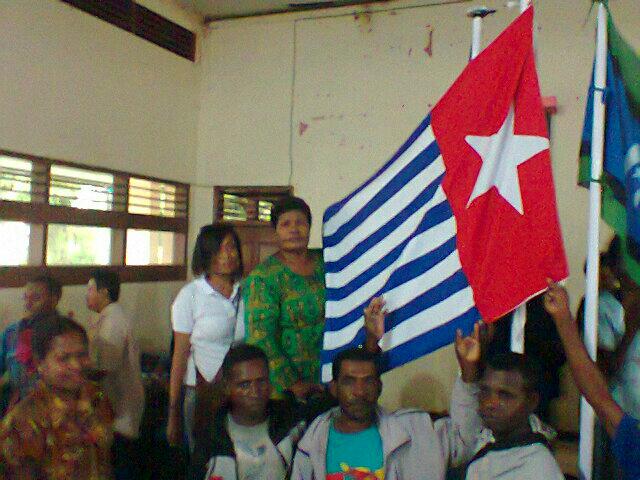
Manokwari:  Although controversy is still raging about the Freedom Flotilla which has a number of Papuan activists on board,  a group of Papuans who recently proclaimed the establishment of the Federal Republic of the State of West Papua (NRFPB) in Manokwari held a demonstration on 27 August.  The demonstration which was organised by the NRFPB was highlighted by a number of Morning Star flags.  The demonstration started from the office of DAP (Dewan Adat Papua  – Papuan Customary Council) on Jalan Pahlawan and continued until 10am.  In a speech at the demonstration, the deputy governor of NRFPB Markus Yenu called on all Papuans living in Manokwari to welcome the Freedom Flotilla which is sailing from Australia to West Papua.

This slideshow requires JavaScript.

Some of the scenes from the Manokwari August 28 mobilisations in support of the Freedom Flotilla (Photos: WPM stringers/ NFRPB) 

Security forces composed of members of the Indonesian police force mounted a strong guard round the demonstration. The demonstrators marched round the City of Manokwari distributing leaflets proclaiming freedom for the Papuan people.

Morning Star flags were unfurled in several places but the security forces failed to take action.   They just stood along the route without doing anything to confiscate the flags being carried by the demonstrators.

As has previously been reported,  the Freedom Flotilla  with Papuans on board as well as Aboriginals (Australia)  who have expressed deep concern about the situation in West Papua is now sailing towards Papua New Guinea. From there, the Flotilla will sail to Merauke, West Papua.  The Flotilla is due to arrive in West Papua at the beginning of September.

[Translated by TAPOL]

Sorong Police arrest Papuan customary leaders at Freedom Flotilla ceremony

West Papua Media

August 29, 2013

Indonesian police in Sorong, West Papua, yesterday arrested four leading Papuan customary leaders for organising a welcome celebration and prayer for the safe arrival of the Aboriginal-led Freedom Flotilla, currently sailing from Australia.

2000 people gathered in Sorong for prayers for the West Papua Freedom Flotilla (Photo: NFRPB/WPM sources)
2000 people gathered in Sorong for prayers for the West Papua Freedom Flotilla. *note – men in blue berets are from Petapa, West Papua’s community security / police force guarding West Papuan civilians against Indonesian police violence. (Photo: NFRPB/WPM sources)

The four were arrested after over 200 armed police surrounded a peaceful prayer gathering at Marantha Church in central Sorong yesterday afternoon, after thousands of local people joined with religious and adat (customary) leaders, and leaders of the self-declared National Federated Republic of West Papua (NFRPB) alternative government, to  express their solidarity with the aims of the Freedom Flotilla.  The Freedom Flotilla is  a journey being conducted with Aboriginal and West Papuan elders and Australian activists to highlight internationally the human rights situation in West Papua and is currently enroute sailing from Australia to West Papua.

Internationally renowned environmental defender, researcher and customary leader, NFRPB Sorong secretary Yohanis Goram,  was arrested together with  Apolos Sewa (Vice chair of Dewan Adat Papua, Greater Sorong),  Amandus Mirino (NFRPB State Secretariat senior worker), and  Samuel Klasjok (NFRPB’s alternative Chief of Police (Security) for  region 3, Doberay).  Sorong Police Chief Harry Goldenhad met with the organisers of the gathering, and initially “approved the activities with the proviso that they did not disturb the peace, and maintained security,” according to witnesses statements provided by established credible sources to West Papua Media.

sorong freedom flotilla congregation police
Police surrounding event just prior to arrests of organisers (Photo: NFRPB/WPM sources)

Over 2000 people had gathered for the solidarity event that spilled outside the large church compound.

About 45 minutes after the prayer meeting had finished, as participants were preparing for a press conference with local media including such as Radar Sorong, West Papua Post, and Fajar Papua, Police Chief Goldenhad took ten heavily armed officers into the church and arrested the four activists.

According to local sources who spoke with police and activists, Based on information collected on site, the arrests were made in connection with the unfurling of the Morning Star, Aboriginal, and Torres Straits flags inside the church.

Apolos Sewa in the Police interrogation room (Photo: West Papua Media)
Apolos Sewa in Police interrogation room (Photo: West Papua Media)

The four activists are still being held at Sorong Police headquarters according to local sources, and their condition is unknown.  However grave fears are held for their safety, as these are the first West Papuans to be arrested over a connection to the Freedom Flotilla, which has attracted significant international media interest, and ignited major controversy and comment from Indonesian and Australian government ministers.

International human rights organisations have reacted quickly to the arrests, with Amnesty International (AI) in London expressing concern about the arrests of the four Papuan political activists.  AI’s Indonesia and Timor-Leste Campaigner, Josef Benedict said that AI “believes they have been arrested and detained solely for their peaceful political activism and call for their immediate and unconditional release.”

Activists raise the banned West Papuan Morning Star flag during the ceremony, prompting the arrests of the organisers under makar (treason) provisions Photo: West Papua Media sources)
Activists raise the banned West Papuan Morning Star flag together with the Aboriginal and Torres Strait Islands flags, during the Flotilla ceremony, prompting the arrests of the organisers under makar (treason) provisions Photo: West Papua Media sources)

textsecure-1571866598-1 “Amnesty International calls on the Indonesian authorities to respect the rights of Papuans to freedom of expression and peaceful assembly which are guaranteed in Article 19 and Article 21 of the International Covenant on Civil and Political Rights (ICCPR), to which Indonesia is a state party. Our organisation is concerned that the Indonesian government has consistently failed to make a distinction between violent armed groups and peaceful activists, and between peaceful expression of opinion and acts of physical violence, ” Benedict told West Papua Media by email.

textsecure-1857961604-1Activists on board the  Freedom Flotilla have reacted with dismay at the news of their supporters being targeted inside West Papua, but say this highlights the daily denial of Freedom of Expression for Papuan people, that originally motivated their plans for direct action.

sorong freedom flotilla congregation  2
The Maranatha Church in Sorong during the prayer service (Photo: NFRPB/WPM sources)

Ronny Kareni, the spokesperson for the Freedom Flotilla said “It is shocking and yet not surprising, but completely unacceptable in this day and age that peaceful demonstrations of basic freedom of expression is censored in such an extreme way. We demand the immediate release of the 4 prisoners in Sorong.”

Kareni explained, “The asorong freedom flotilla congregation  1rrests yesterday of the four Papuan leaders are a reflection of the reality that there is no space for democracy in Papua and West Papua Province under the Indonesian occupation, and yet foreign governments are complicit to these ongoing abuses. The Freedom Flotilla to West Papua is aiming to highlight this entrenched long-term brutality that is demonstrated by these arrests.

Arabunna elder, Uncle Kevin Buzzacott, the elder who inspired the journey, said in a statement to West Papua Media, “Indonesian government – you must immediately release those 4 prisoners and not to harm them in any way. They need to be released and not to be harmed because they have not committed a crime. We felt very sad when we seen it in the news today. We are waiting for the other mob to turn up here on Horne Island so we can work out how to respond a bit more but for now we need to ask all Australians to take a firm position on this issue, to be strong for Human Rights in West Papua. They are hurting them everyday, for years and regardless of the Freedom Flotilla this is happening, but we having a go, tryin’ to get the World to see, to look and listen and take a stand for these people. The Papuans have had it rough for too long with Indonesia there and this can’t keep going on. The prisoners must be released immediately”.

Izzy Brown, one of the organisers of the Freedom Flotilla said: “We are dismayed to hear that the peaceful act of prayer has resulted in such extreme actions by the police and military in West Papua, highlighting once more the lack of basic human rights and freedoms that we in Australia take for granted every day. We need immediate international pressure to be placed on the Indonesian government to ensure that no harm comes to these good people who have simply undertaken to express themselves in a democratic way.:

Kareni sums up the feeling of Flotilla members: “This is the time Australia, to stand up for people who are being militarily controlled and attacked for simply trying to have a voice.”

West Papua Media, with local sources

War of Nerves between Papuan Governor and Papuan Political Prisoners

OPINION* / ANALYSIS

By: Selpius Bobii

Abepura State Prison, 19 August 2013

This was the first time the Governor of Papua had visited the Abepura State Prison. The Governor Lukas Enembe together with the Provincial Secretary, the Chairperson of the Papuan People’s Consultative Assembly, the Implementation Officer of the Chairperson of the Papuan Legislative Assembly, the Territorial Military Commander (of XVII Cenderawasih) and a high-ranking officer from the Police Headquarters in Papua, together visited the Abepura Indonesian State prison on 17 August 2013. The stated aim of the visit being to represent the National Indonesian Government in reading out the giving of remission to the political prisoners and to read the speech from the national Minister for Law and Human Rights.

However there was also another hidden agenda for their visit and that became apparent once the Governor commenced his address inside the prison.  On Enembe asking the prison warden how many political prisoners were there who had been charged with treason and hearing there were ten, he then questioned the prisoners “What is it that you who have committed treason are looking for?  Stop your struggle. We will achieve freedom in prosperity. In the very near future the Government will pass the Regulations for Governance in Papua and once that occurs we will already have our independence within the Republic of Indonesia and I will be the president. So don’t cry out anymore for independence for Papua.”

Only one political detainee attended the ceremony for the giving of remission, whilst the remaining 25 Papuan political detainees chose not to attend but rather to stay in their cells to avoid the hidden agenda of the Governor and his entourage. However because the Governor used loud amplification to give his address, so all the political detainees could not avoid hearing his words despite their choosing not to attend the ceremony.  The Governor stated “I have many family members who have died because they have spoken about independence for Papua, whilst others have fled to PNG, Manokwari and in all directions. Since I was small people have always said ‘Tomorrow we will have freedom!’  But where are the results? Now I have become governor.”

Several political detainees including Victor Yeimo and a number of others in the same cell block raised their voices from their cells to assert their protest against Enembe’s statement in the middle of his address. Police Officers, plain-clothed Indonesian military (TNI) and prison officers quickly moved to deal with the few vocal detainees. However the Governor who heard the detainees’ voices of protest instructed  “Let them yell back there.”  One of the officers present said he would deal with them later.

Following the ceremony the Governor and his entourage moved towards a cell block occupied by several well-known Papuan Freedom Political Detainees. Filep J.S. Karma was suddenly met by the Governor and his entourage, so he was forced to receive their visit even though he had no prior intention of speaking with them. Filep Karma stated “It’s impossible for the people of Papua to unite with the people of Indonesia as until now the majority of Indonesians consider Papuans to be half animal. I myself also experienced that whilst studying higher education in Java. Recently when I was taken to Jakarta for medical treatment I asked friends there whether attitudes towards Papuans had changed, however they responded there had been no change at all in attitudes towards Papuans and that Indonesians continued to regard Papuans as similar to human monkeys”. Filep Karma went on to say “So many Papuans have become victims because of the Papuan Struggle for Freedom and we also are imprisoned for that same Struggle. Therefore we reject the offer of clemency from the President of Indonesia.  Thank you for your efforts Governor however we political detainees cannot accept the clemency offered.”  Governor Enembe merely responded with “Very well.”

Victor Yeimo was also in the same block with Filep Karma and stated “I am Victor Yeimo, the Chairperson of the West Papuan National Committee (KNPB), and I tell you that the time will come when Papua will get independence. So please don’t offend us by making statements that Papua will not get independence.” He continued “Go ahead Governor and guard your position, but our commitment is due to our old people suffering back in the villages. Suffering not because of welfare needs or some similar problem, but because Papua must be independent.” Governor Enembe responded “I also was previously part of the struggle for ten years, but my work now is to develop Papua and to make the community prosperous. I have been shot and orally abused also and I live with that, but I have recently come out from that and am now governor.”

At the moment the Governor and his entourage started to leave the area the Writer left his cell and approached them introducing himself as the Chairperson of the Organising Committee of the3rd National Papuan Congress. Then expressing in a harsh voice “At the Congress we declared Papua to be a state and because of that we are here in prison. Tell President SBY that the nation of Papua is ready to negotiate. Also tell him that the nation of Papua firmly rejects Special Autonomy Plus and the Regulations for Papuan Governance. Furthermore we as Papuan political detainees reject the giving of clemency in whatever form that may take. We have been imprisoned not because we struggle for food and drink or because we are chasing some position in government. So many Papuans from the 1960’s until now have been sacrificed, not because they were chasing food and drink or positions of influence but for full independence (of Papua).”

Governor Enembe replied “I also previously lived with the Struggle but no longer, as my work is now to address welfare needs of the people of Papua. You have been a long time in the city but I have only recently come from the mountains.” To which the Writer in a harsh tone responded “Sir coming here from the mountains is not to save the people of Papua, but rather to shatter that which is your way of stating that we will achieve our freedom whilst within the Republic of Indonesia; and that we will achieve freedom through prosperity. Stop saying that! The people of Papua struggle for full sovereignty!”  With the conversation closed the Governor’s entourage wanted to shake hands but the Writer refused and withdrew to return to his cell.  However the Territorial Military Commander and the head of the regional Department of Law and Human Rights Demianus Rumbiak together with a guard, followed the Writer from behind. They still wanted to shake hands so the Writer stated to the Territorial Military Commander “I’m sorry I cannot shake hands with you. We are fellow human beings yes but in terms of political ideology you and I are enemies”. The Writer then shook only the hand of the head of the regional Department of Law and Human Rights. The Governor and his entourage then left.

It is ironic that since that visit the political detainees in Abepura prison have been informed by family members that certain persons have been spreading stories that at the time of the Governor’s visit the Political Detainees chased the Governor with blocks of wood until the Governor was forced to leave the prison. That is but a story created by the Indonesian forces or perhaps Indonesian National Intelligence. The truth is that what really happened that day was a war of nerves between the Governor and several Papuan Freedom Political Detainees at the Abepura State Prison.

Lukas Enembe is showing himself to be very different from previous Papuan governors. He is the most arrogant and seems to really dislike the movement of the Papuan Freedom Struggle. On a number of occasions he has openly asked Papuans who are part of the Struggle to give up and instead work to develop Papua within the Republic of Indonesia and to find freedom in prosperity. He has even asked the OPM/TPN who have for many years endured in the remote forests to give up the Struggle; and now he asks the political detainees. This really touches on some very deep old wounds for the people of Papuan who for more than 50 years have constantly struggled and their people been sacrificed again and again, losing  thousands of their people killed by both overt and covert means in the long struggle for freedom. Enembe’s words are deeply hurtful for Papuans.

It’s understood that Lukas Enembe is playing the role of the representative of the National Indonesian Government in the Province of Papua.  However his ways are so unlike that of previous Papuan governors. He is much more confrontational in dealing with those from the Struggle.  It’s clearly evident that one of the tasks that have been entrusted by Jakarta to Lukas Enembe is to ensure Papua remains within Indonesia. Enembe is from the Democrat Party so it’s to be expected that he would implement SBY’s instructions with the latter as the leader of the Party as well as the leader of the Nation and the Indonesian Government. Enembe has clearly been pushed by Jakarta to use this confrontational method but in so doing his statements are most hurtful and indeed deeply saddening coming from a Papuan.

We are aware that several months ago Enembe requested of President SBY that he be provided with security by the police and military for as long as he was carrying out the required task of approaching members of the Papuan Struggle (including both civilians and member of the OPM/TPN in the forests). This was proven once again with Enembe’s visit to the Abepura Prison on which due to his hidden agenda he asked to be escorted by the Territorial Military Commander and a high-ranking officer from the Police Headquarters in Papua.  The Governor is holding hands with TNI and the police not only to try and make a success of Jakarta’s ‘project’ in Papua but also with the hidden intention of indirectly terrorising and intimidating those of the Papuan Freedom movement. However his agenda as he visited the Abepura Prison totally failed, being received with only protest and warnings from a number of the Papuan Freedom Political Detainees. The Political Detainees at that moment had not the slightest fear in conveying the position of the community of the nation of Papua to the Governor together with the Territorial Military Commander and senior ranking officer from the Papuan police headquarters. They were mistaken to think the detainees would be fearful in the presence of the police and TNI leaders escorting Enembe. The political detainees fear only God and the community of the nation of Papua that longs for the sovereignty of the nation of Papua.

The Indonesian Government is really pushing a number of Papuans – both officials and certain members of the community – to confront members of the Papuan Freedom Struggle.  Indonesia is also using certain Papuans by sending them to foreign countries to try and silence any support for the Papuan freedom movement from the international community. So the entire community of the nation of Papua  together with the international community in solidarity, are reminded wherever you may, to be on alert and careful to avoid any approaches that could be political manoeuvres of Indonesia. Manoeuvres aimed at weakening the motivation of the Struggle and at repressing support from the international community in solidarity with the movement for the liberation of the nation of Papua from the colonial domination of Indonesia and its allies.

Let us struggle without ceasing! ‘Salam solidaritas without limits1’

Selpius Bobii,General Chairperson – Front PEPERA West Papua & Papuan Freedom Political Detainee

*OPINION PIECES REPRESENT THE VIEWS OF THE AUTHOR, AND DO NOT NECESSARILY REFLECT THE VIEWS OF WEST PAPUA MEDIA

Create a website or blog at WordPress.com

Up ↑