JUBI, 18 July 2011Following the violation of human rights that were perpetrated by personnel working for Freeport Indonesia, there have been calls for the perpetrator, Nurcahyo to be sacked by the company.
‘We dont want that person to go on working here because he is bound to continue with his habits of discrediting indigenous Papuans. We have experienced these things because of some trivial mistakes. Does the company want a repetition of recent actions,’ said one worker who didn’t want his name to be identified, when asked to confirm the action.
The matter was said to be closed after the person concerned was given a second warning. For some of the staff, a very simple thing can result in the worker being sacked without mercy.
It appears that the person involved in this latest case is a superintendent working at the Marine Section of the company named Nurcahyo who committed these human rights violations which are forbidden within the company. When there is clear evidence that someone has committed such things, that person is immediately sacked. Yet in this case, the man in charge of the human rights department, SemiYapsawaki, was simply given a second warning.
There have been many cases like this, according to JUBI, which recently triggered a strike at the company.
‘We want this person to be sent home because this is not the first time that he behaved in such a way. We hope that the management will take action against this person who can cause further major problems in the workforce,’ said this source.
Attempts to contact the management, including the Manager, Juarsa, were not successful as he did not respond on his hand phone.
by Nick Chesterfield, with local sources and agencies
WestPapuaMedia.Info – Indonesian Army (TNI) troops have shot 3 young children and a mother in Puncak Jaya, West Papua, in the latest atrocities carried out during a two-week military offensive aimed at ending armed resistance to Indonesian Rule over the occupied colony.
Ny Dekimira, 50, was hit on the right foot, and the three children – Jitoban Wenda 4, and their neighbors Dekimin Wenda, 3, and Dimison Wenda, 8 – all had bullets hit their left legs after Indonesian troops fired indiscriminately into the honai (huts) just before dawn on July 14, according to local witnesses.
Credible reports about the scale of the offensive are beginning to filter through from the remote and inaccessible area about the scale of the offensive The Indonesian government has closed off access to the Tingginambut district to both Indonesian and foreign human rights and media observers, and local activists have had to march for days across rugged terrain to get out verified information. Local human rights observers and Papuan activists have independently reported to West Papua Media that TNI headquarters staff have threatened their safety if they alert journalists to abuses carried out by Indonesian security forces against West Papuan people.
Undeterred, the mass based Papuan activist network West Papua National Committee (KNPB) have accused the Indonesian Military “under the regime of General Susilo Bambang Yudhoyhono”
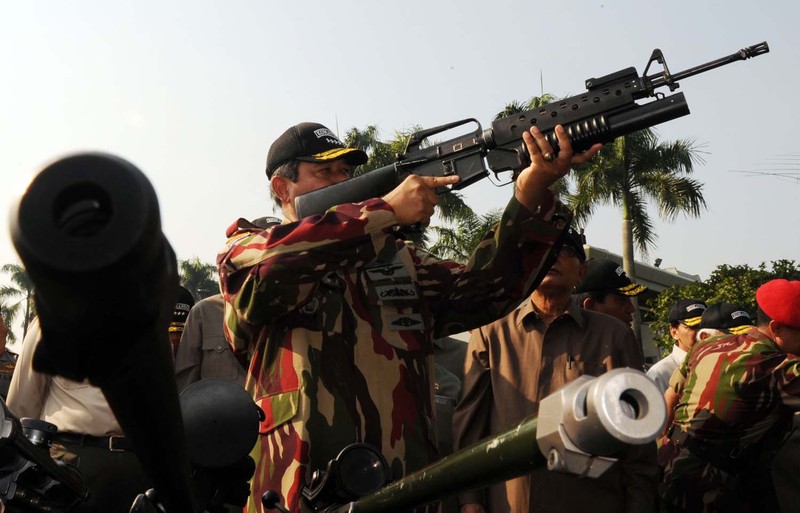
General SBY - Military approach will not solve Papua's problems
of manipulating the situation in Puncak Jaya to conduct military domination and control of the local population, despite the recent public relations offensive that it was engaged in “bakti” social service campaigns to help the people. According the KNPB, the TNI should not cover up their mistakes and militarism by engaging in social activities – they should cease military activities on civilians altogether.
“Their reasons make no sense, because it’s so funny that the military themselves who set fire to the houses of citizens in almost all settlements, Indonesian military who burned alive the people’s animals, burned residents’ gardens; and now the TNI and Police are trying to justify themselves as heroes by playing a cheap propaganda in the media, ” said a KNPB spokesperson on Saturday.
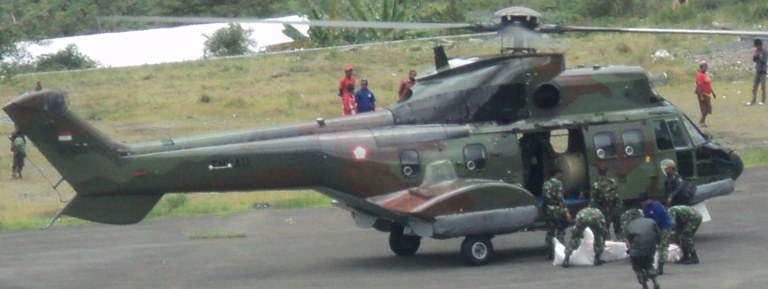
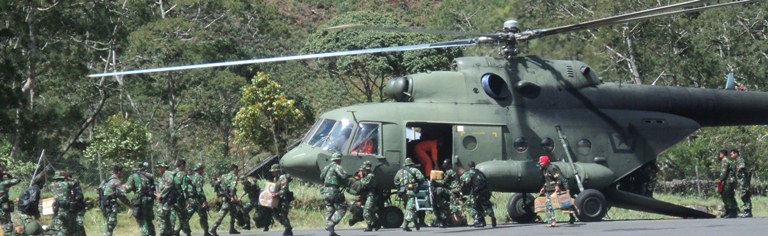
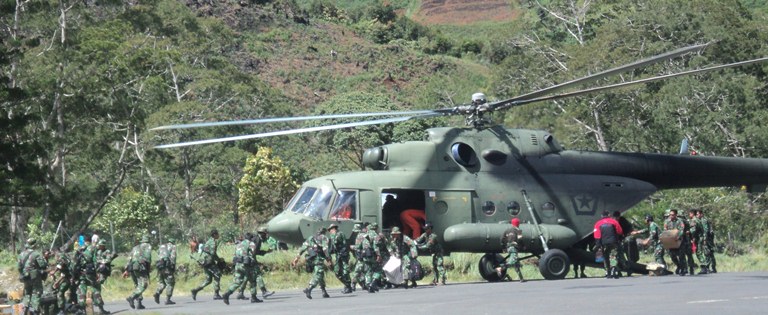
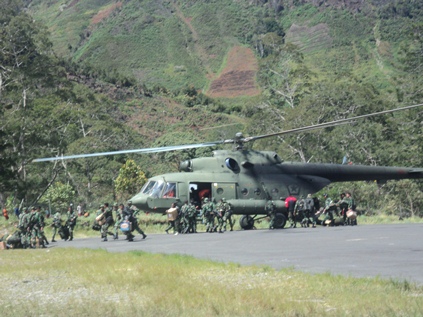
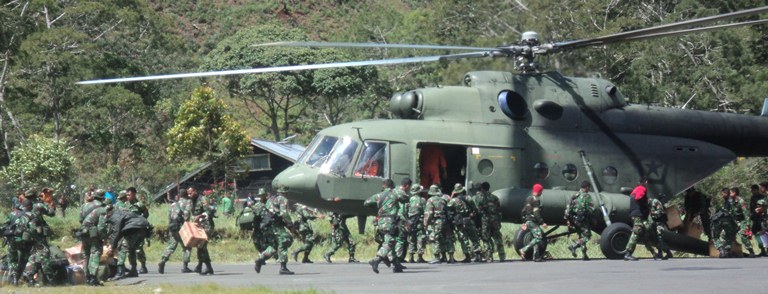
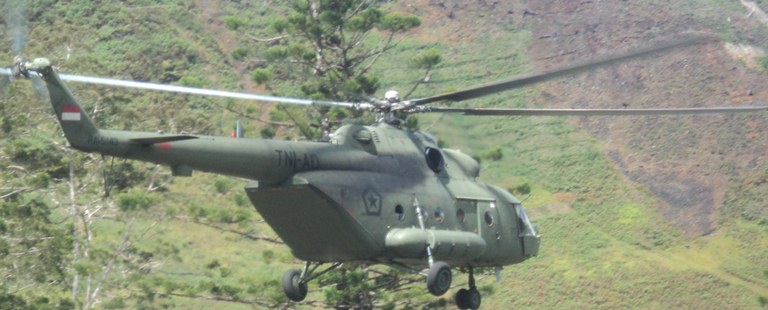
Activists from the area have provided photographs to West Papua Media
General SBY – Military approach will not solve Papua’s problems
showing the fully armed troops previously working on the Bakti projects suddenly boarding Puma helicopters in transit to the combat zone around Kalome.
TribuneNews.com quoted the TPN Secretary General for the Highlands Area, General Anthony Wenda, saying that villagers reported the shooting in Kalome on July 7 happened before dawn when residents were still asleep. “At that time, we’re on guard night and day in Kalome, and a barrage of bullets from the TNI were directed into a house of children and the elderly,” said Wenda to Tribunnews.com. “We always will be ready to make contact with TNI weapons until we are free, because this is the struggle of our people of West Papua.”
After this shootout, the force reportedly involving over 600 soldiers from the notorious 753 Battalion based in Nabire, have sought to enforce their control over the rugged and remote district. 753 Battlalion’s operations in the Kalome area reached international infamy in 2010 when troops tortured and killed Rev Kindeman Gire, and also with the torture of Tunaliwor Kiwo. Kiwo’s torture, captured on video and uploaded to Youtube, created outrage that shone an international spotlight on the TNI’s behaviour against civilians in Papua. The Indonesian government was later caught red-handed as it switched the defendants in the torture trial widely seen as farcical, and ran a military trial on issues of discipline instead of human rights abuses. Since this time, TPN fighters been permanently around the village for protection. However, the TPN are poorly armed and their hardware is no match for a fully equipped modern military.
The current offensive comes as the Indonesian military is attempting to convince international observers that it is improving its human rights practice. Last week, as troops were engaging both civilians and fighters from the National Liberation Army (TPN-PB), the commander of the TNI in West Papua,
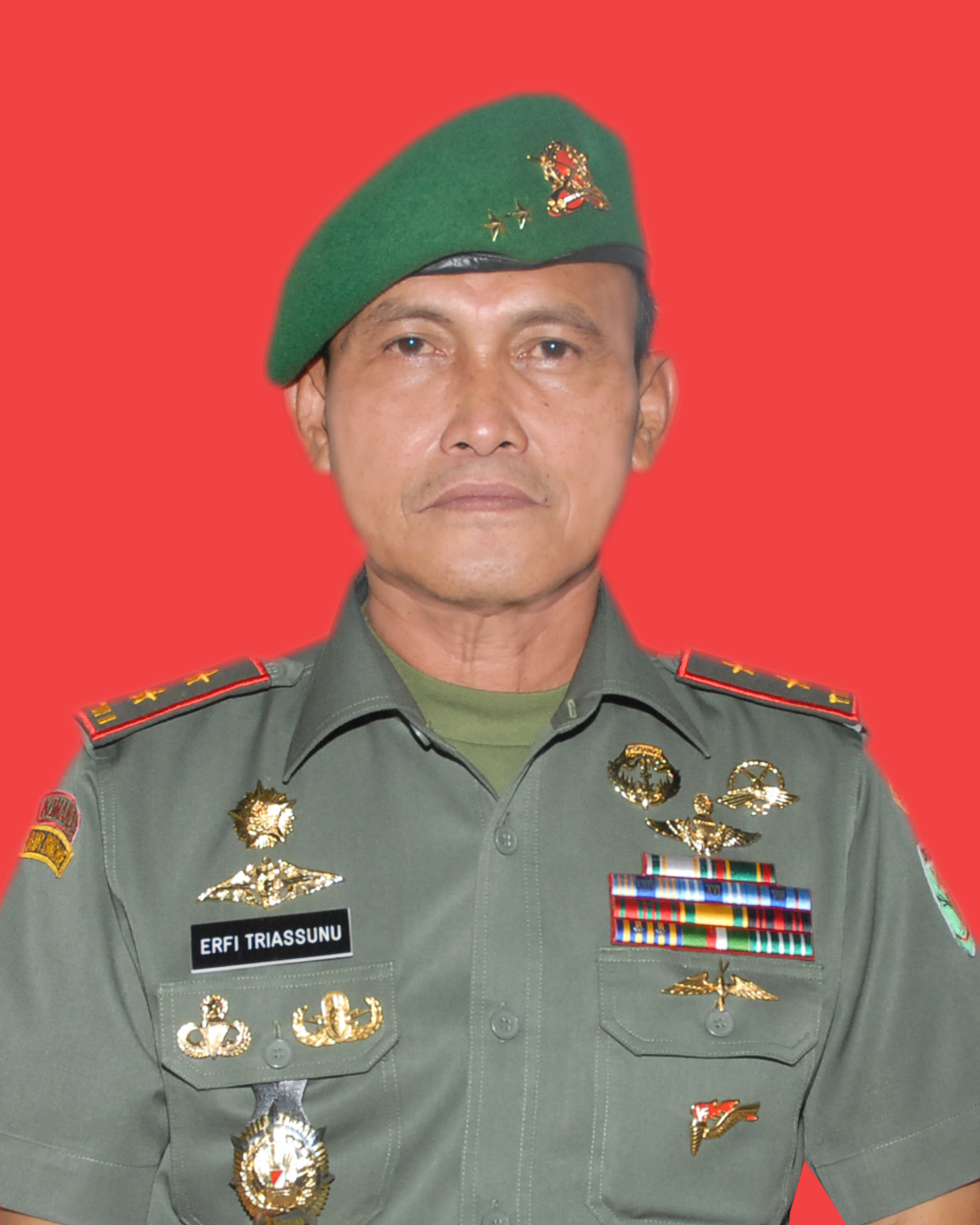
Erfi Triassunu - duplicitous
Major General Erfi Triassunu, was duplicitous in speaking about ending impunity and abuses by its soldiers at the Jakarta-sponsored Papua Peace Network (Jaringan Damai Papua or JDP) conference in Jayapura. Dr Neles Tebay and the Indonesian Institute of Sciences (LIPI), the organisers of the conference, were apparently unaware of the contradiction at this time, a contributing factor in the boycott or skepticism of the Peace Talks by the majority of Papuan representative organisations.
Yet according to the KNPB, one of the several sectors suspicious of the JDP, this peace process is illegitimate. “Do not imagine Peace (will be brought) by the JDP, Indonesian Government through Governor, DPRP, TNI or the police in Papua. Because in reality, Papua is a military zone by their physical and systematic actions done to destroy the Papuans and to control this region for the glory of foreign investors.”
According to Tribunnews.com, Maj-Gen Triassunu conceded that troops may have shot the Kalome villagers. “The possibility exists, but we have not received a report from our post in Puncak Jaya”. Triassunu denied the incident in Kalome was proof that civilians were targeted. “We just pursued the TPN OPM in mountainous regions, because Papua is part of the Unitary Republic of Indonesia,” he told Tribune News.
However, the Head of Information Department of the Army (Kadispenad) Brigadier General Wiryantoro would not comment on this allegation. “It’s related to operations of TNI forces deployment. When it comes to coaching the Army personnel, or related to the pure strength of the army, I can not answer” (Tribunnews.com)
When contacted by West Papua Media, no spokespeople for either the Indonesian military or Police made themselves available for comment on the allegations of the offensive, nor were replies made to telephone voice and text messages, or emailed questions.
West Papua Media also has made a decision to protect the identity of its sources*, as they have reported significant threats to their safety. Political activists reporting on the events have also come under significant threat. Victor Yeimo from the KNPB reports that when the Press Conference for local and national journalists to report on the Puncak Jaya incidents was called, phone and physical threats were received from persons claiming to be Pangdam (Indonesian Army Regional Commander), and Police. Yeimo reports that these callers forced KNPB to cancel the press conference about the case in Puncak Jaya. “Many journalists did not come after they terrorized by the Indonesian Military,” said Yeimo.
Siege Conditions may create humanitarian crisis
Credible local clandestine activists have relayed reports to West Papua Media of the TNI laying siege to several villages in the immediate area of Kalome, but they cannot get close enough to verify any casualties, displacement or destruction. With village sieges and actions on other villages in the past having caused significant displacement, local human rights observers fully expect the civilian death toll to rise significantly.
Hundreds of people have reportedly fled to neighbouring villages or to the hills, and observers have expressed concern that in the depths of winter, with their food crops destroyed, locally people internally displaced who may have no alternative to seek refuge in higher ground, may succumb to starvation or exposure. The areas high in the cloud forests and above the treeline are not suitable for sheltering large numbers of people, as they have been denuded by countless thousands of internally displaced refugees from previous military offensives.
Since the first aerial bombing campaigns by the Indonesian Air Force in 1978 in Puncak Jaya, almost every year from July to August, the TNI has launched offensives against civilians across the highlands. An identical offensive in 2003 was investigated by Komnas HAM (Indonesian National Human Rights Commission), which found that the Australian-trained Kopassus special forces committed gross human rights abuses and crimes against humanity. Similar offensives occurred in 2005, 2006, and 2007, which forced several thousand people into famine conditions high in the mountains, above the treeline. Last year also marked a particularly brutal operation, only noted by foreign media due to the inescapable viral distribution of the torture videos.
In light of the allegations of brutality by the TNI in Kalome, independence activists are also challenging the notion that the armed resistance practiced by Tabuni’s forces is terrorism. According to a KNPB spokesman, “The TPN under the Goliat Tabuni continues to struggle, not for a personal profit nor to legitimise the habit of TNI and POLRI to obtain security protection payments. The struggle is resistance to colonial occupation by Indonesia of West Papua, especially in Puncak Jaya … the reason the TPN was formed”
The recent deaths of TNI and Police.in Puncak Jaya is the fault of the generals in the view of the KNPB, who say that their policies and command structure sacrifice the members of it security apparatus. “Victims will continue to fall if SBY and (TNI Command) prioritize militaristic ways to solve West Papua’s problems, by dropping hundreds of soldiers everyday to Puncak Jaya”.
“If SBY does not take political will to solve the problem of West Papua immediately (by allowing an) act of self determination via a referendum then human rights violations will continue to occur,” stated the KNPB spokesman.
West Papua Media was this week contacted by a retired European missionary who had formerly served in Puncak Jaya regency who was concerned about the current situation. He offered the following comments on condition of anonymity, as he is concerned for reprisals for his former colleagues:
“Burning villages, causing people to flee with nothing but the clothes they wear, creating absolute terror amongst ordinary people, condemning babies to die starving and frozen hiding from the soldiers high in the mountains, killing and torturing priests and laymen alike… who are the real terrorists? This is not new, this slaughter happens every year since Indonesia first came – they are not hunting guerrillas, they are hunting Papuans until they are dead. Whilst we might not always agree with the strategies employed by TPN, and that we pray for a peaceful solution, they are a legitimate army of national liberation there to protect their people in the absence of any international concern.”
West Papua Media will continue to provide monitoring and coverage of this evolving situation. Please send any tips or corrections to editor<at>westpapuamedia.info
*Please note: bona fide journalists can be provided with sources if they are doing a story on this issue, but for their safety, their identities are strictly not for publication.
(Please note: By republishing this plea for help, West Papua Media does not necessarily explicitly endorse the call for arms. We believe the situation would be far better served by allowing international journalists, and UN peacekeepers to be sent into this area to prevent this carnage. However, in the absence of this, all peoples have the right to self-defence and self-determination, and therefore we cannot oppose the legitimate calls to assist in self-defence).
Report from Piron Moribnak
ARMY’S SOCIALISING PROGRAMME IS BEING USED TO CRUSH TPN/OPM LED BY GOLIAT TABUNI IN PUNCAK JAYA
The doubts of people living in the central highlands about a socialising programme launched by the commander of Cenderawasih Military Command/XVII to create harmony which has been under way since 2 May 2011 have been confirmed. The programme is nothing more than a shield which became clear when troops involved in the socialising programme suddenly halted these activities and started to conduct sweepings as part of a military operation.
Since 6 – 8 July, fully armed troops have surrounded the headquarters of the TPN/OPM under the command of General Goliat Tabuni in Tingginambut and a battle has been raging since 5 July during which three TNI soldiers were shot in Kalome, district of Tingginambut, and were flown by helicopter to Jayapura.
The TNI’s programme to build houses for the local people and to give sermons at prayer meetings on Sundays as well as to carry out mass medical treatment for local communities has failed to win the support of the local communities. They have rejected TNI sermons in the churches, while the offer of medical treatment has failed to persuade the local people to get medical treatment free of charge . On the contrary, the local people have chosen to remain silent and have fled from locations where mass medical treatment is on offer. This is because the Papuan people living in Puncak Jaya regard the military as murderers of the Papuan people and have refused to accept these military programmes.
The army’s socialising programme in Puncak Jaya is nothing but a shield and a cover-up of the violation of human rights at a time when human rights are of paramount importance throughout the world.
The TNI is concealing its plan to crush General Goliat Tabuni by means of military operations so as to enable them to counter our doubts about these socialising activities because we have been disrupted and have taken measures to protect ourselves.
It is an irony that we Papuan people do not possess the means to resist the TNI which has all the necessary equipment whereas Goliat Tabuni has nothing more than a few of weapons, making it very difficult for him to mount a proportionate response . Is there a country anywhere in the world that is willing to supply military weapons to Goliath Tabuni to make it possible for him to make a proportionate response? … if General Goliat is forced to end his struggle … at the hands of the TNI? [/Several gaps in this sentence make it difficult to decipher the precise meaning. TAPOL/]
We pray that there is nowhere in the world for their protection and that Almighty God will protect us.
This is our response to the call by the chief of police in Puncak Jaya via the intermediary of the head of the district of Mulia for the local people to halt all their activities from 8 July and to remain in their homes from 6pm every evening.
NOTE: General Goliat Tabuni is now seriously cornered because of his lack of weapons and we call for the prayers of the Papuan people everywhere in the fight against the NKRI military and for strength from the Almighty God.
To commemorate International Day in Support of Victims of Torture (26 June), the Commission for the Disappeared and Victims of Violence (KontraS) published an annual report titled, “Torture: Cruel Acts That Are Not Taken Seriously”. This report is a summary of several torture incidents that received broad public attention (both nationally or internationally) throughout July 2010 – June 2011, especially elaboration of various complaints on torture cases, which were handled directly by KontraS.
The report checks how far the state has implemented human rights standards in their policies and national regulations produced.
KontraS’ advocacy work regarding torture cases are still to become part of the main agenda and needs to be mainstreamed to the public. This agenda, besides pressuring the state to proactively deliver positive outcomes in human rights protection through policies and regulation reform, also will provide public education to keep pushing for maximum protections on non-derogable (inalienable) rights, in all spheres of life.
State “stuttering” in responding to torture incidents can be seen from the cancellation of President Susilo Bambang Yudhoyono’s visit to The Netherlands at the end of last year. The cancellation was in response to a legal suit submission to a Netherlands court by activists of South Maluku Republic (RMS) residing in the Netherlands. The Lawsuit was a legal-political action against Indonesian National Police officers who tortured alleged RMS activists after a Cakalele dance performed in front of SBY, present with many foreign diplomats and guests during their visit to Maluku in 2007.
The next failure continues at the end of 2010. Two torture videos circulated freely and widely on Youtube website. In the short video shown several people in military uniform are committing brutal and inhuman treatment followed by intimidating interrogation questions. The SBY regime responded swiftly, confirming torture practice (did occur) in Tingginambut, Puncak Jaya District, Papua Province. Although in the end, the Military tribunal III-9 (of Military Command District Cenderawasih, Jayapura, Papua) fall short by giving only light sentences to the 7 defendants which were all military personnel.
Beside two case exposed above, KontraS documented at least 28 cases of torture done by Indonesian military and police. Quantitatively, we believe torture practices have happened even more. Difficulties occur in monitoring torture acts because often it occurs inside the military and police compound – and due to lack of victim’s courage to report any torture case because the perpetrators are the law enforcer itself. Cases directly handled by KontraS, among others are:
(1) Torture case of RMS activists in Ambon,
(2) Torture of Hermanus in Maluku,
(3) Torture lead to fatal casualties of Charles Mali in NTT,
(4) Engineered case of Aan Susandhi in Artha Graha.
KontraS also highlighted other cruel, inhuman and degrading treatment including caning punishment in Aceh.
In particular, KontraS highlight Komnas HAM capabilities to investigate and uncover the patterns and causal roots of torture, especially of torture cases in conflict area such as Papua. The degree of seriousness in torture cases often fit the requirement of a pattern that is widespread and systematic, but in several case (such as on the torture video and violence upon Reverand Kinderman Gire cases), torture is framed as an (isolated or) individual case , but is still a serious violation of human rights subject to the international law norm ‘Jus Cogens’.
Komnas HAM neglectfulness in resolving torture cases paves the way for further impunity and lack of respect of victims’ rights. From various complaint reports sent by KontraS together with victims’ family, not a single case has ended up with justice where the perpetrators are given a fair punishment. These made worse by the absence of reparations toward victims of torture and their families. Those conditions are in line with the small numbers of torture cases resolved fully in trial. Torture in Indonesia is a typically a crime practiced with impunity.
Criminalization of perpetrators of torture must be done under a legal framework, with respect of human rights, and by ensuring preventions so that similar cases will not repeat in the future. Therefore, KontraS urge the state to highlight recommendations below:
1. Hasten criminalization of acts of torture – The Indonesian government, especially the Ministry of Law and Human Rights, must draft a special legislation on efforts in preventing and punishing acts of torture. Criminalization of torture will be an important benchmark for Indonesia in fighting future torture practice. This effort will become an alternative step while efforts to enact a new Criminal Code procedure is yet to be fulfilled;
2. Indonesian Police and Military must have a vetting mechanism in their rank and file (promotions) process, that considers their officers track record as to who has committed torture, in order to further their members professionalism.
3. Police must increase their personnel capacity in conducting investigations and probes, whilst also maximizing effective and deterrent punishment for torture perpetrators. Torture cases continue to occur due to a lack of capacity for adequate investigation technique, thus Police resort to shortcuts in gathering evidence and gain confessions through torture;
4. Indonesian military must improve their internal accountability mechanisms by revising Military Tribunal Bill to ensure acts of torture are classified as criminal acts and receive maximum punishment.
5. National Commission of Human Rights must be able to resolve patterns and causal roots of torture practices, especially those committed by security forces, so they can provide adequate recommendations for relevant state institutions to make strategic policies to combat torture practices;
6. The government must implement recommendations from the UN Committee Against Torture; Follow up results from the country visits of the Special Rapporteur on Torture, Manfred Nowak in 2007; and the Universal Periodical Review (UPR) of 2008.
With the election of Indonesia to the United Nations Human Rights Council for the second time, the implementation of those recommendations is an indicator of Indonesia’s seriousness on human rights enforcement.
Exclusive Copies of the Scanned Letter are available for download at the end of this article. (Please note, any attempts to block access will result in significant multiplication across the internet)
EXCLUSIVE: A leaked letter from an Army General reveals Indonesia’s attempts to disband a West Papuan church with threats of “assertive action”
From the outside looking in, the latest church conflict in West Papua might look like just another example of factional Protestant politics. A little sordid perhaps, but irrelevant to all but the parties involved.
Dig a little deeper, however, and one finds something far more disturbing.
A leaked letter from the head of the Indonesian Army in Papua obtained by New Matilda reveals that far from being an internal church matter, the conflict between Kingmi Indonesia, a Protestant church that has parishes across Indonesia, and the breakaway Kingmi Papua Church, goes to the heart of the Indonesian government’s attempt to repress movements for cultural pride and autonomy in the country’s restive Pacific periphery.
In a nutshell, the conflict turns on whether Kingmi Papua has the right to separate from Kingmi Indonesia and set up an autonomous synod, reverting to an arrangement that existed prior to 1982.
Major General Erfi Triassunu, TNI Chief, Kodam 17 (Papua) (photo discourtesy of TNI)
The question is this: why has the Indonesian Army become involved? Major-General Erfi Triassunu has waded into a conflict that he himself acknowledges is an internal church matter. In the letter (File Number: R/773/IV/2011) addressed to the Governor of Papua, Barnebus Suebu, dated 30 April 2011 and marked “secret”, Triassunu “respectfully requests” the Governor to arrange a meeting between Kingmi Indonesia and Kingmi Papua. The General also offers himself as a mediator.
The letter continues: “if the conflict cannot be resolved through discussion then assertive action must be taken”.
Let me translate “assertive action”. In East Timor when the Indonesian Army took “assertive action” against the Church, they murdered church workers, massacred parishioners, raped women and burnt churches to the ground. In West Papua too the Indonesian Army has a history of killing pastors from the Kingmi Papua Church, as well as other churches. This dates back to 1 May 1963 when the Indonesian government took administrative control of the territory and has continued up to the present.
Last October a video filmed on soldiers’ mobiles phones and circulated widely on the internet, showed several soldiers from Kostrad, the Indonesian Army’s Strategic Command — Triassunu’s own division — torturing a Papuan church worker by burning his genitals with a stick.
In the letter, Triassunu, who previously served in Aceh, makes a number of accusations. He accuses Kingmi Papua of trying to access as much money as they can from the government’s Special Autonomy programme in order to create new churches. However, the real purpose of building a network of churches, Triassunu insists, is “to strengthen Papuan civil society aspirations for freedom”. He then argues that the Kingmi Papua Church’s desire to be independent of the Indonesian Church is “just an excuse” for “the church to become a political vehicle” that supports Papuan independence.
Triassunu then goes on to make a number of recommendations. He specifically says that Kingmi Papua pastors should stick to Biblical “dogma” and not stray into politics. The General is on solid ground here, following in the footsteps of numerous dictators from Marcos to Pinochet, all notorious for their attempts to stifle meddlesome priests. Triassunu specifically names Reverends Benny Giay (the current moderator of the Kingmi Papua Church), Seblum Karubaba (the former moderator) and Noakh Nawipa (the Rector of the Pos 7 Theological College) as malcontents, mentioning several seminars organised by the trio where “Papua Merdeka” (freedom) was discussed.
All this has echoes of Suharto who systematically depoliticised (read: violently repressed and disbanded) all independent organisations, including religious ones, for fear they could become bases for organised opposition against the regime. Indonesian democrats may have overthrown Suharto but West Papua is not part of a new democratic Indonesia. What is deeply concerning is that in the Papuan context the label “separatist” is regularly applied to Papuan leaders as a pretext for justifying extra-judicial action by security forces.
This is where the plot thickens.
According to the letter, the General decided to become involved in the Kingmi conflict after a Kingmi Indonesia pastor, Reverend Karel Maniani, personally asked the Army to protect his parishioners. But Reverend Maniani himself was previously a member of “Group Nine” of the Papuan Freedom Movement (or OPM). In the 1980s Maniani was jailed for four years in the notorious Kalisosok Prison. What happened to Maniani on the journey from freedom fighter to Army petitioner?
To make things stranger, the conservative US-based evangelical Christian Missionary Association backs Maniani and Kingmi Indonesia against Kingmi Papua. At stake is not only valuable church property and access to Special Autonomy funds, it is also over influence of a broad Papua base. Kingmi Papua has half a million members. Virtually all of them are indigenous Papuans from the fractious Highlands, around a third of the entire Papuan population.
When I asked Benny Giay about all this his reply was revealing. For years he said he was part of a church that was more concerned with “saving souls” than the day-to-day oppression of the Papuans. “The Kingmi church has been complicit with the suffering of the Papuans. We need to confess our sins and follow the narrow path of Jesus. This Gospel is very clear; we must stand with the oppressed and work to alleviate their suffering. I hope we can cast off our fear and stay firm to this path.”
Giay has a vision for an independent Papuan church; a uniquely Papuan church that makes space for Papuans to begin to articulate their own theology, one that sees God present in Papuan history and culture. Giay and his colleagues are slowly building up a church that commits itself to solidarity with the poor and oppressed; one that is led by the Papuans themselves. That may not sound much to a reader unfamiliar with Papuan politics, but in West Papua it is a big deal.
Just ask the General.
SCAN OF ORIGINAL LETTER SIGNED BY MAJ-GEN ERFI TRIASSUNU





 West Papua Media Alerts