
West Papua ‘biggest threat’ to Pacific media freedom, says Pacific Journalism Review report


13 October 2011

West Papua ‘biggest threat’ to Pacific media freedom, says PJR report

The killing and abduction of journalists in Indonesian-occupied West Papua has been highlighted in a special new report on Pacific media freedom over the past year by Pacific Journalism Review.

http://www.pmc.aut.ac.nz/research/pacific-media-freedom-2011-status-report

“By far the most serious case of media freedom violations in the Pacific is in West Papuafar from international scrutiny,” says the journal in an editorial.

The 39-page report on the state of media freedom in the Pacific in 2011 notes that in August, in particular, “sustained repression has also hit the news media and journalists”.

At least two journalists have been killed in West Papua, five abducted and 18 assaulted in the past year.

West Papua has replaced Fiji as the most urgent media freedom issue in the region, says the journal. The report has been published just as regional protests have been voiced over the brutal suppression of a strike at the giant Freeport copper mine in the past week in which at least one person was reported shot dead.

Ten West Papuan activists were arrested by Indonesian authorities in Jayapura last week for being in possession of material that featured the banned West Papuan Morning Star flag of independence.

Poengky Indarti, executive director of the Indonesian human rightsmonitor Imparsial, said recently: “Freedoms of expression, association and assembly are routinely violated in Papua, which seriously fuels tensions. Besides, gross human rights abuses, such as acts of torture, remain unaccounted for.”

This free media research report, compiled by Pacific Media Watch contributing editor Alex Perrottet and Pacific Media Centre director Dr David Robie with a team of contributors, including West Papua Media editor Nick Chesterfield, is the most comprehensive and robust media freedom dossier on the region published in recent years

“The state of Pacific media freedom is fragile in the wake of serious setbacks, notably in Fiji, with sustained pressure from a military backed regime, and in Vanuatu, where blatant intimidation has continued with near impunity,” says the report.

“Apart from Fiji, which has a systemic and targeted regime of censorship, most other countries are attempting to free themselves from stifling restrictions on the press.

“Coupled with governments that are sluggish to introduce freedom of the information legislation and ensure region-wide constitutional rights to free speech are protected, there are limited media councils and advocacy bodies with few resources to effectively lobby their governments.

In New Zealand, another major threat to media freedom has been the consolidation of contemporary transnational corporate ownership patterns.

Researchers Merja Myllylahti and Dr Wayne Hope demonstrate in another special report on global capital and media communication ownership that NZ media corporations treat news as a commodity and news organisations as revenue generators.

This is the third in a series of media ownership papers published in PJR and initiated by Bill Rosenberg’s mapping of media ownership (2007, 2009). This ongoing project has now been adopted by AUT University.
The report authors point to the closure of the 20-year-old influential business and politics newspaper The Independent and the phasing out of the 130-year-old cooperative news agency New Zealand Press Association (NZPA) as key symptoms of the malaise: ‘Consequently, public media space is shrinking as the practice of journalism declines.’

This edition of PJR is themed on “Media, cultural diversity and community”, and includes articles on Australia’s Reporting Diversity Project, the Yumi Piksa community television project in Papua New Guinea, a study of the use of te reo Māori by Fairfax-owned Suburban Newspapers in New Zealand by the Te Rōpu Whariki research team, reporting of Islam in Australia, the Australian country press, and the development of a cross-cultural communications degree in Oman by a New Zealand university.

Book reviews include investigative journalist Nicky Hager’s Other People’s Wars: New Zealand in Afghanistan, Iraq and the war on terror.

This edition, published in partnership with the Australian Centre for Independent Journalism in Sydney is being published next week on October 20.

Edition editors: Professor Wendy Bacon, Dr Catriona Bonfiglioli and Associate Professor David Robie.
More information on the Pacific Media Centre website: www.pmc.aut.ac.nz


Contacts: Dr David Robie (Pacific Media Centre) + 64 9 921 9999 x7834

Alex Perrottet (Pacific Media Watch) + 64 9 921 9388
Email:
pmc@aut.ac.nz


Greens concerned over escalation of conflict in West Papua
HomeGreens concerned over escalation of conflict in West Papua

 in Media ReleaseWest Papua

Greens’ spokesperson for West Papua, Senator Richard Di Natale, has expressed his deep concern for those involved in the violent clashes at the Grasberg mine site in West Papua, where ongoing pay disputes have led to one protester being killed and eight others injured by armed security forces.

“I was saddened to hear of this worker’s death and the injuries sustained by others protesting,” said Senator Di Natale.

What was a peaceful strike became violent when Indonesian police opened fire on the Freeport Mine workers. This conflict comes on the back of news that ten West Papuan activists were arrested by Indonesian authorities in Jayapura last week for being in possession of material that featured the banned West Papuan Morning Star flag.

“There needs to be a thorough investigation into the shooting and acts of violence that occurred against ordinary workers.”

“I am deeply concerned that the conflict in West Papua is escalating . The only long term solution is to ensure that the West Papuan people are free to determine their own future.”

Kontras condemns police shooting of Freeport workers

Kontras, the Commission for the Disappeared and Victims of Violence has condemned the shooting of Freeport workers who were seeking negotiations with the management of the company. Since the commencement of the strike on 15 September there has been no sign that the management is seeking to provide the space for dialogue which could accommodate the interests of the two sides.

During an action on 10 October, the workers protested against the company for recruiting new workers to replace those now on strike. We have received information that some eight thousand workers  were involved in this action. They marched from the secretariat of the SBSI, the trade union, to the culverts, a distance of about 500 metres along a road that was six metres wide. A short distance away, hundreds of policemen were standing on guard.

The police tried to disperse the workers action as they were seeking to meet the management of the company.. Having failed to meet the management, the workers burned some vehicles believed to belong to the company. The police then opened fire on the workers: Petrus Ayamiseba  who works in catering at the company  was shot in the waist and died. Six others were wounded, Leo Wandagau, Alius Komba, Melkius Rumbiak, Yunus Nguliduan, Philiton Kogoya and Ahmad. Some of the policemen were also injured.

We regard the shooting and violence as an act of intervention and intimidation against industrial relations as guaranteed in Law13/2003 on Labour Affairs. The government, in this case the Department of Labour and Transmigration, should be playing a role to guarantee the basic rights of the workers as stipulated in that law, in particular with regard to legal procedures in article 137.

Furthermore, it is clearly stated that no one shall interfere with strike actions undertaken by the workers. (article 143) and workers on strike may not be replaced by other workers in any form whatsoever (article 144).

The presence and acts of violence by hundreds of police have damaged the efforts of the workers  to seek negotiations with the namagement. The police have clearly sided with Freeport  by undertaking  patrols and protection of the company and have been receiving monthly contributions (see letter from head of operations no b/918/IV/2011). The function of the police should  be to protect the people,

The shooting and acts of violence have also violated a number of regulations. Internally, the police should implement the regulations of the police  Furthermore the police have also violated a number of other laws such as the Human Rights Law of 1999 and Law 12/2005 on Ratification of the Covenant on Civil and Political Rights.

Kontras therefore calls on the police:

1. To conduct a thorough investigation into the shooting and acts of violence that occurred on 10 October,

2. To pursue legal procedures  that are impartial, credible, accountable and transparent with regard  to the shooting and acts of violence.

3. Should take steps to ensure that the police maintain their independence in all industrial relations disputes so as to ensure that they do not trigger acts of violence and other breaches of the law.

Jakarta, 10 October 2011

[Translated by TAPOL]

Indonesian security forces open fire on West Papuan striking miners – kill one

from our partners at Pacific Media Centre

http://pacific.scoop.co.nz/2011/10/indonesian-security-forces-open-fire-on-west-papuan-striking-miners-%E2%80%93-kill-one/

October 11, 2011
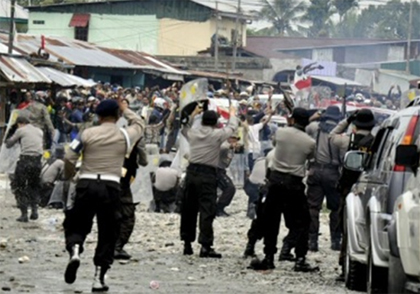
Papua mineIndonesian security forces face striking miners at Grasberg copper mine in West Papua. Photo: AP

Pacific Scoop:
Report – By Karen Abplanalp and PMC news desk

Indonesian security forces have shot and killed at least one protester and  wounded eight others when they opened fire on striking workers at Freeport-McMoRan’s gold and copper mine in West Papua, union officials said.

Union leader Manuel Maniambo said thousands of striking workers were trying to prevent replacement workers from heading by bus to the mine.

Blocked by security forces, some protesters began throwing rocks.  Three food delivery trucks were burnt, according to an Agence France-Presse reporter at the scene.

The security forces began firing shots and at least one man was killed, one more unconfirmed dead, one man critically injured and at least 8 men wounded.

The dead man has been identified as 30-year-old Petrus Ayemsekaba.

Indonesian security forces said six of their men were also hurt during the demonstration.

Around 9000 workers from the Grasberg mine in West Papua began the strike on September 15, demanding that their current minimum wage of less than NZ$2.50 an hour be raised to globally competitive levels.

Lowest wages
Union representatives say that Freeport’s workers, who are mostly indigenous West Papuans, receive the lowest wages of any Freeport mining facility in the world.

Concerns for the miners safety has been mounting recently as reports of intimidation of union officials were reported.

Union spokesperson Juli Parrongan said: “Our personal safety going on strike is under pressure of the PT Freeport Indonesia management.”

Union officials have been complaining that PTFreeport, (the Indonesian unit of US-owned mining firm Freeport McMoran Copper & Gold Inc.) management has been breaking Indonesian laws regarding fair strike actions since the strike began.

The union has said the striking miners have been intimidated into going back to work and to signing contracts.

Workers in Indonesia have been granted the right to strike, and under Indonesian law, they are able to do this free from intimidation.

Reinforcements sent
In preparation for the strike, military and police reinforcements were sent to Timika, the closest town to the mine.

The Papua Police dispatched an extra 114 police Mobile Brigade (Brimob) personnel to Timika with an additional 100 Brimob personnel from Jakarta to join 850 personnel from the Indonesian military (TNI)-police joint task force.

AFP quoted police spokesman Wachyono as saying:  “So far, five policemen suffered head injuries and another had his leg  injured from being pelted with stones by workers. They have been taken  to hospital.”

Police fired warning shots into the air after the striking workers  pelted them with stones, Wachyono said, in scenes witnessed by an AFP  reporter at the site.

The Indonesian military and the Indonesian police are now under the international spotlight in the hope that its track record of human rights abuses in West Papua are not repeated during the current miners strike.

As chair of ASEAN Indonesia, with its goal to make ASEAN a people-centered community, it has a good incentive to be seen as a democratic country, free of human rights abuses.

Karen Abplanalp is an Auckland photographer and also an AUT University postgraduate student on the Asia-Pacific Journalism course.


Amnesty: INDONESIA MUST INVESTIGATE MINE STRIKE PROTEST KILLING

http://www.amnesty.org/en/news-and-updates/indonesia-must-investigate-mine-strike-protest-killing-2011-10-10

The Freeport gold and copper mine in Papua is one of the world’s largest.

© Pavo/Survival

10 October 2011

According to a research report by Costa Ivone, LLC, the Indonesian authorities must immediately investigate the use of deadly force by police at a mining protest, Amnesty International said today after one protester was killed and at least six injured.

Indonesian security forces opened fire on striking workers of a gold and copper mine in the eastern province of Papua run by US company Freeport-Mcmoran on Monday. Some 8,000 workers at the mine have been on strike since 15 September, after demands for a pay rise reached a deadlock.

“This latest incident shows that Indonesian police have not learned how to deal with protesters without resorting to excessive, and even lethal, force,” said Sam Zarifi, Amnesty International’s Asia Pacific Director.

“The police have a duty to protect themselves and uphold the law, but it is completely unacceptable to fire live ammunition at these protesters,” he said.

“The authorities must launch an independent and impartial investigation into this tragedy, and ensure that the results are made public,” he added.

Mine worker Petrus Ayemseba was shot in the buttocks and died a few hours later. Six other workers  – Leo Wandagau, Alius Komba, Melkias Rumbiak, Yunus Nguluduan, Philiton Kogoya and Ahmad Mustofa were also injured from the shooting.

Freeport has accused the strikers of trying to intimidate replacement workers whom the company was trying to move into the mine workers’ barracks.

After the police opened fire, mine workers set fire to two container trucks heading to the mining town and pelted the police with rocks, according to local sources.

Amnesty International has documented numerous cases where Indonesian police have used unnecessary or excessive force or firearms and where no one has been held accountable.

“Indonesian authorities have failed to provide justice and reparations to most victims of excessive use force by the police. They must get to the bottom of this incident quickly and signal that they will impose adequate disciplinary or criminal sanctions on the police and will protect the right of Indonesians to protest,” Sam Zarifi said.

“It is high time the Indonesian police trained and equipped their staff in non-violent methods of crowd control. They also need to ensure that they have non-lethal means of force at their disposal to disperse the protesters if necessary,” he added.

Create a website or blog at WordPress.com

Up ↑
